
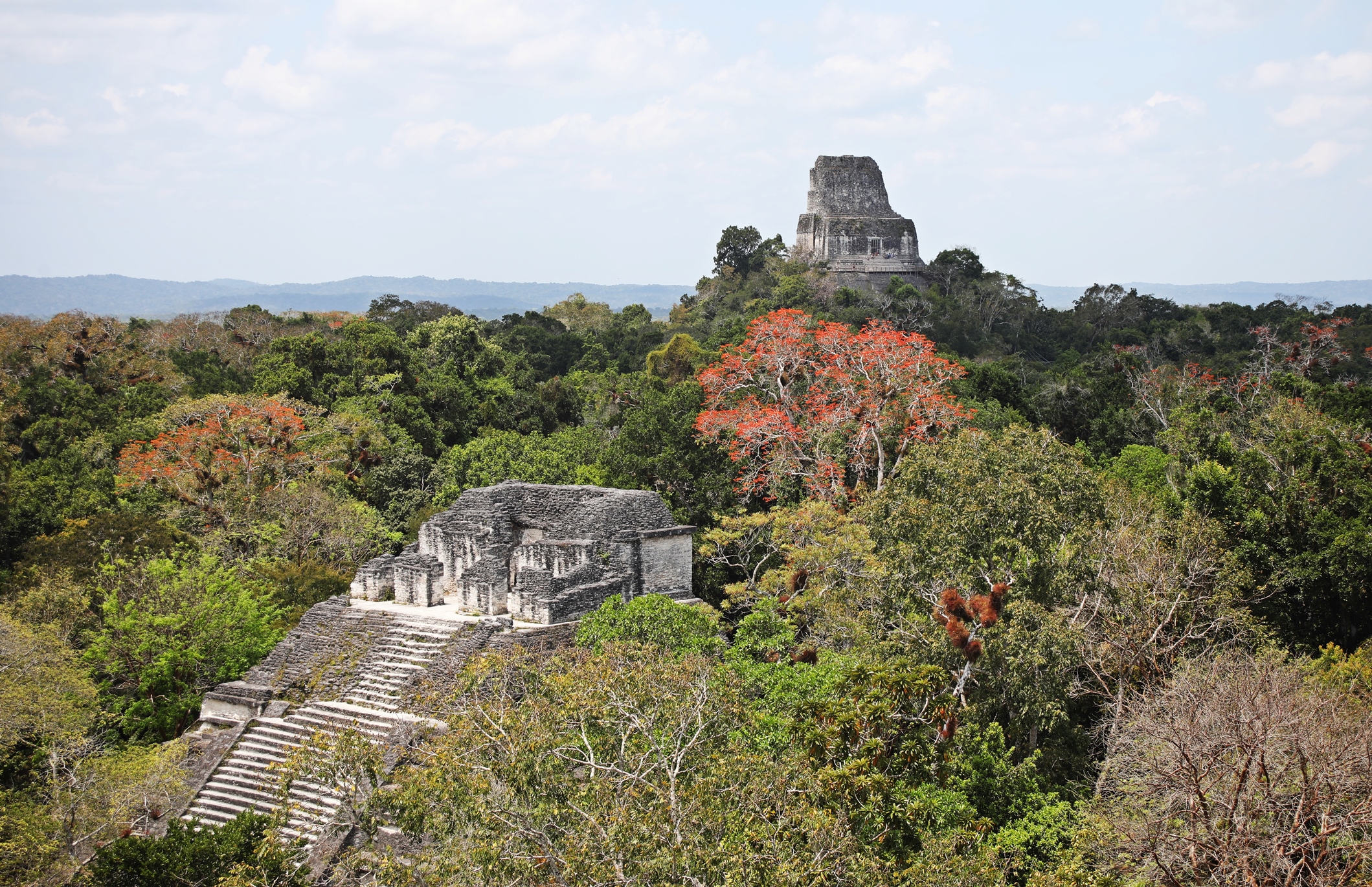
Famous for its five tall temples that soar high above the jungle canopy, Tikal archeological site is bound to impress anyone who visits. The Mayan ruins of both Tikal and Yaxha in northern Guatemala, allow visitors to travel through time while exploring the ancient wonders of the Mayan world.
A Little About the Mayans
As one of the first indigenous groups to settle in Mesoamerica, Mayans spread across Mexico’s Yucatan peninsula and north into the Mexican states of Tabasco, and Chiapas. They also went south into Guatemala, Belize as well as parts of El Salvador and Honduras. Other parts of early Mesoamerica were inhabited by Zapotec and Olmec peoples. We’ll talk about these cultures in our posts from Mexico.

The Maya people were very advanced, excelling in math and astronomy. Using this knowledge, they developed one of the most accurate calendars with 365 days separated into eighteen 20-day months and one 5-day month. They used hieroglyphics with 800 characters to tell their stories, legends and history.
One of our guides explained that the Maya people were not empire builders but instead built independent cities and states. They shared common religious beliefs, customs and language with each other but remained independent. Communities developed cooperative relationships with some of their neighbours while being at war with others.
Exploring these cities is a great way to further understand this fascinating culture.
Tikal
Located in northern Guatemala, in a region often called the Maya Forest, are the Mayan ruins of Tikal. The city was established around the 4th century BCE making it one of the earliest known Mayan settlements. It grew to be one of the largest and most important cities in the area for culture, religion and trade. Tikal remained as a powerful city for a remarkable 1500 years until around 900 AD.
The city lay covered by the dense Guatemalan jungle until the government sent researchers to the area in 1848. This was soon followed by British, Swiss and German archeologists who began to uncover the massive city. Its original name is believed to be Yax Mutal, but was named Tikal when it was rediscovered; a word that may have been taken from either the Itza or Yucatan Mayan languages.
At its peak, around 750 AD, it had over 3,000 buildings spread across 16 km² (6.2 sq. mi.) that included pyramid-style temples set around open plazas, with palaces, ball game courts, residences and markets. The population at that time was at least 60,000. Approximately 700 of those were royalty and elite society. Only about 10% of the large city has been uncovered today. Many of the buildings have been taken over by the jungle. A lot of those are considered too unstable to uncover so will be forever lost.
The oldest buildings found date back to the 4th century BCE, but most of the temples that we see today were built between the years 250 – 900 AD.
Great Plaza
The main site in the large city of Tikal is the famous Temple of the Great Jaguar standing tall at the end of the Great Plaza. Formally it’s called Temple I, but that plain name doesn’t hint to how pretty this building is. It is so striking, that it is a symbol of Guatemala.

At 47 m (154 ft) tall, the 9-tiered pyramid looks very impressive. It received the name Temple of the Jaguar because a wooden lintel above the main door had a carving of a jaguar. When researchers entered inside, they found the tomb of the 26th Mayan ruler, Jasaw Chan Kʼawiil, who is also named Ah Cacau (Lord Chocolate). Inside the tomb they found a carving of Lord Chocolate sitting on a throne decorated with a jaguar carving. Archeologists also found precious jewels in the tomb such as jade, Caribbean pearls, alabaster as well as finely decorated pottery. He was considered the best ruler of Tikal.


Across from this impressive pyramid is another one that is only slightly smaller. At 38 metres (125 ft) tall, Temple 2 is also called Temple of Masks because there are two stone masks on either side of the stairway. This temple was built in 700 AD as a tribute to the wife of Lord Chocolate, Lady 12 Macaw. A wooden lintel inside depicts a woman believed to be Lady 12 Macaw. Researchers believe she is from Yaxha, which is the site we visit next (click here to go directly to Yaxha).


We didn’t expect to still be allowed to climb any of the pyramids at Tikal, but you can climb to the top of three of them. One of those is Temple of Masks. From the top we had a great view of Temple of the Great Jaguar on the other side of the greenspace.

Did you notice a chocolate theme yet? Mayans are the original chocolatiers. We can thank them for being the first to cultivate chocolate as well as chili peppers, vanilla, papayas and pineapples.
On either side of the Great Plaza are the remains of the 4th century Palace of the Nobles and a necropolis. In front of the necropolis are many carved stone monoliths, called stelae. Many of these stelae are carved with hieroglyphs that describe historical events and rulers of the city.


The most important stelae are kept under protective palm leaf roofs. One is of Maya rain god Chaac (250 BCE). In a land where the collection of rain water is the primary source of water, you can imagine how important Chaac was to them. We’ll show you carvings of Chaac in many of the Mayan sites we visited. A different version of the rain god can be found throughout the Mesoamerican civilization such as Cocijo by Zapotec and Tlaloc by Mexicas.

Wildlife in Tikal
As we walked through the jungle between pyramids we were surprised to see so much wildlife. There were coatis, howler and spider monkeys as well as colourful toucans.


We also saw many huge Ceiba trees. They are sacred trees to the Maya because they connect the living world to the underworld. They’re the national tree of Guatemala.


The Lost World Complex
After walking through the jungle we reached El Mundo Perdido (The Lost World) Complex. It was the first complex to be built in Tikal, and its main pyramid dates to 700 BCE. That original structure is buried deep beneath four others so that the one we see today dates to 1 AD, which is still remarkably old.
On the front of the temple two Jaguar masks that are said to protect the stairs. They are in very poor condition though, and we wouldn’t know what they represented if we weren’t told.

This tall pyramid was used as the primary spot for astronomical observations in Tikal. Astronomers noted the positions of the sun as it rose and set as well as the movement of visible planets such as Venus. Buildings with notched roofs were purposely built in front and behind the pyramid to track the sun’s location at certain times of the year.
We climbed to the top of the astronomical pyramid for an amazing view. This was our first glimpse of Temples III and IV. We could also see the tops of Temples I and II poking up from the dense jungle.


Also in The Lost World Complex is a temple that was built in a different architectural design called Talud Tablero style. It was a typical style for buildings in Teotihuacan, near Mexico City, but not in most Mayan cities. Researchers believe that it was built by people who came to Tikal from Teotihuacan in the 4th century. It’s staggering to think of the voyage they undertook from Teotihuacan, which is over 600 km (1,000 miles) away. Eventually Teotihuacan rulers ended up taking over Tikal in 378 AD.

Temple IV
We saved the tallest temple in Tikal for last. Temple IV stands a whopping 65 metres (213 ft) tall. It is named Temple of the Double-Headed Serpent because of engravings found on the pyramid. The bottom of Temple IV has not been restored so climbing on it is not possible. Instead, a wooden staircase of 270 steps takes you to the top for the most famous view of the park. Standing high above the trees we could see Temples I, II, III and Perdita Mundo Pyramid towering over the jungle canopy. It was an awesome view and we were glad it was saved until the end. Some tours come to watch sunrise from this viewpoint, but we were happy to have the soft, late afternoon light we experienced.
This scene was made famous in Star Wars IV. Here’s a link to the Star Wars scene if you’re interested.


Entrance fee – 150Q ($20 USD); Opening Hours – 6 am to 5 pm every day. You must show your passport to purchase a ticket.
Yaxha
Not far from the famous Mayan city of Tikal, is another site that should not be missed. Yaxha (pronounced Ya-Sha) was established a few hundred years after Tikal, around 600 BCE. At its peak, in 800 AD, it had a population of 20,000.
It was abandoned in 950 AD. As with many Mayan cities, the reason for abandonment is not exactly known but was assumed to be the result of a number of factors such as drought, wars and famine. Recently researchers have uncovered another reason. Yaxha is located on the Petan Basin which was mostly composed of limestone ridges. There were no natural rivers or lakes in the basin. Their only water source was rainwater that they collected in pools that they dug around the edge of the city. Many Mayan tombs and funerary items were painted red/orange hues made from mercury ridden cinnabar. Researchers have recently discovered that the pools used in Yaxha and Tikal were laced with mercury from cinnabar, as well as cyanobacteria. It is now believed that their water was contaminated and likely played a large part in the mass exodus from these cities.
North Acropolis
The North Acropolis is the prettiest square in Yaxha. The pyramids in this plaza have similar construction to one that was found in El Mundo Perdido in Tikal. Both were built in a style typically used in Teotihuacan, in central Mexico, called the Tablero Talud.


We climbed to the top of two pyramids in the square where we were treated to views of the other pyramids in this plaza, as well as the tip of Temple 216, far in the distance.


As we explored Yaxha we saw many unnamed stone pyramids and palaces. Unlike most Mayan cities almost all of the stelae found were too worn to allow researchers to read the hieroglyphics. As a result there are still a lot of unknowns to the city. Many of these buildings were simply numbered, without many details on their history.


One stela that is in good condition is Stela 11. It is carved with an image on it that is either, a Teotihuacan warrior, or the Mexica rain god Tlaloc. Either way, it was not carved by Mayans.

Maler Plaza
Set a part from the rest of the city is Maler Plaza (also called Plaza of Shadows). Its main temple is a stepped pyramid and has different look than most pyramids we have seen in other cities. This plaza is believed to have been the site of religious ceremonies.

Wildlife in Yaxha
As we walked through the jungle between the different plazas the roar of howler monkeys came from the trees. When we moved away from the howler monkeys, we saw spider monkeys swinging from branch to branch. Between Tikal and Yaxha we saw more wildlife than on some safaris we’ve been on.


In the video below you can see the spider monkeys swinging in the trees while hearing howler monkeys roaring in the background. Turn on the volume if you want to hear the howlers.
Temple 216
The last pyramid we visited was Temple 216. Built in the 8th century, it is also called Red Hands because red coloured hand imprints were found on the walls. A long wooden stairway took us to the top, 30 m above, where we had a gorgeous view of Lakes Yaxha and Sacnab and as the sun set behind.


Entrance Fee – 80Q ($10 USD); Opening Hours – 8am to 6pm
If you have time and are interested in visiting more Mayan ruins while in Flores, there are two other sites that can be visited. The closest is Uaxactun, which operates as a national park but hasn’t received much restoration work. The other is El Mirador which can only be reached by a five-day jungle hike or helicopter. El Mirador has the tallest pyramid known in the Mayan world at 73 m (230 ft) high.
How to Visit Tikal and Yaxha
While we usually prefer to visit sites on our own, we decided to use a guide for both Yaxha and Tikal and we’re glad we did. Tikal is a massive archeological site and it would have been difficult to find all of the important buildings on our own. Yaxha may have been easy to explore on our own, but the information signs are only written in Spanish so it would be difficult to learn much about the different buildings and the city’s history without a guide.
If you visit during the summer months temperatures can easily reach 40° C. There is no where to buy water or food in Yaxha so make sure you bring your own. There are a few tourist shops and a cafeteria in Tikal if you forgot to bring water, but as you would expect, it’s very expensive. At both sites, the ground is very uneven so wear good footwear.
Best time to visit Tikal & Yaxha
Dry season is the best time to visit but, in this part of Guatemala it only last three months. Dry season runs from March to mid May. The rest of the year is rainy season.
Where to stay when visiting Tikal and Yaxha
Instead of a quick trip to see the ruins, we suggest staying for a couple of day in the island town of Flores. It has easy access to the ruins of Tikal and Yaxha as well as being a pretty, town filled with colourful colonial buildings. You can find a good selection of hotels, guesthouses and restaurants in the island town. You can read more about this cute town in our post A Visit To Flores.
For those who don’t have much time, there are a few hotels near the entrance to Tikal.
How to get to Flores
The colonial town is on Guatemala’s tourist triangle that includes Antigua and Lake Atitlan. This means that there are many ways to reach Flores. Mundo Maya International Airport receives flights from Guatemala City as well as Mérida and Cancún in Mexico. Buses and tourist shuttles connect Flores with Guatemala City and Antigua as well as smaller centres like Rio Dulce, and Lanquin. We booked our tourist shuttles with Green Monkey Hostel in Flores and Tropicana Hostel in Antigua.
Many people travel to Flores from Belize because its proximity to the border. There are several tours and buses to/from San Ignacio and Belize City. There is also a tourist shuttle from Chetumal and Bacalar, Mexico (links coming soon), which is how we arrived. It is operated by Marlin Espadas and was very efficient and safe option.

To read more of our adventures in Guatemala, click here.
Coming Next – Three Relaxing Days on Rio Dulce, Guatemala
For pictures from other blogs go to Gallery at monkeystale.ca
To read about more of our adventures go to Destinations.
If you like what you read, please comment or share (with credit) using the links below.






We'd love to hear from you, please leave a comment.