
Chiang Mai is a popular destination in Thailand’s Northern Highlands. Situated in the foothills of the Himalayas, Chiang Mai offers a cooler climate to explore elaborate Buddhist temples or enjoy a variety of mountain sports.
Chiang Mai
Chaing Mai was the capital of the Lanna Kingdom in the 1200s. It has lost many of the historical buildings from that time, but there are still a few remnants. Old Town was once surrounded by a brick wall with large arched gates. Parts of the 600 year old wall have been restored making it easier to envision how the city looked at that time. Running around the outside of the wall was a moat. Today its is a lovely water feature lined by tall trees providing shade to the sidewalk that follows along its side.
Like most Thai cities, Chiang Mai has plenty of Buddhist wats (temples), many of them are within the walls of the Old City. Wandering up and down the streets without a plan, we stumbled on a few spectacular wats. Some were built out of teak and are still in excellent condition. Teak was often used for construction and it makes for a unique design. Others are covered in golden leaves or have fabulous multi-tiered roofs.


Many of the wats have 1200 year old stupas next to them. Some of these stupas have been restored, and others are crumbling with neglect.


Monk Chat
At Wat Chedi Luang we attended a ‘monk chat’. At this wat, monks invite English speaking tourists to ask them questions about Buddhism and their lives as monks. In return, the monks are able to practice their English. We thought this would be very popular, but when we arrived there was only one other lady.
We spent about an hour speaking with 2 monks who are studying at university. It was interesting to learn about their lives. Their day begins at 5 am with a puja where they chant mantras and light butter lamps. Then they go into the city to collect food donations. This food collectively feeds the monastery for their 2 meals of the day; breakfast and lunch. They do not eat supper. Then in the afternoon, those monks still in university have classes. In the evening there is another puja followed by either free time or school work. They also told us about Buddhism. The most important principle for a monk is mindfulness. Being mindful of your actions and their consequences on themselves and others. The five tenets that all Buddhists should obey are: not to cause harm to another person, never steal, never lie or gossip, not partake in inappropriate sexual activity, and not to take alcohol or drugs. We really enjoyed learning first hand about the daily life of a monk.


As with many cities in Thailand there are a lot of massage therapy businesses in Chiang Mai. We were surprised however when we saw the sign for one massage business. As the sign says, the therapists are ex-convicts. What began in one small business as a way to give formerly incarcerated women the ability to work in a legal trade has become a popular industry in Chiang Mai. There are now several busy locations throughout the city.

Explore the Highlands
Chiang Mai’s location in the foothills of the Himalayas means there are a lot of things to see and do outside of town. On a day trip from town you can vist an opulant wat or a hill tribe. If you want to be more adventurous you can go whitewater rafting or rock climbing. The range of activities is vast. Since its the foothills, the mountains are more like high, treed hills than tall rocky mountains, but it is still a beautiful part of the country. Here are a few of the things to do in the Highlands around Chiang Mai.
Wat Phra That
In the mountains, outside of Chiang Mai, is a very important and incredibly opulent temple, Wat Phra That. Its location on the top of Doi Suthep Mountain adds to its mystique. From Chiang Mai, the route follows a very winding mountain road. We got there using the share-riding Songthaew. These are basically pick up trucks with bench seating in the cargo bed and a roof. They are used as communal taxis everywhere in Thailand. It made for a very uncomfortable ride on the rough road to the temple.

We arrived at the base of the wat complex and looked up to see a staircase of more than 200 steps leading to the temple. At the top of the stairs we entered into a gold-filled courtyard with a 600-year-old golden ‘chedi’ (stupa) in its centre. The chedi is surrounded by chapels, bells, statues and butter lamps all decorated with gold leaves.
The legend of Wat Phra That says that a white elephant carried a relic of Buddha to this site. The relic was enclosed in the chedi making it very important in Buddhism. When we were there dozens of Buddhists were doing a kora around the chedi. A kora is a way of worshipping and has the same effect as saying one of the Buddhist mantras.


Long Neck Karen Hill tribe
There are many different hill tribes in northern Thailand. The Long Neck Karen hill tribe is one of the most interesting. At the age of 5, girls begin to wear brass coils around their neck. Every year of their life another coil is added. An adult woman’s coil weighs approximately 20 lbs. There are different theories on why these tribes began wearing the coils. Most believe it was to show wealth, but some say it was to protect the neck from tiger bites. Today the women also wear coils below their knees and above their ankles as jewelry. Most of the women were very friendly and although visiting the village is a touristy thing to do, it allows the women to earn money for their village.
We were so curious what their x-rays would show. Apparently studies have been done, and the neck bones are not elongated at all. Instead the collarbone and upper ribs are weighted down to give the appearance of a longer neck. Over time however, the neck muscles become so stretched and weak, and the collarbone so deformed that the women can never take the coils off. We lifted one coil and couldn’t imagine wearing that on our necks for 5 minutes. These women wear it for years.


Huay Kup Kap Waterfall
Not far from the Long Neck Karen hill tribe is a small but fun waterfall. A 15 minutes trek on a rough sandy trail through a dense jungle takes you to Huay Kup Kap Waterfall. It’s a nice waterfall with a dramatic 25 foot sheer drop into a deep pool. Richard had a blast canyoning down the polished wall of the waterfall.

Visit elephants
Elephants used to be an important part of the work force in northern Thailand, and there are still wild ones in the jungle. Outside of Chiang Mai are several elephant sanctuaries as well as a few places to ride an elephant. The elephant owners sell bananas to feed the elephants, but we already had some, so we fed him our own. We realized later that our elephant was lucky to feast on a much higher quality banana than usual.

Orchids and Butterflies
Not far from Chiang Mai are a few different orchid and butterfly gardens. They are fairly small gardens, but filled with dozens of kinds of orchids and hundreds of butterflys. Visiting one of these gardens is the perfect activity for a half-day trip from Chiang Mai.


Whitewater Rafting
Whitewater rafting is a very popular activity around Chiang Mai. The rapids we went down weren’t as forceful or fast as in Borneo or Nepal but we rafted over a few big drops that were a lot of fun. On this river though we had one of the most amazing rafting experiences to date. As we floated along the river, we saw 2 elephants bathing in the river just ahead of us. Our raft calmly floated toward them until we were right beside these large animals. The elephants didn’t seem to mind our being there. It was a really awesome experience.


New Year’s Eve Lantern Festival
New Year’s Eve is a big celebration in Thailand and if you’re lucky enough to be in Chiang Mai you will see one of the most beautiful light displays. Thailand follows the Buddhist Era calendar but in Chiang Mai they celebrate New Year’s Eve on Dec 31st as well as on the Thai New Year in April.
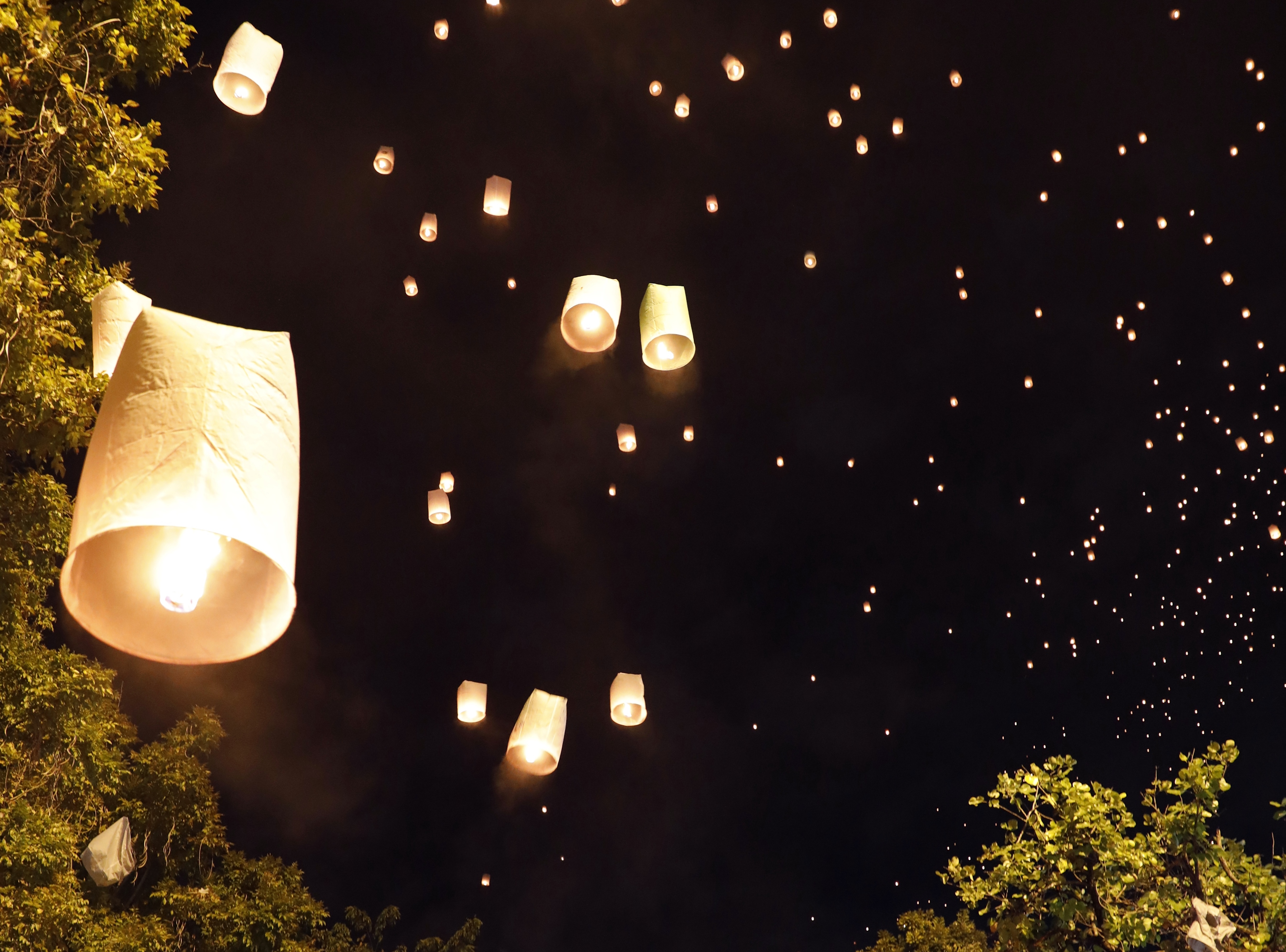
Beginning around 7 pm on Dec 31st, people begin to gather in a few different parks throughout the city. They light their paper lanterns and release them into the sky. The lanterns slowly rise in the dark sky and fill it like stars. We went to the main area near the Tha Phae Gate and released our lanterns just before midnight. It was fun to be a part of this celebration. By the end of the night thousands of lanterns had been released. The sky was spectacular.


Lanterns can be purchased from vendors on the sidewalks and in the parks. They sell thousands of them but give absolutely zero education on how to set them up or release them. As a result, many lit lanterns landed in trees. Since it had been raining a lot the trees were wet, and thankfully none caught fire. The next morning however, we heard that a temple had sustained fire damage caused by a lantern. That made us realize that these lanterns may not be the best activity. Not only are they a fire hazard, but they travel far and wide landing in rivers and fields where they accumulate as garbage.

Tips for visiting Chiang Mai
As the largest city in northern Thailand, Chiang Mai is a very popular with tourists and expats. The downtown core is filled with tourist hotels, restaurants and coffee shops and the sidewalks are crammed with tourists. If you stay in or near the Old City, you won’t have a problem finding accommodation or restaurants.
Wifi in Chiang Mai in 2018 was awful. It was widely available, but painstakingly slow.
During the winter, Nov to Feb, it’s quite cool in Chiang Mai, especially at night. Don’t forget to bring a light sweater.
Red trucks (songthaews) are available everywhere and are a shared taxi option to get to most destinations in town or close to town. Grab is also available and a good option.
Click on the link to read our Travel Guide for Thailand.
Coming Next – Pai – Thailand’s Mountain Town
To see more of our pictures go to Gallery at Monkey’s Tale
To read our trips from other places in the world visit Destinations.
If you like what you read please comment or share, with credit, using one of the links below.


![J.Chron.Lett.Sci.Network [JC-R] Avatar](https://secure.gravatar.com/avatar/6b985b340d4aa7c90b65a64d2c2fa67b37dd3477dd6cf943332d4eecf97dd50b?s=48&d=identicon&r=g)




We’d love to hear from you, please leave a comment.