
One of the largest cities in the world, São Paulo is often overlooked by travellers. Even in this large city of over 22 ½ million we found a few wonderful places with a lot of character that made us glad we had a few days to tour São Paulo.
Parque Ibirapuera (Ibirapuera Park)
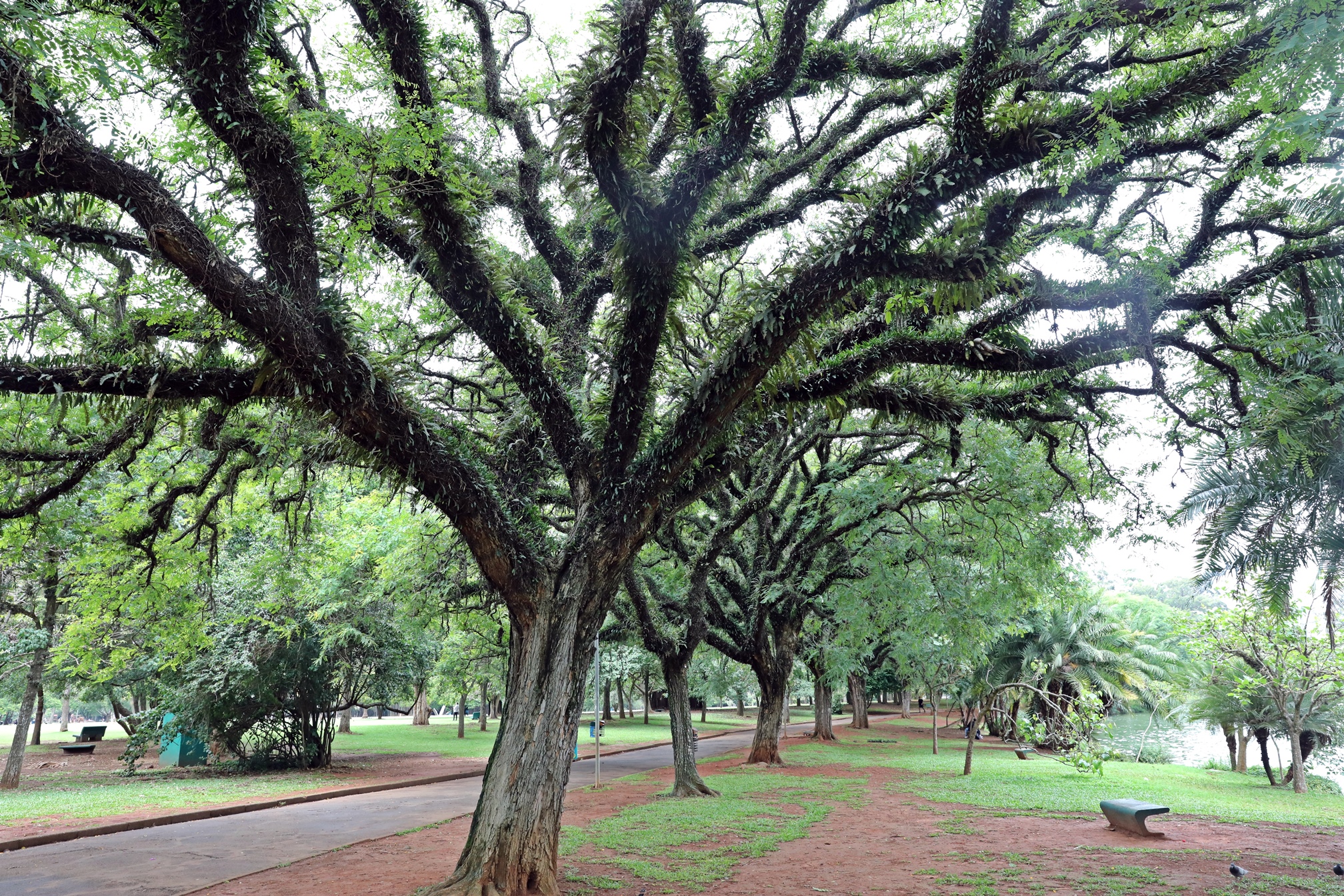
In the middle of the busy city is a huge green space with trees, two ponds and dozens of walking paths. With over 500 different species of plants, Ibirapuera Park was better than some botanical gardens we have visited in other cities around the world. The peaceful park allows you to forget that you’re in a busy city for a while and enjoy the chill vibe.


We followed interconnecting paths that let us walk around the ponds. The paths are often used by runners and walkers, enjoying a respite from the city. On the edge of the water we saw flocks of Australian Black Swans and Chinese Geese. Our trail took us by many varied types of trees including the Paraná pine, açaí palm, ficus trees and many more.


Ibirapuera Park is open from 5 am until midnight and is free to enter.
Jardins District
A mix of tall trees and skyscrapers line the avenues in this modern part of São Paulo. Jardins is actually a collection of four neighbourhoods, each adding their own flavour. The popular Paulista Avenue, known for its high end shopping is at the heart of Jardins. In addition to shops there are many good restaurants on or near Paulista. We walked from here to Ibirapuera Park. It was a really nice walk through quiet, clean communities.

Beco do Batman (Batman Alley)
A small collection of quiet streets play host to colourful street art. Beco do Batman is a great neighbourhood to spend an hour or so checking out the art. Some of the street art was good, some was sub optimal, but it is a nice, quiet spot in a big, bustling city. When you’re done, stop for lunch at one of the funky cafés or pubs


São Paulo’s Historical Centre
When you read about travelling to São Paulo the issue of safety always comes up. We found many parts of the city to be quite safe during the day, but there are also many areas where you need to be on alert. Downtown is one of those places to be on guard. Tent cities can be seen through out the city, but downtown has the highest concentration.

There are many grand buildings in the historical district in downtown São Paulo which are worth visiting. Most travelers will feel much safer if you take an official tour rather than exploring it by yourself as we did. We were there on a Tuesday morning and afternoon and were approached by 4 police officers in separate areas warning us to be very careful with our belongings. One suggested that Richard take out his camera to quickly take a picture and quickly return it to its bag. At the same time, he said Maggie should continuously scan the area behind and beside him looking for people who are watching and approaching us. Praça da Sé, in front of the of the Metropolitan Cathedral, is the worst area that we saw in all of Brazil. People were lying on cardboard on the sidewalks, covered in dirty and torn blankets or plastic bags. A few approached us asking for money, we weren’t worried about them. It was the ones who watched our movements as the camera went in and out of the bag that concerned us.
The safety concerns made it difficult to appreciate the majesty of the main resident on the square, Catedral Metropolitana da Sé. Its gothic, pointed spires in front of a large domed roof is one of the most impressive cathedrals in all of Brazil. Inside, the spectacular building is no less impressive with tall granite pillars along the sides and a golden altar in front.


After leaving the main square we walked along some of the many pedestrian walkways to see some of the other heritage buildings. There were quite a few office workers walking too which made us feel more comfortable, but we were still paying attention to everyone around us.

Visiting Mosteiro de São Bento (St Benedict’s Monastery) was one of our favourite experiences in São Paulo. As we entered, we were instantly entranced by the melodic, monotone Gregorian chants made by the dozen or so monks at the front of the church. Usually, the chants are only performed at 7 am so we felt very lucky to witness this act of devotion. As we sat listening to the chants we admired the beautiful painted ceilings and colourful altar. Unfortunately, we weren’t allowed to record the chants so can’t share it with you.


A few blocks away is Pátio do Colégio; a historic Jesuit college. The building is a humble one compared to the ornate churches and modern skyscrapers on the surrounding streets. It was built in 1554 to catholicize the local indigenous population.

Theatro Municipal de São Paulo
Having seen the Opera Houses in Manaus and Belem, we knew we wanted to see the largest one in São Paulo. From the outside, the grandeur of the building did not disappoint. Built in 1911 it was frequented by the wealthy elites of the city. As with the other two theatres, the majority of materials were imported from Italy, France and England. It is surrounded by busy streets with a continuous flow of cars rushing by that took a little away from the theatre’s mystique.
It is free to enter, but unfortunately it is only open Thursday to Saturday so we weren’t able to see inside. We were only able to sneek a few pictures from the front door.


Mercado Municipal (Municipal Market)
As we walked down the street toward the market, we must have stuck out as tourists. A couple of local guys shouted ‘Hola’ to us and then said ‘Argentina?’ Brazil doesn’t see a lot of English speaking foreign tourists, so we were often assumed to be from Argentina. We just agreed with them and continued on our way to the market.
Unlike other markets we’ve been to in Brazil, the Municipal Market is safe, clean and very enjoyable to wander up and down the aisles. Vendors selling fresh Brazilian fruits were very generous with their samples. Huge containers of local nuts including Brazil nuts, cashews and Batu nuts were on display. We couldn’t resist and bought more Brazil nuts and cashews.


Estação da Luz
Built in the 1860s this large train station is considered to be the most important in Brazil. The building is an interesting red and yellow design but the streets and sidewalks surrounding it were littered with homeless people lying on the streets. We seemed to be the only tourists there so we didn’t explore it for long. Across the busy street is we could see the 16th century Mosteiro da Luz. It was built using clay construction technique which makes it the most important colonial building of the 18th century in São Paulo.


Safety in Brazil
We are usually careful when we travel but in some parts of Brazil, including downtown São Paulo, we were extra diligent. We never travel with valuables such as jewelry and try to dress so we fit in as much as we can. Mobile phones are very popular to pick-pocketers and ours were always kept in zippered pockets or bags. We don’t carry large amounts of cash and only show small bills when shopping. Our most valuable item is the camera which is kept well hidden in a weathered camera bag and only brought out for short times when being used. In busy places there are more likely to be pickpockets so you need to be extra careful. In large cities, most tourist areas are safe during the day, but it is often not recommended to walk at night, especially alone.
How to get to São Paulo
Most international flights arrive at Guarulhos International Airport, 30 km from downtown. Make sure you know which airport your flight is using because there are two other airports. Congonhas Airport is for domestic flights only and is 8km from downtown. Viracopos-Campinas International Airport is 100 km away. São Paulo has 6 bus terminals (rodoviárias) spread around the city. Check which one is most convenient for your travels before booking.
Where to stay in São Paulo
Staying in a safe neighbourhood will make all the difference in your experience in São Paulo. The following neighbourhoods are not only safe, they also have easy access to good restaurants. Jardins, Consolação, Pinheiros and Vila Madalena. Based on our experience we wouldn’t advise you to stay in the city’s downtown.

This article is now featured on GPSmyCity. To download this article for offline reading or create a self-guided walking tour to visit the attractions highlighted in this article, go to Walking Tours and Articles in Sao Paulo.
To read about our other adventures in Brazil click here.
Coming Next – A Day In Curitiba
For pictures from other blogs go to Gallery at monkeystale.ca
To read about more of our adventures go to Destinations.
If you like what you read, please comment or share (with credit) using the links below.




We’d love to hear from you, please leave a comment.