
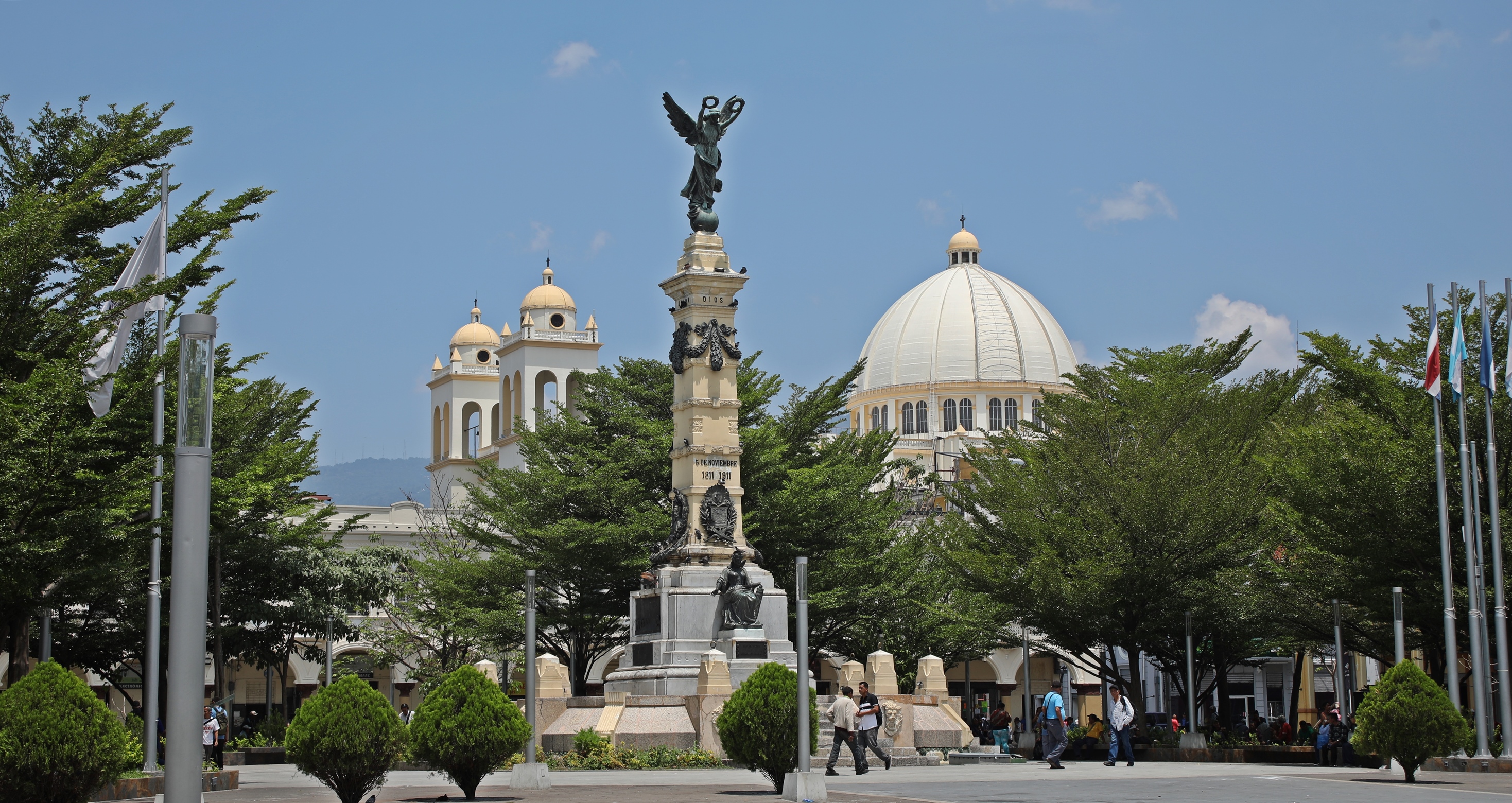
When visiting El Salvador, you will likely travel through its capital at least once. Instead of passing by without stopping, we think it is worthwhile to spend a day exploring San Salvador and area. You can fill your day by visiting the city’s downtown in the morning and Joya de Cerén Mayan archeological site in the afternoon.
Click on the link to go directly to Travel Tips For El Salvador.

The largest city and capital of El Salvador had a reputation for being one of the most dangerous cities in the world. That was definitely true in its past, but fortunately, a recent government crack down on gangs has turned it into a relatively safe city for both visitors and residents. The city is still rebuilding from these years of unrest, but there are a few newly restored sites in the city’s downtown that can be visited in a half-day.
Plaza Gerardo Barrios
Begin your exploration at the city’s main square, Plaza Gerardo Barrios. On one side of the busy park is the National Palace. It is rather grand looking, built in the Neoclassical style. The original palace burned down in a fire in 1889, so this new building is from the early 1900s.
When we arrived there were a couple dozen heavily armed soldiers protecting the building. It is the former house of the president and legislative assembly but hasn’t been used by government since the 1970s. Today it is used for ceremonial events and receptions as well as housing the state’s archives. The soldiers were gone by mid-morning so we suspect there was an important event taking place inside when we first arrived.

In front are statues of Christopher Columbus and Isabella I, wife of 15th century ruler King Ferdinand II. It seemed strange to have Spanish statues prominently displayed outside since the palace was built after they achieved independence from Spain in 1821. We learned that the statues were a gift to the country by Alfonso XIII who was King of Spain in the early 20th century. They were to commemorate the 432nd anniversary of Columbus’ landing in America, making the statues seem even more inappropriate and odd.

The other notable building on the square is Cathedral of San Salvador. The exterior is rather simple but inside, the wooden designs on the ceiling and paintings on the altar make it appear much more elaborate.
The tomb of San Salvador’s beloved archbishop Óscar Romero is housed in the church. He was known for his support and aid to the needy as well as being a vocal critic of the military backed junta government. In 1980 he was shot by a military sniper while giving mass. Two pictures of him are positioned prominently at the front of the church.
You can read more about the military junta and guerilla rebels in our post Visit Colonial Suchitoto.


Across from the Cathedral is the modern National Library. Construction of the new building began in 2022 with financial help from the Chinese government. This is the second structure we saw that was built with aid from China. The other was the new pier in La Libertad.

Plaza Morazán
A block from Plaza Gerardo Barrios is a smaller square that is home to the elegant National Theatre of San Salvador. Built in the early 1900s it has a variety of architectural styles melded together such as French Renaissance, Rococo, Romantic and Art Nouveau. It is apparently open for tours but was closed when we were there.

Plaza Libertad
With the cathedral’s dome and bell towers poking over head in the background, Plaza Libertad may have the most interesting building in the city. Iglesia El Rosario (The Rosary Church) was built in the late 1960s by Salvadoran architect and sculptor Rubén Martínez. The modernist-style church was built to replace a deteriorated wooden one.


Concrete makes up the walls and ceiling of the large arch-shaped building. Colour floods in through linear breaks in the cement that are filled by stained glass. More colour is added by the light’s reflection off the polished floor.
The contemporary design reminded us of Metropolitan Cathedral in Rio. You can see pictures of it in our post Rio’s Historic Downtown.


There is also an art installation by Rubén Martínez in the church. It comprises a modern art depiction of the 14 Stations of the Cross. All pieces were made with left over material from the church’s construction.


Like many buildings in the country the church is connected to the country’s hardships. The building was used as a shelter for hundreds of families seeking refuge during the civil war.
The modern building and art installations were not at all what we expected to find in San Salvador, but that’s what makes exploring these cities interesting.
Entrance Fee – $2 USD. The dress code says that shorts/skirts must cover your knees. There are wraps available at the ticket booth to borrow.
Like many cities in Central America, the squares are lined with porticos meant to make walking in the hot sun more bearable. Most of the people though, were on the pedestrian-only street that runs between the squares. Some of the buildings along this pathway are still a little rundown, but we were able to find a nice place to stop for a coffee.


Walking in this area in the middle of the day felt very safe, but it is advised to avoid the area at night. As well, further away from these three plazas, the streets become rougher and don’t have much to offer visitors at the present time.
After spending the morning in the city’s downtown, you can spend your afternoon exploring Mayan history.
Joya de Cerén
While many parts of El Salvador were inhabited by the indigenous Pipils, the northwestern part of the country was settled by the Mayas. In the late 6th century, a Maya farming community was established in the fertile lands around Joya de Cerén. A previous volcanic eruption made the soil in this region very rich for farming, but probably should have been a warning sign.
The map below shows the historical distributions of pre-Hispanic civilizations across Mesoamerica. Joya de Cerén is in the red region (El Salvador).

In 650 AD Loma Caldera erupted, covering this farming village in 4 – 8 metres (13-26 feet) of ash. For this reason, it is also called the Pompeii of El Salvador. The volcanic ash did a great job preserving the buildings of this community. While there are many stone Maya temples and palaces that can be visited, everyday buildings were made of wood and clay so none survived. That is none, except for those in Joya de Cerén. It is one of the only Mayan sites that allows you to see how the common people lived.
The excavated buildings in Joya de Cerén archeological site are seen from viewing decks above three separate pits. Around the edges of the sites you can see the 14 layers of ash that covered the town for more than 1,000 years. The layers are not only from the original volcanic eruption, but also from subsequent eruptions, floods and earthquakes. In the middle of these pits are some of the well preserved buildings of this farming community. To put the pictures into perspective, remember that the ash wall that surrounds them is up to 8 metres (26 feet) deep.


As we explored the site we saw a community building that was likely used for town meetings with seats at the front for authority figures. Other buildings were farm houses with separate storage rooms and crop fields.


Further on is a female shaman’s house with lattice designs that reminded us of Pre-Incan sites in Trujillo, Peru. Beside it is the ceremonial centre where rituals related to corn harvest and fertility would have been performed.

The condition of the buildings allowed researchers to better understand how Mayans built their homes in the 7th century. Most of the buildings were made of wattle and daub construction. In this technique wet clay, soil and gravel are compressed and applied to a wooden frame. It is known to be an earthquake resistant technique.

Loma Caldera was less than a kilometer away from the village. No bodies were found leading researchers to believe that the community was able to escape without losing any lives. Most of their belongings were left behind as if they left in a hurry indicating that the eruption was sudden, catching the community by surprise. Some of the dishes still had residue of the last meal and a ceramic vessel was found that still contained hundreds of pumpkin seeds.
The well preserved condition of the buildings and pottery resulted in other fascinating discoveries. Researchers found fingerprints on a piece of pottery and remarkably, human footprints in the ground. There were also indications that they raised animals. One example was the duck skeleton that was found still tied to a wooden rod.


Not far from a group of houses is a sauna, called temazcal (also spelled temascal or temazcalli). This is one of the only Mayan saunas found that still has part of a domed roof. This finding allowed researchers to further understand the construction techniques used. They built the roof with sticks that were woven together and then covered in mud.
Inside the sauna is a flagstone floor and a stone box which would hold heated rocks. Water infused with herbs was then poured on top to generate steam. Saunas were used to purify the body after childbirth or when fighting an illness.

Archeologists found vessels, tools, funerary offerings, agave fibre ropes, jewelry and obsidian knives. Many are on display in the site’s small museum.


Entrance – $7 USD and includes an English speaking guide. Opening Hours – Tuesday to Sunday 9am-4pm.
How to get to Joya de Cerén
The archeological site is 34 km from San Salvador. If you don’t have a car, go to Terminal Occidente in San Salvador and take bus 108 destined for Opico. Tell the driver you’re going to Joya de Cerén and he will tell you when to get off.
You can also reach Joya de Cerén from Santa Ana as it is 41 km away. Take bus 201 or 202 for the 1 hour drive.
Where to stay in San Salvador
We stayed in San Benito neighbourhood and found its tree lined streets to be safe and filled with good restaurants and nice hotels. It is considered one of the safest neighbourhoods in the city. Its location makes it easy to reach downtown by Uber or taxi.
Getting to San Salvador
As the capital of the country, San Salvador has a large International Airport, but it is located 32 km from the city’s downtown. It is actually mid way between San Salvador and La Libertad.
If you’re already in the country, it is easy to reach San Salvador by chicken bus. There are at least three bus stations though, so make sure you know which one your bus uses, especially if you are transferring to another bus.
Note the term ‘direct’ for a chicken bus does not mean it doesn’t make stops. There will be countless stops along the way even when you think there can’t be room for any more people, it will stop to let more on. Direct means that you won’t have to change buses.
Getting around San Salvador
Chicken buses and micro-buses connect all parts of the city , but Uber is also a convenient and inexpensive option. Most of our Uber rides from San Bento to the downtown were between $3-5 USD.
Travel Tips For El Salvador
• Safety in El Salvador – Not that long ago El Salvador was considered one of the most dangerous countries in the world. Gang violence was rampant with frequent murders, kidnappings and extortions. Recent government crackdowns resulted in the arrest of at least 80,000 gang members. This seems to have ceased or at least greatly diminished the violence. It is Central America though, so you have to take everything with a grain of salt. Recently it was in the news item that a Salvadoran football (soccer) star asked the president to release his gangster father from prison and the president obliged. Hopefully that is not a common scenario.
According to United Nations, murder rates per 100,000 people in El Salvador in 2018 was 52.02. By 2022 it had decreased to 7.74 and has gone down even further since. Estimates are that El Salvador’s murder rate for 2023 will be around 2.4/100,000. For comparison, Mexico’s murder rate only improved from 29.58 in 2018 to 26.11 in 2022.
What all of this means for tourists is that the country is much safer for foreigners to travel. During the day tourist sites are safe and usually patrolled by heavily armed police or soldiers. You do still need be vigilant using safe practices such as: taking care when walking at night, not carrying a lot of cash or wearing flashy jewelry and taking extra precautions when outside of the tourist sites.
• SIM Cards – We purchased a SIM card from Claro for $7 USD. It gave us 26 days with 5 GBs data plus, 2 GBs for FB, IG, TikTok. We met another traveller who had an e-sim specifically for Guatemala and El Salvador. He said it worked well in Guatemala, but it didn’t work at all in El Salvador.
• ATM – Not all ATMs accept international bank cards and not all are always stocked with money. We found the banks with best rate and consistently had money were BAC Credomatic or Banco Atlántida. The country’s currency is the US dollar. They claim to also use bitcoin but we only saw one store that was accepting it.
• Transportation – Unless you rent a car or hire a private driver the most common way to reach the cities in El Salvador is by chicken bus. Don’t worry, even though at first glance they may look awful, they are a fun way to travel and immerse yourself in the culture. Vendors get on and off the bus throughout the trip selling water, juice, chips, fruit or even electronics and snake-oil medications.
If travelling with luggage, you will bring it inside the chicken bus. Sometimes you will be charged for an extra seat for the bag. It’s not pleasant to haul it onto the bus but it is also safer. We took a regular bus from Sonsonate to San Salvador where the luggage goes below the bus. Someone opened up the sleeping bag compartment of one of our backpacks. If you take a regular bus, watch your luggage and keep an eye on the luggage compartment at every stop.


• Ride Share – Uber operates in San Salvador and El Tunco. Otherwise, taxis are available everywhere.
• Food – Pupusas are the most authentic and widely eaten Salvadoran food. Somewhat like flattened empanadas, pupasas are corn tortillas stuffed with either mushrooms, cheese, beans and sometimes chicken or pork. Other than pupasas, most food is similar to what we think of as Mexican food. Breakfast was similar to that found in other Central American countries with eggs, beans, fried plantains and buns.
• When to travel – The most popular time to visit is during dry season that runs between November and March. The hottest months are March and April. Rainy season is between May and October and would not be a good time to visit.


This article is now featured on GPSmyCity. To download this article for offline reading or create a self-guided walking tour to visit the attractions highlighted in this article, go to Walking Tours and Articles in San Salvador.
To read more of our adventures in El Salvador, click here.
Coming Next – Day Trips From Santa Ana, El Salvador
For pictures from other blogs go to Gallery at monkeystale.ca
To read about more of our adventures go to Destinations.
If you like what you read, please comment or share (with credit) using the links below.





We'd love to hear from you, please leave a comment.