As we approached the enormous Pyramid of the Sun, we stared in awe and wondered how early peasants would have felt as they approached the towering pyramid. After this awe-inspiring first impression, we knew our day exploring the pyramids of Teotihuacan would be unforgettable.

The historic city of Teotihuacan is located 50 km (30 miles) from Mexico City, at an elevation of 2,300 m (7,500 ft). It was built along the San Juan River rather than beside a lake like the other historic cities in the Valley of Mexico. This site was likely chosen because of the surrounding fertile lands and its access to fresh water. People have been living in the area of Teotihuacan since ancient times, but it wasn’t until the 1st century AD that it developed into a city. For the next several hundred years, the city grew and grew until it was the largest city in the Americas. At its height, between the years 300 and 600, the population was an estimated 175,000.

As you would expect for such a large city, it soon became an important centre for religion and ceremonial rites. In addition, its location close to obsidian mines made it a leader in making blades, arrow heads, axes and other tools from the stone. The obsidian was used by the large number of skilled artisans and craftsmen that lived in the city as well as being a key good for trade.

The people of Teotihuacan though did not keep written records. As a result, even though it was such a large and important civilization, not a lot is known about the people or the city. Even without knowing a lot of the details, you can still enjoy wandering through the ancient streets and be amazed by the pyramids, palaces and ceremonial plazas.

The showstopper of Teotihuacan is the enormous Pyramid of the Sun. Built in 200 AD it was the largest building in pre-colonial Mesoamerica. It is so large in fact, that its base is as large as the Pyramid of Giza. Mayan pyramids are much taller, but its large base plus 65 m (210 ft) of height makes it one of the largest pyramids in the world.

The lower walls of the stone structure would have been decorated in friezes and painted with geometric shapes. The paint was made from minerals and semi-precious stones mixed with cactus slime. It’s too bad that those colours didn’t withstand the test of time.

The Teotihuacan people had fled the city hundreds of years before the Mexicas arrived in the 1400s. When they first saw the large pyramid, they thought it was built to worship the sun god and named it Pyramid of the Sun. Because the Teotihuacan people didn’t have a written language it is not fully known what the pyramid was used for, but it is believed that it was built to worship the god of rain, called Tlaloc in Náhuatl.

The Mexica were also the ones to name the city Teotihuacan. It means ‘Place where the gods were made’ or ‘City of the gods’, in Náhuatl. It’s not known what the city was called in the 1st century.

This large pyramid is solid but beneath it archeologists found a few tunnels and a cave. In the cave they found a statue of Huehueteotl, the Fire God as well as a child’s grave in each corner. These graves suggest that the children were scarified and offered to the gods. One theory is that the cave was the original temple and the pyramid was built over top.

At 45 m (147 ft) high, the next tallest pyramid in Teotihuacan is Pyramid of the Moon. The structure we see today is the seventh layer of pyramids on this site. Between 100 and 450 AD, six new pyramids were built on top of the existing one. With each build, human and animal sacrificial offerings would have been made. Apparently it was built to mirror Cerro Gordo behind it.

At the top of the pyramid there was likely a temple dedicated to the Great Goddess of Teotihuacan; the Goddess of rebirth and fertility. Underneath the temple they found jade artefacts and obsidian blades. 

In front of the pyramid is Plaza of the Moon. It includes twelve small, flat-topped pyramids that would have had temples on their tops. They surround a centre altar that was likely the site of ceremonial dances.  

Note – you can no longer climb Pyramids of the Sun or Moon.

The main street in Teotihuacan is the ominous sounding Avenue of the Dead (Avenida de Los Muertos). It begins at Pyramid of the Moon and travels in a north south direction for almost 3 kilometers. It received its name because it was initially believed to have been bordered by tombs but in reality, the buildings were temples and palace residences.

The long street may have been used for processions to reach the ceremonial Pyramid of the Moon.

Along the sides of the avenue are many stone bases that would have had wooden buildings on top. Incredibly, on one of these stone buildings you can see a mural of a jaguar. Many of these buildings would have been painted and this mural is a great example of how the colourful the entire street may have looked at the time.

Not far from Pyramid of the Moon is Palace of Quetzalpapalot (Quetzal-Butterfly). The best feature in the palace is the courtyard in the back. Here you’ll find stone columns lining the edge of the courtyard. They aren’t ordinary columns though. They are ornamented with beautiful carvings.

It was initially believed that the carvings were of the mythical quetzal-butterfly, but are now believed to represent owls. Other depictions of owls have been found throughout the city. As well as the carvings, some of the walls are still bright with red paint.

A different style of pyramid architecture was used in Teotihuacan, called talud-tablero. This style of building was later found in other pre-colonial sites as far away as Tikal in Guatemala (You can read our post of Tikal here). It is one of the ways archaeologists were able to realize how far of a reach Teotihuacan had. You can see it in the first picture below where a sloped apron wall braces the vertical wall.

We also noticed another difference in the buildings’ designs. Smaller stones were placed in the mortar between larger stones. Many of the structures have been restored after suffering damage over the years. These small stones were used to identify the reconstructed walls. You can see this in the second picture below.

If you follow Avenue of the dead beyond these the large pyramids you’ll reach the prettiest building in the entire city. At the far end is the less visited Temple of the Feathered Serpent (250 AD).

We almost didn’t bother climbing to its top because we have climbed several different pyramids on our travels and the view from the top didn’t look very interesting. But, are we ever glad we did. We scaled over a pyramid that stands in front of Quetzalcoatl to see that it was hiding a great surprise.

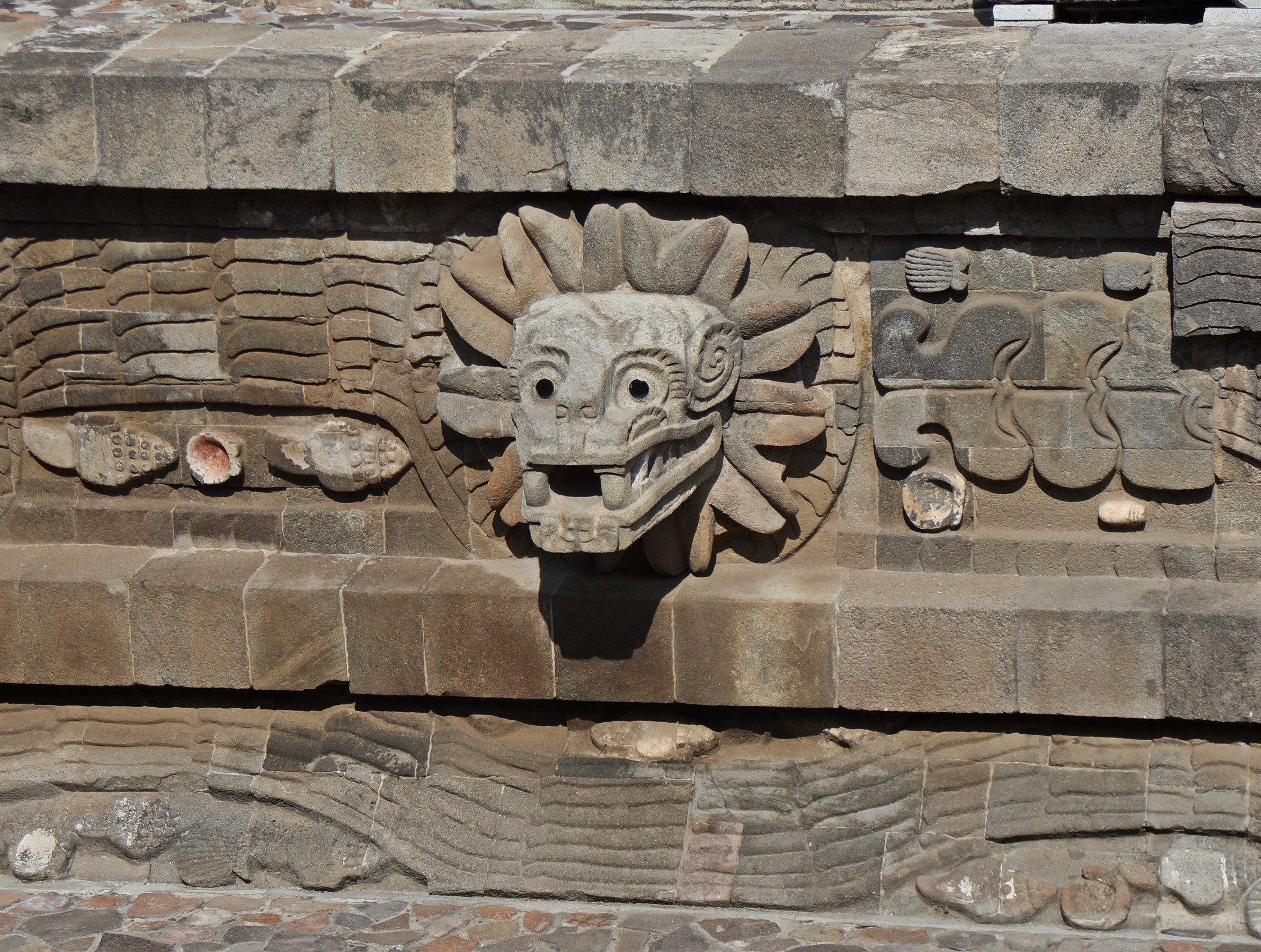
The façade of the temple has several original reliefs that appear to be coming out from the pyramid walls. Heads of Feathered Serpents and a Tláloc-like deity cover the wall.

It used to be called Temple of Quetzalcoatl because the Feathered Serpent reliefs look very similar to the deity Quetzalcoatl seen in later civilizations. We found it interesting that this idol is also similar to Kukulcan, a Maya deity.

As well, the other character looks very similar to Mexica’s deity Tláloc, god of rain. That is what some researchers believe, but others say it may be a precursor to their Fire God, Xiuhcoatl or even the deity Cipactli.  Whoever they represent it is a beautiful display of the skills held by sculptors of that time. These similarities are another indication of how far these Mesoamerican civilizations travelled and how much they interacted.

In the National Museum of Anthropology in Mexico City there is a re-creation of the temple wall. It must have been an incredible thing to see when it was still this colourful.

When the temple was excavated in the 1980s, they found over two hundred skeletons dressed as warriors. It is believed they were sacrificed as an offering when the temple was erected.

In the plaza in front of Temple of the Feathered Serpent was the citadel where rulers of the city likely lived. From there we could look down Avenue of the Dead to see both Pyramids of the Sun and Moon below Cerro Gordo.

It took centuries to build Teotihuacan and yet its demise was rather quick. A fire in the 7th century is believed to have destroyed most of the wooden buildings and as a result, any remaining residents fled to other parts of the Mesoamerica. Researchers are still unsure if the fire was the result of internal conflicts or invading forces.

Although very impressive, Teotihuacan feels a bit like visiting an impersonal large city with baren streets and towering buildings. It seemed to lack much character. It felt very unlike most of the Maya jungle ruins which are more like charming small towns; each with their own personality.

For more information on Maya sites, visit our posts about: Maya Ruins In Belize; El Tazumal, Joya De Cerén in El Salvador; Tikal & Yaxha in Guatemala; and Palenque, Chichen Itza, Uxmal and Tulum, in Mexico (Coming Soon).

If you have a car, it is an easy drive from Mexico City. To reach by public transit, make your way to Terminal de Norte. Inside is a kiosk selling tickets to the archeological site. ($68 MXN/$3.70 USD). Return tickets from the town of San Juan Teotihuacán were only $45 MXN ($2.45 USD). 

There are also many tours offered from agencies in Mexico City. Some combine the ruins with a visit to Basilica of Guadalupe.

One of the best museums we have visited in a long time is the National Museum of Anthropology in Mexico City. It is so large that you can not possibly visit it all in one day. The areas that interested us were Teotihuacan, Tenochtitlan and Maya Empires.

One fact to remember as you look at these artefacts is that those crafted before 1000 AD, so all from Teotihuacan, were made before metal tools were developed in Mesoamerican. The majority of these stone artefacts were therefore sculpted with obsidian blades. Here are some of our favourite pieces from this museum as well as the one on-site at Teotihuacan Archeological Site.

Disk of Death (Complejo Muerte Disk of Mictlāntēcutli) – Found in front of Pyramid of the Sun, this magnificent piece is made of basalt stone and depicts Mictlāntēcutli, god of death.

Huehueteotl – A statue of this deity was found in a pit under the Pyramid of the Sun. This statue of Fire God Huehueteotl is also a brazier that would have been used in rituals.

Goddess of Teotihuacan – This sculpture was found in front of Pyramid of the Moon. It is very similar to the Mexica goddess Chalchiuitlicue, wife of Tlaloc.

Clay figurines, pottery and braziers – There was a large variety of artefacts found throughout the city such as; doll-like figurines with moveable limbs; decorative ceremonial vessels; masks; as well as painted bowls and vases.

These artifacts were found in Tenochititlan, now Mexico City.

Piedra del Sol – The Sun Stone was found in Templo Mayor, Tenochititlan. It was called the Aztec Calendar for years, but now is believed to have been a sacrificial altar. At 3.6 m (11.8 ft) in diameter, it is an impressive artifact.

We saw quite a few sacrificial stones that were found in Tenochititlan. Each one is skillfully decorated with artistic carvings.

Cihuateteo or “Divine Women” – These skull images represented the spirits of women who died in childbirth.

Chaac – When we show you Maya sites in southern Mexico, you will see many icons of Chaac, Rain God.

Chac-Mool – Another common Maya figure is Chac-Mool, used during sacrificial offerings.

Ball Game Rings – The Ball Game is common among many Mesoamerican cultures. The museum has a collection of stone rings used in the game from a variety of sites around the country.

After the archeological site we explored the central square in San Juan Teotihuacán, a Pueblo Magico. Its colourfully painted city hall and central plaza make it a nice stop for dinner or drinks after exploring the archeological site. The small town is not worth a special trip though.

Tip – There are hundreds of Pueblo Magicos in Mexico. It’s a marketing term to generate tourism in the towns. Some of them earn this name, but others fall quite short. Don’t assume because it’s a Pueblo Magico that you will find it magical.

Read from another device.

To read more of our adventures in Mexico, click here.

Fediverse reactions

94 responses to “Explore The Pyramids Of Teotihuacan”

  1. It’s been many years since my visit to that part of Mexico. Your vivid photographs brought great memories back to life. Thank you.

    1. Oh great, glad we brought back those good memories. Maggie

  2. This is sooo interesting, and a fantastic read too. I have always wanted to see the pyramids and the city ever since I was a child and we learnt about the different cultures at school. Maybe one day (sigh)…thanks for sharing the fantastic article and photos 🙂

    1. Happy to bring it to you James! Teotihuacan is a fascinating place. Thanks for your comment 😊 Maggie

  3. Wow what a fascinating site to visit! It always amazes me how they could build such massive structures back in the day. The stairs to climb up look very steep but worth it to see the pyramid details up close and personal.

    1. The size of these pyramids. is really incredible. You do have to pay attention when you climb them, the steps can be treacherous! Thanks Lyssy! Maggie

  4. Amazing feats of engineering and construction for the time or for any time in fact. Were these built by willing subjects or by slave labour, I wonder? The sight of them must have been awe inspiring in the day, unless you were about to be sacrificed. Happy Tuesday Maggie. Allan

    1. I imagine slaves did the grunt work on the construction. But it is quite the feat to build something so massive. Thanks Allan, Maggie

  5. As you can imagine, this takes me back to our own visit earlier this year! I know what you mean about it feeling a bit impersonal and barren, but I have to say I liked the way the openness allowed us to see the scale and arrangement of the pyramids.

    1. That’s true if they were surrounded by trees, their size may not have been as obvious. Thanks Sarah, Maggie

  6. It’s a great site!

    1. It is! Thanks Timothy, Maggie

  7. Fantastic photos, Maggie. Great job!

    1. Thank you Pat!!

      1. Very welcome.

  8. Impressive!
    Wonderful photos. Great details.
    I feel like I’m actually there. Thanks for sharing!

    1. Thank you! Glad you enjoyed the pyramids with us. Maggie

  9. Such an interesting post. So much history. Too bad most of it is lost. I do love all the stone details and sculptures.

    1. Thanks, it’s too bad they don’t know more since this society had so much influence on later civilizations.

  10. It’s such a fascinating, intriguing history. No written language but exquisite artistry. The painted bowl is still very beautiful, even after all this time. Thanks for sharing your visit with us.

    1. Some of the pottery was even more impressive than the large pyramids. Thanks Lynette! Maggie

  11. Wow, what an incredible place to wander through and marvel at the ancients. It is amazing how well preserved these temples are. What a thrill to walk through the temples and then get to see so many of the artifacts there at the museum. 🙂

    1. It is a quite remarkable place. I can’t imagine seeing all of these together when they were at their best! Thanks Meg, Maggie

  12. Thanks for sharing this incredible part of the world!

    1. Glad you enjoyed it!

  13. Amazing ancient structures and carvings!

    1. They are! Thanks Rosaliene!

  14. Oh my gosh Maggie, these pyramids, museums and temples of Teotihuacan are so amazing, detailed and historical marvels. Awesome photos for sure my friend. As always, thank you for the expedition! 😎📸🥰

    1. It is an impressive place. They knew how to build impressive cities back then. Thanks Kym!! 😎

      1. You are so very welcome Maggie. The details done by hand is what gets me every time! Impressive indeed! 🗻💐🤗

  15. The ancient “Ball Game Rings” look like the forerunner of the modern corn hole game. Thanks for a great history lesson of Teotihuacan, its pyramids, and its palaces, The artifacts in the National Museum of Anthropology are simply amazing. 🙂

    1. Haha, some compare it to basketball, but maybe cornhole is closer 😊!

  16. Amazing photos. The pyramids (esp. pyramid of the sun) looks so impressive. I haven’t been to Mexico yet despite it being next doors and despite that I’ve visited around 50 countries.

    1. Thanks, glad their impressive stature came through. You should go, there are many great cities in Mexico!! Maggie

  17. Your photos do an excellent job capturing the scale of the pyramids. They’re enormous! The reliefs on the Temple of the Feathered Serpent are incredible and so full of character. It would be fascinating to go back in time for a day to see the city during its heyday, I can’t begin to imagine what it would have been like back then.

    1. I’m glad the scale of them comes across. They are enormous! Wouldn’t it be amazing to go back in time! Although I’d want to be a high priestess not a lowly slave 😊.

  18. Thanks Maggie! Once again I am reminded of all the things I didn’t see or appreciate during my own visit. In Mexico I am more of an expert in Mezcal rather than history. These revisits through your eyes have been so interesting and enjoyable.

    1. Haha, we had plenty of that too 😊 Maggie

  19. Thanks for showing us all how much Mexico has to offer!

    1. You’re welcome! Still a lot more to come 😊

  20. The pyramids are impressive. Thank you for the history and storytelling behind them. How amazing that the city had so many inhabitants.

    1. I’m glad the impressive stature of these pyramids came through. They are gigantic! It would have been amazing to see this city at its height. Thanks Mary, Maggie

  21. This brings back fond memories of my stay in Mexico City, with two nights spent in Teotihuacan in the hotel next to the site. You were right to combine this with a visit to the National Museum of Anthropology, as all the decoration is there when the archaeological site looks quite bare.

    1. It seemed to make more sense to combine them since you’re right, the ruins are rather bare. It must have been amazing though when it was painted and decorated. Thanks for your comment, Maggie

  22. The photos up close of the Temple of Feathered Serpents are amazing! I am still kicking myself for not walking further down the Avenue of the Dead to this temple.

    1. Oh no! Well you’re not alone, there were very few people who went that far and even fewer who climbed up the pyramid to see the sculptures. Glad to show you how it looked. Maggie

  23. The Temple of the Featured Serpent sounds like something from an Indiana Jones movie. The history and artifacts all look so interesting. Great write up Maggie!

    1. Thanks, its a pretty special place, perfect for an archeological adventurer like Indiana Jones 😊

  24. It’s pretty amazing to think how these pyramids were built and that they’re still standing today. The National Museum of Anthropology sounds fascinating. And it’s neat to see some of the various artifacts, especially the Sun Stone.

    1. I know, they’re really remarkable. Combining the trips to the pyriamids and the museum put it all together. Thanks Linda! Maggie

  25. I find pyramids and the fact that similar ones are found in so many places. These pyramids at Teotihuacan are no exception. Totally amazing how the built with such precision. From your photos I can see they look very geometric craftperson skill boggle the mind for first century AD construction.

    You menition cactus paste in some of the construction. I saw a few trees in the distance. Are there still cactii in the area. Looks like there is not much shad either. Was it pretty hot weather there? I wonder.

    Thank you for taking the climb up, great closeups of the materials of the steps and the stone work. Those steps look a bit steep!

    Did you travel from Mexico City directly to Teotihuacan?

    Is there a volcano nearby? I wonder?

    By the way are there airplane/helicopter tours or something that would give the visitor a view from above of these fantastic pyramids…the areas seems so huge to take in from the ground?

    P.S. I did not miss the mention of the owl carving on the colomn, fascinating!

    Thank you Maggie for an awesome and awe-inspiring look at places that are ancient and still talked about today across the world.
    As alwys safe travel, Maggie

    1. It’s quite mind boggling isn’t it, how they were built so well and are so large to keep the proper shape.
      There were quite a few cacti around the museum, but those were all I saw. They could have brought the cacti from km away or maybe there were more at the time. It was hot, but at 2,300 m elevation it wasn’t too bad.
      Some of the steps are very steep as well as uneven and often too small for my feet! Tough to climb, but tougher coming down. We could only climb the Feathered Serpent here though.
      I think you can take helicopter tours, but there were no helicopters flying above when we were there. It would be an amazing view.
      We took a public bus from Mexico City both ways. They have a pretty good bus system there.

      Thanks so much Suzette for your wonderful and detailed questions. Maggie

      1. Thank you Maggie for your great response. I appreciate your kindness with my many inquiries. Sorry for the typos in my original comment which I just noticed…LOL!

        Safe travels! Have a good one!

        1. I’m sure I send many typos in my comments too 😊

          1. You are most kind, Maggie. Thank you!

  26. So interesting Maggie. I’d like to visit these pyramids too.

    1. They are very impressive, glad they piqued your interest. Maggie

  27. Maggie, I got goosebumps when I saw your photos of the Temple of the Feathered Serpent, the painted bowls, the Sun Stone, and those other richly-embellished artifacts. I really wish I can follow in your footsteps in the near future. It’s incredible to think how old these places and objects are.

    1. Temple of Feathered Serpents is spectacular! We didn’t realize that so much of it was still intact. We couldn’t believe that barely anyone was there! To see the pyramids and then see all of the artefacts from Teotihuacan as well as many other sites in Mexico was a great way to tie it all together. I hope you get there Bama, maybe we’ll interest you in a few more Mexican sites over the next month of posts too 😊 Maggie

  28. We absolutely loved exploring this place, it was just fabulous to imagine the giant city in its pomp and heyday. Learning how they used natural resources – flowers, stems, insect blood etc – to create the colours with which they decorated the walls was fascinating. The size of the pyramids really is awe inspiring.

    1. It’s pretty impressive isn’t it?

  29. The pyramids are so impressive, though it didn’t occur to me you could walk on them. We will almost certainly visit Chichen Itza when we’re in Mexico in the spring, so I’m looking forward to that post. So much human sacrifice back then, but at least they found a use for cactus slime.

    1. You can only climb one of the pyramids in Teotihuacan. I don’t think you can climb any in Chichen Itza. You may also want to go to Tulum ruins. Its temple has the prettiest location.

      1. Thanks for the tip.

  30. Wow, the museum looks absolutely fascinating! I can’t imagine carving those artifacts with only stone tools.

    It’s too bad the pyramids haven’t retained their colors or other designs. However, they’re still so massive and I can see why they’re worth the visit. Imagine building those without modern-day tools and machines as well? I’m exhausted just thinking about it!

    1. It would have been incredible to see when it still had paintings on the pyriamids. And yes, I can’t imagine all of the hard work and without even metal tools, never mind a crane or electric saw!

    1. Oh great, glad to bring back those memories!

  31. Looks fabulous! Adding it to my list.
    — Sai

    1. Thank Sai!! I was thinking of you last week. How have you been? Maggie

      1. Sai Chand Chintala Avatar
        Sai Chand Chintala

        I’m good, Maggie. I messaged on WhatsApp sometime ago. I’ll email with details.

  32. WOW. What a bucketlist item. I am blown away just from the photos, let alone being there. It is mind boggling for me that these structures were created so many years ago. The pyramids would have been even more majestic in their heyday with colours and patterns. I also love the Teotihuacan Pottery, incredible!

    1. It would have been incredible to see them in their prime. I can’t imagine how imposing they must have looked at the time. And yes the painted bowls are incredible. Thanks Hannah!

  33. An impressive sight. I thoroughly enjoyed reading your article on the Teotihuacan pyramids. I can only imagine how beautiful this city was in its heyday when all the buildings looked colourful. The indigenous cultures of Central and South America are fascinating and the lack of written artefacts makes them all the more mysterious and attractive.

  34. I’ve been there! The pyramids and the museum are well worth seeing!

    1. They definitely are worth a visit. Thanks Dawn! Maggie

  35. We went there a few years ago. What an amazing place. Your thorough post does justice to this remarkable site. I’m always intrigued by ancient cultures that sacrificed their own people (whether warriors or children) to the gods. I suppose it’s the ultimate sacrifice – that which is most precious. We humans are so weird.
    Alison

    1. We are weird. Many of these cultures didn’t think death was the end, it was only one step of your life. At least that’s what the people who were sacrificed were told. Tough time to not be the leaders.

  36. How wonderful that so many animal and figure reliefs have survived through the centuries. I wonder if the paintings on them, if they had survived, would be as vivid as modern day Mexican decorations.

    1. The few areas that still had paint on the walls were quite bright colours but I doubt they had as much variety as now. It would have something special to see. Thanks Ruth! Maggie

  37. Just the name, Teotihuacan, is cool to say. The pyramids are massive. It’s almost hard to believe that a civilization that was so large and sophisticated is almost unknown.

    We didn’t have time to get to the Temple of the Feathered Serpent when we were there. It looks like it’s in better shape that I thought it would be. Thanks for the pics.

    1. We had no idea Feathered Serpent would be in such amazing condition. Especially since there weren’t many people there. It was my favourite part of the site. Thanks Dave! Maggie

  38. wow. definitely a must visit site!

    1. Yes, you can’t miss Teotihuacan in Mexico!

  39. The practice of human sacrifice makes me shudder, but the buildings themselves are incredible. It must have been absolute awe-inspiring to be among those people who “rediscovered” them in the 1400s.

    1. It is very disturbing but was very common with these civilizations. It must have been amazing for the peasants of the time as well as the Mexicas who stumbled on it centuries later. Thanks Tanja! Maggie

  40. […] from Teotihuacan in some of the buildings on the North Platform. The remarkable part is that Teotihuacan is over 470 km away. That’s a long way to travel in the 1st or 2nd […]

  41. […] The last picture below is of a mask of Chaac that we saw in the National Museum of Anthropology in Mexico City. […]

  42. […] Kukulcan is the main deity of the Yucatan Mayas. Represented as a plumed or feathered serpent, the deity is called Quetzalcoatl in other Mesoamerican cultures. It was likely introduced to the Maya by the Toltec people around the 10th century. The Mayas adopted the deity and called it Kukulcan. In Maya culture, Kukulcan became very important as the creator god who connects the physical world with the spiritual world. This is another example of how much exchange there was between the Mesoamerican cultures. We saw a different version on the feathered serpent in Teotihuacan. You can see that image here. […]

  43. […] You can read more about this ancient city in our post Explore The Pyramids of Teotihuacan. […]

  44. […] You can read more about this site in our post Explore The Pyramids Of Teotihuacan. […]

We'd love to hear from you, please leave a comment.

Destinations

Discover more from Monkey's Tale

Subscribe now to keep reading and get access to the full archive.

Continue reading