

Overflowing with colourful art, Dendera Temple is said to be the most beautiful temple from ancient Egypt. After seeing it in person, we have to agree. From the beautiful Hathor-headed columns to the elaborate murals on the ceilings, Dendera Temple is not to be missed. Let us show you this wonderful building from ancient Egypt.
Dendera Complex
This interesting complex has several details that distinguish it from other Egyptian temples. To begin with, its construction began in the 1st century BCE, which makes Dendera Temple more than 1300 years younger than the other temples we visited in Luxor. Another difference is that it was not erected by Egyptian pharaohs, but instead by members of the Ptolemaic Dynasty, including Cleopatra VII. The complex was then expanded by the Romans, but was mostly abandoned by the 4th century, when pagan beliefs were no longer widely followed.
The Ptolemy Dynasty came into power after Alexander the Great died. Originally from Macedonia, the pharaohs of the Ptolemy Dynasty continued to follow the ideals set by Alexander the Great. This included respecting Egyptian customs and traditions, such as worshipping their gods. When this dynasty was replaced by Roman emperors, that trend continued for a while. This respect extended into the design and decoration of their temples. For those reasons, Dendera Temple is very similar to the ancient Egyptian ones we’ve seen, but with noticeable Ptolomy and Roman influences.
Note – Cleopatra VII is the famous pharaoh we have all read and seen movies about. From now on, we’ll just refer to her as Cleopatra.
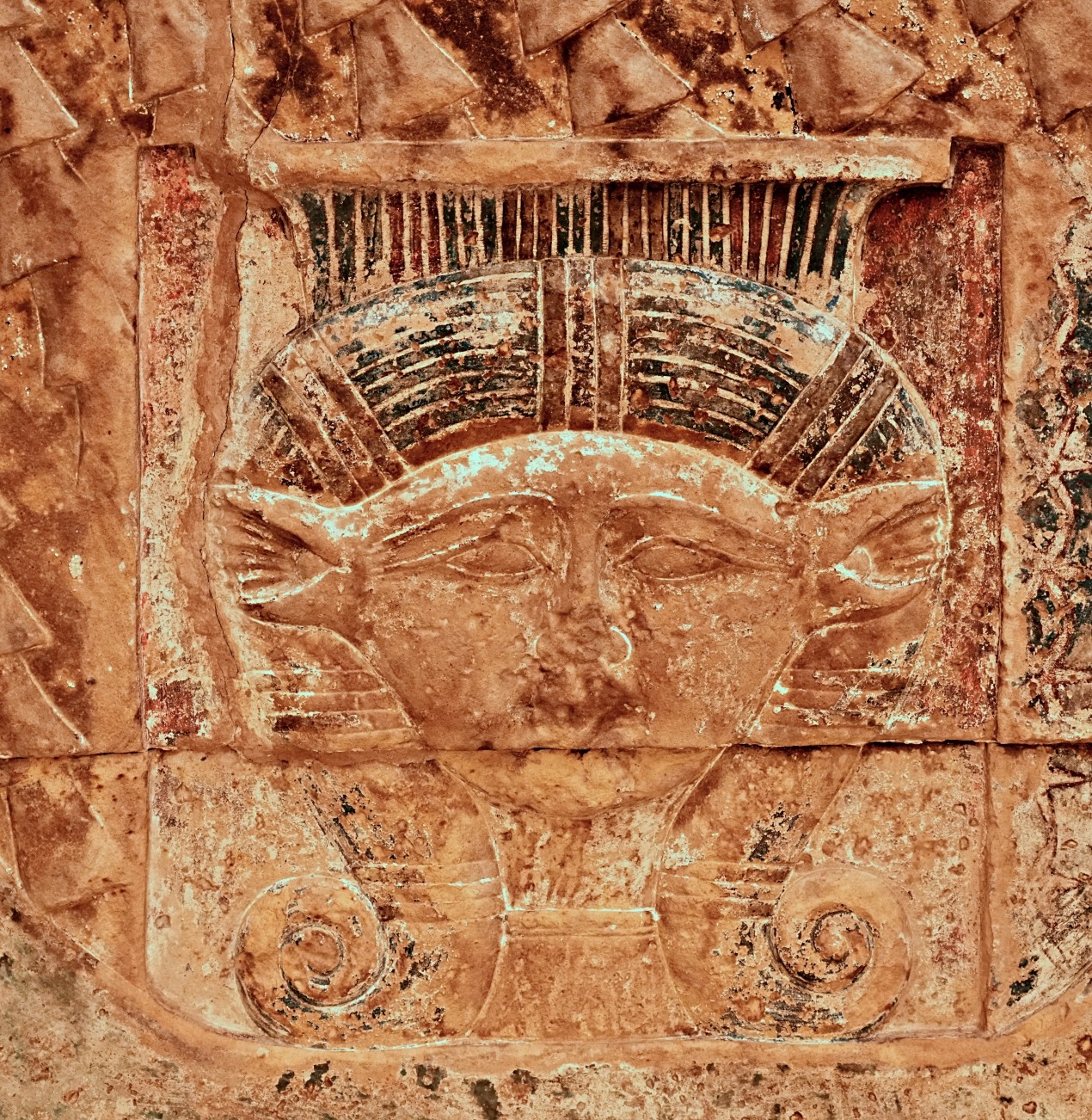
Dendera Temple is dedicated to Hathor, one of ancient Egypt’s most treasured goddesses. She embodied love, joy, music and motherhood. Sometimes Hathor is represented as a cow, or with cow ears because she nurtured and suckled many of Egypt’s pharaohs. Hathor was married to the god Horus, whose temple, Edfu, is 170 km (105 mi) upriver. Once a year, Hathor’s effigy travelled on the Nile from Dendera to Edfu, as part of a large celebration.
Main Gate
Once you see the Corinthian columns, it will be obvious that the Romans built the main entrance to the complex. But it also has sphinxes and reliefs of Egyptians gods Hathor and Horus, showing their continued support of local customs.


Temple of Hathor
After entering through this Roman gate, you’ll be treated to your first look at this magnificent temple. There will be no doubt that it is dedicated to Hathor when you see the six tall columns with Hathor’s Heads. We first saw these columns in Hatshepsut’s Mortuary Temple in Luxor. In the coming weeks, we’ll show a different version of them in the Small Temple in Abu Simbel (Coming soon).

Before entering the temple, wander around its exterior walls where you’ll find many wonderful reliefs. The back wall is in the best condition and has an image of Cleopatra presenting her son, Caesarion, as the next Pharaoh. This was a long-standing Egyptian tradition, but it didn’t work out for Cleopatra; the Ptolemaic Dynasty ended with her. As you may suspect from the name, Julius Caesar was his father.
We learned more about Cleopatra in Alexandria. You can read about it in our post A Guide To Alexandria’s Historic Sites.


Hypostyle Hall
Once you have walked around the outer wall, it’s time to go inside. Part of what makes this temple so impressive is that its interior is largely intact, including the ceiling. During restoration, its walls were carefully cleaned, and some repairs were carried out, but most of what we see is original. That means that this temple is one of the best ways to see what an ancient Egyptian temple may have looked like in the day.
Step through the main door to enter the magical Hypostyle Hall. It is a stunning room with 18 granite columns topped by Hathor Heads. There is one on all four sides of the columns, representing her observance of the entire sky. On top of the head is a naos or small shrine.
This room was built under Roman Emperor Tiberius, 14–37 AD. Even though he didn’t follow the Egyptian religion himself, he allowed priests to continue their beliefs.


In addtion to the columns, every inch of the walls are richly decorated. Instead of depicting Egyptian Pharaohs, as we were used to seeing, the reliefs are of Ptolemic pharaohs or Roman emperors dressed as Egyptian pharaohs.

The wow factor doesn’t end at the walls; prepare for a sore neck from continuously looking up. On one side of the room, the ceiling is painted blue and decorated with astrological motifs, Roman zodiacs and solar boats. There are so many fine details in these images that the ceiling is a highlight of this temple.


Spread across the entire centre aisle, the ceiling has several winged sun disks. It is an important Egyptian symbol representing a union of the sun god with Horus, Hathor’s husband.

A wonderful mural of Nut is found on the other half of the room. As the goddess of the sky, she is often found on the ceiling. Nut swallows the sun at the end of the day and gives birth to it the next morning, symbolizing death and rebirth.

Not many of these old structures still have their ceilings, so it was very special seeing one in this temple.
Sanctuary
Long after it was abandoned as a place of worship, nomadic Bedouins took shelter in the main sanctuary. They often built fires inside, so unfortunately, its walls are darker and a little more damaged than the rest of the temple.

Side Rooms
Several side rooms extend off both the Sanctuary and Hypostyle Hall; each is more breathtaking than the last. Some are chapels, but there is also a treasury, music room, throne room and others. Most of the rooms have poor lighting, but this gave the artwork a more sacred feel.


One of the side rooms is called the Wabet, or pure place. These are sacred rooms where the statues of goddesses and gods were cleansed before rituals and festivals. In addition to many pictures of Hathor, the Wabet’s ceiling has a colourful mural of the goddess Nut.

Dendera Lightbulb
There is also a controversial image in the temple, the Dendera Lightbulb. You may have seen it on the tv show Ancient Aliens, where it was referred to as the world’s first light bulb. They suggest that these images prove aliens visited ancient Egypt. Instead of aliens, though, the image depicts the divine birth of Harsomtus, son of Hathor and Horus, as a snake emerging from a lotus flower. But the lightbulb story is good too.

Rooftop
After exploring the many side rooms, follow the centuries-old footsteps of priests up one of two two dark ramps. They were used during religious ceremonies and lead up to the rooftop. It should be no surprise by now that these halls are also adorned with ritualistic illustrations.

The rooftop has its own special artifacts. Hidden in a seemingly insignificant backroom on this top floor is what some say is a copy of the first zodiac ever created. The feature dates to 50 BCE, and some researchers believe it is a Roman zodiac, while others say it is a map of the stars. The original is in the Louvre, and unfortunately, they didn’t make a very good copy, so we found it difficult to make out many of the characters.

You’ll find more rooms on this upper level; six of them are dedicated to Osiris. Their walls tell the story of the Resurrection of Osiris, when Isis revives a mummified Osiris. You may notice that Osiris has an erect phallus in many of the pictures. This scene is from the myth of the magical conception of Horus. In the story Isis becomes impregnated by the mummy of Osiris. The bird hovering above the mummy is a version of Isis.


As well as the Resurrection of Osiris, the walls are as in excellent conditon and display bright colours.


Crypts
You can find even more secrets hidden below the temple’s floors. Climb down a very steep staircase and crawl under a low entry to reach one of the twelve underground crypts. As with the temple above, the walls are completely covered with carvings. Rather than a crypt for graves, these subterranean rooms were used to store sacred vessels for rituals and festivals.
While these crypts are yet another component of this fascinating temple, they are not incredibly picturesque. It requires an extra ticket, and if you don’t have time, you can skip it.

Roman Mammisi
Beside the temple is the Roman Mammisi. These buildings were used to celebrate the birth of a deity’s baby. Construction of this Mammisi at Dendera began under Roman Emperor Nero and was completed during Trajan’s reign in early 100s AD. It celebrates the divine birth of Hathor and Horus’ baby Ihy.
Like the temple, the mammisi also has a grand entrance. Instead of Hathor heads, its elaborate columns are topped by the god Bes, protector of households.


Inside, the reliefs show Ihy from infancy to childhood along with his parents. Many are of Hathor breastfeeding.


Beside it is an older mammisi, that was converted into a Coptic Church, but it is in poor condition.
How to get to Dendera Temple
The temple is about 60 km from Luxor, on the outskirts of the city of Qena. You can take a bus between the two cities, but you would need to hire a taxi in Qena. It is better to hire a private driver in Luxor. We hired an honest taxi we had already used the day before. The cost was $60 USD, including waiting and return to Luxor, 4 hours. If you do hire a taxi/Uber, make sure to have them wait for you because there won’t be many taxis driving by, and there is no Uber/Careem in Qena.
For information on where to stay and eat in Luxor, including Travel Tips, visit our post Ancient Wonders – Karnak Temple and Mummy Museum.

Click on the link to read our Travel Tips For Egypt.
To read more of our adventures in Egypt, click here.
Coming Next – Explore Aswan: The Hidden Gems of Elephantine Island
For pictures from other blogs go to Gallery at monkeystale.ca.
To read about more of our adventures go to Destinations.
If you like what you read, please comment or share (with credit) using the links below.




We’d love to hear from you, please leave a comment.