
The rolling hills just outside of Lisbon are decorated with colourful and quirky palaces, mansions and castles. Some trail along the ridgelines, others decorate the highest peaks. A few only allow their pointed spires to poke up from the valley bottom. Sintra is more than a historical site, it is a land made for fairytales.
Castles began popping up on Sinta’s hills when the Moors first captured the land in the 8th century. They remained on these hills for over 400 years until King Afonso I of Portugal conquered them in the12th century. After doing so the king established his first official residence in Sintra Palace. The king, nicknamed The Conqueror, had already proven his success by conquering the Moors in Guimarães in 1128. You can read about Guimarães here. (Coming Soon)
It was much later though, in the 19th century, when Sintra started to blossom. Using the hilly landscape as a feature in their architecture, aristocrats built lavish mansions and palaces creating a unique and magical feel to Sintra. Today you can visit many of those palaces and see the designs and decorations that range from elegant to eclectic. Here are our favourite sites in Sintra.
Moorish Castle
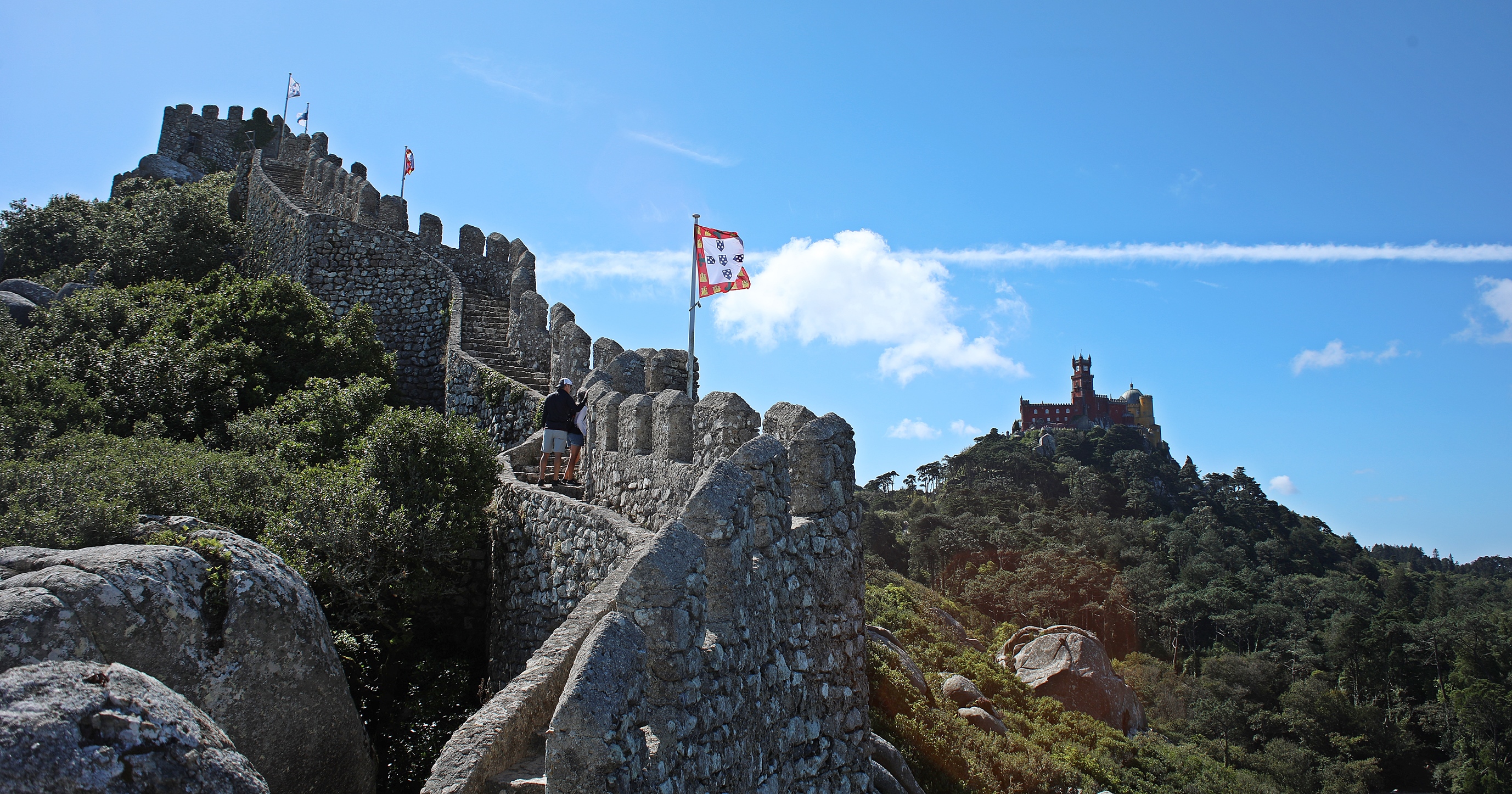
Travelling along the top of a long ridge is a fantastic Moorish Castle (Castelo dos Mouros). It is the largest remnant of the Moors’ 400 years in this area. Although they arrived in the 8th century, they didn’t build this castle until the 10th century.

Since it’s located at the top of the hill, you have to walk up through an alpine forest to reach the castle. It’s a nice walk where large boulders take up the space between the trees. On the walk we passed 12th century Islamic houses, old tombs, a church and parts of the castle wall.


Once you get out of the trees, the castle walls come into view. They almost look like the mountain’s spine, as they follow the undulations and turns of the ridge.


The walls are actually very picturesque, but the best part of visiting this castle is to walk on top of them, between the many towers and sentry posts. As well as having an interesting perspective of the walls, the walk gives you great views of Sintra Palace below and Pena Palace above. As we looked further we could see dozens of other palaces and mansions dotting the landscape.


At the top, is the Royal Tower where we had our best view of the famous Pena Palace. This is likely where King Ferdinand II used to come to enjoy the view of his beloved home. He didn’t live in the Moorish Castle, but is said to have come to this spot often to admire Pena Palace.

Tips For Visiting The Moorish Castle
There are no restrictions on the number of people who can enter the castle at one time as there are at some of the sites. In September we didn’t have a problem buying our tickets when we arrived and there wasn’t a line up, but in mid summer it will likely be much busier. You can reach Moorish Castle on the public buses described below
Pena Palace
Proudly sitting on top of the second highest hill is the flamboyant Pena Palace (Palácio da Pena). It is a palace like no other. A monastery originally was built on this hill but was abandoned in the early 1800 when religious orders were abolished in Portugal. In1838 King Ferdinand II acquired the land and built a new palace on the hilltop.
He was nicknamed the Artistic King because he was an avid ceramics painter and engraver. He was apparently very involved in the design aspects of his new palace and judging from its appearance, he must have been quite eccentric. The hodgepodge of whimsical design elements and colours makes this palace the most popular spot in Sintra, and maybe all of Portugal.


Some of the old monastery was retained, but a lot of new additions were required to build the palace. After completion, it was used as a summer residence by the king and his family. It continued to be a royal summer palace up until 1910. The palace we see today is said to be close to the look of that original summer retreat.
While we thought it was quirky from below, after walking through a Moorish shaped gate we could see that the designs were about to get even more eccentric. The first clue was the crocodile gargoyles hovering above the gate. Then we passed through a second even more elaborate gate. Monumental Gate, is decorated in all sorts of decoration including elaborate sentry boxes and battlements.


This gate leads you to another quirky spot, Triton Terrace. Its funky window frames made of stucco shaped like coral and seashells barely get noticed due to the wild-eyed Triton that looms above the gate. Looking up the other way is a world of colour. The palace’s mustard coloured towers and turrets sit below a bright red clock tower.


If you dare to walk under Triton you’ll reach the Courtyard of Arches. Here you see mismatched tiling and outlandish window frames on one side and more colourful walls around the stripped roof of the chapel on the other. With so much to look at, it was a little overwhelming.


The original monastery chapel was retained and became a part of Pena Palace. Inside there are many statues and carvings. What got our attention though were the azulejos on its walls and between the ribs on the ceiling. For a small room, there is a lot to see.


The interior of the palace is also over-the top-elaborate, but not nearly as quirky as its exterior. Pictures are not allowed inside, so you’ll have to visit it to see for yourself.
After exploring the palace and its courtyards you can walk through the garden. It’s called a garden, but is really a forest. We had heard that there were views of the palace from lookout points in the garden, but the trees are too tall and don’t give away much of a view. We were only able to find one spot where we could see the palace poking above the trees.
It is a lovely, healthy forest, but there’s not much to see so if you’re short on time you can omit it from your visit.

Tips For Visiting Pena Palace
To reach the palace from the main entrance you either have walk up through the gardens, or take a shuttle. There aren’t any view on the way up, but it is a nice walk.
There are two types of tickets. One is for the palace interiors which includes the gardens. The other ticket is just for the gardens (both include the outer courtyards). Tickets for the palace interior must be booked online. They are timed entrances and tend to fill up quickly so book as soon as you know when you want to visit. On the day of your visit, arrive at the site at least 30 minutes ahead of time because it’s either a 15 min walk or shuttle ride from the entrance. It is worth it to arrive even earlier so you have time to explore the outside courtyards of the palace too. If you’re only going to visit the garden, you don’t need to book ahead. You can reach Pena Palace on the public buses described below.
Park and Palace of Monserrate
For a change of pace, Palace of Monserrate is located at the bottom of the hill, but that only means you have to walk back up at the end of your visit rather than at the start. It is a very pretty palace set in a large green space.
This luxurious home had meager beginnings. In the 1500s it was built as a hermitage, dedicated to Our Lady of Monserrate. The original building was badly damaged in the 1755 Lisbon earthquake. In the mid 1800s it was rebuilt by an English businessman who wanted a Moorish look to his gothic home. The result is a mix of styles that seem to work very well together. Its rotund front hints to it original beginnings as a church.


Inside this interesting building, the designs do look less Portuguese and more Moorish. The rooms are decorated with delicate romantic designs throughout. This begins with the lace-like arches that travel down each of the four hallways.

The music room is also very elaborate with a finely detailed designs on the domed ceiling. Around the end of the ceiling are a number of busts of Apollo and his muses. Ceilings in other rooms are equally stunning.


Tips For Visiting Monserrate
Because it’s located further away from the main palaces, Monserrate isn’t very busy. In September, there was only a handful of other visitors. You can reach Monserrate on the public buses described below
Quinta da Regaleira
This is a bizarre place. From the overly opulent palace and chapel to the random fountains, towers, and staircases throughout the large yard you would think it was built for royalty, but it wasn’t. Instead, it was built by a wealthy Brazilian with eccentric tastes. The architecture style is called neo-Manueline Revivalist, but we can’t say we’ve ever seen anything like it.


Random pathways head in various directions through the large estate and then many abruptly end without warning. As you walk on the paths you find towers, turrets, fountains and castle-like walls. You may come across the man-made caves and lakes as well. It seems as if an idea to build something popped into the owner’s head, so he built it without purpose or a plan.


The main palace is overrun with pinnacles and opulent mouldings on the windows, doors and eaves. The church as well as a small bridge matches the fanciful designs.


The interior of the palace is as unique as its exterior with azulejos and murals covering the walls and overly elaborate furniture matching the decor. One of the nicest, least erratic features is a beautifully carved wooden ceiling.

At the very top of the property is a deep well that leads to a tunnel system. There was a very long line up to see this well. We didn’t bother to wait in the one-hour long line up because after a day seeing the sites in Sintra, we were done with long line ups. The rest of the property was more than bizarre enough for us, we didn’t need a well.
Tips For Visiting Quinta da Regaleira
This is a very popular spot. In the fall we waited in line for an hour, so during the peak season you may want to purchase a ticket ahead of time. You can reach Quinta da Regaleira on the public buses described below.
Sintra National Palace
The two tall white cone shaped spires give Sintra Palace its own elegant design. Built in the 10th or 11th centuries, it was lived in by Portugal’s first king. Located in the town of Sintra, it has a more elegant look than its neighbouring palaces.

Sintra
The historic town of Sintra could be very cute with historic buildings lining the many cobblestone streets. The complete take-over by the tourism industry though has made it a bit overdone. Every old and new building is a shop, restaurant, hotel, or tour office. It was a bit too hectic to be able to enjoy the town.


How To Travel Between The Sites In Sinta
Although technically you could walk from the town of Sintra to all of the sites, it is a very hilly area making the distance between sites feels greater than they are. If you do walk you could likely only be able to visit a couple of places. The best option we found was to take Buses 434 and 435. They are both circuit routes and between them they travel to most of the castles and palaces. They are two separate circuits but are owned by the same company. You can buy full-day passes, or pay by the ride. Tickets and passes can be purchased from the bus driver or the office in the Sintra Train Station. The buses do get very crowded, but they run frequently so if one is full, you’ll be first able to get a seat on the next one.
The elevation of Pena Palace and the Moorish Castle are above 400 m so it will likely be a bit cooler and depending on the time of year so you may need a jacket.
How to get to Sintra
Unless you have joined a tour, the best way to reach Sintra is by public transit. Trains leave every 30 minutes from Rossio and Oriente Stations in Lisbon. There is also a bus that leaves from Marques de Pombal, but it is more expensive than taking the train. If you’re staying in Cascais you can catch bus 1623 to Sintra Train Station. Once in Sintra, you can catch the local buses to tour Sintra from the train station.
If you have a car it is better to leave it in Lisbon. There is no parking at the palaces and actually very little parking in Sintra.
The first map below shows the location of the sites we explored in Portugal. The second map is an expansion of the southern half. You can click on either for a closer look. You can find Sintra just above Lisbon.


Where to stay in Sintra
Most people visit Sinta on a day trip from Lisbon, but if you want to arrive at the sites early, you can stay overnight in the town. There are quite a few hotels and B&Bs in town and many restaurants.
After visiting the Palace of Sintra, don’t forget to explore the beautiful architecture in Belém and Lisbon or go for a hike around Cabo da Roca.


This article is now featured on GPSmyCity. To download this article for offline reading or create a self-guided walking tour to visit the attractions highlighted in this article, go to Walking Tours and Articles in Sintra.
To read more of our adventures in Portugal, click here.
Coming Next – Hiking Cabo da Roca
For pictures from other blogs go to Gallery at monkeystale.ca
To read about more of our adventures go to Destinations.
If you like what you read, please comment or share (with credit) using the links below.







We’d love to hear from you, please leave a comment.