
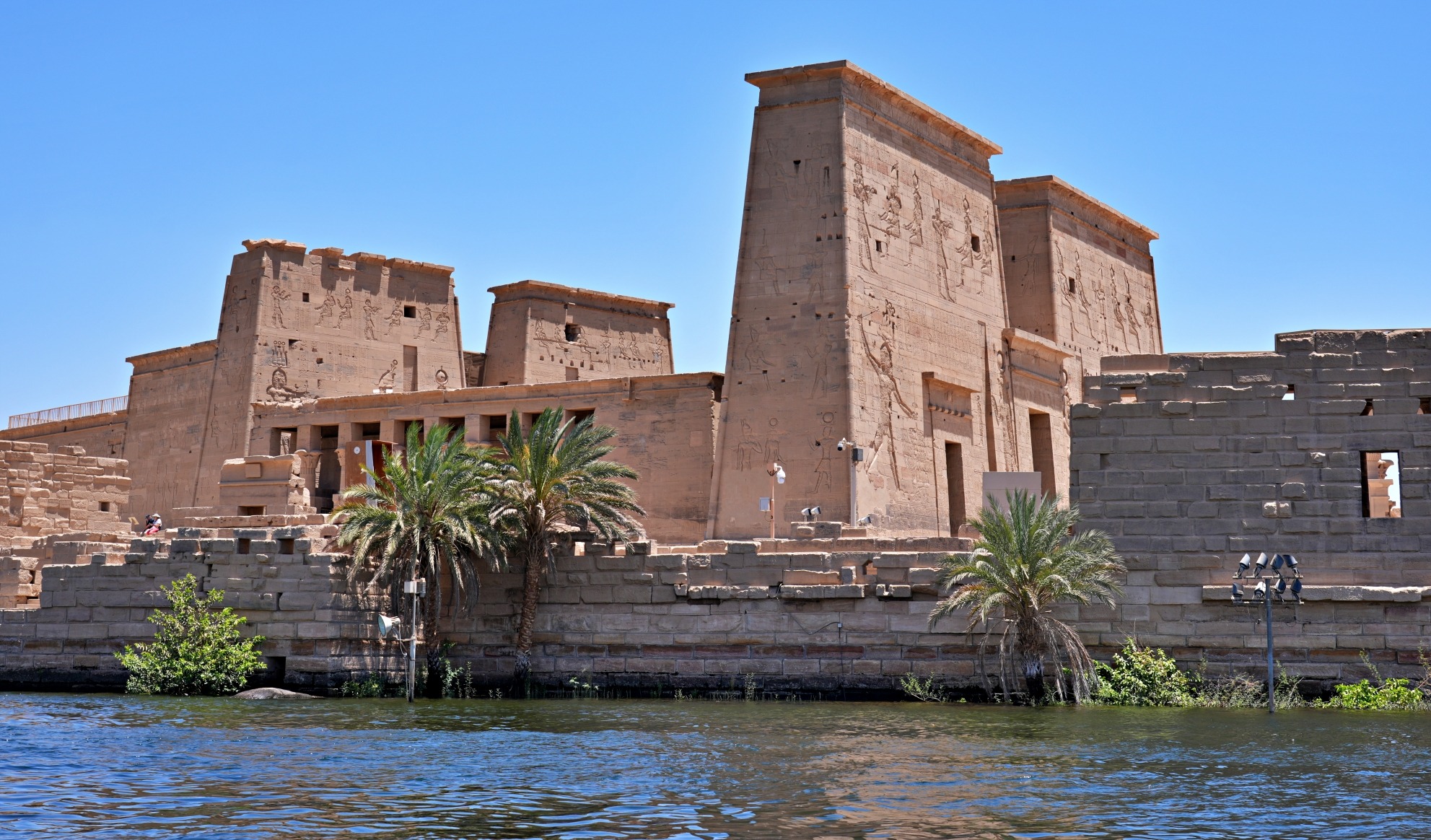
Perched on a small island in the middle of the Nile is one of ancient Egypt’s youngest temples. Philae Temple’s youth, though, doesn’t make it any less spectacular. In addition to visiting the temple, there’s another fascinating attraction right in the city. The Unfinished Obelisk gives you a glimpse into how these monolithic monuments were made. Don’t forget to visit these historic sites when you’re in Aswan.
Philae Temple Complex
Arriving at this ancient site by boat makes the entire visit even more memorable. As we neared the island, two magnificent pylons rose above the Nile, beckoning us to get a closer look.


After Alexander the Great died, his kingdom was divided into two, and the Ptolemy Dynasty took over his Egyptian lands. Even though they were Macedonian Greeks, pharaohs of the Ptolemy Dynasty continued to follow Alexander the Great’s lead. They respected Egyptian customs and traditions, including worshipping their gods. This extended into the design and decoration of their temples.
The temple complex is interesting, not only for its ancient carvings, but also for its unique story. It was originally built on another island, called Philae. In Egyptian mythology, this revered island was one of the burial places of the goddess Isis. Based on that belief, the Ptolemy Dynasty built a temple on Philae and dedicated it to the deity. In the ensuing years, more temples and shrines were built on the island.
In the 1960s, the new High Aswan Dam was being built, and it became clear that it would cause the island to become submerged. This had already happened to a lesser extent after the construction of the smaller dam in 1902. Therefore, after much searching, a new island with an appropriate location was found. Before the High Dam was completed, the temples were disassembled and moved to Agilkia Island, 500 m away, where they were reassembled. What an immense undertaking that would have been. Remarkably, other than maintenance patches and artificial ceilings, the walls were restored but not modified.
Temple of Isis
The main temple on the island, the Temple of Isis, is often called Philae Temple, an homage to its previous location. It was established over hundreds of years with many additions and extensions. Although an earlier shrine existed, what we see today was first built under the Ptolemy Dynasty in the 3rd and 2nd centuries BCE and expanded by the early Romans.
Once on the island, your first view of the temple is its First Pylon (Gate). It was built around 80 BCE, so it is a newer addition to the main temple. This gate reminded us of Ramses III’s mortuary temple in Luxor with larger-than-life engravings on the walls. Instead of Egyptian pharaohs, the reliefs are Ptolemaic pharaohs. One is of Ptolemy XII holding his enemies by the hair and striking them with a mace, to show he will protect both the temple and Egypt.


Temple of Imhotep
In front of this pylon are the walls of the Temple of Mandoulis, also called the Temple of Imhotep. While it is not much to see today, Imhotep has an interesting story. He was the designer credited with building the Step Pyramid in Saqqara in the late 2600s BCE. By the Ptolemy period, his reputation had elevated him to god-level status, but more due to his accomplishments as a physician than an architect.

Mammisi of Horus
The 2nd Pylon is very similar to the first and has the Mammisi of Horus on its edge. These buildings were used to celebrate the birth of a deity’s baby. This one is dedicated to the divine birth of Horus, child of Isis and Osiris. Inside, an inscribed falcon of Horus takes centre stage, but there are many other reliefs. Most are of his parents, including one of Isis breastfeeding Horus.
We saw another Mammisi at Dendera Temple; you can see it in our post .


After going through the second pylon, you will enter a colonnaded courtyard filled with pillars. These ones, though, are topped with capitals that are much more elaborate than Egyptian Papyrus bulbs. Instead, they have a mixture of papyrus, lotus and palm leaves; all trees found along the Nile. These multi-plant columns became prevalent during the Greco-Roman period of Egypt. You can see a few faint Roman engravings on a few of the columns.

Further inside the temple, you’ll find several small rooms, all decorated with reliefs. Most of these would have been painted, but during the seasonal floods caused by the first dam, most of the paint was washed away.


In addition to images of Ptolemy pharaohs making offerings to the gods, there are a lot of hieroglyphics. Since the Ptolemy pharaohs spoke Greek rather than Egyptian, this is another display of their support of local customs.
Hadrian’s Gate, in another part of the complex, has the last known Egyptian hieroglyphic to be carved.

One of the most important rooms was the Central Sanctuary, or Holy of Holies. You can’t enter, but you can look from the doorway to see the old altar. It would have held a statue of the Goddess Isis.

The Coptic Christians used the temple in the 6th century. In places, you can see their Coptic Crosses carved over the ancient Egyptian art.

In addition to the main temple, there are a few other buildings to see.
Kiosk of Trajan
Believed to have been originally built by Augustus, the first Roman Emperor, this chapel is very different from other buildings in Egypt; the main difference is that the columns are built on top of the walls.
Kiosk of Trajan was left unfinished, so it only has two carvings on its walls. They represent Emperor Trajan, as a pharaoh, performing typical Egyptian rituals. These reliefs gave the chapel its current name.


Nilometer
Beside the Temple of Isis is a Nilometer, with enclosed stairways down to the river. You can only see it from above, though. If you are interested in seeing more Nilometers, visit our posts Cairo’s Historic Centre and Aswan.

At the back of the complex are a few smaller shrines. Most are in ruin, but are quite picturesque, posed in front of the famous Nile River.

Entry – 550 EGP ($11 USD), payment can only be made with a credit/debit card; Opening Hours – 7 am – 4 pm, closes at 3 pm in winter.
This complex, along with Abu Simbel, the Unfinished Obelisk, and the archaeological site on Elephantine Island, are UNESCO World Heritage Sites.
Getting to Philae Temple Complex
Located 7 km from downtown Aswan, in an underpopulated area, you will need a car/taxi to reach the Philae Museum entrance and the boat docks. It’s best to have your taxi wait, since there probably won’t be any taxis waiting. You will have to pay 20 Egyptian pounds for the taxi to park. The return trip plus waiting will cost around 500 Egyptian pounds.
Our taxi ride was quite an adventure. We hopped in a taxi, a 50-year-old Peugeot, and drove through Aswan to reach the Philae Museum gates. The car stalled several times, it had no shocks, the seats were worn, and the windows didn’t roll down, but it made it to Philae and back. Most of the taxis in Aswan are very old, but private drivers have newer models. We found the taxi drivers to be much friendlier and easier to deal with than the private drivers.
Once we arrived, we discovered that the taxi ride was the easier part of getting to the island temple. The stress comes from haggling with the boat captains. The only boats are located inside the museum gates, so you have no other options and are at a haggling disadvantage. The island is only a 5-minute boat ride, but initially they asked for 450 EGP per person for the two-way trip. They wouldn’t budge on the price, so Richard told the main tout that if the fare is per person and not per boat, then we each want a separate boat. The tout actually laughed and eventually agreed to 700 pounds for both of us on one boat. If you are a solo traveller, it is cheaper to take a tour, but for two, it is cheaper to go independently.


Unfinished Obelisk
We have mentioned in a few posts that some of the material used to build the pyramids and tombs was granite from Aswan. Most of those quarries are long gone, but an important monument was discovered in one of them. Covered by centuries of sand, researchers found an obelisk that was being built for Pharaoh Hatshepsut in the 1400s BCE.

Obelisks were popular in ancient Egypt and were usually placed in pairs in front of temples. They were. At 42m (137 ft) tall, this unfinished one in the quarry was intended to be the tallest obelisk in Egypt. While being carved, the granite cracked, and it was left in place in the ground.
Although the obelisk is all there is to see at the quarry, it shows some of the construction techniques of the time, including the trough that stone masons cut into the bedrock. In addition, researchers found dolerite balls used to break the granite. Dolerite is a volcanic stone that is much harder than granite. This broken obelisk may have been seen as a failure at the time, but it has gave archaeoligists valuable insights into the creation of these Egyptian monoliths.


Entry – 220 EGP ($4.30 USD), payment can only be made with a credit/debit card; Opening Hours – 7 am to 4 pm.
For information on where to stay and eat in Aswan, please visit our post Aswan’s Hidden Gems on Elephantine Island.
Click on the link to read our Travel Tips For Egypt.
To read more of our adventures in Egypt, click here.
Coming Next – The Stunning Rock Cut Temple of Abu Simbel
For pictures from other blogs, go to Gallery at monkeystale.ca.
To read about more of our adventures go to Destinations.
If you like what you read, please comment or share (with credit) using the links below.



We'd love to hear from you, please leave a comment.