
When planning a trip to Paraguay, the best place to begin is its capital city, Asuncion, where you can experience its rich history and culture. Paraguay is unique in South America because the indigenous Guarani people retained their pre-colonial culture and language. While most other countries are primarily Spanish speaking, Paraguay is 90% bilungual; Guarani and Spanish. This distinction will be felt and heard as soon as you set foot in Asuncion, making it a great starting point for visitors. Below, we’ll take you to the top spots the city has to offer.
Click on the link to go directly to Travel Tips For Paraguay.
A Little History of Paraguay and Asuncion
Being situated in the centre of South America doesn’t mean that landlocked Asuncion is without a waterfront. The large Paraguay River provided Spanish conquerors with the ideal location to establish their new South American port city. The importance of the river, though, goes back before the Spanish arrived. The indigenous Guarani people occupied the land between the Paraguay and Parana Rivers for hundreds of years. These large rivers provided food, transportation and trade. The Guarani were semi-nomadic, but established small, mobile villages along the banks, including the Paraguay River, the future location of Asuncion.
The Guarani were often at war with other indigenous groups, including the Incas, who were slowly moving toward their territory. When the Spanish arrived in the 1500s, the Guarani were keen to have assistance in fighting off the Incas and therefore welcomed the Spanish. Unlike other indigenous peoples in South America, the Guaranis were not massacred or used as slaves by the Spanish. Instead, they integrated, and many mixed-race families were formed. As a result, today, the majority of the Paraguayan population is European-Guarani. The Spanish treatment of Guaranis wasn’t likely as pleasant as it reads on paper, but in general, the Guaranis were not as harshly treated as many indigenous peoples in the rest of Spain’s colonies.
Once the Spanish settled in Nuestra Señora Santa María de la Asunción, as it was first named, the city began to grow. In its early days, Asuncion became one of Spain’s main centres in the Viceroyalty of the Río de la Plata. They used Asuncion’s location to both gain hold of the mineral wealth in Peru and as a base from which to further conquer South America.
After its time as an important colonial city, Asuncion lost favour to the more important Buenos Aires. This resulted in Paraguay’s disdain for Argentina; as a result, they ended up fighting against Spain on their own, achieving independence on May 14, 1811.
Even after becoming an independent nation, Paraguay’s leader was discontent with the division of land. The second president, López, was hungry for power and wanted to amass more territory. López tried to take land from Argentina and Brazil, but it backfired. Instead of being a conqueror, he found himself on the wrong side of the War of the Triple Alliance (1865-1870), where Paraguay was pitted against the allied countries of Argentina, Brazil and Uruguay. In the end, over half of Paraguay’s population was killed or severely injured, including President López. On top of that, not only were they unsuccessful in gaining land, but they actually lost territory to Argentina and Brazil. Nevertheless, this greedy president holds a prominent place in their history books.
Another part of their history is similar to that of other newly formed countries in South America. Between 1954 and 1989, Paraguay was under the rule of tyrannical dictator Alfredo Stroessner. Hundreds of thousands of political opponents and protestors were murdered, disappeared or tortured under his long rule. As well as the atrocities committed against his own people, he gave political asylum to foreign war criminals such as Nazi Josef Mengele. After more than 30 years in office, Stroessner was defeated by a military coup in 1989. The country has spent decades trying to recover
Today, Paraguay operates as a democratic government, although many say it is very corrupt. The primary industries are agriculture, specifically soybeans, and hydroelectricity. Recently, tourism, including shopping, has been a major source of revenue.
After all this history, let’s explore the sites in Asuncion.
Lopez Palace
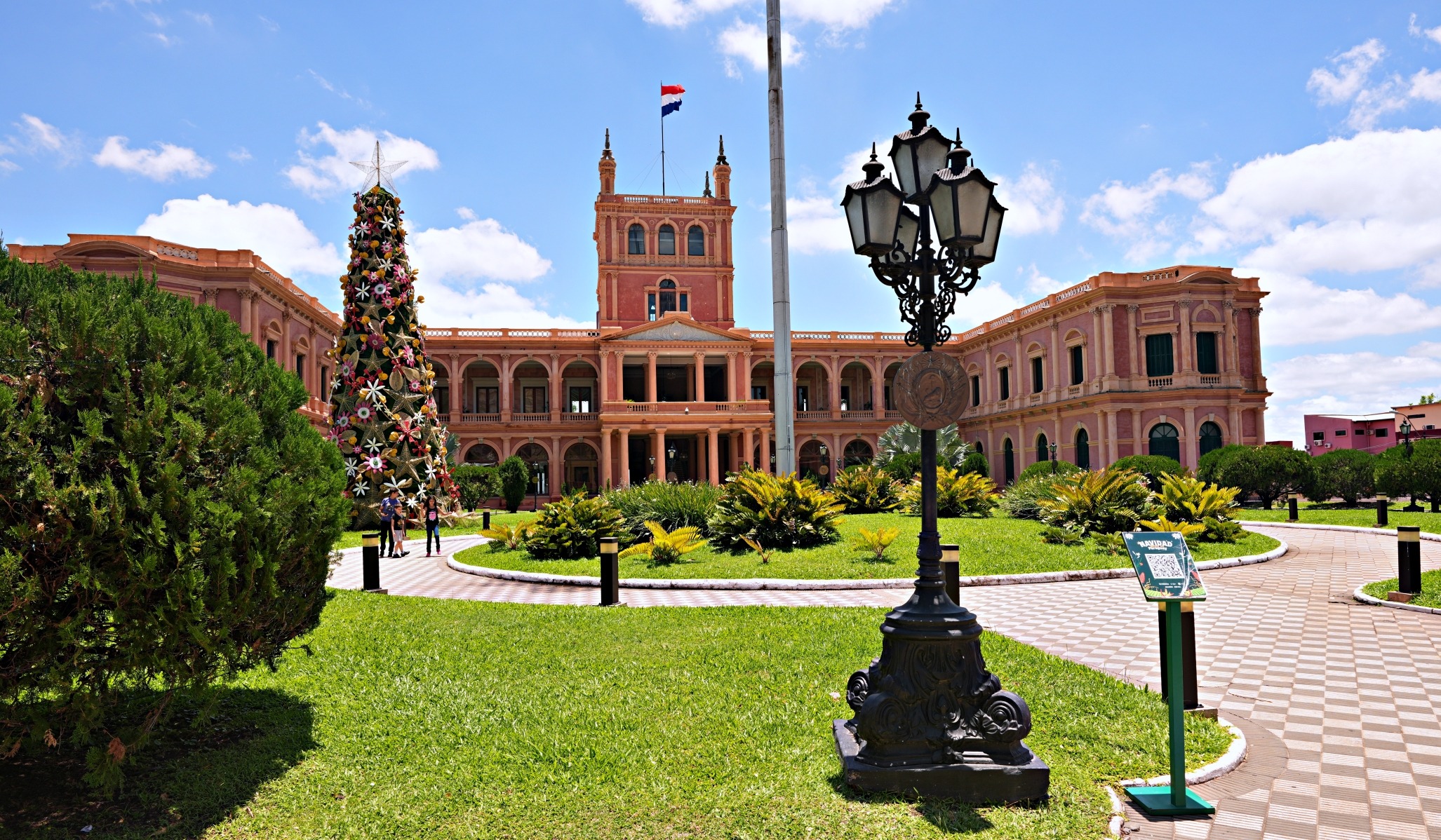
The regal pink with peach trim neoclassical building has a prominent location just above the Rio Paraguay. Lopez Palace (Palacio de López), also called Government Palace, was built in the mid 1800s. It is the office of the president of Paraguay and the seat of the federal government. The palace was named for Paraguay’s first president, Carlos Antonio López, father of the second López president, mentioned above.


We visited a couple of weeks before Christmas, and the palace’s decorations were already set up. The manger scene was cute because the three Wisemen brought watermelon, which is not something we would ever see at a Canadian nativity scene. For further proof that we were in Paraguay, the Christmas tree on the palace lawn had brightly coloured, tropical flowers.


Plaza de los Desaparecidos
Immediately beside the palace is the small Plaza de los Desaparecidos (Plaza of the Missing Ones). It was built in 2018 to commemorate the many lives lost during the Stroessner dictatorship. The statue does well to depict people being crushed by oppression.
It is a very small park, and if you’re not looking for it, you may walk right by without noticing.

National Pantheon of Heroes
The most impressive building in the city is the National Pantheon of Heroes (Panteón Nacional de los Héroes). Construction of the building was supposed to begin in the late 1800s, but the War of the Triple Alliance prevented it from being built. It wasn’t until 70 years later that the Pantheon’s construction was complete.

Today, it is a state mausoleum for former presidents and war heroes, so it is protected by two guards, dressed in formal uniforms. We heard that a changing of the guard ceremony takes place several times a day, but didn’t know the times. We decided to have a long lunch at a café across the street and wait for the ceremony. Instead of seeing the pageantry, though, we watched the same two guards suffer in the extreme heat.
Eventually, we learned that there is a big fanfare ceremony at 10 am every day, but we missed that as well. If you see it, let us know how it was.

Inside, the first floor is home to the ornate Oratory of the Virgin of the Assumption (Oratorio de la Virgen de la Asunción), patron saint of the city. Below the chapel is the crypt with the bodies of presidents, war heroes, and children killed in the wars.


It’s free of charge to enter, but there isn’t a lot to see and not much information other than the names of those buried in the crypt.
La Costanera de Asuncion
Behind the palace, the long riverfront walkway, La Costanera, allows visitors and locals to take a leisurely stroll on the side of the Bay of Asuncion, a cove on the Paraguay River. Designed as an accessible outdoor space for all, the long pathway features bike lanes, pedestrian paths, sports complexes and an amusement park. The river walk passes Playa de La Costanera. The city beach is more of a boat launch than a beach, though.
We visited this area midday when it was very hot, so it was quiet. As is common throughout the country, most locals were partaking in a siesta in their home. We were among the very few who were outside, walking in the hot sun.


Once the most important shipping port in the country, today the Port of Asuncion is no longer in operation, having moved to the neighbouring city of Villeta. It used to be located just downriver from the beach, but most of what remains today is the Paraguay Armada docks (Navy).
Barrio Loma San Jeronimo
Just a few blocks from the palace is Barrio Loma San Jeronimo, one of the oldest neighbourhoods in Asuncion. To reach it, climb up the colourful stairs on Pasaje Escalinata to find Guarani homes painted in bright hues. At the top, follow the narrow lanes (pasajes) that wind their way between the old houses with a few examples of street art. The district is not large, but it is worth exploring and is very safe.


Plaza de Armas
As the first public square established in Asuncion, Plaza de Armas is in quite a sad state nowadays. Flooding in the city in 2019 resulted in hundreds of families camping out in the park for weeks, causing extensive damage. After the cleanup was complete, the city erected a fence around the park to prevent this from happening again. We were able to get through an opening in the fence, but what we saw was not the Plaza de Armas we had hoped to find. These squares are usually the heart of most South American cities, but in Asuncion, it is almost empty.
There are still a few lovely colonial buildings on its edge. The former Cabildo (City Hall) is the nicest, but you can also find the Post Office and the Theatre.

In the centre is a strange-looking obelisk. It was created in 2008 to celebrate the 471st anniversary of the founding of Asuncion. It is meant to represent the Spanish tradition of raising a log in their newly established colonial cities, which explains its odd design.

A plaque states that the old Government House stood on this square. It was the sight where de Velazco, the last Spanish governor, surrendered, giving Paraguay its freedom. It was also where the Paraguayan president ruled until 1840, when Lopez Palace was built. The building was demolished in the 20th century.
Metropolitan Cathedral of Asuncion
At the far end of Plaza de Armas is the Metropolitan Cathedral of Asuncion (Catedral Metropolitana de Asunción). There’s now a parking lot between the church and the square, so your approach to the building makes it feel less grand. The cathedral was first built in the late 1600s, but this current neo-classical church dates to the 19th century.
A plaque dedicated to the Spanish conquistador leader and tyrant, Irala, is on the church’s front wall. He was known for his abusive treatment of the Guarani, so it seems strange that it has such a prominent placement. Even more odd is that it shows Irala in a loving scene with a Guarani leader.


The church was closed when we visited, and apparently is only open for mass.
Right beside the church is a slum neighbourhood called La Chacarita. When Richard walked toward the ghetto, Police yelled at him, saying it was very dangerous and he should not get too close, especially carrying his camera. So, we recommend that you also avoid La Chacarita.

Casa de la Independencia Museum
The museum is located in the old house where conspirators met and planned the revolutionary coup that led to Paraguay’s Independence on May 14, 1811. The interior of Casa de la Independencia Museum is arranged to resemble a period home, complete with dining rooms, bedrooms, and lounges. While the building holds great historical importance for the country, the museum doesn’t have much inside. We enjoyed seeing the old building more than the furnishings.
Entry is free. Opening Hours – Monday to Friday 7:30 to 4:30; Saturday from 7:30 to 9 pm, and it is closed on Sundays.


Colonial Buildings
There aren’t many other specific sites in Asuncion’s downtown. We spotted a few colonial buildings that alluded to the city’s former prominence, but they are squeezed between characterless 20th century buildings. Many of both the old and new are not in good condition, leaving the area feeling a little forgotten. Here are a few nice ones that we found on our wanderings.


Shopping
Known as an international shopping destination in South America, we thought Asuncion would be a modern, affluent city. However, in reality, there is a large divide between the rich and the poor. Some districts are remarkably modern, while others are visibly poor, unmaintained and unattractive.
With prices in Paraguay much lower than in neighbouring Brazil and Argentina, a large number of tourists come to Paraguay to shop. The most popular destination is Ciudad del Este, near Iguazu Falls, but Asuncion is growing as a shopping destination.
How to get to Ascuncion
Assuncion’s Silvio Pettirossi International Airport receives flights from many destinations in South America. A few flights arrive from the US, but most transfer through another country first. If you’re in Argentina or Brazil, an easy way is to take an international bus between border cities. The main crossings are between Ciudad del Este (Paraguay) and both Foz do Iguaçu (Brazil) and Puerto Iguazú Argentina); Encarnacion (Paraguay) and Posadas (Argentina); and finally Asuncion (Paraguay) and Clorinda (Argentina). El Pulque bus company specializes in cross-border travel. You can find them online.
Where to stay in Asuncion
In most South American cities, the best neighbourhood for visitors to stay is the historic centre, but that’s not the case in Asuncion. While it is closer to the downtown sites, the centre really has no personality, and there is not a lot of tourist infrastructure. Better neighbourhoods to stay in are Villa Morra and Recoleta.
If you want to shop, you may want to consider staying in Las Lomas near the Shopping del Sol Mall. This mall, and others in the area, carry international brands and there are several international chain hotels nearby.
We stayed in the community of Recoleta and enjoyed our time. We had a nice, modern apartment, and were steps away from our choice of restaurants. One evening, we caught an outdoor Christmas show at the local mall. A choir was singing Christmas carols while families watched, wearing shorts and t-shirts. We have been in hot climates for several Christmases, but it still always seems strange to us.

Where to eat in Asuncion
As with hotels and apartments, the neighbourhoods of Recoleta and Villa Morra have a large selection of restaurants offering local and international dishes.
Travel Tips For Paraguay

- When to visit Paraguay – The mildest climate is between May and September, making it the most comfortable time to visit. During the South American summer, between December and February, Paraguay experiences very hot temperatures with extremely high humidity. Rainy season varies in each region, but it is generally from October to March, when there can be torrential downpours. We witnessed a few in December.
- ATMs – Bank fees in Paraguay are cheaper than in Argentina, but higher than in many other South American countries. We found that Western Union has the lowest fees. Credit cards are accepted in the larger centres, but cash is often preferred. Charges for credit cards are reasonable.
- Safety – Other than a few neighbourhoods that you would not likely plan to visit, Asuncion and Paraguay in general, are very safe. We entered the country on high alert, hearing stories of pickpockets, but we soon let our guard down and never felt unsafe.
- Transportation – Paraguay is slightly larger than Germany and smaller than Spain, so be prepared for long-distance travel. Unfortunately, internal flights are not common, so most travel will be by bus, taxi or private car.
- For short-duration trips, the buses are old and do not have air-conditioning, but they are very cheap. Timetables and routes for the shorter distances can not be found online; you’ll need to check at the bus station.
- For longer trips, most buses are air-conditioned, which in this hot, humid country is really needed. You can find long-distance routes on BusBud, or Platforma10. The best companies we found were Gauriana and La Velas del Norte, but don’t expect Wi-Fi or plug-ins; these are very basic buses. Whether it is a short distance or long, buses will take much longer than their advertised times, and much longer than Google Maps suggest the trip will take. They do not break for bathrooms or food, so be prepared. A few buses have bathrooms on board, but not all.
- Asuncion has an international airport, but there are very few domestic flights in Paraguay.
- If you are considering driving yourself, you should know that outside of the major centres, the highways are not in very good condition, with multiple potholes, small or non-existent shoulders, and erratic drivers. In Asuncion, traffic is horrendous. Its busy, roads are disorganized, and drivers don’t abide by most traffic laws.
- Border Crossings – When you cross the border to enter Paraguay, you will likely need to show proof of accommodation for the first few days. Our accommodation was booked for 3 nights, and that was enough for the border guards.
- SIM cards – Tibo or Claro sell prepaid SIM cards at their official offices. We purchased one from Claro and got 10 GB for 14 days for 40,000PYG ($6USD). Coverage is very good in the cities and towns, but not always great in the countryside.
- Getting around in the cities – Uber or Bolt are only available in the larger centres such as Asuncion, Villarica and Encarnacion. Otherwise, local taxis are widely available.
- Language –The official languages are Spanish and Guarani. The latter is the primary language spoken throughout Paraguay, but most also speak Spanish. You will not find a lot of English spoken or written on menus.
- Walking – Be aware walkers; pedestrians have no rights. Sometimes it felt as though cars were speeding up when they saw us walking across the road. As well, sidewalks in most towns and cities make it very difficult to walk. The cities do not build public sidewalks in most places. It is left up to the businesses and homeowners, each of whom creates a sidewalk that suits their needs rather than being consistent with their neighbours. Some don’t even bother to make a sidewalk. So, when walking, be prepared to climb up and down a lot of steps, when travelling between homes, and back and forth to the street when the space for a sidewalk has been left as wild bush.
- Food – Food is similar to Argentinian with a lot of barbecued meats, but restaurant meals are significantly cheaper in Paraguay than in Argentina, and of excellent quality. Here are a few typical Paraguayan foods:
- Lomito – A sandwich or wrap with thinly sliced beef similar to shwarma, although with different herbs and spices.
- Tereré – is an iced version of mate, where water is infused with the crushed leaves of the yerba mate plant. Some add special herbs to their drink. They drink it in a guampa (cup) and through a bombilla (straw). It is so popular that most people walk around carrying a cooler of ice water and frequently pour it over the sieve.
- Chipa – This bagel-shaped bread, or small bun is made from manioc flour and sometimes corn flour. They are found on almost every street corner in Paraguay. We found them to be quite tasteless.

This article is also featured on GPSmyCity. To download this article for offline reading or create a self-guided walking tour to visit the attractions highlighted in this article, go to Walking Tours and Articles in Asuncion.
To read more of our adventures in Paraguay, click here.
Coming Next – Best Day Trips From Asuncion – Aregua, San Bernardino and Itaugua
For pictures from other blogs go to Gallery at monkeystale.ca.
To read about more of our adventures go to Destinations.
If you like what you read, please comment or share (with credit) using the links below.




We’d love to hear from you, please leave a comment.