
The indigenous Guarani people have lived on the shores of the vast Ypacarai Lake for generations. Its name translates to Sacred Water, and as the central figure in Guarani folklore and songs, the lake holds a special place in the hearts of Paraguayans. While Ypacarai Lake remains a treasured site today, it has transformed from a spiritual and cultural heritage site to a recreation destination. Along its edge lie three towns, each with a different appeal. Visiting Aregua, San Bernardino and Itaugua on a day trip from Asuncion offers a glimpse of what life is like outside of the bustling capital city.
You can read about what to do in Asuncion, in our post Explore Paraguay’s Capital: Asuncion.
Let’s explore the three destinations of Aregua, San Bernardino and Itaugua.
Aregua
Nearest to Asuncion, only 20 km (12 mi) away, is the serene settlement of Aregua. While it isn’t packed with sites, it is a nice, quiet town with tree-lined streets and pretty homes that make Aregua a special village to visit.
Church of Our Lady of Candelaria
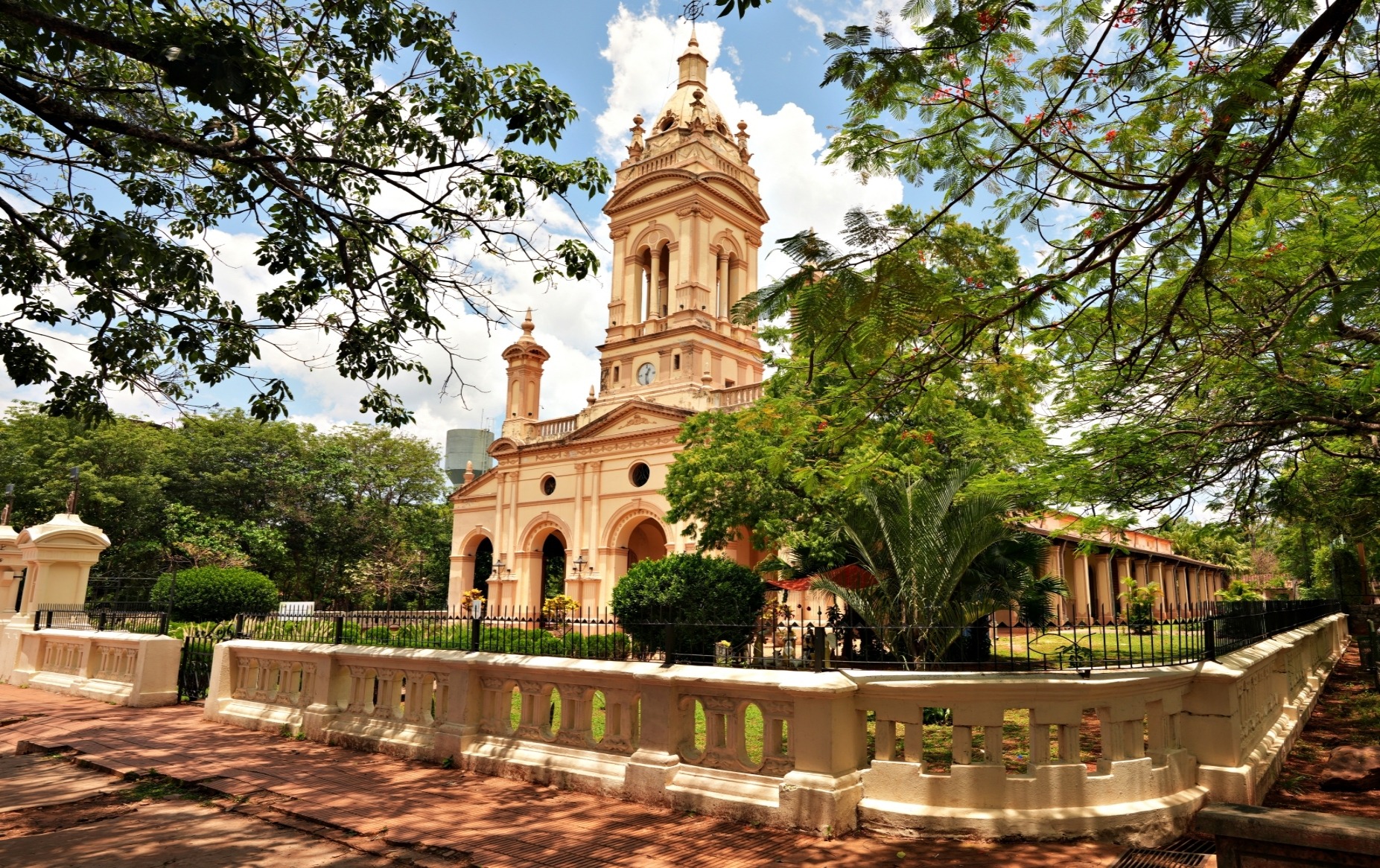
The main reason to visit Aregua is to visit the historic 19th century Church of Our Lady of Candelaria (Iglesia Virgen de la Candelaria), or more simply, Aregua Church. Set in a tranquil, park-like setting with manicured bushes, flower beds and a large grassy yard, the church is very striking.

The Church of Our Lady of Candelaria was built on the foundation of a Mercedarian friars’ chapel. They were a Spanish brotherhood who arrived with the Spanish conquistadors to both preach Christianity to the local indigenous population and establish farms to supply food to the new Spanish rulers.
Having lived through several restorations, the church’s outer appearance is a combination of a mission church and one from the 20th century. The overhanging roof and colonnades are reminiscent of mission churches, while its tall bell tower and façade are similar to features found in many 20th century South American churches. The styles, though, blend well together, and combined with its garden setting, make it a very pretty church.
Colonnades are common in Paraguayan colonial buildings. These covered balconies provide shade while protecting the building from the effects of the strong sun and torrential downpours.

Since the church was built atop a small hill, the other benefit of this veranda is the lovely view of Ypacarai Lake. A painted staircase leads from the water up to the church.


The quiet streets around the church are lined with well-kept colonial homes. The low-roofed buildings with covered front porches are typical Paraguayan-Spanish colonial style. Unlike some towns, the ones in Aregua are very well maintained and add to the town’s appeal.


As we rode in our taxi between Asuncion and these lakeside towns, Paraguayan music blared from the car’s speakers. It reminded us a little of Mexican folk music with guitars, accordions and wooden flutes. The peppy beat kept our toes tapping on the hot drive.
San Bernardino
Founded by German and Swiss immigrants in the 19th century, San Bernardino is unlike most other Paraguayan towns. A decade after the War of the Triple Alliance ended, five German families moved to this spot on the edge of Ypacarai Lake. Over the years, the number of Germans and Swiss moving in continued to grow, until the town had a distinctively European feel.
Estate Homes and Mansions
Today, San Bernardino is popular as a weekend retreat for upper-class Paraguayans, as well as home to expats from Canada, the US, and Germany. The lake shore and its adjoining street are home to elegant estate homes, boasting manicured gardens that hide behind security fences.
As we walked on the streets between these homes, we noticed how quiet the area is. It lacks the hustle of most Paraguayan cities. This, combined with the clean, tree-lined streets and peaceful surroundings, makes it a very pleasant town to go for a stroll.
Note: Most of the large mansions are tucked away, hidden behind security fences, so we can’t show you too many of those, but we can show you some of the smaller ones we saw in the town.


Not surprisingly, soon after the Germans arrived, the first brewery was built in Paraguay. It laid the groundwork for the first Paraguayan-run brewery, Cervecería Paraguaya S.A, which was established in 1910.
After seeking out the mansions, don’t forget to visit a few other sites.
Miradors Bella Vista
There are two miradors atop a small hill beside the lake, Mirador Bella Vista 1 and 2.
After climbing a colourful staircase, you will reach the top of a small hill and the first mirador. Mirador Bella Vista 1 has a statue of the Virgin Mary, but the views are obscured by the surrounding dense forest.


Not far away, the other viewpoint, Mirador Bella Vista 2, offers nice views of both the town and the lake. When we were there, a nice breeze cooled us down after the hike up.


As we walked through the trees in this charming town, we saw many birds. At the base of the miradors, we saw a few very pretty red-crested Cardinals. We continued to see them in Paraguay as well as parts of Argentina and Uruguay.

Rotonda Beach
As you would expect in a lakeside community, one of the biggest pastimes is to go to the beach. Playa Rotonda (Rotonda Beach) is the main ‘city’ beach. There is a small port next to it where you can rent a peddle boat, kayak or SUP. Ypacarai Lake is polluted, so despite the sweltering heat, we were not enticed to take a dip.

Promotional material says it has a more moderate climate than Asuncion, but we couldn’t tell the difference. Both were stiflingly hot and had excessive humidity in early December.
Our Lady of the Assumption Church
Built during colonial times, Our Lady of the Assumption Church (Iglesia Nuestra Señora de la Asunción) has retained a prominent spot in the town. The approach to the church is on a lovely, tree-lined street and is the site of religious processions.
Opening hours are listed as being from 7:30-11:00 am Monday to Friday, but it was closed in the morning when we visited.


Beside it is the cute German Lutheran chapel, Iglesia Filial de la CEAA – San Bernardino.

Hotel del Lago
In the city’s very small downtown, there are the vestiges of what was once a luxury hotel. During the town’s heyday, the hotel was frequented by many rich and famous international visitors to Paraguay, such as Charles de Gaulle, Franklin Rosevelt and Charles Aznavour.
Built in 1888, the hotel was built in the style of a French seaside resort and was once quite grand. Unfortunately, today, it needs quite a bit of work and is not open for business.

You can find a few German bakeries in the city’s downtown, a reminder of their German roots. Given that it is touted as ‘little Germany’, there weren’t as many as we had read.

Itagua
Located a kilometre or two away from the lake is the bustling city of Itagua. As we entered the town, we noticed that the streets were hectic with traffic and the sidewalks were overflowing with clothing and furniture stores. It seemed as if everything they had for sale was out on the sidewalk, leaving no room to walk. We wondered if it was worth visiting, especially compared to the tranquillity we enjoyed in the other two cities.
The picture below is of a side street, but on the main streets, every shop is like this one.

Our Lady of the Rosary Church
A couple of blocks away, though, we found the city’s best monument, Our Lady of the Rosary Church (Parroquia Nuestra Señora del Rosario). The busy street surrounding it takes away some of its idyllic setting, but there’s no denying that it is a beautiful building.


It was built in 1886 and resembles the style of Jesuit mission churches with a long colonnade around the outside and a wooden ceiling in the nave. Renovation in the 1960s gave its front a more modern look.


Unfortunately, the hectic town is not as pleasant to visit as its church. The surrounding streets have examples of colonial houses, but they are more run-down than in Aregua.


Ñandutí Lace
Itagua is known for its delicate ñandutí lace that combines European techniques with Guarni colours and patterns. They are mostly used in traditional dress, so we didn’t see many on display. This lace Christmas decoration, pictured below, was all we could find.

If you are coming this way to see the other towns, it is worth a quick stop in Itagua, but don’t go out of your way to visit.
Other things to do in the area
If you have your own car, there are a few hikes in the surrounding jungle-covered hills. For us, the temperatures were too high, and the views didn’t look spectacular, but if you visit in the winter, they may be nice walks to consider. Cerro Patiño is one hill, and Cerro Koî is the other that are said to have good hikes.
If you’re in the market for pottery, San Bernardino’s artisans are famous for their pottery. You can find their stalls on the edge of town and on the side of rural highways around Ypacarai Lake.
On a different trip, you may be interested in seeing the heritage Franciscan Mission Church in Yagauron. Click on the link to read our post fom Yagauron.
Getting to these sites
You can find all three cities near Asuncion on the map below. It is an interactive map, so you can zoom-in or click on the markers for links to our posts from that region.
Although it is possible to visit all three of these towns by public transportation, it is also very economical to hire a driver for the day. We hired a taxi driver in Asuncion for 400,000 PYG ($60 USD).
Short-distance buses running between cities are not air-conditioned and reminded us a little of Chicken Buses in Guatemala.

Click on the link to go directly to our Travel Tips for Paraguay.

To read more of our adventures in Paraguay, click here.
Coming Next – Franciscan Mission Church in Yaguaron, Paraguay
For pictures from other blogs go to Gallery at monkeystale.ca.
To read about more of our adventures go to Destinations.
If you like what you read, please comment or share (with credit) using the links below.




We'd love to hear from you, please leave a comment.