
As the plane crossed the Pacific, our excitement was building. And then, we couldn’t believe our luck. Outside our airplane window, we were treated to an amazing view of Rapa Nui, and we knew our dream of visiting this famous island was about to come true.
Note – Rapa Nui is often called Easter Island, and in Spanish, Isla de Pascua. We will mostly use Rapa Nui because that is what locals prefer.

The island of Rapa Nui (Easter Island) is one of the world’s most isolated and mysterious spots. Stories of its enigmatic statues have put it on many people’s travel wish lists.
Planning trip to this island can be overwhelming because you don’t want to miss a thing on this once-in-a-lifetime experience. We’ll try to help you plan your itinerary by showing you its many sites, but there’s so much to see that we are presenting it in three posts. In this, we’ll show you some of the things you can see for free in the island’s only town, Hanga Roa. Next, we’ll take you to the famous Ahu Tongariki and Rano Raraku Quarry. In the final post, we’ll explore Orango and Anakena Beach.

Rapa Nui’s Beginnings
Although the exact dates vary based on your source, Rapa Nui was first settled over a thousand years ago. The first king, Hotu Matu’a, was likely from the Marquesas Islands of Polynesia, 3,200 km (2,000 mi) away. Legends say that the king’s holy priest foresaw impending natural disasters that would destroy their home. This priest then dreamt of an island with freshwater, fertile soil, trees and other vegetation. His dream pointed to Rapa Nui, so the king sent an exploratory crew of seven to find a new home for his people. They navigated across the vast ocean using only the Southern Cross and the Orion Belt as guides.
When the crew returned to tell the king that they had found the treasured land, he immediately set off with his pregnant wife and 100 settlers. They packed their canoes with chickens, pigs, vegetables and Polynesian rats, and set off for Rapa Nui. Others followed, and soon many settlements were scattered around the island.
Located in the middle of the Pacific Ocean, 3,700 km (2,300mi) west of Chile, Europeans didn’t even know about the island for centuries. In fact, it was not on any maps when Dutch explorer Jacob Roggeveen stumbled on the island in 1722. It happened to be Easter, which led to the island being called Easter Island for hundreds of years. He reported seeing tall statues across the island, but by the time Captain Cook’s ship arrived in the late 1700s, many had been toppled. We’ll explain the reasons for this when we show you some of these wonderful statues.
Explorers and missionaries continued to arrive, exposing Rapa Nui’s population to beliefs, foods, clothing and tools used around the world. For better or worse, this once unknown island became a curiosity worldwide, so that today tourism is its primary industry.
While its famous statues are what bring visitors to the island, there are a few wonderful things to see in its main town, Hanga Roa, too. So, before we see its iconic moai statues, let’s first explore the sites in town.
Hanga Roa
The island’s only town, Hanga Roa, is likely where you will be based when you visit the famous island. Hanga Roa’s downtown is rustically cute. Its streets are fringed by tropical trees providing shade to the grass roofed buildings. The town is definitely ready for tourists with restaurants and tour agencies housed in the colourful shops, but it hasn’t lost its island feel. Even its Catholic Church has an island character.


Hanga Roa Harbour
Begin your exploration at Hanga Roa Harbour, also called Roa Otai. Colourful fishing boats are moored in the choppy water while dive shops line the edge. In front of the harbour is the small Plaza Hotu Matua with a statue of St. Peter (San Pedro), patron saint of fishermen.
Hanga means small bay or cove in the Rapa Nui Language.


Ahu Tautira
In front of the harbour is the first moai we saw, and maybe it will be your first too. Ahu Tautira is home to one restored moai and another that is very worn and damaged.
You will see the words ahu and moai a lot. Ahu translates to platform, and moai is the word for the famous statues on Rapa Nui. These statues were a key component of their beliefs. The people of Rapa Nui worshipped their ancestral tribal kings, therefore it is referred to as an Ancestor Cult. Central to their beliefs was the idea that tribal leaders possess a spiritual energy, called mana, which they retain after death. The people believed that this energy protected the tribe and its residents.
To honour their ancestors, villagers built shrines, consisting of monolithic statues (moai), representing the deceased king. Each tribe or village built one platform (ahu) and added a new moai after the death of each king. The moai always face the village, so they could oversee it and offer protection.
Seeing this first one right in town will build your excitement to visit the rest that are scattered around the island.


Hanga Vare Vare
Beside the harbour is Hanga Vare Vare Park. The picnic tables placed under palm trees seem to be a popular spot for local families. In front is a sheltered cove that creates a perfect natural swimming pool.


The park is also home to several public art installations, including the Seven Archangels, which represent peace, love and unity.
In keeping with this theme, the park also features the Moai of Peace. Created in the 1990s, the replica moai’s back is decorated with images from the Rapa Nui culture, including the Birdman Cult. You can read more about this cult in our post from Orongo. (Coming Soon)
Another moai stands on the edge of the park, but we don’t know anything about this one.


Ahu Tahai Complex
Not far from Vare Vare Park is a collection of platforms at Ahu Tahai Complex. Although we had seen both authentic and replica examples already, Ahu Vai Ure and its five partially restored moai gave us an idea of what we’d see on the rest of the island. Standing with their backs to the rough water, these five moai date to the 13th century.


Beside it is a single moai on the platform Ahu Ko Te Riku. With a red hat (pukao) and coral eyes, it is considered one of the most complete restorations on the island. We’ll explain more about the hats and eyes when we show you Anakena Beach and the Pukao Quarry.

The final moai is on Ahu Tahai. Dating to 700 AD, it is the oldest in the complex and one of the oldest on the island. Although a few are around the same age, most moai were built between the 1000s and 1600s.
Ahu Tahai Complex is a popular place for sunset views, but it was very cloudy when we were there, and we were never lucky enough to have a nice sunset.


Not far away are ruins of a village that these moai were built to protect.

Entry – Ahu Tahai Complex is free to enter, and it would be best to visit on your first day, before seeing the island’s main sites.
Pea Beach
Walking the other way from Hanga Roa Harbour, it won’t take long to reach Pea Beach and the natural Pea pool. Being so close to town makes it a popular swimming area.
It’s also not far from the park’s office, so most independent travellers will find themselves in this area. Not only will you pay your park fees at the office, but they will also put a special Rapa Nui stamp in your passport if you ask.

Coastal Views
A sidewalk follows the rugged coast beyond Pea Beach. Along its edge are several newer stone and wooden carvings representing Rapa Nui’s culture.


Hanga Piko Harbour
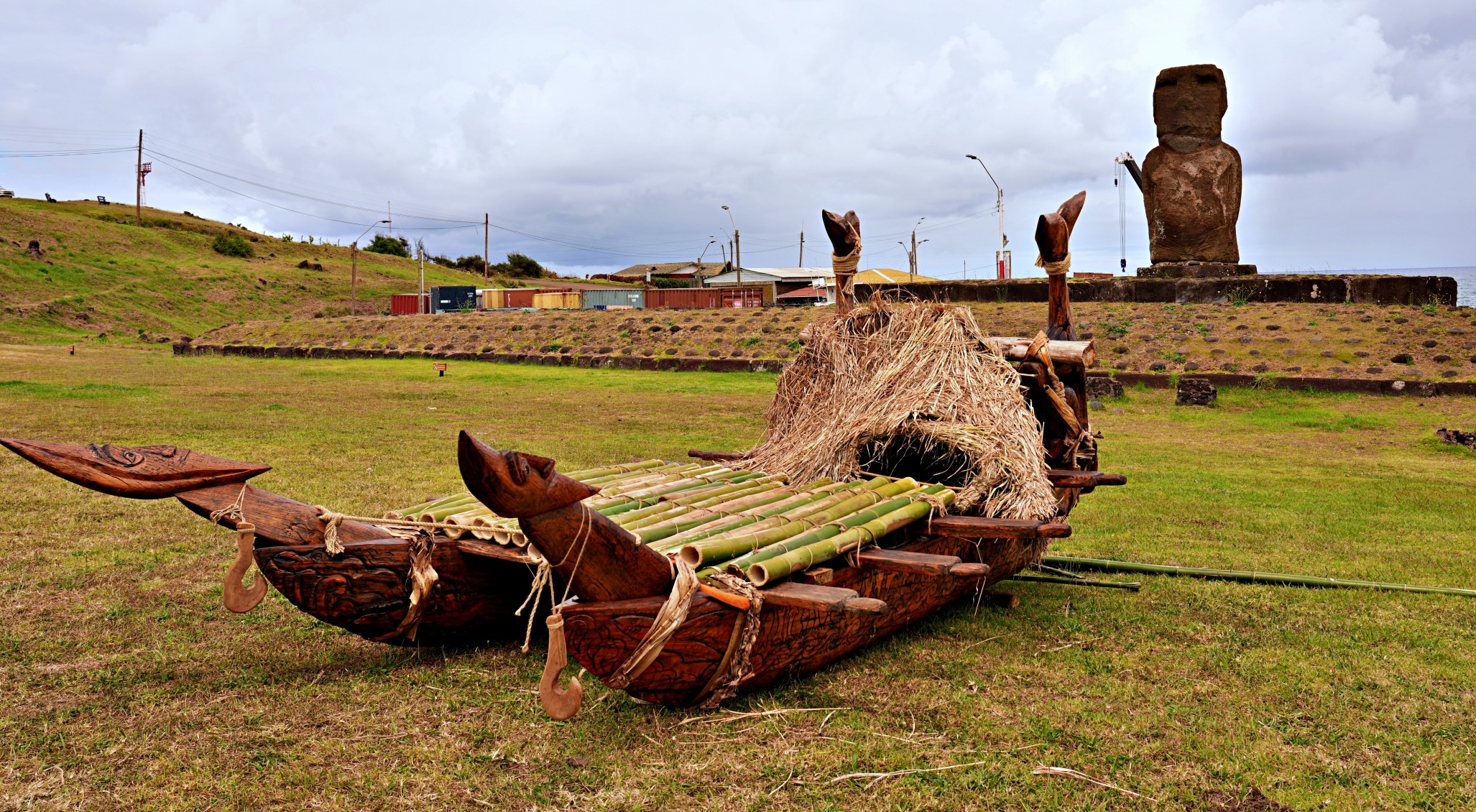
The walk takes you to the smaller Hango Piko Harbour. It has a much more local feel with colourful fishing boats in the water and outrigger canoes on shore. You’ll also find another platform, Ahu Riata. In front of it is an example of a traditional boat, once used by the islanders.


After visiting the free sites in Hanga Roa, it’s time to see the main sites on this mysterious island.
Tips For Visiting Rapa Nui
• You require a guide to enter all parks which is where the majority is sites are located. You can hire a guide ahead of time online, but it is very easy to find one when you arrive. There are many tour companies in town and they all seem to offer similar tours at similar prices. They also offered private guides. If you have your own car, you still need to hire a guide to enter the park.
• Park passes can be purchased online, but there is an extra fee. You can also buy them at the parks office in downtown. Currently the fees are 96,000 Chilean pesos ($100USD). You can only pay by credit card, cash is not accepted.
• There is not much mobile coverage on Rapa Nui. We had Claro and it didn’t work, but apparently Entel does. Unfortunately, Entel does not offer tourist pre-pay packages.
• There are ATMs, but many report that they don’t always have enough money. Some of the shops and restaurants only accept cash (pesos), so bring enough with you.
• When you fly, try to sit on the right side of the plane for an amazing view of Rapa Nui.
How to get to Rapa Nui
Only one airline, Latam, flies to Rapa Nui. During off and shoulder seasons, there is usually only one flight a day going between Santiago and the island. In high season, there may be two flights. As you can imagine, flights are expensive. We found a cheaper way to buy tickets by using Latam’s Chilean website. If you use the Chilean web version, prices are less than half the price. We think it can only be accessed when you are in Chile, and if the language is kept in Spanish. We purchased ours within a week of flying to the island on the Latam Chilean website, and paid much less than if we booked it from their US website.
Another way people visit is while on a cruise that stops in Rapa Nui.
Best time to visit Rapa Nui
Between December and March, you have the best chance for good weather, with less rain, but it can be very hot and humid. January and February are the busiest months, and therefore prices skyrocket. The two-week festival in February, called Tapati Rapa Nui, is a very popular time to visit, so a trip at this time must be booked months in advance. The main factor to consider when planning a trip is rain. The island averages 1,050 mm (42 in) of rain a year. Most falls in April and May, but it does rain every month. When we visited in November, it poured every night.
How many days do you need in Rapa Nui
Even though there are several ahus (platforms) around the island, not many have been restored. You can usually see all the major sites in 2 full days. Keep in mind, however, that the island receives a lot of rain, so you may want to factor in an extra weather day. We stayed for 3 nights, giving us 2 full days and 2 half days, which we found was plenty. We met a couple who had 7 days and found that it was too much time, and they were struggling to fill their days.
Where to stay on Rapa Nui
Most of the population lives in Hanga Roa, the main town. Its downtown has several tourist restaurants, but hotels are scattered throughout the town. Since it is small, location doesn’t matter as much. The main thing to take into account is noise. There are many barking street dogs and roosters in all parts of town, so if noise is a concern, read your hotel reviews first. Remember too that hotels are generally expensive for what they offer.
Interested in reading more about Rapa Nui? Click on the links to read our posts from Ahu Tongariki and Rano Raraku Quarry, as well as Orango and Anakena Beach.

Click on the link to read our Travel Tips For Chile.
To read more of our adventures in Chile, click here.
Coming Next – A Guide to Rapa Nui’s Famous Sites: Ahu Tongariki and Rano Raraku Quarry
For pictures from other blogs go to Gallery at monkeystale.ca.
To read about more of our adventures go to Destinations.
If you like what you read, please comment or share (with credit) using the links below.



We'd love to hear from you, please leave a comment.