Imagine you are a merchant in ancient Egypt, travelling across the vast desert when suddenly, you see immense figures rise above the Nile. It must have been an intimidating sight, and that is what Ramses II had in mind when he built Abu Simbel. Today, the colossal statues carved into the cliff walls are no less impressive and are the reason Abu Simbel is a top attraction in Egypt.

On the drive from Aswan to Abu Simbel, the flat desert reminded us of the prairies back home in Canada. Instead of wheat fields, though, all we saw in Egypt was sand. The closer we got to Abu Simbel, the greener it became with farms growing alfalfa, corn and other crops. The reason for the vegetation is that these fields are irrigated with water from Lake Nasser; otherwise, nothing would grow.  

Abu Simbel

When Abu Simbel was built, this land was on the edge of Upper Egypt’s territory, near the border with Nubia (Sudan). Although the border has changed a few times over the years, the temple is once again very close to the Egypt-Sudan border. In the 13th century BCE, Ramses II built two temples on this land. Instead of being built solely as centres of worship, Abu Simbel was designed to intimidate Egypt’s enemies and foreign merchants. To achieve this, he had colossal statues of himself built into the cliff walls immediately above the Nile.

It no longer sits above the Nile; today, the water below the temple belongs to Lake Nasser. This artificial lake is the result of the Aswan High Dam. When the dam was being built, archaeologists realised that this new lake would flood Abu Simbel. To save this ancient monument, international specialists set out to do the impossible. Between 1963 and 1968, they moved the temples. First, they built artificial mounds with concrete domes above the temples, adding more than 60 m (200 ft) of height to the hills. Then, they systematically disassembled both temples before creating new caves and reconstructing them on higher ground. In total, they moved 16,000 blocks. If this hadn’t been done, these magnificent temples would have been submerged and lost forever. 

Great Temple

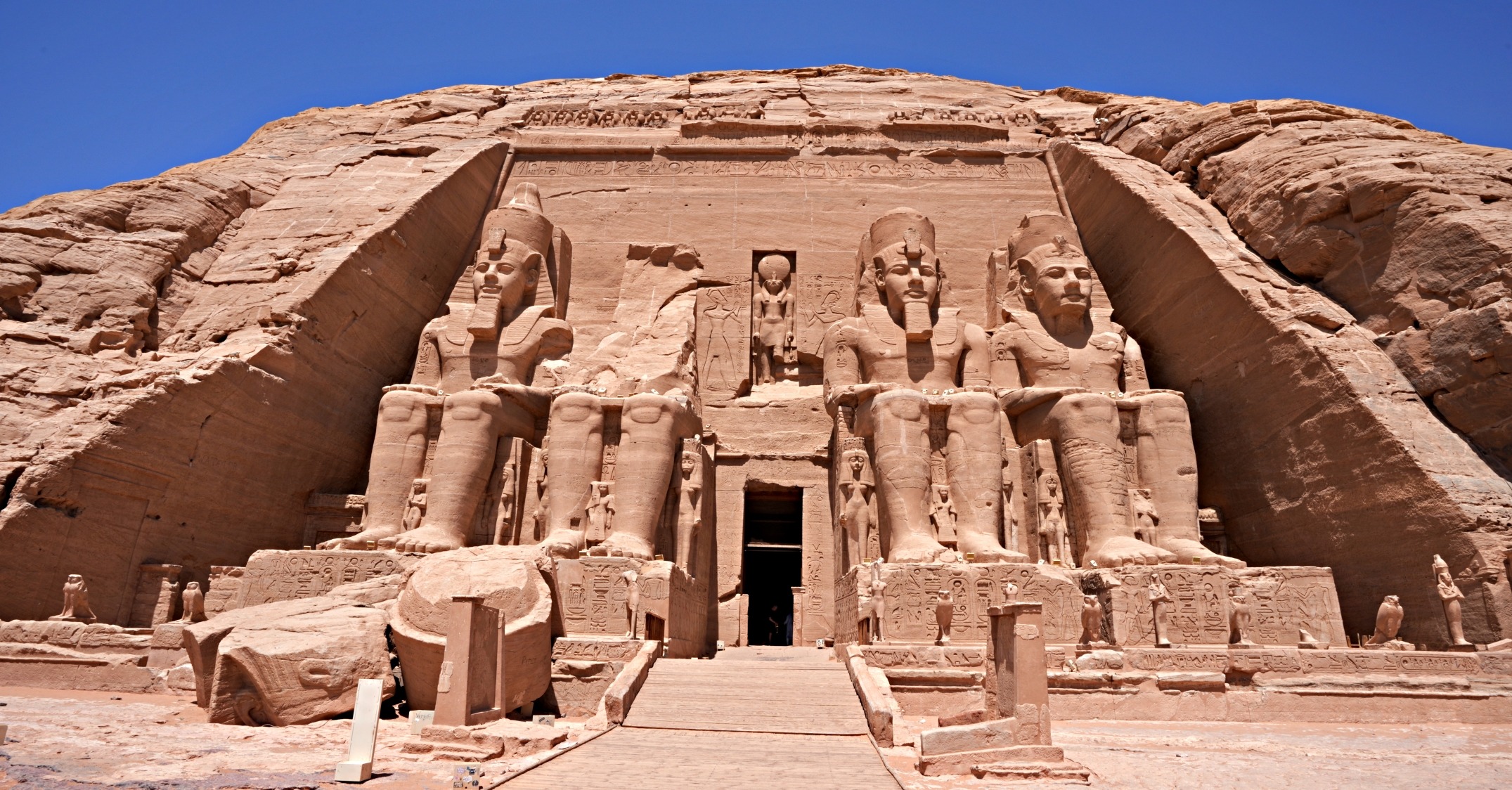
Even after being relocated, you will still be captivated by this temple complex. Carved into the mountain wall just above Lake Nasser, the Great Temple is one of the world’s most remarkable temples. Its grand entrance was meant to intimidate and impress, and 3000 years later, it still does just that. Four statues of Ramses II, each seated on thrones, flank the temple doorway. Towering at 20m (66 ft) tall, they are giants. Although one was damaged by an earthquake in antiquity, the other three remain remarkably intact.

Not only are these statues immense, but they also exibit finer details. At their feet are small statues of his wife, Nefertari, their children and his mother.

Above the door is a statue of Ra-Horakhty, the god of the rising sun. An often-missed detail is the frieze of baboons at the very top of the entrance. They represent the god Thoth as a baboon. He is the god of wisdom, and these baboons are posed to greet the morning sun.

Large Hall

Once you pass through the gate, you’ll enter this magnificent rock-cut cave. Welcoming you are eight Osiride Ramses II statues lining either side of the Large Hall. This type of statue presents the pharaoh as the god Osiris, displaying the pharaoh’s eternal divinity.

In the rest of the room, every available place on the squared pillars and walls has reliefs and hieroglyphics. Most are battle scenes where Ramses II is victorious over the Hittites in the Battle of Kadesh. You can see Ramses II on a chariot, on horseback with a bow and arrow and even grabbing a gang of his enemies by the hair. We saw a version of this scene used over a thousand years later in the Philae Temple near Aswan.

An odd one that stands out is the god of fertility, Min, with an erect phallus. It symbolized masculinity.

Small Hall

Continuing deeper into the cliff, the next room is the Small Hall. Instead of battle scenes, the square pillars and walls in this room display mostly religious motifs.

There are many side chapels with low ceilings. Their walls are equally decorated; most depict offerings to the gods. As we admired the artwork, we had to keep reminding ourselves that this temple was actually a rock-cut cave.

Inner Sanctuary

The Great Temple is dedicated to three Egyptian gods, Amun-Ra, Ra-Horakhty, and Ptah, as well as the pharaoh himself. At the far end of the temple, 56 m (185 ft) deep into the cliff wall, lies the Inner Sanctuary. Also called the Holy of Holies, it pays reverence to the three gods and the pharaoh with a statue of each.

During sunrise on February and October 22, the sun’s rays enter this room and illuminate all of the statues, except Ptah. The sunlight does not shine on him because he is the god of the underworld. When the temple was in its original location, this occurred on the equinox, the 21st. Moving it 200 m higher changed the date, but not the effect. Isn’t it remarkable they were able to carve this temple with such precision?


Small Temple

Beside Abu Simbel is the Small Temple. It may not be as tall, but it is almost as impressive. In fact, if the Great Temple wasn’t beside it, you would be left with your jaw agape at your first view of it. Ramses II built both temples at the same time and dedicated the Small Temple to his wife, Nefertari, and the Goddess Hathor. It is often called the Nefertari Temple. 

Similar to the larger temple, the front entrance is also graced with statues; four are of Ramses II, and two are of Nefertari depicted as Hathor. Although they are not as tall as those in front of the Great Temple, they are still attention-grabbing at 16 m (52 ft) tall.  An interesting detail is that Nefertari’s statues are the same height as Ramses II’s, which is unheard of in these times. It shows his great love and respect for his wife. Their children are shown as the small statues at their feet.

Small Temple is also a rock-cut temple and beyond this gate you’ll be inside the mountain. The first room is the Hall of Hathor Pillars. As the name suggests, the square pillars are topped with Hathor’s heads. We saw similar ones in Hatshepsut’s Mortuary Temple and Dendera Temple.

Below these capitals, the pillars are adorned with large images of Nefertari, Hathor, and Ramses II.

On the walls you can enjoy more images of Nefertari and Ramses II. One shows the deification of Ramses II by Horus and Set, and another, of Nefertari being crowned by Hathor and Isis. There are also several cows on the walls. Hathor is often represented as a cow, or with cow ears, because she nurtured and suckled many of Egypt’s pharaohs.

There is also a sanctuary at the back of the temple. A relief on its back wall depicts Hathor as a cow, but unfortunately it is in very poor condition.

This complex, along with Philae Temple, the Unfinished Obelisk, and the archaeological site on Elephantine Island, is a UNESCO World Heritage Site.

Entry – 800 EGP ($16 USD). On Feb and Oct 22, the entry fee is 1,200 EGP ($24.25 USD) and tickets must be reserved in advance; Opening Hours – 6 am – 5 pm. Time Needed – Plan to spend a couple of hours between these two temples.  

Lake Nasser

On the walk from the parking lot to the temples, you’ll have nice views of Lake Nasser. This artificial lake is quite picturesque in its mountain surroundings. Their shape makes some of the mountains look like pyramids, but they are natural, made from sandstone and volcanic plugs.

We found that this poster helped us to put all of these dates, including many from outside Egypt into perspective.

Historical Chronology of Landmarks Around the World, from Abu Simbel Temple Museum

Getting to Abu Simbel

Drive – The 200 km drive from Aswan takes just under 3 ½ hours. If you’re not on a tour, it is easy to find a private driver, but be sure to ask important questions. Only certified agencies are allowed to transport tourists in Egypt.

Our drive to Abu Simbel was an interesting one. We hired a private driver in Aswan who said he was allowed to make the trip. But when we stopped for a coffee just outside of Aswan, he said he needed 600 EGP to give to the police. We were a little upset because he didn’t tell us earlier, but we agreed that it would be taken out of his final payment.

Then, 5 km later, he turned off the perfectly good highway and into a gravel pit, where he drove on a very poor gravel road, made only by the hundreds of other cars who do the same. After 500 m or so, we pulled back onto the highway. We figured out that he was avoiding the check stop. Another time he drove on the wrong side of a toll booth to prevent paying the fees! It was similar on our tourist shuttle between Luxor and Aswan, where we had to keep the curtains closed so police couldn’t see that he had passengers!

Many private drivers do this; if they get caught, they pay the police, and all is forgotten. It seems to be a game to them, to trick the police. We didn’t see things like this in the Lower Nile, but in the Upper, we experienced it with two drivers in three days.

After Abu Simbel, the highway continues to the Sudan border. As we neared the temple, we passed hundreds of semitrailers parked on the side of the highway. Most were waiting their turn to cross the border into Sudan. Most of the time, the trucks can get through the border in a day, but at times, their wait can extend for weeks. Hearing this, we’ll no longer complain about long line-ups at Customs at the airport.

Fly – There is also an airport receiving domestic flights from Cairo or Aswan.

Click on the link to read our Travel Tips For Egypt.

To read more of our adventures in Egypt, click here.

For pictures from other blogs go to Gallery at monkeystale.ca.

To read about more of our adventures go to Destinations.

If you like what you read, please comment or share (with credit) using the links below.

Fediverse reactions

80 responses to “The Stunning Rock-Cut Temples of Abu Simbel”

  1. The relocation of the temples is almost as much of an accomplishment as the original construction.

    1. It really is, and if we didn’t know, we wouldn’t be able to tell.

      1. The cuts are still visible though. They are clear in your nice photo of the detailed torso of Ramses. Strange that his chipped left arm still has hieroglyphs (beside the carvings of the XIXth century vandals) … would it be a piece found and approximately replaced there or in ancient times somebody spent some time to redo a cartouche ? And in your photo i can see now that Ramses either has 6 fingers at his right hand … or his thumb was so long that could be aligned with the other four fingers 🙂

        1. All of the stones, artwork and carvings are original. They obviously had to cut them to move them, but nothing was remade. Any damaged pieces were put exactly where they were found, including the broken Ramses. It is very well done considering the task.

          1. Yes, indeed they are all original. But the cuts left a discrete grid that you can see if you take a photo using a zoom, like you did. They had to use thin blades to do it. Smart Swedes planning and skillful Italian executing.

  2. Absolutely spectacular. The temples themselves are astonishing enough, but the fact that the entire complex was cut apart and reconstructed on higher ground makes the story even more remarkable. I also loved the detail about Nefertari being depicted at the same height as Ramses—quite a statement in ancient Egypt. And your adventures with the driver sound as though getting to Abu Simbel may have required nearly as much faith as building it.

    1. There are so many remarkable details to these temples. Nefertari’s equal height statue may be my favourite of them. Thanks

  3. Wow! I would be intimidated by these for sure. I can’t believe they moved them, that is doing the impossible for real. That is interesting about the drivers and their tricks!

    1. The temples creats quite the first impression don’t they? We’ve been with crazy drivers before, but Egypt takes it to another level 😊 Thanks Lyssy

  4. The temples and the moving of them are just wow. So amazing!! What a place to see!

  5. Who could fail to be impressed by this colossal vision? If you want to impress someone, go big. Beautiful photos Maggie. I still recall the stories of this place from my school days, as the Aswan High dam was being completed. Have a great Friday. Allan

    1. Thanks Allan, quite the show stopper aren’t they? Interesting that you learned about it in school.

      1. It has to be. This moving of Abu Simbel and Philae is, in many aspects, the starting point of the World Heritage Convention and the World Heritage List that followed. At Abu Simbel they did not carve anymore but they built a huge concrete dome over the moved temple to create the fake mountain on top …

  6. I had the pleasure of visiting Abu Simbel almost two years ago, and your descriptions and photos are absolutely stellar, Maggie. Usually there are loads of people and you managed to photograph without them, only to put a person or two in to demonstrate perspective. Even inside the tomb where it was so dimly lit, you created stunning photos. And your history and explanations, also great. I so loved Abu Simble, it was great to be back there again today, thank you very much.

    1. Thanks so much Jet. We visited this spring during the Iran War, so there were a lot fewer tourists. But we also arrived very early, the bus tours were arriving when we were leaving, so the timing was also good.

  7. Wow. I remember reading something about the moving of this site. It amazes me how different people of different times can accomplish what seems impossible.

    1. The ancient Egyptians really were clever. Thanks Jenn

  8. Wonderful post and so rich in detail!
    It brought back beautiful memories of my trip to Egypt.
    I will never forget the magic of the evening light show right in front of the illuminated temple… a truly enchanting atmosphere!
    Thank you for taking me back there

    1. Thank you do much Luisa, the lightshow sounds wonderful.

      1. It was truly unforgettable, 💙

    1. It really is, thanks June

  9. It is truly a stunning site. Yes, the fact that it’s carved out of a rock cliff and also the precision required in ensuring the light – amazing.

    1. What I realized on this trip was how clever the ancient Egyptians were. It would be quite the show to go when the sunrise hits the shrine. Thanks Lynette

  10. I continue to be amazed by Egypt’s historical landmarks. They’re all fascinating! 🙂

    1. I know, I was constantly amazed at these ancient sites. Tha ks Nancy

  11. The word ‘awesome’ is seriously overused but it surely applies to these temples! And come to that, to the act of moving them so carefully – an amazing achievement in its own right. I love that you included people in some shots as they give us the scale (especially the first one of the Osiride Ramses II statues with the man in local dress). But there don’t seem to be many people around – was it really that quiet?

    1. It was very quiet. We went this spring during the Iran War so there weren’t many tourists in the entire country. We also went very early, so the bus tours didn’t arrive until we were leaving. It was very safe when we went, not affected by the war at all.

  12. Your pictures are stunning. It’s especially great for me to read your posts of all the places we didn’t visit. We had to duck down on the floor in the back seat of the car one time while the driver took out and lit a cigarette. He said the guards won’t stop drivers that are smoking because they would never smoke with tourists in the car! It’s amazing this is still going on 10 years later.
    Stay safe,
    Steve

    1. Same stuff, it seems to be a game to them. 😊

  13. It’s just incredible how detailed and many the carvings are, Maggie. I can’t imagine how long it must have taken to achieve all this. Wonderful to follow you and Richard around there xx

    1. It really is an impressive place glad you are liking Egypt. 😊

  14. Amazing. Unaware this even existed.

    1. Egypt has so many unexpected treasures. Tha ks Pat

  15. Such an amazing place. We flew to Aswan though the drive looks interesting. (Suzanne)

    1. The crazy drivers made it more adventurous than we expected. 😊

  16. I can’t even begin to understand how this was all taken apart and relocated, but I’m so glad someone knew how to. It’s fantastic.

    1. I know, it is beyond my capabilities too. Those Egyptians were so clever!

      1. But it was an international effort that took years. The modern Egyptians had no clue how to do it back in 1957 and did not have the money ether. This is why the effort triggered the World Heritage system we have today.

        1. I should have said ancient Egyptians, as they were the clever ones.

  17. Magnificent! Abu Simbel is absolutely high on my list. What’s even more amazing is that when they moved the temple, they reconstructed it on higher grounds with such precision that if no one told us about the move we would’ve probably thought that it had been there from the beginning. If you find myself publishing a post about Egypt sometime in the near future, you know you’re to blame, Maggie. 🙂

    1. Haha, the country has so many fabulous, historical places that I know you would love it.
      If I didn’t know Abu Simbel was moved, I never would have guessed by the excellent job they did. It really is a a magnificent complex with such a great first impression.

  18. Truly stunning, particularly the photo of the temple with the lake in the foreground is amazing. You are the quintessential traveler, Maggie!

    1. Thanks Tricia, these temples are truly magnificent.

  19. It’s hard to believe that the entire site was relocated is remarkable as the statues are stunning. It’s odd to learn about how the drivers skip the police tolls by taking passengers on unmade roads. I don’t think I’d be too happy about that but at least all went well for you both.

    1. You really have to go with the flow in Egypt. It was more comical than annoying. Tha ks Marion

  20. That great temple is just spectacular. I can only imagine the impact it must have had on visitors so long ago – it’s still incredible today. I didn’t even know it had been moved, they’ve done an amazing job restoring it!!

    1. They really did do an amazing job, it is fascinating to visit today, never mind thousands of years ago.

  21. The temples are stunning and a major place to visit. Thanks for sharing. Your photos are stunning too.

    1. Thank you, it is a very special place to visit.

  22. What an enterprise: moving this entire site to a new location. The temples are magnificent, the carvings so gorgeous. I love the photo of the man in local dress among the Osiride Ramses II statues. It seems very quiet. Do you think tourism has been affected by the war in Iran?

    1. Yes, tourism was down 60-80% since the war. For us it worked out great because the sites were empty, but it is hard on the locals. Until the recent Red Sea manoevers Egypt had no involvement in the war and was completely safe. Now it is still safe, but you’d have to be more cautious on the coast. Abu Simbel is an amazing place, both it’s original features and the move to higher ground. A highlight of the trip. Thanks Leighton

  23. It is so impressive. I say this for every place, but keep it in mind 😊

  24. Thanks for the memories – I flew to Abu Simbel, so was spared the dodgy driver. Your photographs put mine to shame – I had forgotten the frieze of baboons.

    1. The baboons are great aren’t they?!

  25. Wow, bus tours, flights? They weren’t a thing when I visited.
    This was one of my favourite temples in Egypt, and the history of its relocation is both fascinating and incredible.
    Thanks for taking me back there! Cheers, Nilla

    1. I know, but luckily for us there were not many tourists anywhere in Egypt. It is probably the second most visited place after Valley of the Kings, so would be very busy on a normal year.

  26. It’s great that they were able to move the temple so that it wouldn’t be flooded. Interesting to hear how it was relocated and that new caves were created. The amount of detail and planning that went into things is just incredible.

    1. It really is a spectacular place with a great story too. Thanks Linda

  27. Reading how the temple was moved is just fascinating. ‘Intimidate and impress’ – yes, it definitely still does that today. You really get a sense of how big these statues are when someone (a person) stands next to them. And the carvings in the walls … well, it’s just spectacular.

    1. It is an unbelievable task to build it in the firat place, and then to move it is almost more remarkable. Thanks Corna

  28. Whoa, that is super cool. I’ve never seen anything like that (and honestly, probably never will!) I might have gotten a little claustrophobic inside there too.

    1. It’s a pretty big space, and you can usually see the open door all the time, so you’d be okay. It is a fascinating temple complex. Thanks Theresa

  29. I remember when the Aswan Dam was being planned. I saw photos in Life magazine of the exteriors of the temples. in the school library. People were lamenting that the two temples would be forever submerged if not relocated. I am glad they were preserved. Thank you, Maggie and Richard, for posting the photos of details I had not seen before.

    1. It must have been quite the undertaking to move it, but thankfully they did. It is a fabulous site. Thanks Cheryl

  30. Excellent essay about unbelievable structures. And their relocation and reassembly were mind-boggling feats. I remember reading about all of that in the mid or late 1960s in National Geographic magazine.

  31. I can’t even imagine what that must have been to relocate two ancient temples like that. I will never complain again about moving furniture

    1. Haha, I know it sounds like a daunting task. Thanks again Meg

  32. They MOVED the temples?! I’m glad they did this and preserved them, but I can’t even imagine actually executing this. The person who initially suggested moving them must have had everyone looking at them like they were crazy.

    1. Haha, you’re probably right. What a daunting task, but they pulled it off with expert precision. Thanks Diana

  33. In your opinion, is Abu Simbel as impressive as the pyramids in Giza?

    1. That’s a tough question. The pyramids are so massive, and even though you’ve seen pictures, they are still impressive. They’re around 3,000 years older than Abu Simbel so that’s difficult to beat. But Abu Simbel is refined and imposing in a different way. I guess I can’t decide. 😊

  34. Another stellar post, Maggie! I admit to getting ‘templed out’ when we saw temples day after day in Egypt, as they ran into each other in my mind. I couldn’t differentiate from one to another after a bit in my own mind. Did you face the same issue? I think that why I began blogging, so I could have something to look back at that would remind us of our travels.

    1. Thanks Annie, I actually didn’t get templed-out in Egypt. Partly because we didn’t visit in the order I’m posting them, and I also found that each one had something that made it unique and interesting.

  35. I totally agree that each had distinct characteristics but I just couldn’t remember which was which!

  36. Egyptian history just blows my little mind! 🙂 Mel

    1. Mine too, the more I learn, the more astounded I am.

  37. I can’t imagine how they were able to relocate the temple without damage to the statues, but even more, can you picture how they were carved? The ray’s of the sun illuminating the temple except for the god of the underworld – how clever and brilliant they were to make that happen!

    1. Isn’t it remarkable? Both the relocation and the original build! Thanks again Ruth

We'd love to hear from you, please leave a comment.

Destinations

Discover more from Monkey's Tale

Subscribe now to keep reading and get access to the full archive.

Continue reading