
If you love ancient mosaic floors, then you need to visit Madaba. Although they’ve been hidden under rubble for hundreds of years, the city’s Byzantine floors are as gorgeous as ever. While these mosaics may have brought us to the city, its storied history meant we found much more. What makes it even more interesting is that you can see how ruins from its previous civilizations lie piled on top of one another in layers.
To see where Madaba is located, please click on the link to view our interactive map of Jordan.
Madaba’s Story
Inhabited since at least the Bronze Age, the Moabites established a settlement as early as the 13th century BCE. Madaba then became part of the Hellenistic Empire before the Nabataeans, famous for building Petra, and then the Romans moved in.
When the Roman Empire crumbled, the Byzantines captured Madaba, and under Emperor Justinian, the city flourished. From then until the 8th century, the city’s churches, homes, and palaces were decorated with elaborate mosaic floors. Unfortunately, the 8th century Galilee Earthquake that destroyed Jerash, Gadara and Pella also flattened Madaba. The city was partially rebuilt, but eventually it was abandoned and forgotten.
In the late 19th century, the city was revived. Due to ongoing conflicts in Kerak between Arab Christians and Bedouins, the former picked up and moved to Madaba in the late 1800s. When they arrived, they found a city covered by hundreds of years of debris. But as they began building their homes and churches atop the old city, they discovered wonderful mosaics.
After being covered in centuries of dust, today, we can appreciate these mosaics and the stories they tell. Come with us as we explore the mosaics of Madaba.
St George’s Church
In 1884, when these Arab Christians were building St. George’s Church, construction crews discovered the remains of a Byzantine church. Imagine their surprise when they unearthed a piece of art that had long been forgotten: a mosaic map of the Holy Lands. The mosaic floor depicts many biblical places as they appeared in 560 AD.
Because of this magnificent piece of art, it is often called the Madaba Map, and St George’s Church is nicknamed the Church of the Map. When you look at the map in the images below, Israel is nearest to you; Jordan is on the far side.


Crafted from over 2 million tiles, the mosaic is a large map showing the accurate locations of cities and religiously significant sites in Jordan, Palestine, Israel and portions of Lebanon and Egypt. This age-old map gave historians valuable information, including names and locations of ancient settlements. Most significant of those was the baptismal site of Jesus, called Bethany Beyond the Jordan. In fact, the location of the baptism was lost for hundreds of years. It was only rediscovered in the 1800s after this mosaic map was uncovered. Today, it is considered the most important map of the Holy Land ever produced.
In the picture below, the text ΑΙΝΩΝ’ΕΝΘΑ ΝΥΝΟϹΑΠϹΑ ΦΑϹ is what led them to this exact location on the Jordan River. It roughly translates to a ‘Spring that today is known as the Place of Willow’.

You can read about our visit to the baptismal site in our post, Bethany Beyond the Jordan and Mt. Nebo: Day Trips From Amman.
In addition to Bethany Beyond the Jordan, the map shows most of the length of the Jordan River. As well, you’ll find many cities on the map, such as Jericho (ΪΕΡΙΧⲰ).

We spent a long time studying the map, looking for cities we knew. We’ll show you a few of those.
Jerusalem is the largest image that is recognizable as a settlement. Its tiles include landmarks such as the Old City’s walls and gates, the Church of the Holy Sepulchre and Mount Zion. In another area of the map, you can see ΒΗΘΛΕΕΜ, Bethlehem. It is at the top of the second image below.


Other areas show the Dead Sea with boats on the water. You can also see Mount Sinai in Egypt represented by the longer multi-coloured ridge in the second picture. Below it is the Nile River Delta in Egypt.


The reason for creating this masterpiece is unknown, but theories say it may have been a map for pilgrims or a representation of Christian history. Others say it was built for political and economic purposes. We’ll likely never know, but instead, let’s enjoy it.
An icon of the Virgin Mary hangs in the church, but often gets overlooked. In the 8th century, Emperor Leo III enforced Byzantine Iconoclasm. This included forbidding the veneration of icons. John of Damascus was a writer at the time who strongly opposed iconoclasm, and his writings incited revolts by the working class. As a result, the emperor ordered John’s right hand to be cut off so he could never write again. After losing his hand, John the writer prayed to a painting of the Virgin Mary, and miraculously, his hand was restored. After this, he added a silver hand to the painting as an offering. Since then, many versions have been created, and it is called the Three-Handed Virgin; the original hangs in Greece.

Entry fee – It is not included in the Jordan Pass; the entry fee is 3 JD ($4.25 USD). Opening Hours – 8 am- 6 pm; closes at 5 pm in winter, Monday to Thursday and Saturday. Since it is a functioning church, it is not open to tourists during service. Therefore, on Sundays and Fridays, the hours are 9:30 am – 5 pm, year-round.
Madaba Archaeological Park
This open-air archaeology site is split in two by a modern road, but enough has been saved on both sides to make it worthwhile.
Part 1 – In this section of the museum, first you’ll find several mosaics in frames hanging on the walls, salvaged from the area. The two main features, a church and a mansion, though, are further inside.

Church of the Virgin Mary
Throughout Madaba’s historic centre, you can see many examples of civilizations either altering previous buildings or constructing new ones on top of them. It is especially obvious in this church. A Roman Temple was first on this spot, and it set the shape of the church’s round nave. Later, the Byzantine floor was altered by the Islamic Umayyad, who replaced the religious motifs with geometric patterns. Under this floor, you can also see remains of Roman buildings.

Hippolytus Hall
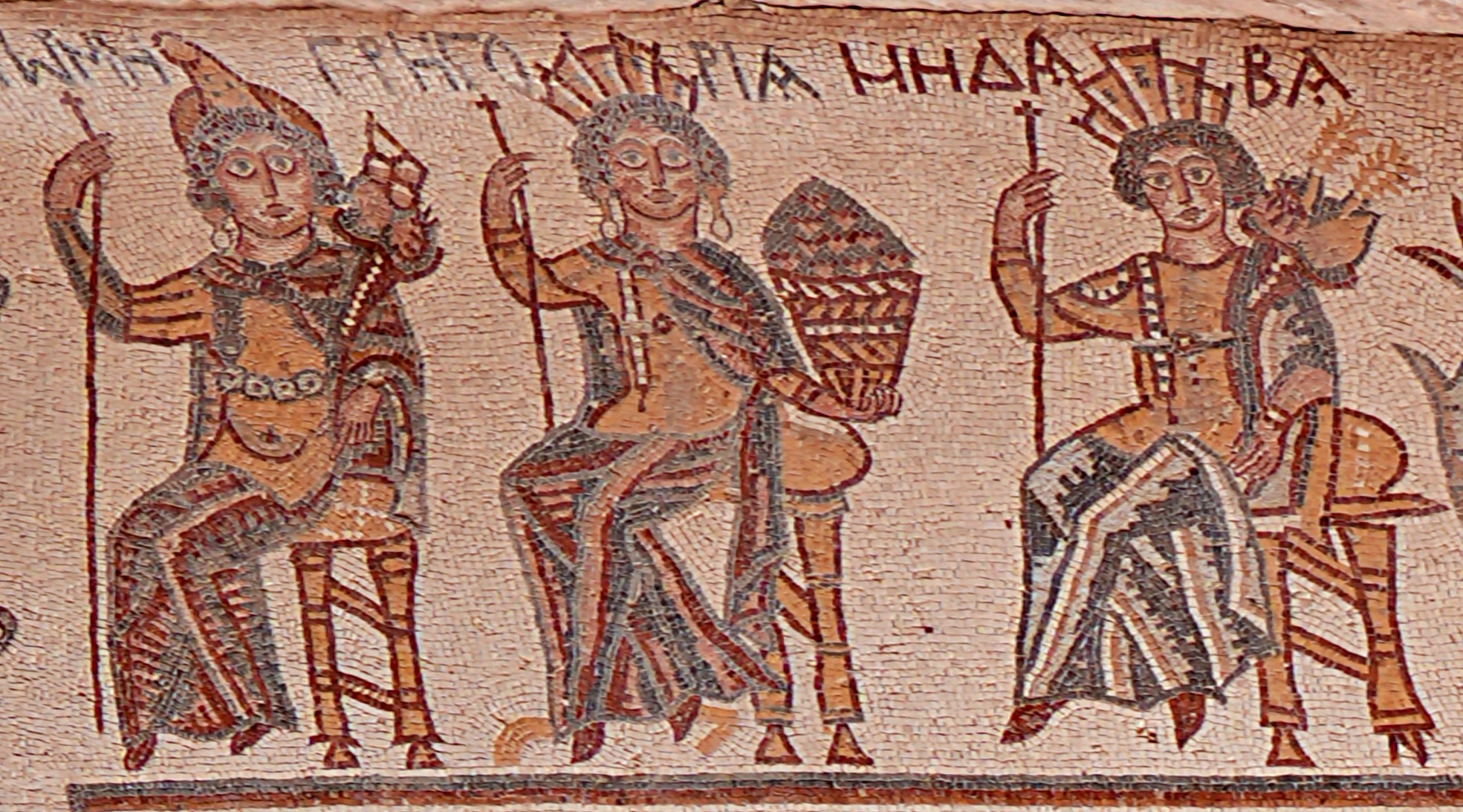
Beside the church is our favourite piece in Madaba, the 6th century mansion’s wonderful mosaic. It presents scenes from the Greek tragedy ‘Hippolytus’ by Euripides: a story of love, jealousy, suicide and forgiveness. The main characters are featured, including Theseus, Hippolytus, Phaedra and the gods Artemis and Aphrodite. Can you imagine having this floor in your house?

Along the floor’s upper section are three quirky depictions of the Goddess Tyche. They represent personifications of the cities of Rome, Gregoria and Madaba. Some say they associate strength and vigilance with Madaba. Other images of Tyche decorate each corner, dressed as a symbol of the four seasons.


Part 2 – The other part of this museum is down the block from Part 1 and also includes mosaics from a palace and a church.
Burnt Palace
When it was uncovered, the palace was blanketed in ash and soot from a fire, which led to its name. You can still see damage on some of the mosaics. This 6th-century residence belonged to a priest from the nearby Church of the Holy Martyrs. On the floors in the palace’s West Wing, you can see a lion and buffalo fighting, while flowers and geometric shapes adorn another section. The East Wing is in much better condition, with hunting and herding scenes bordered by plants, fish and birds.


Church of the Holy Martyrs
In the same complex, you’ll find the Church of the Holy Martyrs. The large floor is badly damaged, but columns along the sides help you understand the layout. From a walkway above, we looked down at images of palm trees and animals such as deer, turtles, lions and camels. In the corners were personifications of the seasons.


Entry – The Archaeological Park is included on the Jordan Pass, otherwise, you can purchase a ticket that includes the Archaeological Museum and Church of the Apostles for 3 JD ($4.25 USD); Opening Hours – 8 am – 6 pm, closes at 4 pm in the winter.
Church of the Beheading of St. John the Baptist Church
This church is very different from the other churches in Madaba. It does not have mosaics; instead, it features remains of a Roman and Byzantine Acropolis. Built in 1913, it is named for the site where John the Baptist was beheaded, 30 km away. We’ll take you to Herod’s Machaerus Fortress, present-day Mukawir, soon.

This church, more than any other, really shows the layers of history in Madaba and makes it very easy to understand how civilizations built atop the previous ones. After climbing down the church stairs, you’ll find yourself in a labyrinth of tight tunnels, left over from the Roman and Byzantine acropolis. At one end, there is even a 3,000 year old Moabite well.


After exploring the vaults beneath the church, climb the steep series of ladders to the top of the belfry for views of the city, including King Hussain Mosque. The stairs are very steep, and the platform at the top is narrow, so those with a fear of heights may not enjoy it.


Entry Fee – It is not included in the Jordan Pass. The fee is1.5 JD ($2.10 USD); Opening Hours – 8 am to 6 pm, Monday to Saturday and Sundays from 10 am to 6 pm.
Madaba Archaeological Museum
Don’t confuse it with the Archaeological Park; this small museum is based in a collection of ancient houses that display a few wonderful mosaics. Some were discovered in these homes; others were brought from other sites in the city. There aren’t as many as we saw around the city, but an interesting one displays a scene from the Bacchic Procession with a Maenad and a Satyr.


Entry fee – included on the Jordan Pass, otherwise, you can purchase a ticket that includes the Archaeological Park and Church of the Apostles for 3 JD ($4.25 USD); Opening Hours – 8 am to 6:30 pm, in winter, it closes at 4 pm.
Church of the Apostles
Originally built in 578 AD, this large Basilica is a wonderful old building from the outside, but inside is an even bigger treat. The large space is protected by a stone roof, and walkways along the side let you look down on the mosaic flooring from above.


In the centre is a round image titled Personification of the Sea. The nave and chapels have separate mosaics, but unfortunately, the walkway only lets you see one side of the flooring.


Entry Fee – included on the Jordan Pass, otherwise, it is included in a ticket for the Archaeological Park and Archaeological Museum for 3 JD ($4.25 USD); Opening Hours – 8 am to 6:30 pm, in winter it closes at 4 pm.
Tip– At some of the sites in Madaba, museum staff may follow you and try to explain the artifacts and mosaics. They expect a tip, even though you didn’t ask for it. So, unless you want an impromptu guide, tell them from the start that you do not want a guide. Most only repeat what you can read on the signage anyway.
Where to stay in Madaba
The town is not that large, and most hotels and guesthouses are located near Tourist Street. We visited during the Iran War, so hotels were only at 1% capacity; they are usually at 80%. For us, the sites and streets were nice and quiet, but we felt bad for the locals trying to make a living, having nothing to do with these conflicts, and yet their geography made it a little uneasy to travel there.
Where to eat in Madaba
There are quite a few very good restaurants and coffee shops in Madaba. Even though we usually avoid the tourist hotspots for dining, the ones on the pedestrian Tourist Street are very good, offering delicious Jordanian food. Our favourite was Fokar & Bhar Restaurant. There are also several on Palestine Street near St. George’s Church.


Getting to Madaba
The Amman airport, Queen Alia International Airport, is only 20 km from Madaba, so it is very easy to reach from abroad. If you’re already in Jordan, you can also reach Madaba by road. Otherwise, it is quite easy to reach by bus. From Amman, they use the North Bus Station. If you’re coming from Jerash or north, you need to change buses in Amman. This is very easy, though, as we found all the bus drivers at the station very helpful. There is only one bus station in Madaba, whether continuing north or south.

Please note, we visited Jordan in the spring of 2026. At that time, there was a ceasefire in the Iran War due to the signing of the Memorandum of Understanding. Since conditions are changing frequently, please read current news on the area before planning your trip.
Here’s a link where you can read more of our adventures in Jordan, and a link to our interactive map of Jordan.
Coming Next – Floating in the Dead Sea
For pictures from other blogs go to Gallery at monkeystale.ca.
To read about more of our adventures go to Destinations.
If you like what you read, please comment or share (with credit) using the links below.



We'd love to hear from you, please leave a comment.