
Amman’s location on the hills above the historic Jordan River puts it in close proximity to important Biblical sites. In fact, it is easy to visit the Baptismal Site of Jesus (Bethany Beyond the Jordan) and the historical Mount Nebo in one trip from Amman. While we recommend spending more time at the Dead Sea, you could also visit it on the same day.
To see where Bethany Beyond the Jordan and Mount Nebo are located, please click on the link to view our interactive map of Jordan.
Tip – These also make great day trips from Madaba.
1. Bethany Beyond the Jordan
Located on the eastern bank of the Jordan River, only 9 km from the Dead Sea, is one of Christianity’s most sacred sites: the Baptismal Site of Jesus Christ. It is named Bethany Beyond the Jordan to distinguish it from another Bethany in Israel. In Arabic, it is called Al-Maghtas, meaning the baptism or immersion.
The 251 km (156 mi) long Jordan River runs between the Sea of Galilee and the Dead Sea and is specifically mentioned in several stories in the Bible and Torah and is referred to in the Quran. This historically important area, therefore, has more than one thing to see. The UNESCO World Heritage Site has ancient hermit caves, baptismal pools, churches, monasteries and chapels. Before we show you the Baptismal site, we’ll take you to some of these other important ones.
Driving below Sea Level
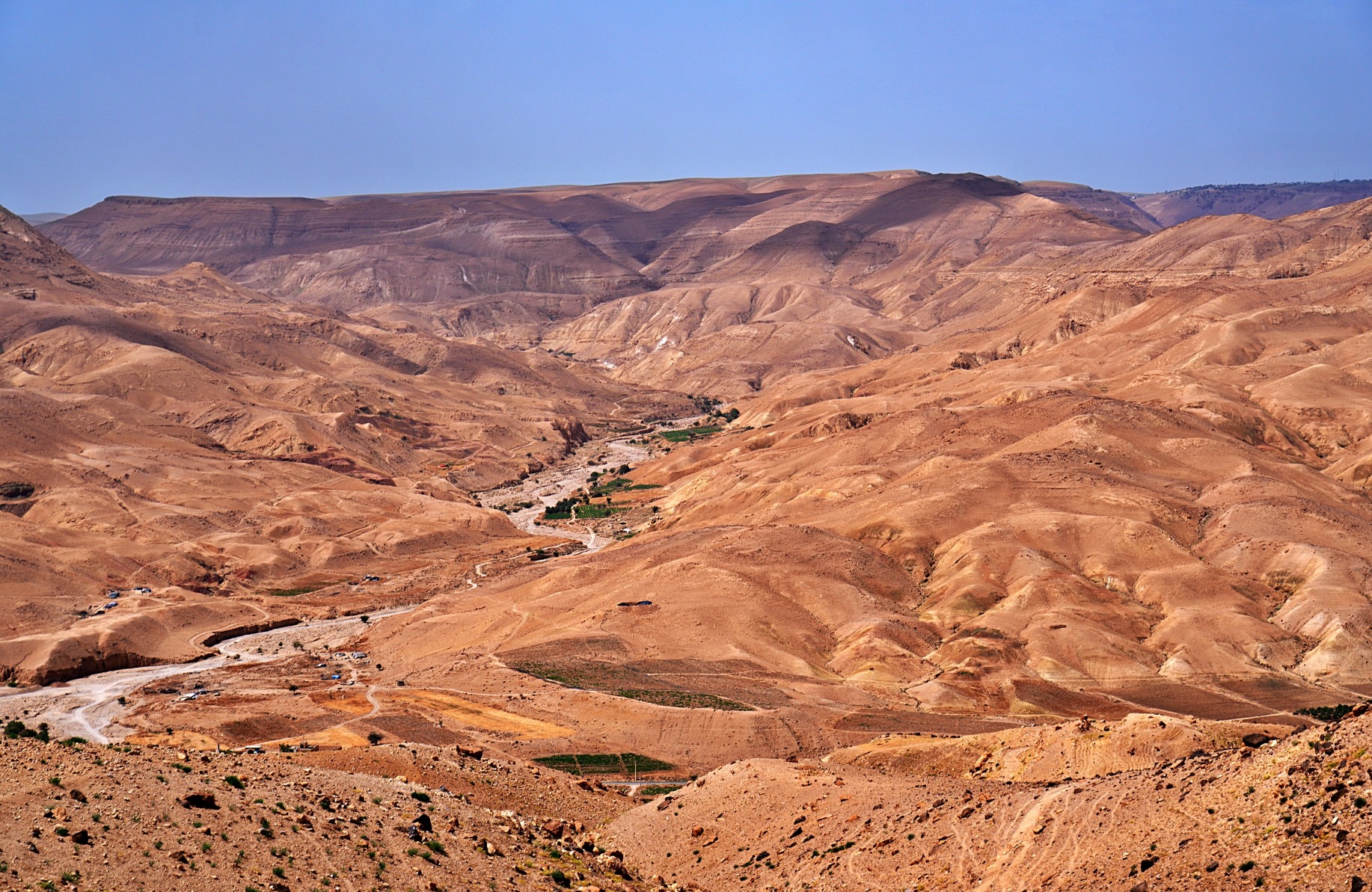
To reach Bethany Beyond the Jordan, we left downtown Amman at an elevation of 700 m (2,270 ft) and drove down and down until we reached the Jordan Valley, 350 m (1,150 ft) below sea level. We noticed that it is much more fertile in the valley than the arid hills above. Compared to the barren desert hills near Amman, the agricultural fields in the valley grow corn, bananas, and dates.
Once we saw the highway sign pictured below, we chuckled that we had recently been scuba diving in the Red Sea, but we were now at a far lower elveation than when we were diving. Although not included in the diagram, the Red Sea is at the same elevation as the Mediterranean.

In the distance, we saw Israel-occupied Palestine, something that would be within sight for most of our day. Not long after, we reached Bethany Beyond the Jordan, where Christianity began.

We’ll very briefly tell the Biblical stories as we explore these sites, but we won’t go into great detail.
Tar Mar Elias (St. Elijah’s Hill)
The history in this region began long before the story of Jesus. In the 9th century BCE, a whirlwind tornado carried St. Elijah to heaven while riding a burning carriage. That incident happened on what today is named St. Elijah Hill (Tar Mar Elias). Commemorating this historical spot are the ruins of Byzantine churches, caves, baptismal pools and several wells. One chapel still has parts of its Byzantine mosaic floor.
We still couldn’t get over the fact that we were on the top of a hill, and yet still more than 350m below sea level.


Almost nine hundred years after Elijah’s journey, John the Baptist, along with some of his followers, made their way to this area. He lived in a cave on the hill, subsisting on locusts and honey. His life’s work was to baptise believers in the nearby creek, Wadi al-Kharrar. Ritualistic cleansing was not uncommon in ancient times, but John’s approach was novel because baptism followed repentance of sins and represented their spiritual renewal.

St. John the Baptist Spring
Below the hill, at 400m below sea level, is the spring where John baptised his followers. It is believed that Jesus visited John a few times, drank water from this stream and shared honey made by bees in the nearby reeds.
From the spring, you’ll walk further downhill through a lush forest of tamarisk shrubs to reach the place where Jesus was baptised.


Baptismal Site of Jesus
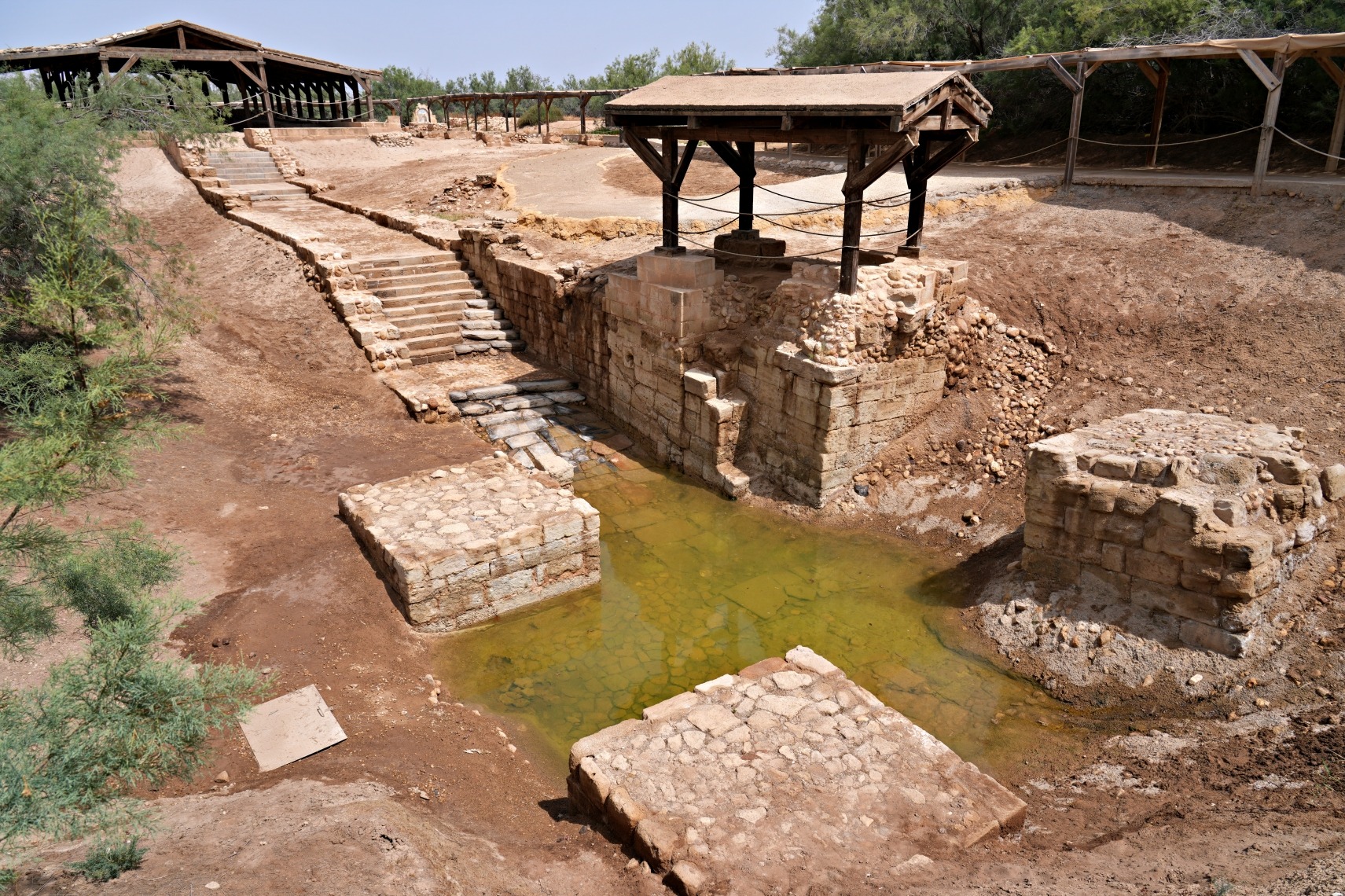
On one of his trips, Jesus was baptised by John the Baptist. Not in the spring, though; he was baptised further down, in the Jordan River. Today, only a small creek brings water to this location, but in the time of Jesus, the Jordan River flowed this high.
Over the ages, pilgrimage churches were built on this spot, including Byzantine churches dated to the 4th and 5th centuries. Portions of the old mosaic flooring are still visible in their ruins.

The location of the baptism was lost for hundreds of years. It was only rediscovered in the 1800s when a mosaic floor in Madaba was uncovered. This 6th century piece of artwork turned out to be a treasure trove of valuable clues. The mosaic is a large map that included accurate locations of cities and religiously significant landmarks in the region, including the baptismal site of Jesus.
In the second picture below, the text ΑΙΝΩΝ’ΕΝΘΑ ΝΥΝΟϹΑΠϹΑ ΦΑϹ is what led them to this exact location on the Jordan River. It roughly translates to a ‘Spring that today is known as the Place of Willow’. You can see more of this map and other mosaic floors in our post The Wonderful Mosaics of Madaba.


Jordan River
The Jordan River today forms the border between Israel and Jordan, and it is shockingly narrow. At less than 10 m wide, the Israel-occupied West Bank of Palestine seemed uncomfortably close. When you read about the West Bank in the news, it is on the opposite side of the river from where we stood. The river used to be 500 m wide, but since dams have been built, it is now only a very narrow sliver of water.

Many pilgrims come to both sides of the river to be baptised. That wasn’t our plan, but we did take a few steps to the river’s edge and put our hands in the water. On the other side, in Palestine, we watched a baby being baptised. Unlike baptisms in Western churches, the baby was completely plunged into the water three times by the priest.


Churches
Just above the bank of the Jordan River is St. John the Baptist Greek Orthodox Church. Built in 2003, the church is used by pilgrims coming to be baptised. Inside, the walls are adorned with murals of Jesus, John the Baptist and St. Elijah.


On the surrounding hills are more churches, including a Greek Orthodox, Roman Catholic, Russian Orthodox, Armenian Orthodox, and Lutheran.


An on-site museum displays Greek Orthodox icons, robes and pottery, but it is more of a gift shop than museum.
How to visit Bethany Beyond the Jordan
Located 45 km from Amman, you can easily reach it by taxi. You should have them wait for you, though, because there isn’t likely to be one waiting for potential rides. Uber is also available, but we didn’t use it in Amman. Our driver charged us 50 JD ($70 USD) to take us to Bethany, viewpoints of the Dead Sea, and Mt. Nebo. It may be cheaper at other times because gas prices were over $2 USD/litre when we visited due to the war in Iran.
There are also many tours available from Amman, but since you get a museum guide, it really isn’t necessary.
Entry fee – it is included on the highest level of the Jordan Pass. Otherwise, the entry fee is 12 JD ($17 USD); Opening Hours – 8:30 am to 6 pm (last entry is 5 pm) , in winter, the last entry is 4 pm.
The historical sites are located a couple of kilometres from the visitor centre and ticket office. The entry fee includes a shuttle to the sites and a guide. Since it is within steps of the Israeli border, you must stay in your group. Our guide was not very informative, so while it is historically important, the visit fell a little flat for us. If you want to be baptised or go in the water, you should join a church tour.
When to visit Bethany Beyond the Jordan
At almost 400 m below sea level, it can get very hot in the Jordan Valley, making spring (March to May) and autumn (September to November) the best seasons. In summer, temperatures are very hot, as much as 50° C, and it often rains in the winter.
2. Mount Nebo
Above the Dead Sea and the Jordan River is the mountain from which Moses saw the Promised Land before he died. Partway up Mount Nebo, we could already look down on the Dead Sea. On a clear day, you should be able to see Bethlehem and the Mount of Olives in Jerusalem from the summit. For us, however, haze marred our view. Hopefully Moses had better visibility.


The main place to visit on Mt. Nebo is the Memorial Church of Moses. This newly built structure was erected over the ruins of a 4th century church. Since it had been abandoned in the 16th century, no one knew what lay beneath the ground. In the 1930s, Franciscan monks purchased the land and began excavating the ruins. During this work, they uncovered some of the most beautiful Byzantine mosaics from 530 AD.
Today, the church operates a museum, allowing visitors to see these magnificent mosaics.


The showstopper is located in the historic Diakonikon Baptistery room. Its floor is decorated with scenes of hunting and herding African animals such as lions, zebras, giraffes, bears, boars and ostriches. The mosaics were meticulously restored, so that today we can appreciate their beauty.


Entry fee – it is not included in the Jordan Pass, 3JD ($4.25 USD); Opening Hours – 8 am to 7 pm, closes at 4 pm in winter.
3. Dead Sea
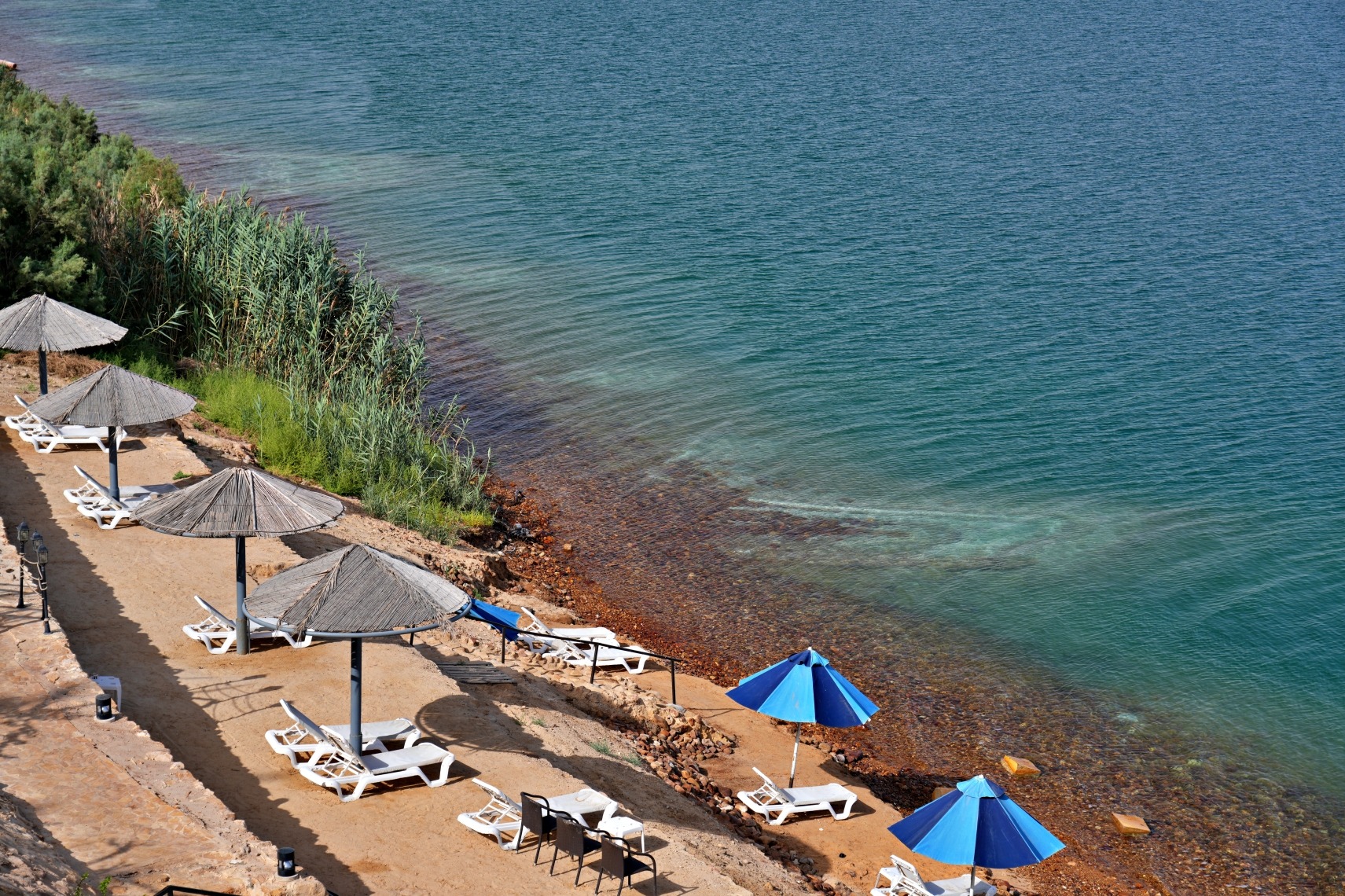
While in the area, you can easily stop at one of the many viewpoints over the Dead Sea. Instead of a quick stop, we recommend at least an overnight visit so you can appreciate this unique body of water. To see what you can experience on a stay, visit our post, Floating in the Dead Sea: A Unique Experience. If you don’t have time to stay, here’s what you could see from the highway.


For information on places to visit, where to stay and eat in Amman, please visit our post Discover Amman’s Rich History.
Please note, we visited Jordan in the spring of 2026. At that time, there was a ceasefire in the Iran War due to the signing of the Memorandum of Understanding. Since conditions are changing frequently, please read current news on the area before planning your trip.
Here’s a link where you can read more of our adventures in Jordan, and a link to our interactive map of Jordan.

Coming Next – Roman Ruins of Gadara and Pella – Day Trips From Irbid
For pictures from other blogs go to Gallery at monkeystale.ca.
To read about more of our adventures go to Destinations.
If you like what you read, please comment or share (with credit) using the links below.




We’d love to hear from you, please leave a comment.