
Spread across a large, open field, the former Roman Decapolis city of Jerash is a must-see in Jordan. Strolling along its colonnaded streets, between the ancient temples, theatres and gates, will feel as though you’ve stepped back to the days of the Roman Empire.
To see where Jerash is located, please click on the link to view our interactive map of Jordan.
Jerash Archaeological Site
Although inhabited since the Neolithic period, the oldest ruins in Jerash were left by the Hellenistic Greeks. Alexander the Great established it as a military outpost, and by the 2nd century BCE, the Hellenistic Seleucid Empire founded the city as Gerasa. Around one hundred years later, it became part of Pompey’s Roman Empire.
The modern name, Jerash, is the Arabic version and is the one we will use.
Its location on busy trade routes between Damascus and Petra meant Jerash gained popularity and immense wealth. It was actually considered quite cosmopolitan for the ancient world. In fact, it was one of the Decapolis league of cities in the Roman Empire in the Levant. These 10 semi-autonomous cities included Philadelphia (Amman), Gadara (Umm Qais), and Pella. Although it saw intermittent attacks by Persians and Arabs, Jerash remained strong. When the city came under the Byzantine Empire, the city continued to flourish.
You can read about the other Decapolis cities in our posts from Amman, and Gadara.

A series of earthquakes damaged many of the structures, but the final blow came in the 8th century. This is when the Galilee Earthquake destroyed Jerash as well as Gadara and Pella. After this, Jerash was slowly abandoned, and eventually, it was left to be covered in soil.
The benefit to us today is that a large part of this wonderful Roman Decapolis city was still lying there, just waiting to be discovered. It means that we can walk on Jerash’s ancient streets and imagine what life was like for the Greeks, Romans and Byzantines who once strolled on these same paths. Let’s take a look at what they would have seen over 2,000 years ago.

Arch of Hadrian
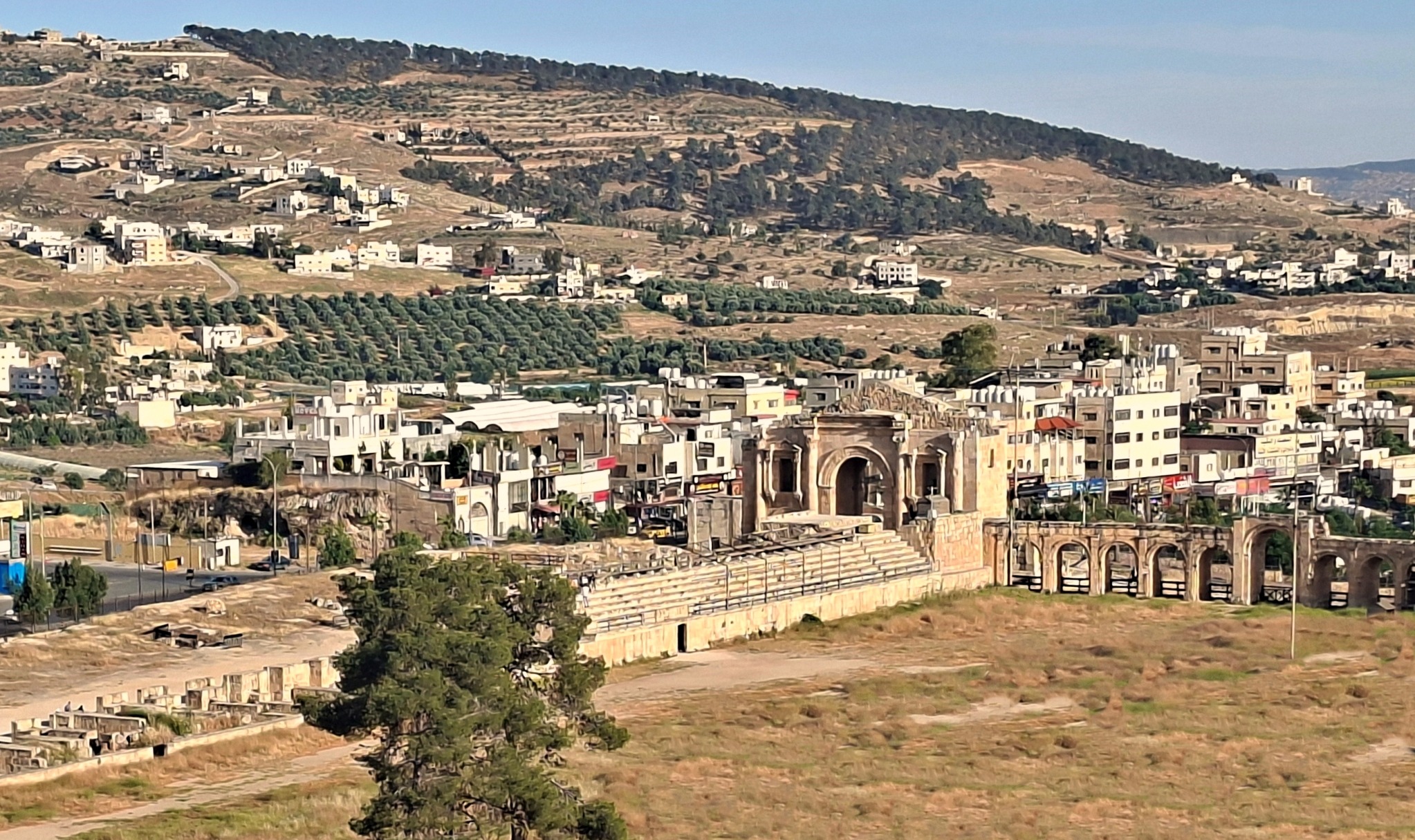
After walking through the gauntlet of semi-aggressive vendors in the tourist market, you’ll see the magnificent Arch of Hadrian. Known as one of the largest arches in the Roman Empire, its columns and pediment still exhibit many of its ancient details. Among those are its columns with Composite capitals. These capitals blend the leaf motif of Corinthian columns with the scrolls from Ionic ones. This style isn’t common, but we also saw it on the Library of Celcus in Ephesus and Hadrian’s Gate in Antalya.
Locally, it is named Bab Amman (Amman Gate) because the ancient road from this gate led to Amman.


Hippodrome
After passing under the arch, you can’t help but notice the Hippodrome. Although it seemed large to us, it was one of the smallest hippodromes in the Roman Empire. The earthquake caused significant damage, and the hippodrome wasn’t rebuilt. Instead, many of its stones were taken to rebuild the city, so there isn’t much left to see.


Church of Marianos
Beside the Hippodrome is the 6th century Church of Marianos. Almost all that is left is its stunning mosaic floor. You may notice the Hindu swastika designs in the tiles. The Byzantines also used the symbol, calling it the gammadion cross.

South Gate
These first three buildings, the Arch of Hadrian, the Hippodrome, and the Church of Marianos, are outside the archaeological museum, so they can be visited at any time. Once you pass through the South Gate, you will see the ticket office and enter the archaeological site. There are usually quite a few touts outside the gate.

Sanctuary of Zeus Olympios
Immediately above South Gate is the Sanctuary of Zeus Olympios. It is a large multi-level complex, and from below, you can see the columns of the Temple of Zeus high above. Not much remains of the shrines on the mid-level terrace, but you can visit the small museum in the Roman Vaults below.

Built in 162 AD, the temple is surrounded by Corinthian columns. Inside the main temple, most of the walls are bare, but remarkably, the outer walls still have niches and decorative elements.

Theatres
Immediately beside the Temple of Zeus is the 3,000-seat South Theatre. Even though it sustained damage from invasions and earthquakes, its front wall still shows off some of its design details. Originally, this wall was two stories high and must have been gorgeous.


It is worth climbing to the top seats for a wonderful view of the archaeological site spread out below the modern city.


On the other end of the city is the much smaller North Theatre, also called the Odeon. This intimate theatre hosted poetry readings and public gatherings. It is still used as a venue today, so everyone can enjoy the historic site, including its gorgeous marble floor.

Oval Plaza
Built in 110 AD, the Oval Plaza connected the city’s main street, Cardo, with the Temple of Zeus. It is a large empty space, but it’s easy to imagine that during its heyday, it was a bustling part of the city.


Colonnaded Cardo Street
This 800 m (½ mi) long main street was first laid by the Romans and then rebuilt by the Byzantines. Remarkably, the original limestone paving is still underfoot and walking on these same centuries-old steps is an honour. You can even see grooves made by chariot wheels.

This old street would have been a hub, lined with markets and used for processions. In addition to the main street, some side streets are also still guarded by tall columns.


South Tetrapylon
One of the most decorated intersections we’ve seen in a Roman city is the South Tetrapylon. This round plaza has the remains of four pedestal towers from the four-sided gate that stood in its centre. Their pink granite came all the way from Aswan in southern Egypt. Even if they took a shortcut and transported the granite across the Red Sea, it was still a 1,000 km (620 mi) journey.

To better understand how it may have looked, at the far end of Cardo Street is the North Tetrapylon. In the centre of the old intersection, the massive four-sided arch reminded us of Hyderabad’s Charminar. We don’t think this highly decorated arch is often visited because of the grass growing between the paving stones.
In the picture below, you can see North Gate in the distance. The road beyond this gate led to Pella and Gadara, among others.

Nymphaeum
Along the side of Cardo Street is the Nymphaeum. You can still see original ornamentation on the facade of this two-level public fountain. With only 230 mm (9 in) of annual rainfall in Jerash, they had to be good at collecting and distributing water.
In addition to this fountain, they built aqueducts, underground pipes and a cistern. If you peer between the paving stones, you can see remains of the clay pipes.

Temple of Artemis
Artemis was the patron goddess of Jerash, and the temple dedicated to her was given a prestigious spot on the highest hill in the city. Its Propylaeum, or entry gate, is still standing, and from it you can appreciate what a grand entrance it would have been.

Behind the gate, a wide stairway takes you up to the sanctuary, standing on the top of the hill. For a variety of reasons, the temple was never completed. Archaeologists discovered that the original plans called for 32 columns, but only 12 were built.
These twelve columns, though, gave historians a lot of information. Since the temple withstood several earthquakes before finally collapsing, they knew there was a difference in its construction. What they discovered was that metal dowels and clamps were used instead of mortar between the stones. These allowed the columns to be more flexible in high winds and small tremors than if they were rigidly held in place.


Long after the Romans left, stone masons set up shop on the grounds below the temple. One of the most significant discoveries was a 6th-century mill found in one of the temple’s underground vaults. The waterwheel produced enough energy to power two four-bladed saws and is believed to be the world’s earliest machine. Before this, everyone thought the first machine was built in the Middle Ages. A replica mill is on display.

Cathedral and Church of Isiah
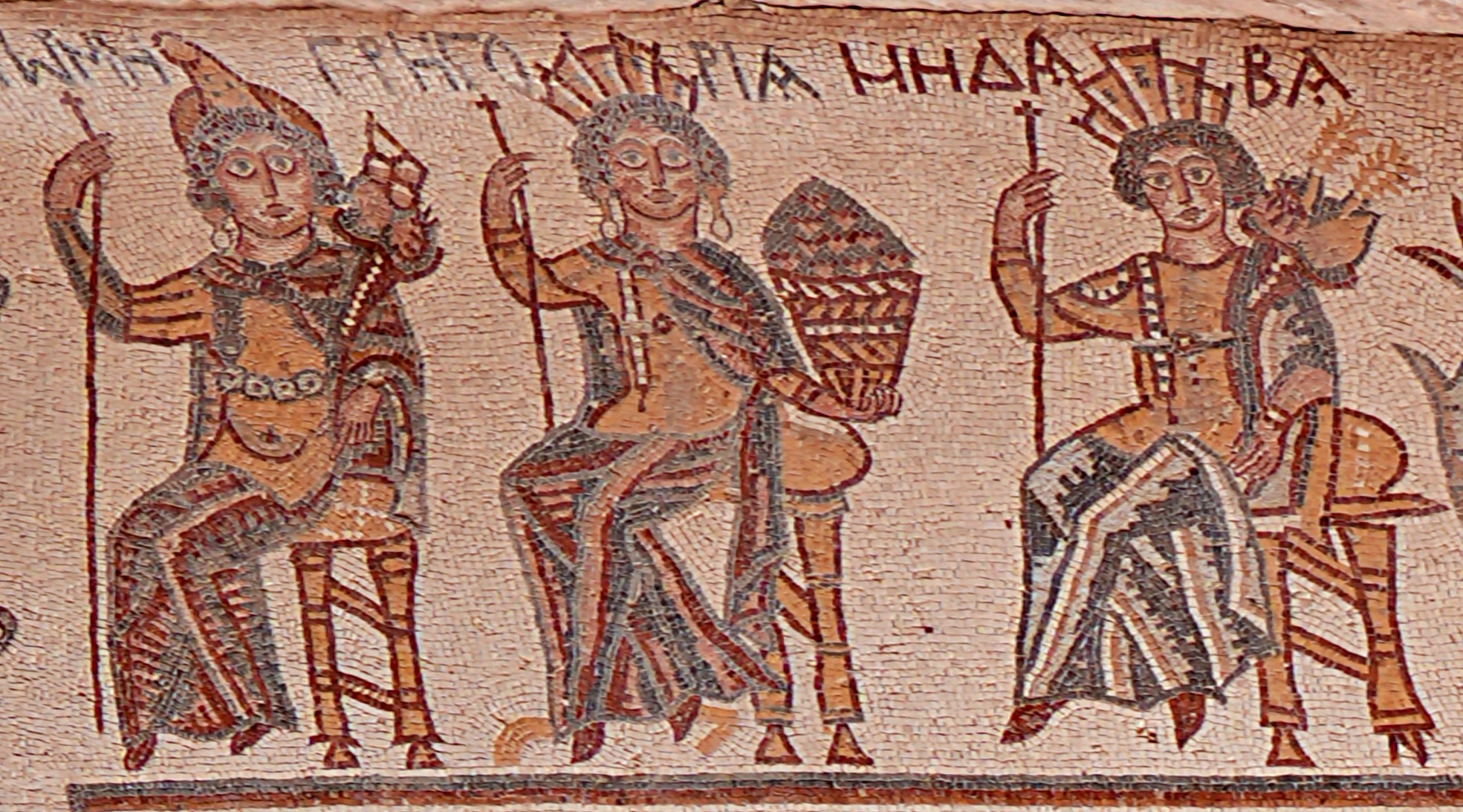
In addition to the Church of Marianos, Jerash has two other Byzantine churches. The Cathedral is located in the centre of the city, but is in very poor condition. Another church is at the other end of the city, and if you like mosaic floors, you will want to visit the Church of Isiah. Although the floors were purposely altered in the 8th century when church authorities banned the use of religious icons, it is still worth seeing them. You’ll notice more gammadion crosses in the image below.

Roman Bridge and Baths
Outside the complex, the Roman ruins continue. Take a walk along the Chrysorrhoas River to see the Roman Bridge and Baths.

Like many in northern Jordan, the city’s white limestone homes scale up and down its many hills, giving the city an interesting look. Other than the archeological site, though, there is not much to see in the city.


Getting to Jerash
If you don’t have a car, Jerash is also easy to reach from other cities by bus. The biggest problem with buses in Jordan is that they do not publish departure terminals or times online, so we’ve included some information here. For travel to/from:
Amman – Buses destined for Jerash leave from the Northern Bus Station (must pay extra for luggage). In Jerash, they use the Amman Station, which is near Hadrian’s Gate. Buses leave when full; ours left 10 minutes after we arrived.
Irbid – In Irbid, they leave from the Amman Station. In Jerash, buses to Irbid leave from the station by the North Gate of the Archeological site.
Madaba – To get between Jerash and Madaba, you need to transfer in Amman’s North Station.
Where to stay in Jerash
You can easily visit Jerash on a day trip from Amman, but if you want to visit other places nearby, it is an easy city to use as a base. There are several locally run hotels and guesthouses near the archaeological site. Since this is the only real thing to see in Jerash, you will want to stay near it.
Ajloun Castle – Day Trip from Jerash.
After spending the day in the archaeological complex in Jerash, you can visit a nearby castle the next morning. Perfectly perched on top of Mount ‘Auf (1,250m), Ajloun Castle had a great vantage point to keep a lookout for invading Crusaders coming over the distant hills.
Its Arabic name is Qalʻat ar-Rabad.

At the end of the 11th century, the Crusaders captured Jerusalem and set out to protect all entry points to their territory. As a result, they were in frequent battles against the Islamic empires in Jordan, especially the Ayyubids. During this time, Sultan Saladin’s nephew built Ajloun Castle to both defend against Crusader invasions and to store armaments for his other defensive settlements in the region.
We first learned of the sultan at the Saladin Citadel in Cairo. He put an end to the Crusaders’ reign, limiting it to less than 100 years. You can read about our visit to the citadel here. We’ll show you two Crusader castles in Jordan in the coming weeks.

Protected by a moat, the castle originally had two gates. Expansions, however, have left only one entrance to the castle. It is across a drawbridge, giving it an authentic medieval castle feel.

The castle was expanded under the next few leaders, but it seems their plans were a bit haphazard. Instead of a seamless network of hallways, it is a maze with doorways and windows appearing in unexpected places. This labyrinth of stone steps and walls made our exploration quite fun, rather than frustrating.


As with most construction in the region, the castle was built on top of an earlier Byzantine church. A small chapel with a mosaic floor is a reminder of this previous history. In another area, a prayer room with Gothic-like arches remains from an old mosque.


There actually isn’t much to see inside the castle. While its maze of hallways and stairs makes it interesting, the best part is seeing the landscape from its terraces.

Entry fee – it is included on the Jordan Pass, otherwise it is 3 JD ($4.25 USD); Opening Hours – 8 am – 7 pm, it closes at 4pm winter. The castle has quite a few stairs and is not accessible.
Getting to Ajloun
Located 17 km from Jerash, 66 km from Amman and 38 km from Irbid, you can easily visit the castle on a day trip from any of these cities. Tours are offered in all three, but we hired a taxi in Jerash to take us to Ajloun for 17JD ($24 USD).

Please note, we visited Jordan in the spring of 2026. At that time, there was a ceasefire in the Iran War due to the signing of the Memorandum of Understanding. Since conditions are changing frequently, please read current news on the area before planning your trip.
Here’s a link where you can read more of our adventures in Jordan, and a link to our interactive map of Jordan.
Coming Next – Wonderful Mosaics of Madaba
For pictures from other blogs go to Gallery at monkeystale.ca.
To read about more of our adventures go to Destinations.
If you like what you read, please comment or share (with credit) using the links below.




We’d love to hear from you, please leave a comment.