
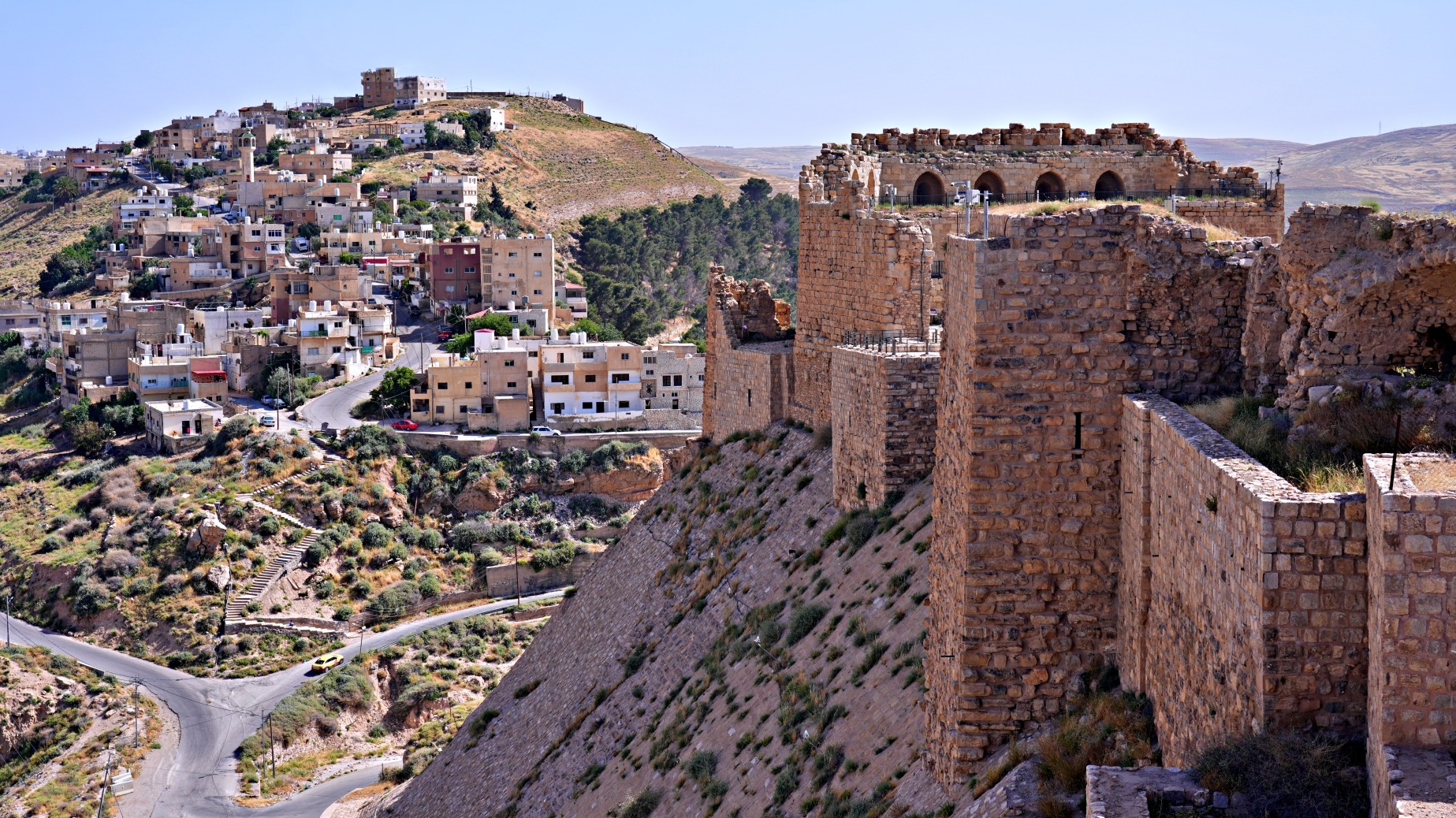
Placed on high points above the King’s Highway are reminders of Jordan’s varied history. In the Middle Ages, the Crusaders controlled this route to the Holy Lands and built castles to protect Christian pilgrimages. Of those, Karak Castle is the largest and is a great example of their strongholds. Further south, Shobak Castle enjoyed a strategic, yet very picturesque placement on top of a small hill. You can visit both when you drive the King’s Highway. Let’s look at them now.
Note – It is also spelled Kerak.
You can find Karak and Shobak Castles on the King’s Highway map below.
The Crusades
Under the direction of the Roman Catholic Pope, in the late 11th century, Christian mercenaries banded together to overthrow Muslim rulers in the Holy Lands. This marked the beginning of the Crusades. Soon after, Christians began making pilgrimages to Jerusalem, and knightly military orders were established to protect them. One of those routes ran through Jordan, along the King’s Highway, and the Crusaders built six large castles, strategically placed along its edge. Karak and Shobak Castles are easy to visit, while two others near Petra, Al Habis and Vaux Moise are in ruins.
Although they were in Jordan for less than 100 years, the Crusaders left a legacy of fortresses. Their defeat came at the hands of Egyptian Sultan Saladin. You can visit his citadel in Cairo and his nephew’s castle, Ajloun, in northern Jordan. A large statue of Sultan Saladin stands in Karak to celebrate Jordan’s historic hero.

Karak Castle
Built on a narrow ridge between Wadi Karak and Wadi al-Sitt, this mighty castle was once the largest in the land. With the steep canyon walls and tall ramparts for protection, Karak is still an impenetrable-looking fortress.
This hill was first inhabited by the Moabites as early as the 9th century BCE, when it was known as Kir Moab” or “Kir-Haraseth”. They were followed by the Greeks, Romans and Byzantines, who built a fortified settlement on the ridge. It is the Crusaders’ 12th-century castle however, that brings visitors to Karak today.


First built in 1142, Karak not only protected the pilgrimage route but also enforced the collection of taxes on the valuable trade routes and cut off communication between Islamic rulers in Egypt and Syria. They named their castle Crac des Moabites, and it was a stronghold for a while.
Karak did have a weak point, however. Today, the city has taken over the hill of Umm al-Thallanj, but during the times of the Crusaders, it acted as a launching pad for medieval catapults. The Crusaders were able to defend it for decades, but by 1188, Sultan Saladin of the Ayyubid Dynasty used this hill to successfully conquer the castle. Soon after, brought down the rest of the Crusade in the Levant.

The undulating ground on the ridge was once filled with a variety of buildings. Exploring the castle today means walking between the vestiges of the Crusaders, Ayyubids and Mamluks. Each added their own features, and you can often see the difference in the stone walls.
The largest areas left by the Crusaders are the two-story north wall, the moat, and the ruins of the Cathedral. The majority of the buildings we see today, though, were added by Mamluks. Those include the Mamluk Keep (Al Hamala’ah Tower), palace, mosque, and lower courtyard. Unfortunately, in 1293 a massive earthquake caused extensive damage to the castle.
The Jordan flags pictured below also show how windy it was during our visit.


From above ground, it doesn’t appear as if there is much to see, but the more you wander, the more fascinating parts you’ll discover. Climb down the stone steps to find a labyrinth of vaulted halls. Some were used by the military, while in other areas they were part of an extensive covered market. You can even still see the channels that were built into these walls to collect and store water which was necessary to remain self-sufficient when needed.


Below the Mamluk Keep, another set of stone stairs takes you to a different underground section. Here, you’ll find the remains of a Mamluk palace and mosque.

Unfortunately, the castle’s story doesn’t end there. In 2016, a group of young Jordanian militants attacked emergency responders and police in the region. Under police pursuit, the terrorists ran to the castle for shelter. International tourists were visiting the castle at the time, but most were at the opposite end. Sadly, one tourist, a Canadian, was killed, along with the terrorists and 13 others, including police and Karak citizens. The Islamic State claimed responsibility.
As we wandered through the many dark hallways, nooks and crannies in the complex, we found it difficult not to think of those tourists, especially the Canadian. It must have been terrifying.
Even though there was this terrorist attack, Jordan is considered very safe, and the government is continuously working to suppress extremism. There are Security gates at all tourist sites, but in Karak, they seemed to more vigilant, especially in checking local visitor’s ID.
Entry – included on the Jordan Pass; otherwise it is 2 JD ($2.80USD); Opening Hours – 8 am to 6:30 pm (closes 4 pm in winter.) There are two museums on-site, Folk Museum and Archaeological Museum, but both were closed during our visit.
Al-Karak City
Long after these battles, Muslims and Christians lived together in peace in the city of al-Karak for hundreds of years. In the 19th century, though, tensions between the Bedouins and Christians forced most Christians to leave. They settled in nearby Madaba, which is how many of the famous mosaics were discovered.
Although the Ottomans used parts of the castle, they left their legacy in the town below. Streets are lined with typical stone Ottoman buildings with overhanging balconies and lined by palm trees, making it quite an attractive town. In addition to the buildings, the streets were home to small vendors, including many wearing a traditional red and white shemagh (keffiyeh). It is a symbol of honour of their Bedouin heritage.


How to get to Karak
Located on the King’s Highway, midway between Amman and Petra, Karak is quite easy to reach. Many tourists rent cars to drive this section of the route. Stopping in Karak makes a nice road trip. If you don’t have a car, you can reach Karak by bus, but it is a little more involved. From Amman, take a bus to Dhaba, where you can take another bus to Karak. From Karak to other centre’s south, such as Petra or Dana, you will need to travel to Ma’an or Tafila, where there are more options. Another way is to travel by private driver or taxi, which is what we did.
To read about other historical sites along the King’s Highway, see our post Driving the King’s Highway, or go directly to our posts fro Karak, or Petra.
Where to stay and eat in Karak
Although most visit on a day trip, there are several local hotels and guesthouses near the castle. They are not luxurious but are also not expensive. As well, you can find a few restaurants in front of the castle and on the surrounding streets. We had excellent meals at Mu’Ab Restaurant.

Shobak Castle
Perched atop a small hillock, Shobak Castle looks like the perfect medieval fortress. Built in 1115 by Crusader King Baldwin I of Jerusalem, Shobak was originally named Mont Real. It is older than Karak by a few decades, and as with the other castle, was built to protect pilgrimage routes to Jerusalem.

In 1189, after the 18-month-long Siege of Saladin, the castle fell to Sultan Saladin. The Ayyubids moved in and made a few changes, and then in the 14th century, the Mamluks took over Shobak Castle. They used it as a military stronghold and removed most of the Crusader’s features. During the Ottoman period, the castle fell into disrepair.
Unfortunately, during our visit in the spring of 2026, the castle was under restoration, and most of it was closed. You can visit the remains of two churches, one of which was converted into a Mamluk soap factory, but there isn’t much to see.


Even though there wasn’t much inside, we enjoyed the views of the surrounding landscape, including the abandoned mud village. The people who once lived there slowly moved to more modern houses in the town of Shobak, across the valley.


Entry – Included on the Jordan Pass, otherwise it is 1 JD ($1.40 SUD); Opening Hours – 8 am-5 pm daily; in winter it closes at 4pm
Abwali’s Cave House
Below Shobak Castle, you will want to stop for tea at Abwali’s Cave House. It’s not an official café, but the owner, Abu Ali, loves sharing a cup of tea with visitors. He has lived alone since his wife passed away several years ago, and he is famous in Jordan, receiving visitors from all over including the king and his family. Abu Ali also operates the smallest hotel in the world, housed inside in a VW Beetle in front.


Getting to Shobak Castle
Shobak is 30 kilometres north of Petra and 120 km from Karak. Since it is located on the edge of the King’s Highway, you can make a quick stop when travelling between the two.
Dana Biosphere Reserve
Another stop you’ll want to make is Dana Biosphere Reserve, located between the two castles. We’ll take you to Dana next and recommend a two or three day stop when travelling between the castles.

Please note, we visited Jordan in the spring of 2026. At that time, there was a ceasefire in the Iran War due to the signing of the Memorandum of Understanding. Since conditions are changing frequently, please read current news on the area before planning your trip.

Here’s a link where you can read more of our adventures in Jordan, and a link to our interactive map of Jordan.
Coming Next – Hiking in Dana Biosphere Reserve
For pictures from other blogs go to Gallery at monkeystale.ca.
To read about more of our adventures go to Destinations.
If you like what you read, please comment or share (with credit) using the links below.




We’d love to hear from you, please leave a comment.