
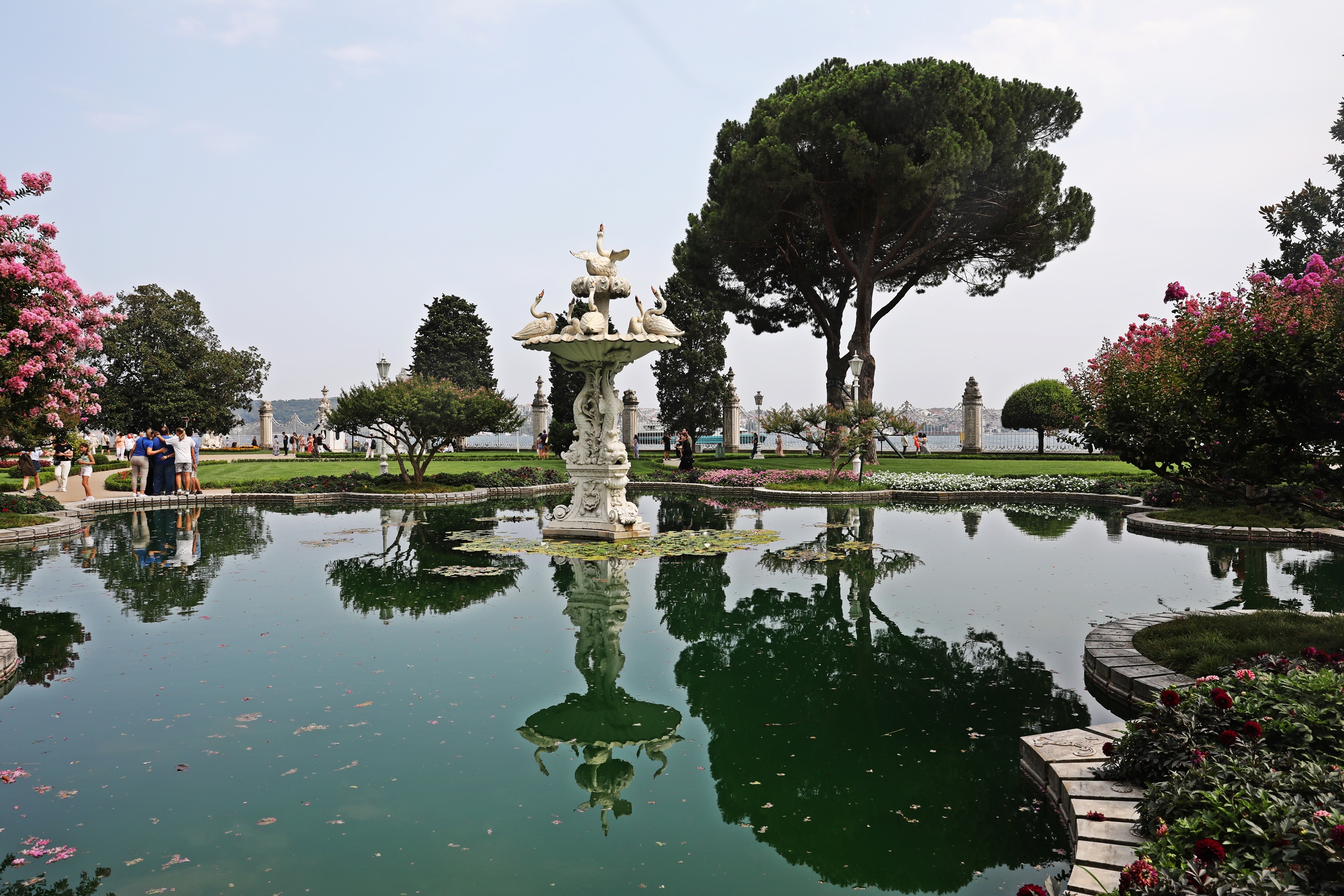
In a city known for its grand mosques, there should be no surprise that it has equally stunning palaces. The Ottoman Empire ousted the Byzantines from the city of Constantinople in the 15th century and claimed it as their new capital. As if to prove themselves worthy of this beautiful location, the reigning Sultans built regal palaces. Some of these were permanent homes, while others were summer residences. Touring Istanbul’s glamorous palaces gives you a glimpse into what life was like for the Ottoman rulers of this kingdom.
Topkapı Palace
The oldest palace in Istanbul is Topkapi Palace. Once Mehmet the Conqueror defeated the Byzantines and included Istanbul in his Turkish Empire, he ordered the palace be built. At the time, the Ottoman capital was a little south in Bursa, but he quickly moved to Istanbul. The palace continued to be the main residence for Ottoman sultans between the 15th and 19th centuries. Each successive leader added their own touch including buildings, courtyards and decorations.
Even before entering Topkapi Palace you are treated to lovely sight. Just outside the entrance is the elegant rococo-style Fountain of Sultan Ahmed III.

Once you enter through the first gate, you are in the first of four large courtyards, each wrapped in palace buildings. The first two courtyards are less ornate. They contain the buildings that were more accessible to the public. Its rooms and buildings feel regal, but not as intimidating as you may expect.
The Byzantine church, Hagia Irene, was incorporated into the first courtyard’s wall. This courtyard would have been big enough for most palaces, but in Topkapi they continued to go on and on. We didn’t expect the palace grounds to be so large.

In the second courtyard, the Imperial Council building is the most prominent. It is where the business of the empire was administered. The main feature of the building is the tall Tower of Justice that can be seen even from the other side of the Golden Horn. It’s almost as if it was meant to remind others that the sultan is now in charge.
The most interesting looking building though was the palace kitchen. Its multiple, uniform chimneys coming out of its roof makes it very unique.


Many of the palace buildings are set up as museums displaying jewelry, clothing, armour and weaponry. What was more impressive to us than these displays were the embellishment on the ceilings, walls and entryways.


Beyond the first two courtyards, are the more private areas of the palace and where its ornateness is on full display. The most notable building in the third courtyard is the Sultan’s Privy Chamber. The rooms in this building are gorgeous with beautifully tiled walls and a golden domed ceiling. The building is now being used to display Holy Relics. It includes a large collection of personal items belonging to the Prophet Mohammed, including his footprint.
In the same building were other interesting items such as fragments of bone that were supposedly from the hand and skull of John the Baptist, as well as a staff used by Moses.


The prettiest part of the palace was in the fourth courtyard. Baghdad and Yerevan Pavilions are both elaborately decorated small buildings. We were drawn to the blue tilework on their exterior walls. Inside, the walls are adorned with more colourful tile designs as well as stained glass windows. A marble courtyard is between them and gives you a lovely view of the city and the Bosphorus.


Topkapi’s Harem is in a separate area of the palace grounds so that they wouldn’t interact with any men other than the sultan. The name ‘harem’ usually conjures up images of scantily clad, beautiful women feeding grapes to their sultan. This harem was in fact where the wives and concubines of the sultans lived, but it all seemed too civilized for the images our minds had created. When we first entered the harem we were disappointed. Instead of opulence we found bare stone walls. We were told this area was used as accommodations by the slaves and eunuchs. I guess they didn’t ‘deserve’ pretty things.
A little further on, however, we came to the rooms for the concubines, wives and mother of the sultan. Each woman had their own bedroom, some had large apartments but they shared lavish living and dining rooms. We thought it must have been an awkward place at dinner time. There seemed to be a lot of bathrooms in this area. I guess if you have up to 300 hundred concubines and 6 wives, you need a lot of bathrooms.


There is an extra fee to enter the Harem which meant is was much less busy and more pleasant to explore. It also was the area where most of the extravagance is on full display. We thought it was worth the extra fee.
Entrance fee – 750 TRY plus 350 TRY for the Harem (As of Autumn 2023); Opening hours 9:00 am – 6:00 pm
Note – We visited during the summer high season. It was so busy that after waiting in line to enter the palace we still had to line up to enter many of buildings inside the Palace. This made us realize how busy it is to travel in Europe in the summer. It was so different from the rest of our trip through Central Asia where there were almost no tourists.
Dolmabahçe Palace
Even before we reached the main entrance to Dolmabahçe Palace we knew we were in for something special. On the side of the street we saw the elaborately designed Sultan’s Gate. It’s such a beautiful piece of art but it is almost ignored in its position along a busy Istanbul street.

The origins of this ornate palace is a typical story of the rich and powerful. In the mid 1800s, the Ottoman Empire’s 31st Sultan, Abdülmecid I, had travelled around Europe visiting palaces, castles and mansions. When he returned to Istanbul he found Topkapi Palace too plain and not up to his new standards. And so plans were drawn to build one of the most ornate palaces in the land.
He began by choosing a gorgeous location along the side of the Bosphorus so that all who sailed by could see the opulent home.

The jaw-droppingly scene begins as soon as you spot the main gate. Its over-the-top details show that it was built to impress; and it certainly does.


Inside the gates, manicured gardens are gracefully laid out in front of the selamlik (men’s quarters). This building holds the administrative part of the palace and looks much less grandiose than the gate. At least it looks that way from the outside.


On one side of the palace a long, decorated fence stands between the gardens and Bosphorus Strait. On the other is the gate we had seen earlier from the taxi. From our perspective inside the palace yard, you can see how much the city has built up around the palace.


If the selamlik seems plain from the outside, your opinion changes instantly once you step inside. Influenced by baroque, rococo and neoclassic styles, the palace rooms were designed to impress. We explored its halls, a library, meeting rooms, bathrooms, living rooms and dining rooms. Each was more outlandish than the last. Even the squat toilets were made of marble.
Each room had at least one crystal chandelier. Some of these lights were lovely and elegant. Others were seemed a bit more tacky, painted in pastel pink and green. The best part of every room was its ceiling. Each was decorated with mouldings, murals and even gold leaves. The furniture was also elaborate, looking like it came straight out of Versailles.
Pictures are not allowed inside, but once Monkey’s Tale’s photographer is told ‘no’ he’ll do anything to take a picture. As a result we have only a few pictures to show you these over-the-top decorations.


The harem was located in a separate area in the palace. This is where the apartments for the Sultan’s wives, concubines and mother are found. The rooms in this area were nicely furnished and decorated but not nearly as ornately as the rest of the palace. Nor were they as fancy as the harem in Topkapi.
As with Topkapi, the women shared common living areas, patios and a dining room which again would have been quite awkward. The largest apartment was for reserved for the Sultan’s mother. She was in charge of all of the women making her quite powerful in the palace.
Entrance Fee – 650 TRY (As of Autumn 2023); Pictures are not allowed inside. Opening hours – 9:00 am – 6:00 pm. Closed Mondays and Thursdays.
Rumeli Fortress
Located further along Bosphorus from Dolmabahçe is Rumeli Fortress. Today it doesn’t feel very far away from Old Town Constantinople, but in the 1400s, its location was much more remote. The city has since filled in the space, so they are all a part of the same city.
The large, stone fortress looms over the Bosphorus. Sultan Mehmed II had the fortress constructed and used it while he was preparing to attack Byzantine’s Constantinople. Unfortunately, in the summer of 2023, it was under restoration and was closed. From the outside, its formidable walls made us wonder what’s inside.

In addition to Topkapi and Dolmabahçe Palaces there are three other palaces in Istanbul as well as several pavilions that were used as summer homes. We couldn’t visit them all in one trip, but they give us a reason to return to Istanbul.


This article is now featured on GPSmyCity. To download this article for offline reading or create a self-guided walking tour to visit the attractions highlighted in this article, go to Walking Tours and Articles in Istanbul.
Click on the link to read our Travel Tips For Turkey.
Click on the link for more of our stories from Turkey.
Coming Next – Exploring Istanbul’s Waterways
For pictures from other blogs go to Gallery at monkeystale.ca
To read about more of our adventures go to Destinations.
If you like what you read, please comment or share (with credit) using the links below.




We'd love to hear from you, please leave a comment.