When you think about Peru, images of Machu Picchu and the Andean Mountains come to mind, but Peru has a lot more to offer. Plan to spend time visiting its colonial cities which blend Peru’s Inca and Spanish heritages for some of the most charming places in South America.

Cusco

Like most people, we thought we’d waste a couple of days in Cusco (also spelled Cuzco) to get acclimatized before trekking the Inca Trail. Instead of feeling as if we were just wasting time, we fell in love with this mountain town. Spanish colonial architecture is interspersed with extraordinary Inca stone walls, making it a unique and charming city.

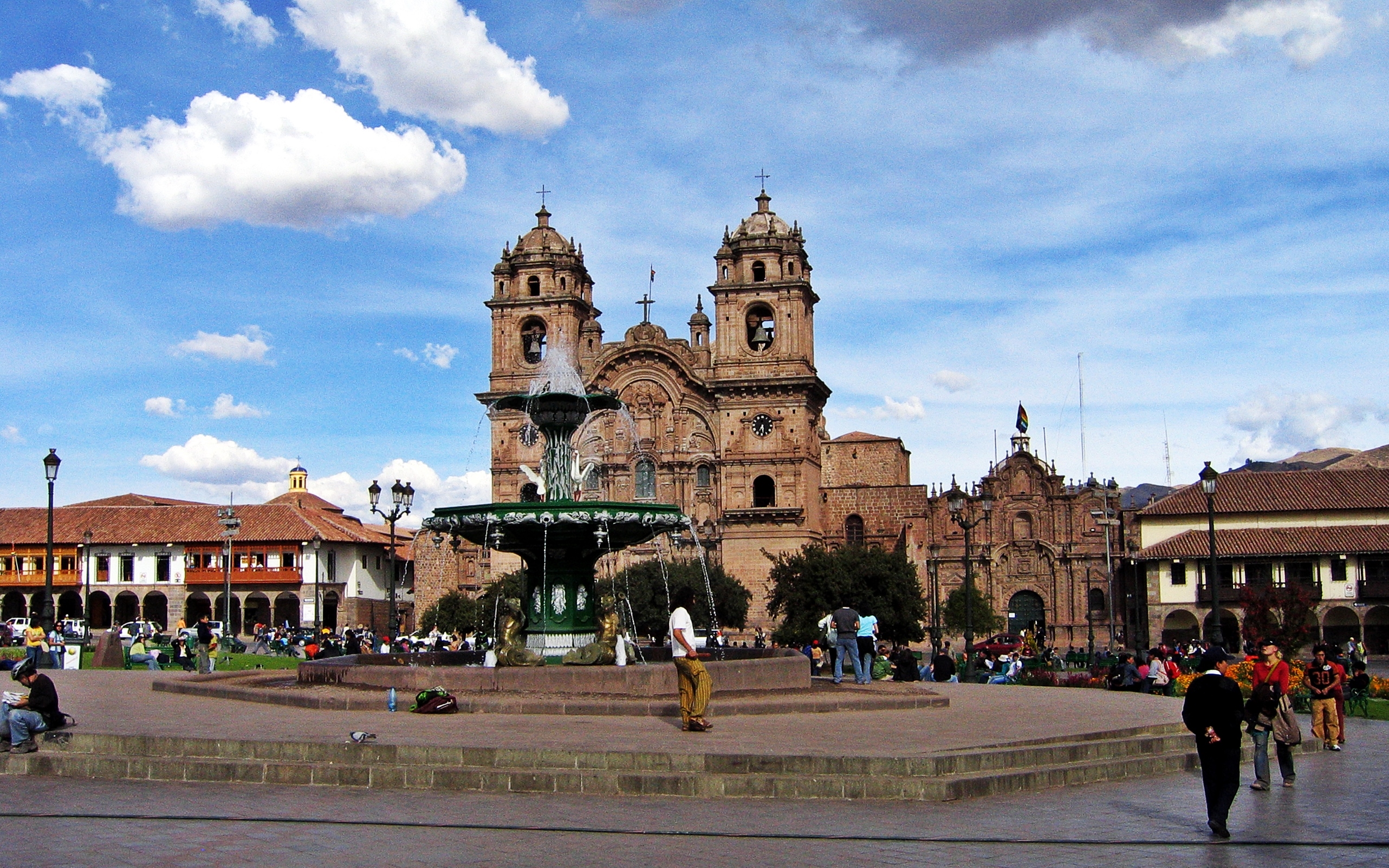
Once the heart of the Inca’s Cusco, Plaza de Armas is still important today. It’s a lovely spot with park benches, flowers and manicured lawns. Set in the Andes mountains at 3326 m, its high altitude means there are few large trees, but that doesn’t at all take away from its charm. The plaza is a popular area for both tourists and locals. We couldn’t resist taking pictures of the quechua women dressed in traditional clothes.

On one side of the square is La Catedral. It is an imposing building with tall twin bell towers with elaborate spires and an ornate doorway surrounded by massive pillars.The cathedral was built on the site of an Inca palace with stones taken from the nearby Inca site, Sacsayhuaman. The church is large, but looks even larger because of the two smaller churches on either side. To its immediate right it is joined to El Triunfo, the oldest church in Cusco. On its left is the plainer Church of Jesus Maria.

This church’s design was inspired by the cathedral in Jaén, Spain, which we also visited. You can read about Jaén here.

A second large church borders Plaza de Armas and competes with the Cathedral in grandeur. La Campana, a Jesuit church, was built a few years later. It’s another impressive twin towered church with small domed roofs and an elaborate façade. When the Jesuit church was being built Cusco’s bishop was concerned that it would be more impressive than the Catholic Cathedral. He sought out help from the pope. La Campana was almost finished when the pope finally intervened and so this Jesuit church is an equally remarkable building.

Walk away from the plaza and you’ll be climbing. Narrow cobblestone streets and stairs climb the hills behind the plaza and offer great views of the city below. At over 3,000 m, it’s much more difficult to walk these streets than you expect.

In much of old Cusco, the Spanish plunked their buildings right on top of the foundations of Inca buildings. We loved to stroll through the neighbourhood of San Blas where many buildings have Inca stone bases topped with typical whitewashed colonial buildings.

One of the most fascinating aspects of Inca’s construction are their walls. They were amazing masons, sculpting so precisely that mortar wasn’t required. Inca masons also carved the contact surfaces of each stone with precise notches and bulges to correspond exactly to the opposing stone. This skill allowed for many of the Inca walls to withstand earthquakes, when more modern buildings failed.

They had different design strategies based on their purpose. What looks to be seemingly random arrangements of stones, actually resulted in strong joints. This method was used in building walls. One wall in Cusco has a 12-sided stone.

Designs with consistent patterns were considered more aesthetically pleasing. These were used for temples and palaces. The foundation of the Coricancha (Temple of the Sun God) is great example of aesthetic Inca construction. Its symmetrical, smooth finish demonstrates incredible skill. The Spanish Convent of Santo Domingo built on top of it looks a bit awkward in comparison. The convent had to be rebuilt many times after earthquake damage, but the foundation stood strong.

Boleto Turistico

To visit most of the sites in Cusco you need a tourist ticket. There are four different packages available with different sites, length of days and prices. Research which sites you want to visit and how much time you have to be sure you buy the ticket that best matches your needs. Sites that are on the Boleto Turistico do not sell individual entry tickets. The best place to buy these are at the COSITUC office in Cusco.


Arequipa

The picturesque city of Arequipa lies under the shadows of the active Volcano Misti and the extinct Volcanoes Pichu Pichu and Chachani. Its buildings shine brightly in the sun because they were made from their white volcanic sillar rock.

The elevation is much lower than Cusco at 2325 m so Arequipa has more vegetation. Plaza de Armas, the main plaza, is filled with tall, green trees. On one side of the plaza is the beautiful La Catedral. The church takes up the entire block with large white columns filling the space between two tall bell towers. Its location close to the volcanoes resulted in many severe earthquakes causing massive damage to the city. La Catedral had been rebuilt many times after being decimated from earthquakes and fires. There was an earthquake as recently as 2002 when our friends were visiting. They recounted a terrifying story of the buildings shaking and collapsing around them.

There’s an interesting story about Arequipa’s large Monasterio Santa Catalina. It was established in 1580 by a rich widow. She selected daughters from the best families in the area to be the nuns. They didn’t live a typical simple convent life however. Each nun had her own servants and there were often large parties with musicians in the convent. This lifestyle carried on until the 1880s when the pope found out.

Today, there are still a few nuns, but the rest of the convent is open to visitors. It’s a huge complex of winding pathways beautiful courtyards and fruit orchards. From a rooftop terrace you can see El Misti Volcano.


Lima

The Spanish claimed Lima as their capital and left behind a lovely historical centre. In the city centre Plaza de Armas, also called Plaza Mayor, is a large busy square surrounded by gorgeous Spanish Colonial buildings. La Cathedral is a large church that takes up the entire side of the square with the Archbishop’s Palace attached. The Cathedral is a beautiful white building with two tall bell towers and an ornate main entry decorated in detailed sculptures. The Archbishop’s Palace is less grand than the cathedral, but has equally impressive details on the front as well as a string of wooden balconies. Similar to Cusco, the cathedral’s design was inspired by the cathedral in Jaén, Spain. You can read about Jaén here.

On the next side of the plaza are colourful yellow municipal buildings. Due to many earthquakes, the only structure in the square that is original is the old fountain in front of the cathedral. Built in the 1650s it demonstrates how elaborate this plaza must have been.

Jiron de La Union pedestrian mall connects Plaza de Armas to Plaza San Martin. Here we found a statue with an interesting history. On the top is Peru’s liberator General Martin, but below him is the unusual part. A small statue of Madre Patra (Mother of Peru) was a gift to Peru by Spain. The instructions for the artist said that the Mother of Peru should have a crown of flames. The message got confused as the Spanish word for flame is llama, so the Peruvian sculptor put a furry camelid on her head!

Both times we were in Peru there were nation-wide strikes and protests. While in Lima, there were a large demonstrations in the downtown area so we didn’t explore as much as we had planned. Our visits were more than 10 years apart, and yet protests disrupted our visits both times.

To read more of our adventures from Peru, click here.

Coming Next: Trekking the Inca Trail to Machu Picchu

For extra pictures from Peru click here. For pictures from other blogs go to Gallery at monkeystale.ca

To read about more of our adventures go to Destinations.

If you like what you read, please comment or share (with credit) using the links below.

Fediverse reactions

51 responses to “Cusco, Arequipa & Lima – A Blend of Peru’s Inca and Colonial Heritage”

  1. A really enjoyable read, as ever! Those cobbled streets are quite something and I love that photo taken from the top of one such street showing the town snake up around the distant peak! Cuzco and Machu Picchu have been on my bucket-list since forever haha

    1. Thanks Colin, Cusco is such a cute town in a great setting. Machu Picchu is our next post so hopefully it will entice you to go once we’re allowed to travel again!

      1. I am really happy to know it is actually as wonderful as I’d always thought/hoped!! I’ve been to a few places that I’d always wanted to see only to be left rather underwhelmed! That said, you have shown us some mountain ranges that need to be added to my list :-)!

        1. We went to Cusco with no expectations and loved it. We went on the Inca Trail with high expectations and loved it – but there are a lot of tourists which lessens it a bit, but not much if you expect it to be busy.

          1. Haha, didn’t Sartre say that ‘hell is other people” 😉 He probably didn’t have whordes of tourists in mind. I know that I am also a tourist but I do prefer out-of-season travelling.

          2. We prefer off season too, but sometimes you can’t avoid hell 🙁

  2. What another wonderful post 🙂 Peru is one of those countries is in my bucket list and your photos just give me more reasons to go 🙂 Cusco seems truly beautiful 🙂 have a great week, PedroL

    1. Thank you Pedrol, we love Peru and especially Cusco. I hope you get to travel there someday soon. Maggie

      1. Thanks for the feedback Maggie 🙂 PedroL

  3. A fascinating part of the world. My son and his wife went here on their honeymoon and enjoyed it. Thanks for sharing. Allan

    1. Thank you Allan, we love Peru.

  4. Lovely towns, so beautifully captured. Makes me feel like going there at least once.

    1. You definitely should try to travel to Peru. The towns are cute and the people are very friendly. Thanks for reading!

  5. Beautiful pictures that remind me my road trip imb Peru.

    1. Thank you, It’s a gorgeous country isn’t it?

      1. Definitely ! There is so much to see and I liked staying in Arequipa and Cuzco very much. Looking forward tp you post on the Inca Trail 😊.

  6. […] Coming Next: Cusco & Arequipa – A Blend of Peru’s Inca and Colonial Heritage […]

  7. Enjoyed your view of Cuzco and Lima. Was unable to visit Arequipa while I was in Peru so I found the Monasterio very interesting. Great read!

    1. Thank you Roxanne, we were surprised by all of the towns in Peru, but especially by the difference between Arequipa and Cusco. Thanks for stopping by! Maggie

  8. Great post. We spent a month in Peru and found it to be our favorite country so far, after Colombia of course. Arequipa is a gem of a city and our favorite. A lot less touristy than Cusco. The food in Peru is considered the best in all of South America and Lima is the Culinary capital! We can vouch for that!

    1. Thanks, we love Peru as well. We spent over 6 weeks there so felt like we got to see a lot of the country. We loved both Cusco and Arequipa but I think in Cusco it was the mix of the Inca walls that put it over the top for us. You’re right though it is very touristy. And yes the food is amazing. I still make a few of the dishes at home, although not as good!

  9. I share the same feelings about Peru and the three cities discussed in the post, presented with well-chosen words and attractive photos. It is a country from which visitors come back enriched by the contact with the Inca period, the Spanish colonization and the current population which makes a great leap forward by welcoming so many tourists that make them improve their standards. It has become easy to travel in Peru, while rubbing shoulders with a touch of exoticism that enriches our travel experience. Thank you so much for sharing your experience.

    1. Yes, Peru has many tourists, but it doesn’t seem to have changed its rich culture (not yet anyway) but has allowed many to have a better quality of life. Thank you for your kind words. Maggie

  10. fantastic places, fantastic photos.

  11. Lovely cities, amazing architecture! We’ve also had awesome time in all these cities😊
    We didn’t hike Inca trail, instead we picked a trip in Colca Canyon, it was the best part of our trip in Peru!
    Nice photos!!

    1. Thanks Christie, We went to Colca Canyon too, it’s really spectacular isn’t it! Thanks for reading, Maggie

  12. The colourful traditional fabrics, hats and those llamas give Peru a very unique look. Some of your photos look like a perfect promotional campaign for the country. The Inca walls are incredible! I often just hear of Cusco as “the place to get acclimatized” so it’s nice to read about the city’s many charms, which seem totally worthwhile even if not continuing on for the famous trek (though I’m excited to learn about your experience).

    1. We loved Cusco, I think it may be our favourite SA city, at least in the top 3. There are a lot of tourists in Cusco, but we still found it very charming. The local people have adapted to the throngs of tourists, but don’t seem to have changed their culture and values. They’re wonderful people.

    2. Bittersweet memories for me it’s Cusco. Ended up in a hospital/ private clinic almost dead with altitude sickness and chest/ lung infections I must have picked up from the Amazon. Our trip to Peru/ Bolivia pretty much ended there and your post has brought it all back to me. Would I change anything? Nope! I’d go through it all again as Peru was so fascinating. Especially those intriguing ‘Inca’ walls. Thanks for this!

      1. Oh no, that’s awful! And yet, you still have good memories from Peru. It is an amazing country with such interesting an history and culture. Thanks for reading!

  13. Great photos that bought back lots of memories for me. I loved Cuzco but I loved Arequipa more.

    1. Arequipa is a great city too, so many beautiful buildings. We only had a day there so maybe didn’t give it enough time to explore.

  14. Great photos and a bit jealous, since I didn’t even get one comment on my post about when I passed through there. But then your photos are a lot better than mine.

    1. Well I happen to travel with an expert photographer 🙂 I notice that the more I comment on other blogs the more comments I get. Stay healthy.

  15. Wow, the masonry was fascinating. I can see the similarities in the towns, possibly caused by the Catholic influence. The steep streets would be taxing for their elderly.

    1. Yes, there are a lot of Spanish influences in many Peruvian cities, but their ancestral roots also come through a lot. It seemed like the elderly in Cusco were in better shape than most of the tourists! Maybe because of the streets! Thanks for reading!

  16. Love the llama sitting on the sidewalk like a dog. Wish we had that here.

    An improvement on the traditional nun’s life, to be sure, but I’d still take a pass… 🙂

    1. I love llamas and alpacas! They are everywhere in Peru. This one is unusually docile as they’ll spit at you if they’re in a bad mood. I agree on the nuns, I thought it was funny that it lasted so long.

      1. I spit at people if I’m in a bad mood, too. 😉

        1. 😀😀😀😂😂

  17. Isn’t Cuzco a picturesque city set in the mountains like that! I think I would really like visiting Peru with the beautiful plazas and churches and the pretty countryside. Gorgeous photo!

    1. You would love Peru, it’s exactly like the pictures, but there are more tourists than we show in our pictures 🙂

      1. Hehehe yes that’s usually the case, we do try for those sneaky empty photos.

  18. How is Peru nowadays? Keep safe!

    1. This is actually from a trip a couple of years ago. No traveling right now.

      1. Oh I thought you were still there. Here in NZ we are now ok to travel domestic as we are now covid free. FYI. 🙂

  19. Usually I never comment on blogs but your article is so convincing that I never stop myself from saying something about it. You’re doing a great job Man,Keep it up.
    Crown Construction System In Melbourne
    Crown Construction Services In Melbourne

    1. Thank you for taking the time to comment David, we really appreciate it! We love Peru, I’m glad it came across in the post. Maggie

  20. […] in the 1650s it demonstrates how elaborate this plaza must have been. On our first visit to Lima in 2007 the fountain was a prominent feature, but in 2022 it was being restored and was hidden behind a […]

  21. […] in the city of Arequipa. We visited Arequipa on a previous trip to Peru and posted a blog about it here. During both trips to Arequipa we visited Santa Catalina Monastery. On tours of the monastery […]

We'd love to hear from you, please leave a comment.

Destinations

Discover more from Monkey's Tale

Subscribe now to keep reading and get access to the full archive.

Continue reading