
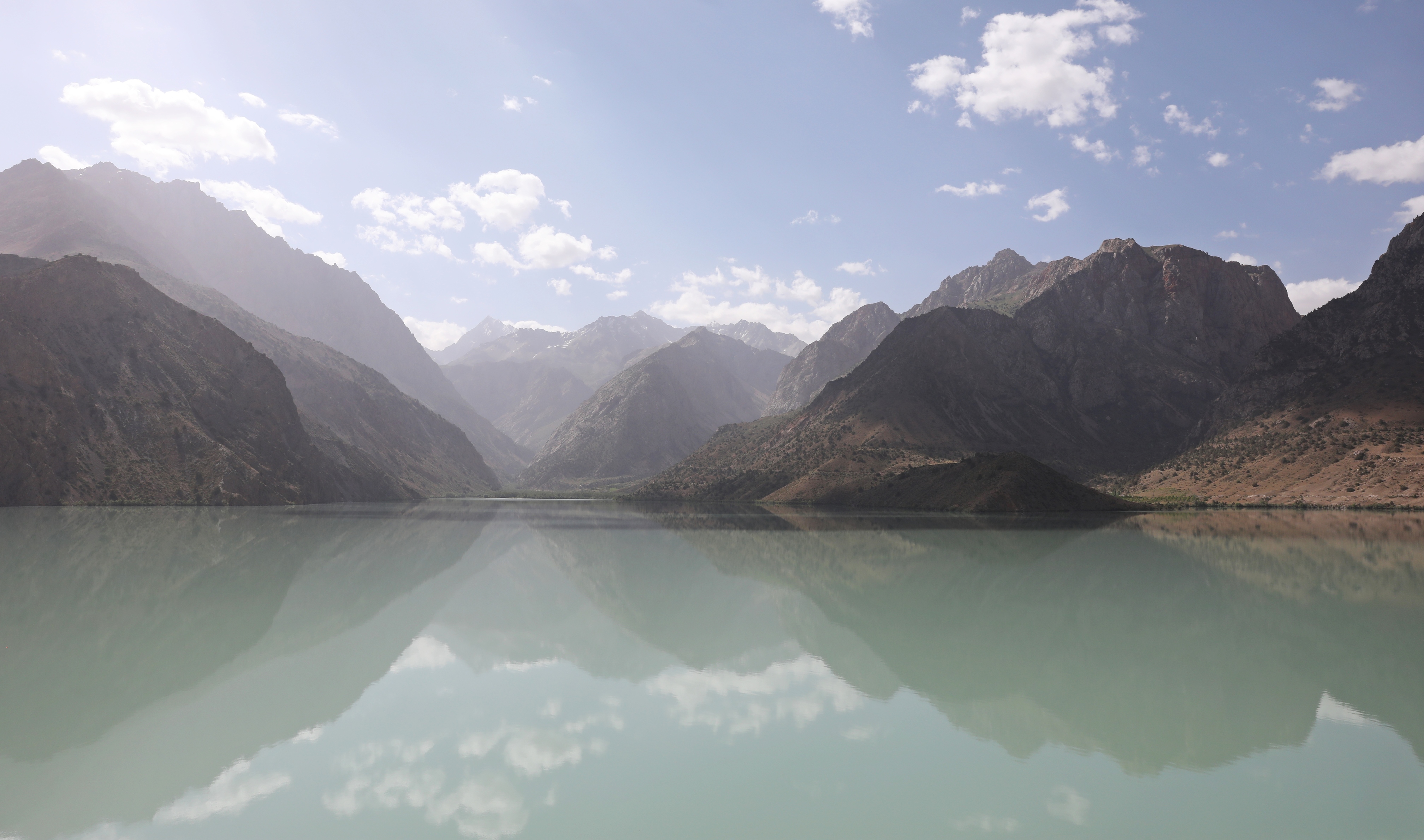
As we crested the mountain pass and drove down toward Iskanderkul, we understood why this lake is so popular. The rounded peak of Alexander’s Hat was standing prominently at the far side of the aqua blue lake, changing what would otherwise be a pretty lake into a stunning one.

Dushanbe is only 130 km south of Iskanderkul, making the lake a popular weekend spot for people from the city. We were travelling to Iskanderkul from the north having just trekked between the beautiful Seven Lakes (Haft Kul). Whether you drive from either direction, the final stretch to reach the lake is through a deep, narrow canyon with bright red cliffs on either side. The road was rough, with many potholes and steep drop-offs. The amazing views however, allowed us to forget the road and instead we were excited for what we’d see at the lake.


Note: Kul is the word for lake in many of the Central Asian languages so you will read this word a few times in our Central Asia posts. Iskander is the Tajik name for Alexander; in this instance referring to Alexander The Great. Therefore, the name translates in English to Lake Alexander.
Like many places in Central Asia, the formation of Iskanderkul comes with a legend. In the year 329 AD, Alexander the Great was terrorizing his way through Tajikistan. After he conquered this area, the local community rebelled against his army. The legend says that he was so incensed at this reaction that he ordered the river to be dammed so that their village would be flooded. Not only did the newly formed lake cover the village in water, but it also drowned many of the villagers. Those who survived rebelled again. During the uprising Alexander The Great’s horse, Bucephalus, fell into the lake and drowned. To this day, the legend says that at on the night of a full moon the horse comes out of the lake at midnight to graze along the shore. Another version says that in the winter when the lake freezes, the horse can be seen running across the ice.
Unfortunately, the legend may not be true. As with the Seven Lakes, Iskanderkul was formed when earthquakes caused landslides that dammed the Sarytag River and created the lake. Because of the legend, the lake is named after Alexander the Great.
However it was formed, today it is a beautiful glacier fed lake surrounded by the high peaks of the Hisser Range in the Fann Mountains. It is said to be one of the prettiest lakes in Tajikistan. Once we saw it for ourselves, we had to agree. The aqua coloured lake is so beautiful that the President of Tajikistan has not one, but two retreats (called Dachas) along the lake’s shore.

The most famous view of Iskanderkul is of the stubby mountain that has been nicknamed Alexander’s Hat. Its actual name is Chulboi and its distinctive rounded peak makes it very picturesque. In the morning when the lake is flat, the view of Chulboi reflecting off the lake’s surface is breathtaking.

What to do at Iskanderkul
You could spend your day relaxing by the water and soaking in the views, but there are also a lot of other things to explore around the lake. Here are a few suggestions.
Hike To A Viewpoint
At the east end of the lake there are a few hikes that take you higher up the mountainsides for great views of the landscape. The trails can be seen on Maps.Me. The one we did begins near the bridge in the village and climbs up one of the hills. There is another viewpoint on the other side of the river. We could see the trail but didn’t explore it.
As well as formal trails, the arid open mountain sides around the lake provide perfect opportunities to create your own viewpoint. We hiked up the slopes on one of the other peaks for views of the lake from a different angle. Even if there aren’t hiking trails, the ground is dry and open and easy to navigate around the small shrubs. You can go as high as you feel comfortable.
There’s not a lot of vegetation, but surprisingly we found a large rose garden on our way to the viewpoint.


Sunrise
Watching the sun rise above the mountain peaks and slowly bring the mountains to life will be one of the best parts of your day at Iskanderkul. The best views of the lake, at least when we were there, were at sunrise when the lake is as still as glass.


Seeing the reflection of the multiple layers of softly lit mountains was one of the best reasons to wake up early. It became one of our favourite views.

Iskanderkul Waterfall
The large glacier fed lake drains into a fast-moving river. Not far from the village is a small trail that takes you through a small canyon made by Iskanderkul River. There are no signs, but if you are following the river, you’re on the correct trail.


At the end of the trail, the river drops from a cliff making a powerful waterfall. It’s a nice waterfall, but its difficult to see it in entirety because of its location behind the cliffs. A rickety Soviet built platform lets you get right above the falls. From higher up however, the platform obstructs the view of the falls. Regardless of how much of the falls you can see, it is a nice walk and not a bad way to spend an hour or so.


Walk Around The Lakeshore
Even though it’s the same lake and the same mountains, it is remarkable how much the views change as you make your way around the lake. The road goes almost the entire way around the lake.


Climbers’ Memorial
A nice objective if you want to go for a walk is the peninsula on the south shore. At the end of the peninsula is a memorial for four climbers who died in 1966 attempting one of the local mountains. We hiked up the mountain behind the memorial for more gorgeous views of the lake. From there we also have a nice view down a different valley behind the lake.
When we were there, a few hundred Choughs circled around us. We had never seen such large flocks of these black birds before or since.


Sarytag Village
Set below the majestic Sarytag Mountain is the small village of Sarytag. The hike up to the village follows a gravel road that crosses a mountain pass. The surrounding mountains are very colourful and the combination of the red rocks and green trees makes it a very pretty walk.
On the way we were surprised to see a lovely waterfall coming down from the Kanchoch River. It made a commanding forceful drop through the red canyon to the river below.

From the top of the pass there is a great view of the village spread out below Sarytag Mountain. The village has become popular as a base for people doing multi-day hikes in the Fann mountains. If you’re not doing one of these backpacking trips the town doesn’t have much to offer, but it’s worth it to hike to the pass for the view from above.
Not far from the pass are a few traditional mud homes. They are no longer lived in, but are interesting to see.


Zmeinoe Lake
Above the village of Iskanderkul is a small lake that seems to be a popular hike. Its nickname is Snake Lake so we weren’t enticed to get too close. It’s actually more of a lagoon than a lake.

Have Lunch Or A Beer On The Lakeshore
There aren’t many restaurants around the lake, but we found a small one with a fantastic view. It was a great place to enjoy a Tajik beer. The funny part was that the beer came in a one litre plastic bottle like a coke.

Getting to Iskanderkul
Whether you’re coming from Dushanbe, Panjakent or Khujand you can easily reach Iskanderkul by car. The road is very good until you reach the turn-off at Sarvoda. If you don’t have a car you can take a minibus (marshrutka) to the town of Sarvoda. You may have to switch mini-buses at Ayer. From Sarvoda you have to take another private or share-taxi to Iskanderkul. Some suggest that you can get a cheaper ride from the turn-off for the lake which is a kilometer or two south of Sarvoda. Taxis in Sarvoda were very aggressive and tried to charge us 400 TJS ($36 USD) for a private taxi. Finally we were able to get a share-taxi for 100 TJS ($9 USD) each.
Where to stay in Iskanderkul
The remote lake has a few options to stay, but none are luxurious. Where the road arrives at the lake is a small collection of hotels and cottages often referred to as Iskanderkul Village. There are at least two hotels/motels here, a campground and one or two restaurants. Halfway around the lake is a nice family run guesthouse called Khayom, where we stayed. It’s much quieter than staying in the village. Every morning we had a peaceful breakfast on a tapchan over the lake. Be warned though, the lake is busy on weekends and any place can get noisy.

Click on the link to read our Travel Tips For Tajikistan.
To read about our other adventures in Tajikistan click here.
Coming Next – Discover Dushanbe
For pictures from other blogs go to Gallery at monkeystale.ca
To read about more of our adventures go to Destinations.
If you like what you read, please comment or share (with credit) using the links below.



We'd love to hear from you, please leave a comment.