
The capital city of Romania may not have the draw of other European capitals, but with its revitalized Old Town, maybe that will change. Filled with grand 19th century buildings, Old Bucharest has its own charm and we were easily able to fill our day exploring this vibrant neighbourhood.

Originally founded in the 15th century by Vlad Țepeș, otherwise known as Vlad Dracul and Vlad the Impaler, Bucharest was declared capital of the newly formed Romania in 1862. From the 18th to 19th centuries, the city’s downtown was a busy place filled with boutique shops and concert halls. It was often visited by wealthy Europeans and was known at the time as ‘Little Paris’.

The area was severely neglected during communist rule. After the overthrow of Ceaușescu’s government it took awhile for the country to begin repairing the years of damage. Old Town was apparently quite rundown before revitalization began in 2010. Today, many of the grand historic buildings have been restored to their glory days. Others though, are still in much need of some TLC. Intermixed with these historic buildings are rather plain communist ones and modern high-rises so you have to pick and choose your view.
Lipscani Pedestrian Street
The best place to begin your exploration of the historic district is Lipscani Pedestrian Street. Today its heritage buildings are brimming with shops, restaurants and pubs. In fact many of the intersecting streets in this region are now pedestrian-only so you can easily wander around looking at the lovely restored buildings without worrying about traffic. It was a very busy place when we visited on a sunny Saturday afternoon. Apparently at night the scene changes as the many nightclubs open their doors, bringing a different crowd.


After having a coffee at an outdoor café and admiring the grandiose buildings, don’t forget to check out the pretty bookstore with its own fairytale ending. Carturesti Carusel was originally a six-story, elegant bank headquarters. During the communist’s reign the building was confiscated and consequently it suffered a lot decay. After years of court battles it was returned to its original owners who lovingly restored it. Today it houses the prettiest bookstore in the city.

In the middle of this busy pedestrian zone is the peaceful 18th century, Stavropoleos Monastery. The church’s interior is very humble. Its stone walls are painted with dark frescoes and portraits are presented in unpolished golden frames.


Victory Way
There are a number of covered passageways between the pedestrian area and the busy Victory Way. We took Macca-Villacrosse Passage which has a fabulous entrance. Inside the passage we passed by busy shops to reach the main street on the other side.

Victory Way has its own heritage buildings including the Odeon Theatre and University of Bucharest’s immaculate library.


Revolution Square
Follow Victory Way until you reach Revolution Square. The hectic area received this name because it was the setting for the beginning of the 1989 Romanian Revolution. Before the revolution, the square was called Palace Square because the former palace is also located here. Now that building houses the National Art Museum. The palace building isn’t that interesting, but beside it is the nice looking 18th century Kretzulescu Church.
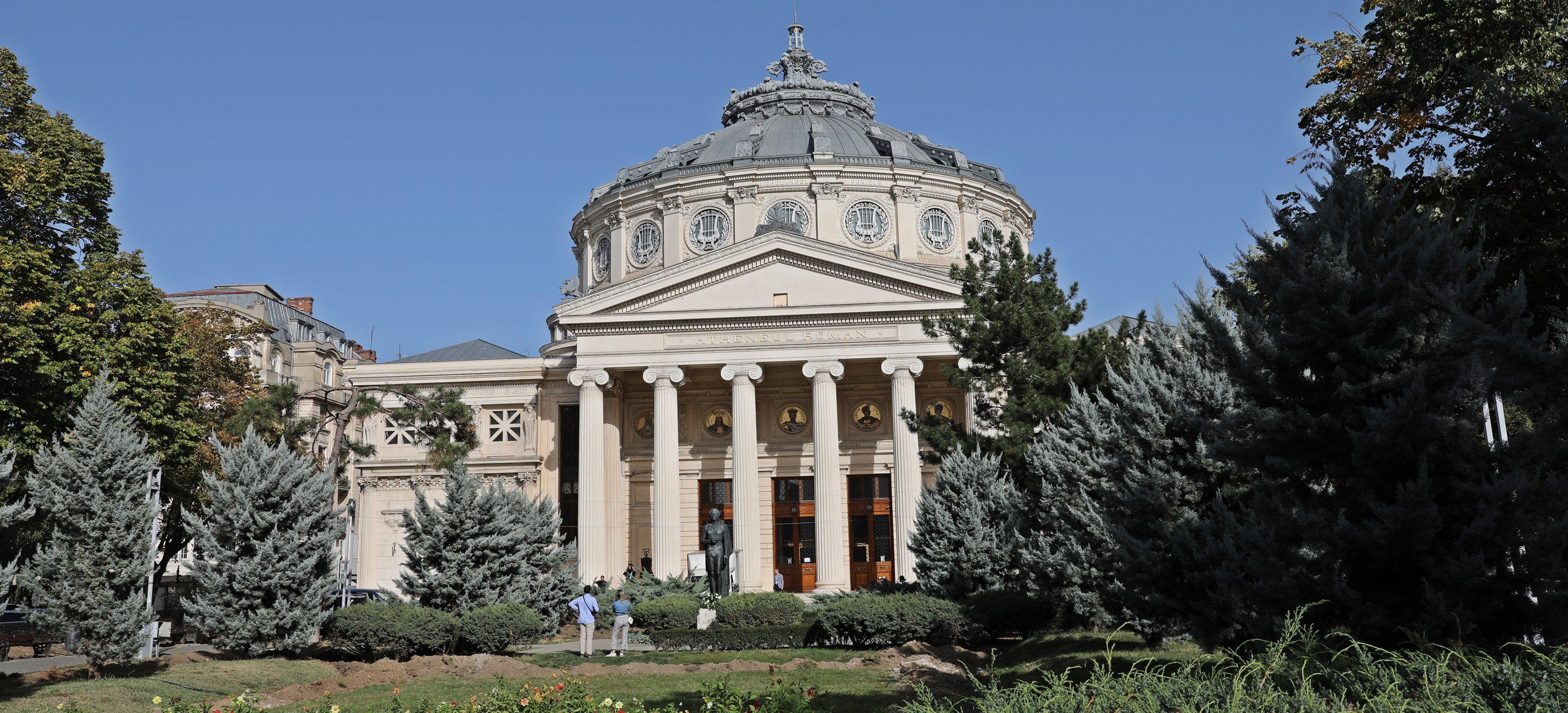
On the other side of the large square is Romanian Athenaeum; an elegant concert hall with Greek columns below a large rotunda.


Palace of the Parliament
You can’t visit Bucharest without at least taking a look at the massive Palace of Parliament. At 365,000 sq. meters ( 3.9 million sq. ft.) and 4,098,500 tonnes (9 billion lbs), it is one of the largest and the heaviest building in the world. The complex has over 1,000 rooms including: Senate Chambers, a convention centre, ballrooms, restaurants, libraries, and museums. There is even a cathedral on the grounds.


The Palace of Parliament was the vision of dictator Nicolae Ceaușescu. Construction began in the 1980s to show the government’s dominance and supremacy. Thousands of people’s homes and businesses had to be torn down so that this monstrosity could be built. Ironically, Ceaușescu the megalomaniac, was executed before it was completed. The construction up until the time of his death had already cost a lot of money. Although it was a symbol of the regime, it was deemed too expensive to tear down, so construction continued. Today construction has still not been completed and we could see a few construction cranes on the grounds.
It’s possible to take a tour of the building, unfortunately it was closed to tours on the day we were there.

Bucharest’s Old Town is a great place to spend a day, but when you leave the historic district, the city’s buildings are quite unappealing. Many are ugly communist-era constructions that are rather run down. It didn’t feel unsafe at all for such a large city, but it has the feeling of still being in transition from its time under communist leadership.
How to get to Bucharest
Otopeni International Airport is 20 km from city centre, but can be easily reached by train from downtown. You can also reach Bucharest by bus. The bus station is on the southwest side of the city, but many intercity buses will stop in Union Square downtown. If you’re only visiting large cities in Romania, you can take public buses between them, but travelling to smaller centres would be more difficult by bus. Buses also run between Bucharest and cities in Bulgaria and Turkey.
It is not easy to reach many of the historic sites in Romania by transit though, so renting a car is usually the best option. If you do rent a car, visitors from almost any country outside of the EU need to show a physical copy of their international driver’s permit. A digital copy is not enough. International agencies are very strict with this rule.

Where to stay and eat in Bucharest
There are many hotels and apartments for all budgets within walking distance of Old Town. Lipscani Pedestrian Street is where you will want to go to eat as it has numerous restaurants and cafes to chose from.


This article is now featured on GPSmyCity. To download this article for offline reading or create a self-guided walking tour to visit the attractions highlighted in this article, go to Walking Tours and Articles in Bucharest.
Thanks to Romania Tourism for allowing us to use their map.
Click on the link to read our Travel Tips For Romania.
To read more of our adventures in Romania, click here.
Coming Next – Peleș and Pelișor Castles
For pictures from other blogs go to Gallery at monkeystale.ca
To read about more of our adventures go to Destinations.
If you like what you read, please comment or share (with credit) using the links below.




We’d love to hear from you, please leave a comment.