
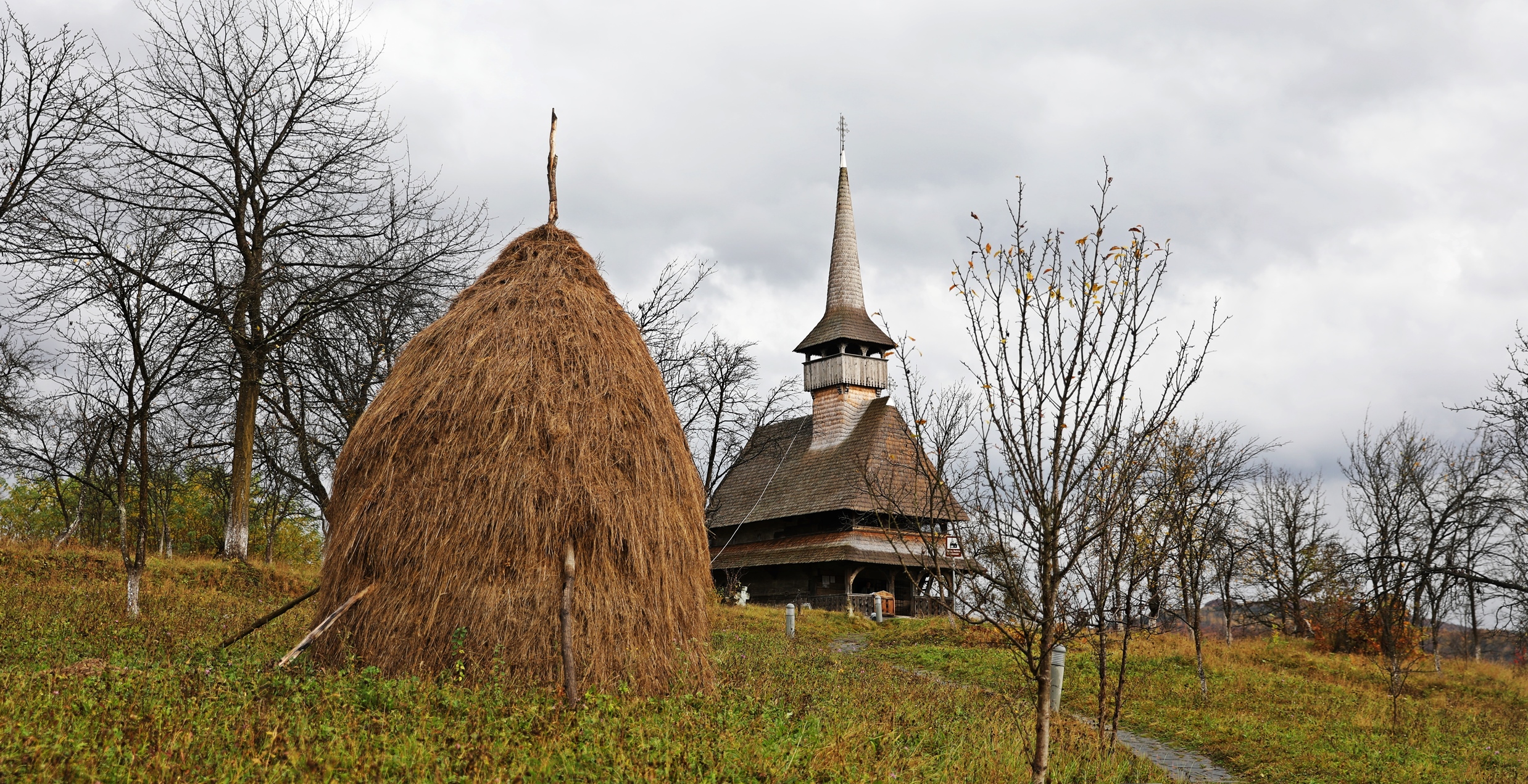
A tall, spindly spire reaches high above the small, wooden church to look like something out of a Brothers Grimm fable. The old wooden churches in Maramureș were unlike anything we’d ever seen before. Once we saw one, we were excited to continue our travels through northern Romania to see more.
Built between the 16th and 18th centuries, these artistically crafted churches are from a time when the Roman Catholic Austro-Hungarians ruled Maramureș. This empire prohibited the building of stone Orthodox or Greek-Catholic churches so, the local villagers were forced to use another material. They chose to build their churches with timber. Since the surrounding hills are carpeted in oak forests, the villagers were accustomed to building with wood. In fact woodworking was a skill passed down from generation to generation. Instead of erecting ordinary wooden structures through, they got creative and built churches that would show off their carpentry skills.


Originally over three hundred of these churches were built. Today approximately 100 are left and most are from the 17th and 18th centuries. Eight of them are UNESCO World Heritage Sites. We visited a few of these churches and not only did we enjoy seeing these wonderful buildings, but we also loved meeting the incredibly warm and friendly people in this region.
The wooden churches are spread out in small villages in the district of Maramureș in northeastern Romania. It is the aqua-blue area in the map below.

Ieud Wooden Church
We couldn’t believe our eyes as we approached our first wooden church in Maramureș. Built in the early 17th century, Church on the Hill’s slim body and tall bell tower soaring above a double eave roof made it look awkwardly cute. As we would find as we visited more of them, this is the common look for the wooden churches of Maramureș. They are not elaborate cathedrals, but village churches, built and maintained by the local community.
This church in Ileud is one of the eight UNESCO Heritage Site churches.


Surrounding the church is a small cemetery with carved wooden grave markers. Many of them have metal tops to protect them from the elements. It was impressive to see how well tended all of the cemeteries in Maramureș are. Many graves have fresh bouquets or planted flowers and candles letting you know family members stop by often.

The village of Ieud is almost as cute as the church with rustic wooden farm houses lining the road to the church. Some have eyes similar to those we saw in Sibiu.


Poienile Izei Wooden Church
Although similar in construction, Saint Parascheva Church in Poienile Izei village is smaller and looked a bit more weather-worn than the church in Ieud. Between its condition, the cemetery and the gloomy sky it had an almost spooky appearance.


The frescoes on the church door are fantastic and make it look every one of its 400 years. These paintings made us understand why it received UNESCO World Heritage Site designation.

Like many of the wooden churches, this church was locked when we visited. There’s usually a phone number posted near the entrance that you can call to have someone let you in. We didn’t bother calling. It would have been a difficult conversation over the phone since we don’t speak Romanian and most of the locals don’t speak English.
Bârsana Monastery & Wooden Church
There are two sites to visit in Bârsana. First we stopped by the new monastery. It was built in the 1990s on the site of the original monastery and was fashioned in the spirit of the wooden heritage buildings. Today it operates as a nunnery. Even though the buildings are not that old, they are very picturesque.
The entrance is through a large wooden gate with decorative carvings. Beyond the gate, the complex has ten buildings including a church, nuns’ residence, belltower and other monastery buildings. Speakers played Romanian hymns which gave it a peaceful feel. The buildings surround a manicured garden, but the best part of the setting for us was the fall colours on the surrounding hills.


The second site we visited in Bârsana is the heritage wooden church. It is one of the UNESCO World Heritage Sites. Built in the early 1700s, it is located in a large grassy yard on Jbâr Hill. When we arrived, a service was just ending and church goers were departing with bags of bread and the kids had bags of candy. It was likely bread that was consecrated by the priest for the start of Christmas fast.


A legend explains why the church is so important to the villagers. In 1710 a plague killed many people in the area. Soon after the plague was over, villagers built the church on the monastery grounds to thank God for sparing their lives. After the monastery closed, the church was moved to Jbâr Hill, not far from the cemetery for the plague’s victims. Apparently villagers moved the church one wooden plank at a time.

Tip – Google Maps places the church 1 km east of its location. A sign on the highway is correct and directs you to the church.
Merry Cemetery
After visiting Bârsana, don’t miss this side trip to the city of Săpânţa. It doesn’t have a wooden church, but it does have something unique to see. Merry Cemetery is much different than most cemeteries. Instead of being a somber place, the grounds are filled with bright blue wooden grave markers and surround a brightly painted stone church. Even the rain didn’t dampen our spirits at this cheery place.


Each grave marker is colourfully decorated with folk art paintings. They depict the deceased working in their profession. The back of each marker has a painting showing their hobbies as well as a poem. We couldn’t read the poems, but understand that they are quite whimsical in their retelling of the person’s life.
This tradition began in the 1930s when a local folk artist began crafting the crosses. It is believed he was inspired by their Dacian ancestors who celebrated the life of the deceased rather than mourn their death. The cheery nature of the headstones caught on and today the tradition is being continued by his apprentice. There are over 800 painted grave markers in the cemetery.

The church’s interior looks like many of the Orthodox Churches we visited, except that the altar wall is painted a pretty, baby blue.


Peri-Săpânţa Monastery
The tallest wooden church in the world can be found just outside Săpânţa. At 76 metres (256 ft) high, Peri-Săpânţa’s bell tower makes the church look a little top-heavy. For perspective, the church beside it has a typical bell tower height. Construction of the monastery church began in the 1990s but they built it in the vernacular architecture style of the area.

Budești Wooden Church
It was pouring rain when we visited the UNESCO World Heritage Site in Budești. Church of St Nicholas isn’t quite as tall as the others, but the four small turrets on the bell tower makes it much cuter than the other ones we’d seen.
Hanging on one of the walls is a wooden plank (semantron) that is banged with a mallet during the call to prayer. We saw one of these previously when we visited the painted monastery in Voroneţ.


Breb Village & Wooden Church
Not only are the churches made from wood, many of the gates and houses in Maramureș also showcase the skill of the local carvers of the time. We saw many examples of this in Breb. Even the newer houses and churches keep up the tradition having carved wooden gates in front.


Even in the rain we could tell we would enjoy our stay in Breb. Said to have the last peasant culture in Romania, we were instantly charmed by its quaint, bucolic setting.


The wooden Church of Holy Archangels Michael and Gabriel has the oldest bell tower in Romania. Today though you would hardly know that it was a bell tower with its short stature.


We stayed at a lovely guesthouse in Breb where we instantly felt the warmth and hospitality of the people in this region. As soon as we stepped out of our car, they welcomed us with shots of their home-brewed Horincă also called Țuică (in Hungarian regions it is known as palinka). It is a potent, but tasty plum brandy. Their daughter joined us, dressed in a traditional costume. After a couple of shots, their grandmother took us into their shed to show off their Horincă still.


More shots of brandy were served as we ate a delicious, traditional dinner. We chose between cheesy vegetable or pork polentas served with a hearty bread and salad. Dessert was papanasi, which are fried donuts covered in cream and a fruit compote. It was a fun evening being entertained by their animated stories. Lucky for us one of the other guests spoke English and could translate. You can find Casa Grai Moroșănesc on Booking.com.
Desești Wooden Church
The next morning we visited the wooden Saint Parascheva Church, in Desești. It was raining as we arrived, but we still had time to appreciate the well tended cemetery as we raced toward the church. Many of the graves have flowering bushes and perennial flowers planted around them.

We arrived when service was taking place in the small sanctuary. The priest was leading prayer and a few locals were singing in response. It was a great atmosphere, but it was the re-touched frescoes from 1780 that caught our attention. Crude as they may be, they are wonderful and tell the stories of saints and sinners. They are one of the reasons that church received UNESCO World Heritage Site designation.


Plopiş Wooden Church
The design of Church of the Archangels Michael and Gabriel in Plopiş is a little different from the others. It has two rows of windows along its wall and a single eave roof which gives it a unique exterior. The best part, however is its interior decorations. When we were visiting, a painter was examining the frescoes to see which needed touching up. He showed us the elaborate paintings around the altar and the more simple drawings on the ceiling and remaining walls. It was these unsophisticated ones that appealed to us a little more.
This church is a UNESCO World Heritage Site.


How to visit the wooden churches of Maramureș
Maramureș is located in the northwestern region of Romania near the border with Ukraine. Many are in small, villages that are not easily reached by public transport. We drove almost 200 km to visit all of these churches so reaching them by public transportation would be very difficult. The nearest airport is Cluj-Napoca, roughly 150 km south. Renting a car or joining a tour is the easiest way to see most of these churches. Tours will only take you to a few of the churches though. We rented a car in Bucharest so that we could continue to tour more places in the country.
Tip – Car rental agencies in Romania require a physical copy of your international driver’s licence. Only a few, smaller companies will rent to you without one.
Where to stay in Maramureș
Many of the towns and villages in this region have guesthouse, the larger centres will have a selection of hotels. Where you stay will depend on which churches you want to see. The cities of Baia Mare and Sighetu Marmatiei will have a larger selection. We loved our guest house, Casa Grai Moroșănesc, in the village of Breb. You can find it on Booking.com.
Tip – Make sure you have a written receipt from your hotel. Since the area is close to the Ukrainian border, officials may stop your car to see your passport and hotel receipt.
If you liked these churches, you may also enjoy the Painted Monasteries of Romania.

Thanks to our friend Florin at Născut Pe Lista Neagră (Born on the Blacklist) for his help in planning our trip to Romania.
Thanks also to Romania Tourism for allowing us to use their map.
Click on the link to read our Travel Tips For Romania.
To read more of our adventures in Romania, click here.
Coming Next – Romania’s Corvin Castle
For pictures from other blogs go to Gallery at monkeystale.ca
To read about more of our adventures go to Destinations.
If you like what you read, please comment or share (with credit) using the links below.





We'd love to hear from you, please leave a comment.