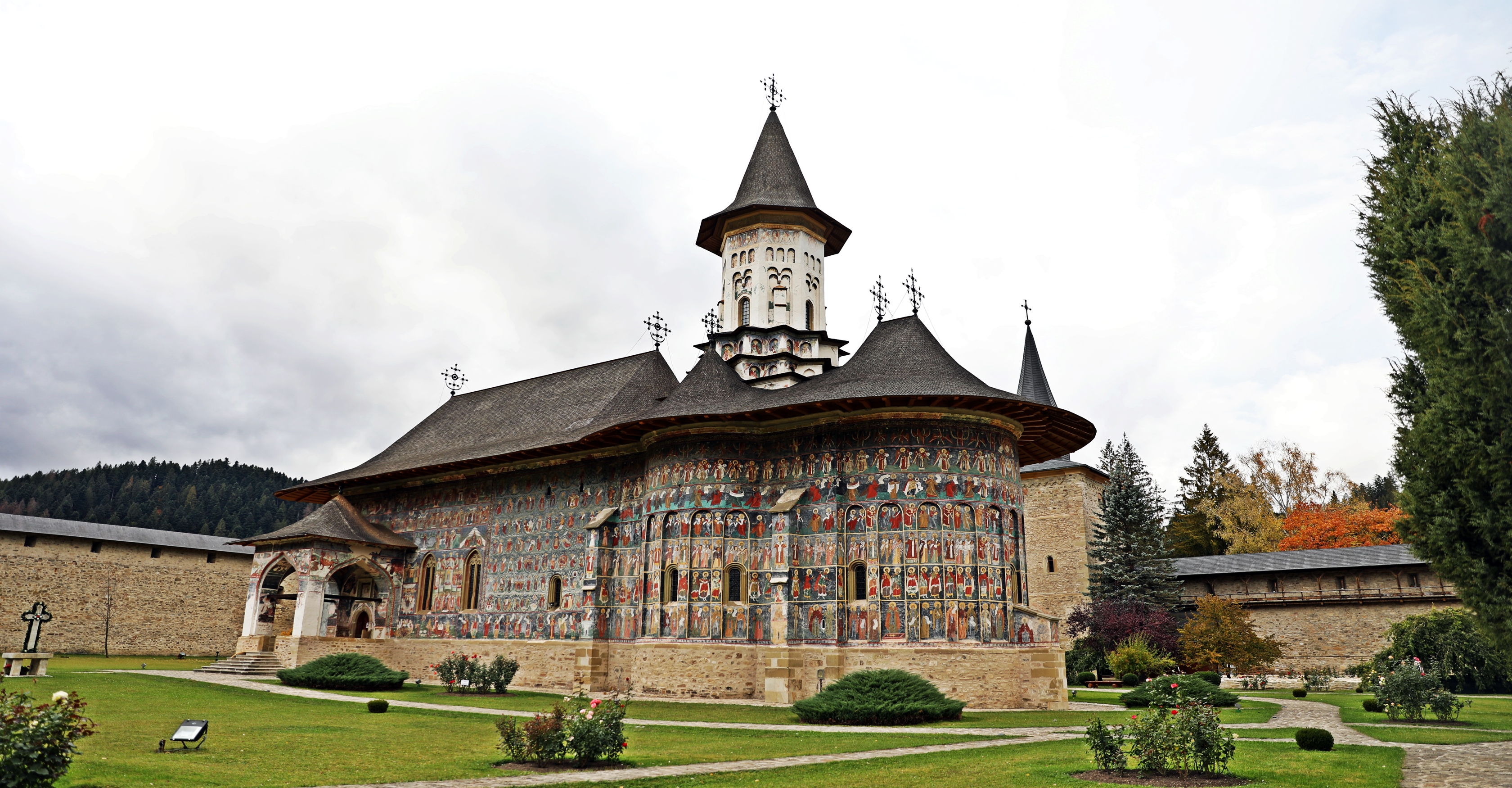
We stepped through the gate of a large stone wall and were stunned by what was inside. Standing in the middle of the courtyard, was a church with the most colourful walls we’d ever seen. This was our first painted monastery and it was one of the prettiest buildings imaginable. What makes them unique are the exquisite paintings that decorate their exterior walls. You can find painted monasteries scattered throughout Bucovina in the northeastern part of the country.

Most of the monasteries were built in the 15th and 16th centuries and are decorated in paintings that illustrate scenes from the Bible as well as portraits of saints and prophets. Some churches have imaginative depictions of heaven and hell. These frescoes were used by priests to teach villagers Bible stories and about Orthodox saints.

We visited eight painted monasteries in the historical district of Bucovina. It’s the maroon coloured section in the map below. As we drove between these eight, we passed dozens of road signs pointing to others. In total there are over 400 painted monasteries in Romania. Eight have been deemed worthy of UNESCO World Heritage status. Some of the ones we saw had this designation while others did not.

Credit: https://romaniatourism.com/

Suceivita Monastery (1581) is fortified by an imposing stone wall. Once inside the gate, our jaws dropped. A very friendly nun greeted us with a wide smile when she saw our reaction. In front of us was a large church decorated in colourful and elaborate murals dating to the 1600s. It’s almost impossible not be mesmerized by this building. It was quite clear how this building achieved its UNESCO World Heritage Site status.

Overhanging eaves protect three sides of the church, but the paintings have almost worn away on the fourth side which gets most of the sun. Surrounding the fortified church are stone buildings that provide residence for the nuns. Between the residence and the church is a perfectly manicured lawn.

Inside, the large church is separated into three successive rooms. A centre aisle takes you from one to the next. As with most of these churches, the interior walls are also adorned with frescoes of Bible stories and saints. Even the thick window sills are colourfully painted. At the front, golden and green picture frames surround the portraits. 


Founded by the Prince of Moldova in 1532, Moldovița Monastery is also a fortified monastery. It is surrounded by a tall, stone wall with vines growing up the sides. A small rose garden and plantar boxes complete the peaceful setting. The nuns and priests in this monastery were very friendly. When we were paying our entry fee, the priest tried to give us his recently purchased plate of French Fries.

Similar in appearance to Suceivita, the large church in the centre is decorated in colourful frescoes. The sunny side of many of these monasteries are faded, but the shaded sides still have restored, not repainted, paintings in vivid colours. We could make out images of saints reading scrolls and carrying crosses. These frescoes were so perfect that we could understand how it received UNESCO World Heritage status.

With almost no windows, it was very dark inside the sanctuary. On top of that, we were there on a very cloudy day which added to the lack of light.


As we were admiring the frescoes that adorn the outer walls of Voroneţ Monastery, we saw a nun walking around the church carrying a large wooden plank called a semantron. You can see her in the lower left corner in the first picture below.

Then she circumambulated again, this time banging on a clacker. It was the most unusual call to prayer we had ever seen. Then we heard voices coming from inside the sanctuary. Some of the nuns were reciting prayers while others sang in response. At the end of prayers, the church bells rang.

The most dramatic paintings at this monastery were on the end wall of the church. There were paintings of heaven and hell and what actions would lead you to either destination. It is a fascinating method of teaching people to be good. This UNESCO World Heritage Site really earned its designation.


Located a few kilometers from the town Gura Humorului, it is one of the original painted monasteries. The building looks its age, but in a good way. The weathered exterior walls only have a few of the retouched original reliefs remaining. Some are of beggars and horses in a series of stories.  It is not in as good condition as the other UNESCO World Heritage Sites, but is worth a visit nonetheless.

The monastery was originally fortified, but the walls of the fortress are now in ruins and only a tower remains. Humor is no longer used as a monastery and beside it is the new white church and monastery.

As we drove around Bucovina we enjoyed the fall colours that blanketed the countryside. We stopped often to take pictures of the stunning scenery. The landscape pictured below is not far from Gura Humorului.


The tall, white Văratec church stands in the middle of a rose garden. Only one wall of the church still has painted murals on its exterior. Around the edge of the complex are less elaborate white buildings that serve as nuns’ residences.

While there weren’t many paintings on the outside, inside is a different story. Every square inch of the church’s interior is adorned with beautifully restored paintings.


We drove through many small towns and villages in Bucovina and saw a large number of stork nests. Platforms were erected on the tops of electrical poles so that storks had a spot to build their nests. Unfortunately we were there in the autumn and the nests were empty. It would be a great area for birdwatchers to visit in the spring.


Unfortunately, the main church in St. John the New Monastery was covered in scaffolding so we couldn’t see its exterior. It’s a UNESCO World Heritage Site so we really wanted to see its walls. We were able to go inside however and found a richly decorated church and plenty of light to see all of the details.

On the grounds around the church is a cute old chapel, a bell tower and monks residence.  The monastery is dedicated to St. John The New of Suceava, who was a monk during Ottoman occupation.

The town of Suceava wasn’t on our side though, as the old fortress in town was also closed for restoration. Maybe it will be open when you visit.


In the small village of Pătrăuți we found the cute Holy Cross Church and a small black wooden bell tower. Built in 1487, only the church and bell tower remain from the original monastery. It has remains of aged paintings on its front wall, but this ruined state makes it more endearing. The colouring of the paint matched the fall colours on the trees behind making it even cuter.

It was shocking to walk inside the small building. While the outside walls are white, the walls and arched doorways inside are covered in very dark frescoes. The condition of the church’s interior made us understand why it is a UNESCO Heritage Site.


Similar in shape to Pătrăuți, Arbore Monastery has not been restored. The original frescoes on three of its sides hint to its 500-year age. There is an old stone gate but, because it was not founded by a prince, it does not have a belfry tower. To us though, the entry gate looks like a belltower anyway. This UNESCO World Heritage Site is not in as great condition as some of the others, but is still worth seeing.

The monasteries are located in the northeast region of Romania called Bucovina. Most of them are in small, rural towns. We drove over 200 km to visit all of these monasteries so reaching them by public transportation would be very difficult. The easiest way to see the monasteries is either by taking a tour or renting a car. We rented a car in Bucharest so that we could tour these and more places in the country. Other options are to fly or even take a train to Suceava where you could then rent a car or join a tour.

Tip – Car rental agencies in Romania require a physical copy of your international driver’s permit. Only a few, smaller companies will rent to you without one.  

Most of the monasteries are open daily from 9am to 6pm. Some have a small entry fee, but others are free.

Which monasteries you want to see and the order will dictate where you stay. You would have a good choice of hotels and guest houses as well as restaurants in Suceava and Gura Humorului, but Sucevita, Voroneţ or Vama would also be good choices.

Tip – Make sure you have a written receipt from your hotel. Since this area is close to the Ukrainian border, officials may stop your car to see your passport and hotel receipt.

If you liked the Painted Monasteries, you may also like reading about Romania’s Wooden Churches.

Read from another device.

Thanks to our friend Florin at Născut Pe Lista Neagră (Born on the Blacklist) for his help in planning our trip to Romania.

Thanks also to Romania Tourism for allowing us to use their map.

Click on the link to read our Travel Tips For Romania.

To read more of our adventures in Romania, click here.

Fediverse reactions

108 responses to “Painted Monasteries of Romania”

  1. All of these monasteries are worthy of much appreciation and study. That said, the Pătrăuți Monastery is the most appealing to my eyes because of its clean lack of busyness. It is more conducive to silent contemplation.

    1. I loved Pătrăuți too because it’s so simple. It would have been covered in frescoes in the day, but for us it just matched the trees. It is very peaceful.

      1. Alistair Luke Avatar

        We recently finished a tour of Romania. Rented a car at Opopeni (Bucharest airport) and drove for 15 days – Transylvania, Maremures and Gura Humorlului. Of the painted monasteries, Pătrăuți was our favourite. Wooden churches – probably leud or maybe Rogoz? If you rent a car in Romania photograph every mark on it when picking it up. Also, be prepared for crazy drivers and very difficult roads. Romania is stunning – wonderful people, amazing food, wonderful scenery and a wonderful and amazing history. The fortified churches, wooden churches and painted monasteries are an incredible bonus.

  2. Good lord what beauty on these walls!!! The artistry that went into painting it all just astounds me. A special region indeed to have so much unesco sites in one area.

    1. I know these buildings are quite remarkable, and there are so many! It was a fascinating visit! Thanks Anna!

  3. Oh wow! What a stunning (and interesting) architecture!

    1. I know, they were more impressive than we could have imagined! Thanks Vanesa!

  4. 👏🏻👏🏻👏🏻👏🏻👏🏻👏🏻🥇🥇🥇

    1. 🙏😊 Thank you!!

  5. Dr. Frances Flint Avatar
    Dr. Frances Flint

    Wow, stunning monastery views! Incredible that so much care and love went into building and caring for these buildings. Thank you for showing this history! Beautiful!

    1. Thanks Frances, they are really lovely buildings and many are still being used. Puts our architecture to shame 😊 Thanks so much, hope you’re well. Maggie

  6. Wow. Now On my to be visited list !

    1. It is completely worth it! And maybe add the wooden churches too, coming next… 😊

  7. Wow, these really are incredible, what a fabulous experience to drive around and study these amazing places. We haven’t seen anything like these painted monasteries anywhere on our travels. Unique!

    1. We hadn’t either, other than the two monasteries in Bulgaria. They are so beautiful, peaceful and very unique. Driving through the countryside is nice too.

  8. I can see how your jaws dropped, how stunning!! They all look like such quiet and peaceful places to visit too. It would be interesting to see the storks nesting, I’ve never seen anything like that!

    1. The monasteries are gorgeous and you’re right they are very peaceful. Especially the ones that still operate as a Monastery. The stork nests are everywhere and their nests are huge! We’d love to return in the spring. Thanks Lyssy! Maggie

  9. How were your senses not overloaded when touring these magnificent monasteries? The nun with the clacker and the stork nests were interesting captures, too! 🙂

  10. Absolutely amazing. I am always impressed by the accomplishments of artists throughout history. Especially when it comes to working in not-ideal conditions without the tools and supplies we have today. Too bad the names and a little history of these artists hasn’t been preserved.

    1. I know it’s very impressive to think of the tools and paint supplies they had. I think the artists did it because of heir devotion not recognition, but they do deserve credit. Most of the ones we saw are so well taken care of even today. It was a great part of Romanian history to see 😊

  11. They are incredible

    1. They are! It was amazing to see them, thanks for taking the time to comment! Maggie

      1. Maggie, I need to take the time to visit )))

        1. Haha yes you do! 😊

  12. Wow, such a surprise, and really interesting architecture.

    1. It was for us too! They are so much more spectacular than we ever expected. Thanks June, Maggie

  13. These are amazing. We saw painted monasteries in Turkey and Jordan which were very impressive but these ones win the prize of the most beautiful. (Suzanne)

    1. Thanks Suzanne, these monasteries are stunning, even the ones that haven’t been restored lately. After visiting many Byzntine and Orthodox churches we thought we knew what to expect, but these are quite unique. Thanks for your comment, Maggie

  14. These are stunning! My grandfather was born in Suceava so this was a nice glimpse into his life.

    1. Oh wow! You must visit. Not only are these monasteries beautiful, the countryside is very pretty and the people are incredibly welcoming and friendly. Maggie

  15. Well, Arbore is not at all similar to Patrauti, it is quite a special plan with its western inverted apse/niche that is believed it was used for the church bell in the beginning. It does not have a spire on the naos so, inside, you will only see two domes, one in the naos and one in the pronaos. Romanian orthodox churches are of several types but they all have the same spaces – pronaos (the space for the young and the women in early Christianity), naos (central space, with or without a tower but always with Jesus Pantocrator as a painting above, space for men) and altar (divided from naos by a wall usually of wood but in early churches made of masonry, with three doors and representation of Crist and all twelve apostles – as in San Marco Venice – being the most sacred space, reserved for the priests and men, forbidden to women, with some rare exceptions). To this group of spaces you may find added to the west a narthex (like a vestibule that is closed) and, sometimes an exonarthex (or an open space as a porch). You may see this in Voronet that was the same type as Patrauti at the origin, in the time of Stephen the Great. His son painted the outside (Petru Rares) and probably his grandson (Alexandru Lapusneanu) added the narthex and had painted also on the outside. Anyway, this extension with the present famous western wall with its final judgment depiction happened just after patru Rares died in 1547. The structure of the space is clear even from the outside like in the other examples and is visible even through the different nuances of the colours used on southern facade. At Moldovita you see the naos with apses and small windows, the naos with two larger gothic windows and the the exonarthex with the open arches. On the southern facade of Moldovita, in the lower left of the two gothic windows is the depiction of the fall of Constantinople. Sucevita has splendid restoration in the late sixties, with reinforced concrete exposed in the reconstructed parts, with new wooden doors and other details of sensible design by a female architect – Ioana Grigorescu. Sucevita has the same succesion of spaces from east to west – altar, naos, pronaos, narthex but has also the small side exonarthex. It is the last of the painted churches and initially was not included in the serial position of UNESCO WH List but added in 2010. 25 years ago i took a nice picture there but it was a printed one and the colours faded a little bit. I scanned and presented it here: https://pozedecat.wordpress.com/2021/01/01/stairway-to-heaven/

    1. Thanks for the additional information on these fascinating monasteries. Maggie

  16. These are amazing, Maggie!

    1. Thanks Jyothi! Maggie

  17. Wow! Just Wow! Amazing painting and craftwork on the churches. Love all of them. I am hardpressed to choose a favorite. What a fabulous trip this must have been Maggie.

    I like the fascinating frescos and paints used on Voroneţ Monastery. This particular monastery seems (to my untrained eyes..) to have more and different shade of blue than many of the others. It not a common shade of blue. I wonder how they got their paints and colors for these fabulous illustrations?

    Love the beautiful Văratec Monastery. Its inside walls frescoes are fantastic!!
    Great photos, I especially like the closeup photos.
    Thanks for the expansive view of Vama, puts everyting in such a beautiful light in the valley as well.

    P.S. Is this area in the Carpathean mountains region!

    As always, thank you Maggie for the remarkable travelog. Safe travels!

    1. I would say you have a very trained eye Suzette. Apparently the blue painted on Voroneţ is the same composition to some of the other monasteries, but since they were all painted on wet plaster, some think the plaster on Voroneţ was wetter than the others. It apparently it is now a colour referred to as Voronet blue, but I had never heard of it before. The paint source were different but sometimes were made from crushed semi-precious stones or minerals.
      We couldn’t believe our eyes when we saw each one of them, but the friendliness of the Nuns and fascinating call to prayer put Moldovița and Voroneţ at the top.
      They are also in the Carpathian Mountains.
      Once again, great questions! Happy Friday 😊 Maggie

      1. Thank you for the additional information, Maggie. It is quite fascinating that the blue has been named after Voronet.. Amazing buildings. Happy Friday!

  18. I am always so amazed at the level of details on these building!!

    1. I know, it is remarkable, and so unlike our North America buildings. Thanks Janice, Maggie

      1. Yeah, we have no patience for details.

  19. Wow, these churches truly are amazing! The interiors reminded me a little of churches and monasteries I visited in Bulgaria but I’ve never seen anything like those exteriors 😮 In some ways I quite like the more faded and damaged ones that show their age, but the detail on the clearer ones is amazing to see. The paintings of Heaven and Hell, and what deeds lead to each, at Voroneţ reminded me of similar paintings we saw on a temple in Luang Prabang – different religion, same ideas 🙂

    1. Oh, I don’t remember that in Luang Prabang, I’ll have to look through out pictures. The interiors did remind us of Bulgaria too, but the exterior walls is what sets these apart. We kind of liked the faded ones too, and in the next post we liked the simpler ones a little more, but all are so amazing to see. Thanks Sarah! Maggie

      1. I’ll check my photos too. We saw similar paintings in a couple of temples there I think.

  20. How fascinating to be able to explore these impressive monasteries. What a lovely guide Maggie.

    1. Thank you Marion, it is an incredible part of Romania’s heritage. Maggie

  21. Fabulous finds and share, Maggie. Great job.

  22. As you have shared some amazingly colorful and intricately designed structures from your extensive travels, it’s hard to imagine finding one that is even more colorful! But it certainly is very impressive. Thanks Maggie; very enjoyable post!

    1. I can’t think of any that are more colourful than these. 😊 Thanks Tricia! Maggie

  23. A very clever and beautiful way of teaching the bible and religious precepts to a population who for the most part couldn’t read. All of them are gorgeous, even the ones that haven’t been restored.

    1. It is both clever and beautiful. The unrestricted ones definitely have their own charm. Safe travels Lynette, Maggie

  24. This is so interesting, thank you! Quick typo alert – you mean prophets (people) not profits (money). Have a a nice weekend 🙂

    1. Yikes!! I’ve changed it, thanks so much for letting me know!!

  25. What an extraordinary number of these churches, Maggie! It gives Bible stories a whole new perspective. Aren’t they wonderful?

    1. We couldn’t believe how great they are. Some are really fun, not like the stoic paintings we were expecting. Thanks Jo! Maggie

  26. Very interesting, it’s obvious how difficult it is to maintain exterior paintwork.

    1. Yes, I think it takes frequent maintenance, but it’s worth it. 😊

  27. Thanks to you for letting us discover these wonders!! 🙏🏼🙏🏼🙏🏼

  28. When I started reading this, I wondered if they had to repaint those walls from time to time due to their exposure to the elements. But then you mentioned that on the sides most exposed to the sun, the paintings have faded. And on the shaded sides, they’ve been restored. I really hope those beautiful frescoes will survive for many more centuries to come because they really look special.

    1. They really are special and it seems that the people realize this. I believe that some of the churches have been barely touched up while others have needed and so received more restoration. It is a unique and beautiful part of their history.

  29. Wow. Ethereal.

    1. Yes, they’re quite spectacular. Thanks Cindy

  30. You are opening my eyes to an area that is so unknown to us and yet not so far away!! I am now eyeing the region up for a visit!!

    1. We really loved Romania, glad we could open your eyes to some of its beautiful places. 😊

  31. I had not heard of these monasteries – they sound magnificent.

    1. They really are. They’re so unique and beautiful. Thanks! Maggie

  32. Oh my gosh Maggie, I absolutely am mesmerized by your shots of the Suceivita Monastery and the other painted monasteries in Romania! 🛕💖🕍📸🕌

    1. Thanks Kym, they are stunning 😊

      1. You’re very welcome and indeed they are. 🥰🥂😍

  33. Wow. These are just extraordinary.

    1. They are! Puts our boring buildings to shame 😊

  34. Oh wow, these monasteries are phenomenal! The level of detail in the paintings is astounding. I had no idea these monasteries existed, thanks for the tour and the introduction 🙂

    1. They really are astounding, glad to bring them to your attention. It’s another hidden gem in Romania 😊

  35. Wow they are absolutely incredible. What special, special places. Can I ask a question – you guys seem to really explore a country in depth when you visit, do you manage jobs while you’re on the road or just plan your holidays super well? I never find myself with time to see and do all these amazing things 🙂

    1. Well our secret is… we’re retired! We retired early so that we could travel. We spend weeks or months in a country allowing us to see a lot more. 😊

  36. A good account and travel guide! A nicely articulated piece!

    1. Thank you for your kind words. 😊 Maggie

  37. Oh those are incredible! I can’t imagine the time and dedication it must have taken to add such beautiful details to these monasteries. More and more I am falling for Romania in your posts 🙂

    1. There are so many different and wonderful places to visit in Romania, we were frequently stunned 😊

  38. These are absolutely incredible. How much time and dedication must have gone into that… wow. Can’t believe I didn’t know about them before now.

    1. They really are stunning and you’re right, so much time and dedication. It’s mind boggling 🙂 Thanks for your comment 🙂 Maggie

  39. Amazing buildings. Thanks for sharing Maggie!

    1. Thank Katelon, they are quite spectacular 🙂 Maggie

  40. Arbore church ( technically a church now) is designed to follow patterns from the sun. Around the Easter period sunlight from the sunset falls on the altar itself. There was a really cool book about this church and the sun. Arbore church has been desecrated by the Ottomans and is missing many faces. Fun fact: the ottomans removed faces that were not in the Quaran. The opposite thing that was done in Spain by the Maurs .

    1. I didn’t know about the Ottoman damage, but am not surprised. It was actually one of my favorites. Thanks Stefan, Maggie

  41. OMG they are gorgeous! I want to see them all! This reminded me of our road trip to visit the painted churches of Cyprus – very plain on the outside but beautiful inside.
    Alison

    1. They are stunning! And there are so many of them! You would love them Alison! Maggie

  42. […] Hanging on one of the walls is a wooden plank (semantron) that is banged with a mallet during the call to prayer. We saw one of these previously when we visited the painted monastery in Voroneţ. […]

  43. I returned to make another comment about these churches. It is specific for Moldavian churches to have slender spires on the naos as they use a special structural sysem named Moldavian vaulting that makes possible to start from a square and reduce the area by adding vaults rotated 45 degrees over the pendents of the first arches. Detalils here: https://en.wikipedia.org/wiki/Moldavian_vault Actually this system is the origin of the image used on the small insignia marking historic monuments in Romania. The graphic symbol for these plaques signifies a plan of a naos and its vaulting – https://ro.m.wikipedia.org/wiki/Fi%C8%99ier:Monument_istoric.svg

    1. Thanks for the added info. 😊

  44. Such lovely posts on important and beautiful Romanian sites, delightful to admire the photos and read the information about places so close to where I live, and quite well documented! 😀 It is interesting, you know, Sucevița and Moldovița are in fact names coming from Suceava and Moldova, they are diminutives, with that -ița suffix, and sound so cute, the monasteries are splendid to visit and photograph, especially in spring! 🙂

    1. These monasteries are so pretty and unlike any I’ve ever seen before. Where are located? If you’re close I would suggest a trip to see them 😊 I hadn’t even realized they were diminutives, but you’re right and it is a cute way to name things. I wish English had it 😊 Thanks Nicole, and sorry I’m slow with reading your posts. We’re traveling now and I’m finding it very difficult. Maggie

      1. Oh.. I have visited all of them more than once, especially when my son was a little kid, we used to tour Bucovina during the holidays. We live in a county near Suceava, so it is.. our next door neighbour, that beautiful region 🙂
        About my posts, dont’ worry, I have posted much less frequently lately. Wishing you happy travels!

        1. Lucky you 🙂

  45. Thanks once again for some interesting stories of well preserved sites. So many stories on those artful walls… I wonder if any have to do with the villagers and their history, or just religious warnings and doings of the rulers.

    1. I think some likely had to do with local customs, but most were Bible stories, saints, ten commandments etc. They are such a fascinating part of the history.

  46. These painted monasteries look stunning. That’s so cute how the priest tried to give you his French fries!

    1. The people of Romania are so friendly. That priest story is just one of many examples.

  47. […] To read more about these colourful monasteries in Romania visit our post Painted Monasteries of Romania. […]

  48. i’m blown away! I must return to Romania just to see these monasteries I had no idea! The painting on the outside is really unique

    1. They were really fantastic Andy! We were completely blown away too 😊

  49. Very unique and amazing the work and time that went into all this.

    1. It boggles the mind how much effort it would have been to design and paint these churches. They are really unique and beautiful. Maggie

  50. Thank you so much for documenting this amazing artwork and worship work.

    1. You’re welcome. Glad you enjoyed it 😊

  51. Simply magnificent! The last one has worn out but we can see how the paintings are in their original state.

    1. We were stunned at each one we saw. It is definitely worth a visit to see them. Thanks Len! Maggie

  52. […] Coming Next – Romania’s Painted Monasteries […]

We'd love to hear from you, please leave a comment.

Destinations

Discover more from Monkey's Tale

Subscribe now to keep reading and get access to the full archive.

Continue reading