
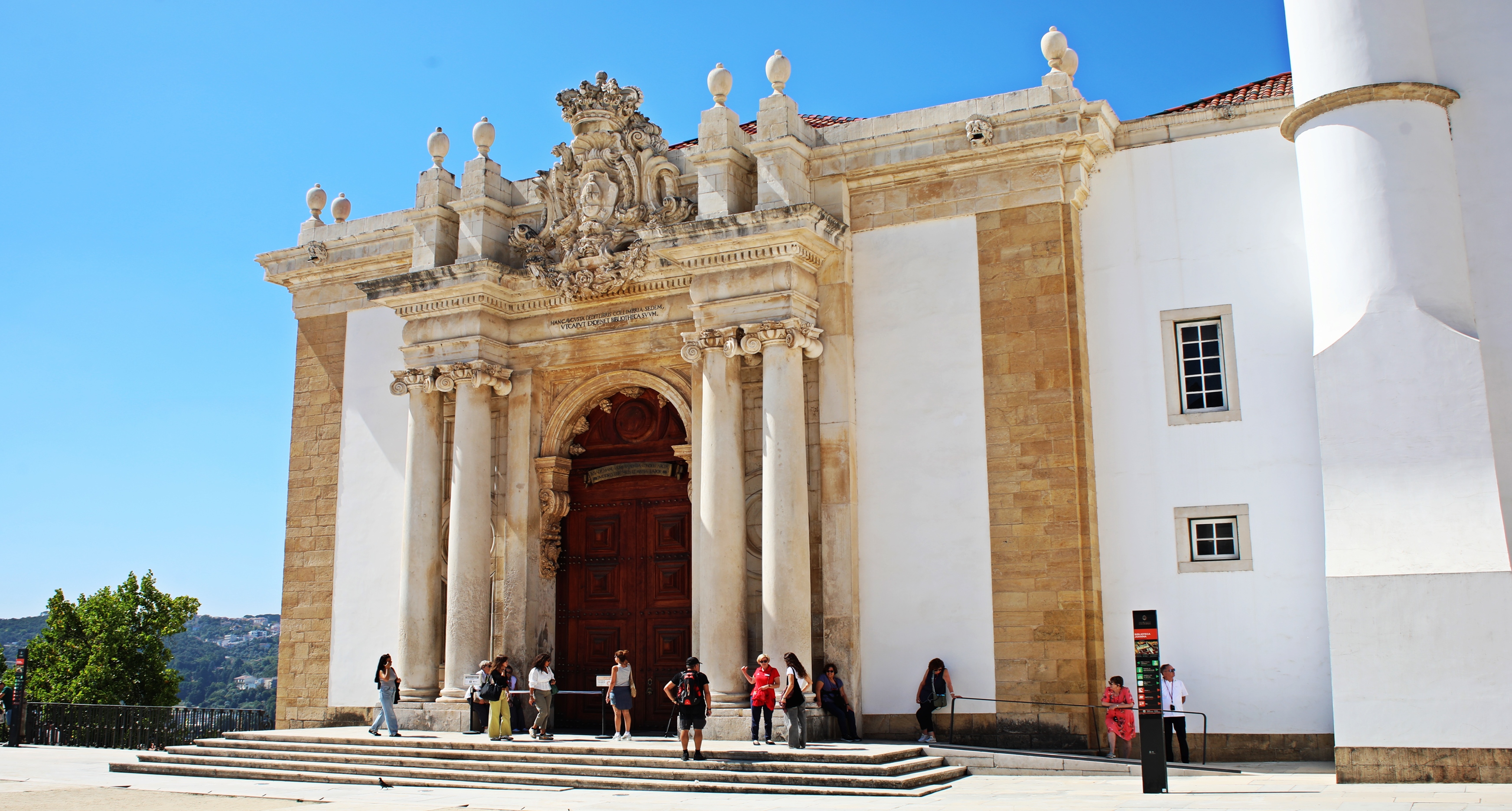
Since it was the first capital of the newly formed Portugal, we knew Coimbra would have wonderful architecture. As we discovered it definitely does, especially the elegant royal palace. The unusual fate of these regal buildings is that they would end up being a part of a university campus. As we explored the University of Coimbra’s lovely historical buildings we couldn’t help but think of the lucky 16th century students who were able to study inside the former royal residence and read books in the lavish library.
At the end of the 13th century, King Dinis founded the University of Coimbra. This date makes it the oldest, continuously operating university in Portugal, and one of the oldest in the world. In its early years, the school had faculties of theology, law, medicine, and literature. Initially it was independent, but after a short while it merged with a Jesuit college.
In the 16th century the university was moved from Lisbon to Coimbra by King João III. Coimbra was the first capital of Portugal so therefore, it was already filled with wonderful buildings, including the king’s palace. Since the capital had already been moved to Lisbon, what better use of the beautiful Alcaçova Palace than as a centre for higher learning. That is how it came to be called Palace of Schools (Paço das Escolas).

The Palace of Schools is comprised of Joanina Library, Capela de São Miguel and Royal Palace. They form the border of an open area called Courtyard of Schools. It is this complex where the original university buildings can be found.
Joanina Library
The most brilliant of these is Joanina Library. It was founded in the 1200s, but the current library building is from 1544. This UNESCO World Heritage Site is said to be built on the money brought back from Brazil’s gold mines in places such as Ouro Preto. (You can read about our time in Ouro Preto here).


We entered the building on the ground floor where we found an unusual group of rooms. The Academic Prison was housed on the main floor and was exactly as it sounds. Students, faculty and staff who were convicted of crimes were locked in cells in this building each night. It was done in order to protect them from staying in a general prison. There must have been quite a few convicted criminals among the student body and staff though to warrant so much space.
The best part of this building is its lavish top floor, called The Noble Floor. Three long, connected rooms hold two stories of book shelves. In total there are 60,000 volumes of books from the 15th-18th centuries. Between each room are elegant arches adorned with royal crests.
Pictures aren’t allowed, but we have a few to show you from the University’s website.

The oak shelves and balustrades are gilded with leafy decorations. Oak is the preferred wood because it doesn’t attract insects which helps to protect the books. They are further protected by the building’s design. It was built as a vault with walls over 2 metres thick to prevent moisture and temperature fluctuations. The most unusual thing that the library does to protect the books is its use of bats. Each night after closing, the furniture is first covered with sheets and then bats are released to circulate through the rooms. Their job is to feast on any bugs that may have entered during the day.


Not only are the shelves and arches richly decorated, even the ceiling deserves your attention. It is painted using a series of boxes and designs that give the illusion that it is even higher than it actually is.

Capela de São Miguel
Not to be outdone, its neighbour, Capela de São Miguel (St. Michael’s Chapel), also has a beautiful interior. This small chapel packs a lot of decor into its small space. A golden organ decorated with angels hangs on multi-coloured tiled walls. More colour comes from the many side altars along these walls.


Royal Palace
Standing at the head of the square is the former royal residence. Alcaçova Palace, commonly called Royal Palace, was the residence of the first Portuguese king. It continued to be one of the royal family’s homes for the next few generations. The palace buildings were purchased by the university when it was converted to a school.
There aren’t many of the original palace rooms anymore, but the few that are left, are quite fabulous. The Throne Room, now called Graduates’ Hall (Sala dos Capelos), is the grandest. Hanging from its walls are 17th century portraits of Portugal’s kings. Above them is a wooden ceiling with beautifully carved royal crests. Today the room is used for university ceremonies and academic events.


At the side of Courtyard of Schools is Porta Férrea (Iron Gate). It separates these royal buildings from the general university. Most of the buildings on the other side of the gate are 19th and 20th century, but were built in a grand style.


In addition to the buildings, the university has an interesting old custom called Praxe. It is a set of rituals and customs based on the school’s history. These customs are said to be one of the main reasons students want to attend the university today. We were lucky to witness some of those traditions.
Without planning, we happened to visit the university on the first day of a new school year in September. First we saw a group of students carrying signs. Many of these students were tied together by a long rope. Other students were dressed in traditional black suits and long capes. They were yelling orders at those tied up. We later learned that they were law students and the ones on the ropes were first years, while the ones in capes were returning students. We don’t really know what was being said, or what the point was, but even those tied to the rope seemed to be enjoying the experience.
Old Town Coimbra
We didn’t know what to expect from the rest of the city, but were pleased to find a very nice historic centre that filled in the slopes of the hill and much of the land below the university. A block away from the university are the new and old Cathedrals of Coimbra. With tall stone walls and golden side altars, the New Cathedral was similar to most other churches. What is different though is the elaborate choir. Ornate golden frames with portraits of saints are hung above the wooden choir benches.
It is believed that this church’s outer façade inspired the design for the cathedral in Salvador, Brazil, commonly called Terreiro de Jesus. You can read about this church in Salvador here.


On the street below the new cathedral is the Old Cathedral of Coimbra (Sé Velha de Coimbra). Built in the Portuguese-Romanesque style, the12th century church is the only one built in this style that is still standing in Portugal. Its rounded back is said to be typical of this style. From the front it looks a little like an old fortress with crenellations on its walls. The church is a little worn out, but was likely quite elaborate in its day.


At the bottom of the hill is Barbican Gate which was once an entrance to town. Today it lies between Old Town and the pedestrian mall, Rua de Ferreira Borges. This busy pedestrian street has mostly 17th and 18th century buildings on its sides and is a popular shopping street.


Santa Cruz Church & Monastery is at the end of the pedestrian street. It has a very ornate façade, and an even a more elaborate interior. The nave is wrapped in azulejos that are painted with religious scenes, battles of the crusaders and cherubs.
The church’s organ is unique because it has 4,000 pipes and only four organists are trained to play it.


Old Town fills in the hillside between this street and the university. You can walk up and down the labyrinth of cobblestone streets to find many more charming scenes.


The historic centre extends all the way to Mondego River where Largo da Portagem (Place of the Gateway) sits just in front of Santa Clara Bridge. This square is filled with more gorgeous heritage buildings and statues. From the other side of the bridge are great views of the city as it climbs the hill to reach the university on top.


On the other side of the university is St. Sebastian Aqueduct. This 16th century waterway was built on the site of a Roman aqueduct. Historically, it provided water to the upper parts of Coimbra.

How to visit the Historic University Buildings
Only some of the university buildings are open to visitors, and a ticket is required to visit. There are different types of tickets and passes, but make sure you buy a pass that includes the library since it is the most beautiful building in the library. You can buy tickets on-line in advance. We didn’t purchase ahead but in September it wasn’t necessary as we were able to buy tickets for the same day.
How to get to Coimbra
From Lisbon the 200 km route can be covered by train from Lisboa Oriente Station or bus. From Porto it is 140 km. You can take a train from Vila Nova de Gaia or bus from Porto. You can easily drive to Coimbra, but don’t plan to drive in the historic centre.
Where to stay in Coimbra
The large university city has many choices for hotels and apartments. Find one that is walking distance to Palace of the Schools, or to Rua de Ferreira Borges. If you have a car, make sure your accommodation has options for parking because close to the centre, parking is limited.
The first map below is of the entire country. The second map is an expansion of the northern half. You can click on either for a closer look. You can find Coimbra near the middle of the second map.


This article is now featured on GPSmyCity. To download this article for offline reading or create a self-guided walking tour to visit the attractions highlighted in this article, go to Walking Tours and Articles in Coimbra.
To read more of our adventures in Portugal, click here.
Coming Next – Day Trips From Coimbra
For pictures from other blogs go to Gallery at monkeystale.ca
To read about more of our adventures go to Destinations.
If you like what you read, please comment or share (with credit) using the links below.





We’d love to hear from you, please leave a comment.