Trekking through the High Atlas Mountains in Morocco allows you to see another side of this varied country. Tall, snow-covered peaks hover above modest mountain towns. In addition to the scenery, the local Amazigh (Berber) people will welcome you into their homes and allow you to see their way of life. Hiking the Two Valleys route is a truly unique hiking experience.

On the drive from Marrakesh, the High Atlas Mountains slowly revealed themselves to us, making our excitement for the hike grow. The Atlas Mountains travel 2,000 km (1,200 mi) from Morocco to Tunisia. Its tallest is Mount Toubkal (Jebel Toubkal) 4,167m (13.671 ft). It is the highest mountain in Morocco and the 3rd highest in Africa behind Mt. Kilimanjaro and Mt Kenya.

The links will take you to our stories about climbing those mountains.

An hour and a half after leaving the busy city of Marrakesh, we were in the quiet town of Imlil (1,740 m/5,700 ft). It looks like a typical mountain town in an underdeveloped country. The hilly streets are crowded with jeeps parked in front of guiding and outdoor gear shops. In fact, the downtown district is purpose-built, exclusively for the mountain tourism industry. Residents live in one of the many Amazigh (Berber) villages that climb the hills around it, most of whom work in tourism.

Distance – 15 km (9 ¼ mi); Elevation – 500 m (1,640 ft) gain and 300 m (984 ft) loss; Time – 4 hrs walking plus breaks.

Finally, it was time to begin our trek. As we climbed the steep trail out of town, we looked back for better views of the snowy Toubkal Range. Even on a cloudy day, it is a pretty picture with the town of Imlil sitting in the valley below.

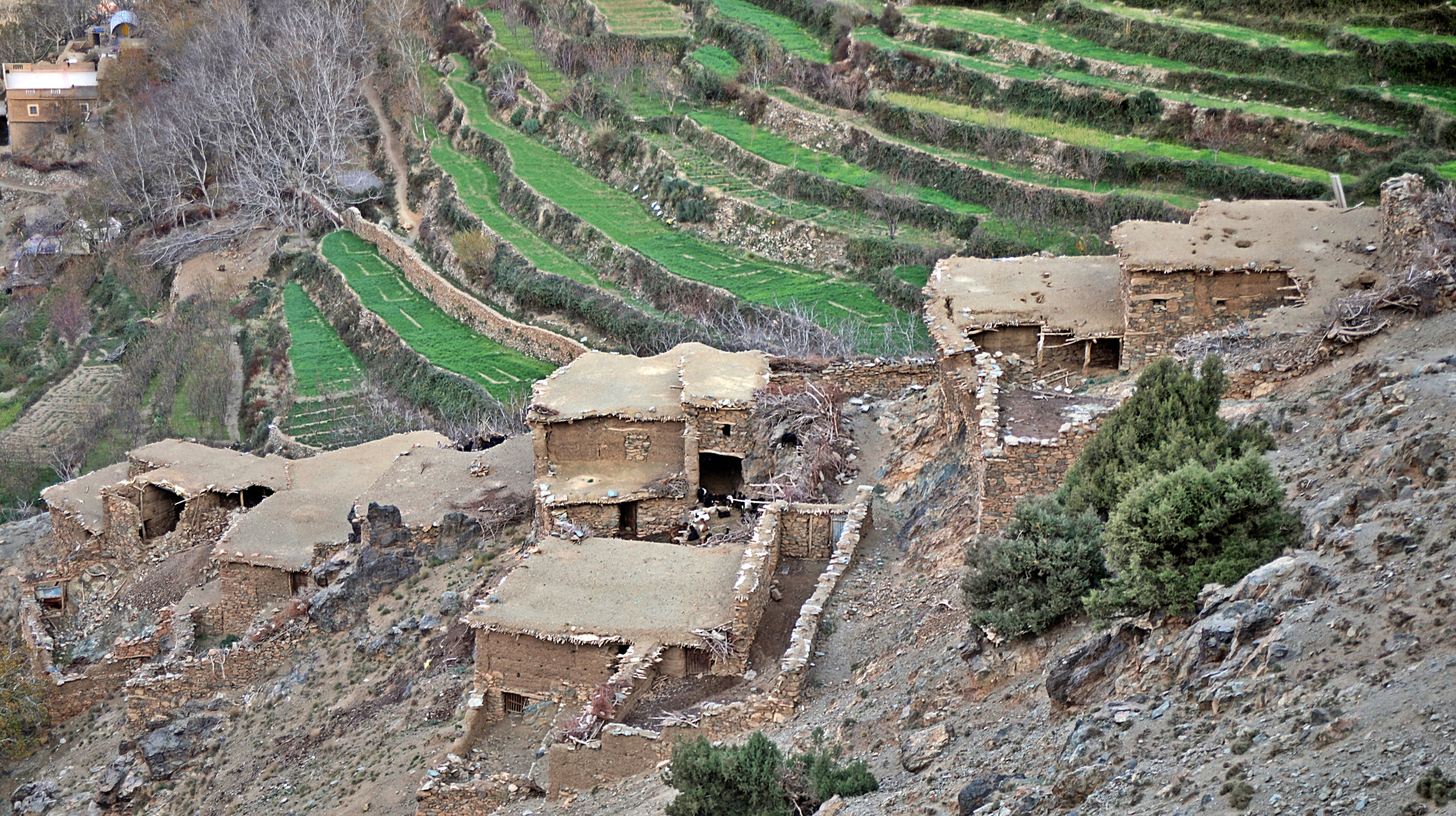
As we rounded the side of the ridge, we saw red sandstone mountains ahead and mud homes of Amazigh villages near their bases. Each family in these villages owns a plot of land where they garden. In the summer and fall, they grow turnips, corn, wheat, barley, cherries and apples.

Each family also has their own small walnut orchard. The nuts are harvested in the summer. They are not paper walnuts that can be cracked by hand. In order to crack them perfectly, the nuts are soaked in water for 1 or 2 days. After soaking, they are easier to open without breaking the nuts into a million pieces.

The higher we got, the colder it was. The sky was quite cloudy, and the wind whipped through our clothes. Spanish juniper and pine trees dotted the hills and soon we were walking in a sparse forest of them.

At the top is the very windy pass called Tizi Oudite (2,200m/7,220 ft) with views of Mount Toubkal’s snowy range. Other than Toubkal and its chain, the mountains are not high. They are more like hills than high mountains.

From the pass, we descended all the way down the valley, losing almost all the elevation we gained. Ait Oussadene Valley (also spelled Azzaden) is home to 4 or 5 Amazigh villages. Each is built into the side of the mountains. Ait Aissa village at 1,900m (6200 ft), would be our home for the night. Between the snowy ridge of Mt. Toubkal, walnut orchards and garden terraces, it has a lovely setting.

We stayed in a local guesthouse that was decorated in Amazigh designs on the crown moulding and ceiling. Tiled archways separate the living and dining areas. The pillars look wooden but are actually sculpted plaster. It was so nice to see the interior of these homes. Our guide said the decor is typical in this region.

He explained that all of the people living in the High Atlas are Amazigh. When the Romans arrived in North Africa, they called the local people Berber, which means barbarian. Next, the Arabs took over Morocco’s land and the Berbers retreated to the mountains and desert. They prefer to be called Amazigh which means ‘free life’ in the Tamazight language. Their alphabet, originally from the 4th century BCE, was only re-discovered 25 years ago. Under Arab rule, the alphabet, but not the language, slowly disappeared. Today it is taught in schools, but many of the older generation can’t read it.

We saw the Amazigh symbol throughout the country, it means freedom.

Amazigh Symbol
Amazigh Symbol – credit: Wikipedia

The houses may not be luxurious, but many of these humble homes have small hammams (saunas). They look like small copulas sitting in their yards.

We found it fascinating to walk around the village and see the homes built on the steep slopes. There is a mix of older compressed mud and newer cement and brick houses. Many of the old mud homes have been abandoned and were falling apart. In September 2023, a 6.9 magnitude earthquake struck Morocco’s Atlas Mountains, less than 60 km (35 mi) from Imlil. Most of the homes in this region were built with mud bricks and many collapsed. Almost 3,000 people were killed, and over 5,600 injured. On the hike, we saw a lot of rebuilding. Homes that were previously mud are being rebuilt with re-bar, reinforced concrete and brick. The government is providing financial assistance for temporary housing and to rebuild. It’s a long process though, and many people are still living in tents.

Distance – 15 km (9 ¼ mi); Elevation – 600m (1,970 ft) gain and loss; Time – 4 ½ hours.

Before the sun rose above the peaks, we left our cute guesthouse and began walking up the valley. We passed a few small mud villages that appeared to be clinging to the slopes high above. Their red earth colouring blended into the mountain walls. The last Amazigh village in this valley is Tizi Oussem. It received extensive damage in the 2023 earthquake. Men were already out rebuilding a house as we passed through.

As we continued to walk up the steep slopes above Tizi Oussem, we passed a couple of summer villages. Farmers bring their sheep and goats to these huts from spring until fall. They sustain themselves by growing vegetables. Before leaving, they plant barley in the garden terraces. The fields are covered in snow over the winters, so in the spring, the barley regenerates and can be harvested.

At one point we could see Tamsoult Refugio. It is used in the spring and fall by groups summiting Mt Toubkal.

From there, the incline was steady but more gentle as it worked its way toward Tizi n’Mazik (Pass). We found ourselves in another sparse forest of juniper trees, leaving the villages far below. The pass gave us a great view of Mt Toubkal and the villages that fill in the edges of Imlil Valley. The main one in the centre is Imlil. Although they are very close, each village has a different name. The largest village is Aroumv. We are going a little further up the valley, to the village of Aroumd.  

From the pass, the descent was very steep on loose gravel through a sparse forest of pine and chestnut trees. Goat herders were taking their animals up the hill to find food.

Eventually, we reached Imlil Valley where we had a great view looking up to Mount Toubkal’s main summit (4,167 m/13,671 ft).

We stayed in a guest house in Aroumd at 1,900m (6,250 ft). It’s only a few hundred metres higher than Imlil, but it was very chilly at night. Our guesthouse owner lit a fire in a woodburning stove, and we all gathered in the main room for tea with the family’s cat.

Distance – 10 km (6 ¼ mi); Elevation – 300m (985 ft) gain, 500m (16, 40 ft) loss; Time – 3 hours. Distances and elevations are approximates.

Around is directly beneath Mount Toubkal, so our route in the morning wound its way between huge boulders below the tall peak. It wrapped around a hill to enter Toubkal National Park where we crossed a forest of fir and pine trees. The government planted these trees to stabilize the slope and to provide trees for birds. The forest also had shrubs we weren’t familiar with. Their branches fan out like paintbrushes. They turned out to be ephedra, which is used in cold and weight loss medications in some countries.

A little further on and we found ourselves on a ridge right above Imlil. From there we could see Tizi n’Mazik, the pass we were on the day before.

Once back in Imlil, we went to the Women’s Argan Oil Cooperative. There are argan stores in most Moroccan cities, but most in the tourist areas don’t sell pure argan. In fact, what they sell is often mixed with olive oil or other cooking oil. Going to this cooperative with our guide, we are confident that we bought 100% argan. It wasn’t cheap at 100 ml for 200 Dirham (€19). You can find these cooperatives in many places in the country, they are usually a safe store to buy quality products.

While the scenery is nice, it’s not spectacular. Walking through the Amazigh villages and learning about their culture and history made the trip more than worthwhile.

Other treks – There are many other treks to do in this area. Depending on conditions, length of time you have and season you may be able to hike to the summit of Mount Toubkal.

Our guides – We used Trek Atlas for our 3 day-2 night trek through the Two Valleys. It is a locally run mountaineering firm. The owner, Ahmed, as well as our guide and cook were very experienced, professional, and spoke English. The food was very good, and we stayed in lovely guesthouses. We highly recommend them if you want to do a short or long trek in the High Atlas. Here’s a link to the Trek Atlas website. We do not receive compensation for this recommendation.

It is possible to hike independently, it would just be more difficult to find accommodations, but many can be found on Google Maps.

The mountain town is only 60 km from Marrakesh. You can reach it by private or shared taxi. The Grand Taxi stand is near Jema El Fnaa Square. If you hire a guide, the transfer to and from Marrakesh is usually included.

You can find Imlil in the lower left area of the map below. Click on the image to be directed to an interactive map.

Map of Morocco
Read from another device.

Click on the link to read our Travel Tips For Morocco.

To read more of our adventures in Morocco, click here.

Fediverse reactions

110 responses to “Two Valleys Trek In The High Atlas Mountains”

  1. For me a tempting destination. Maybe one day… Thanks for sharing, Maggie.

    1. It combines two things we love to do. Explore nature and culture. You’d like it too 😊 Thanks! Maggie

  2. Thanks for sharing this fantastic part of your Moroccan visit. Very interesting reading about it and it seems you really enjoyed it, too.

    1. Thanks Lynette, it was a great way to better understand the people.

  3. As always, I was fascinated by your post and photos.
    Thanks for sharing another fabulous tour, dear Maggie.

    1. Thank you Luisa, glad you enjoyed hiking in Morocco with us. Maggie

      1. It was a real pleasure!!!

  4. The Amazigh people are apparently quite industrious, resourceful people to be able to live and thrive in such challenging conditions.

    1. They are, and hardy.

  5. I wouldn’t be able to tackle such a trek so it was a real pleasure to enjoy it vicariously through you. As well as the mountain scenery I loved the pretty room in the guesthouse, and it was really interesting to learn more about these people and their traditions.

    1. It was a great way to learn about their way of life. You can still get great mountain views from the road and see some of the interesting villages.

  6. Amazing scenery

    1. It was a surprisingly beautiful part of Morocco. Thanks Sheree


  7. Fascinating trek, MT, and excellent descriptions and photos. Thank you for this wonderful tour.

    1. Thank you Jet, glad you liked the views. Maggie

  8. Very nice scenery. We drove through the High Atlas but didn’t hike. (Suzanne)

    1. Thanks Suzanne, the scenery is nice and meeting the locals was the best part.

  9. Thanks for this, Morocco is on our travel list 🙂

    1. Oh great! There are so many amazing places to see in the country. Thanks June

  10. You saw so much in your time there, Maggie. It’s not a place I could easily envisage living but you’ve given us a real sense of life in those mountains xx

    1. No, I couldn’t live there either, but it was a great way to see how they live in this modest mountain homes. Thanks Jo

  11. Gorgeous through and through

    1. It it beautiful mountains scenery, thanks Selma

    1. It’s a great part of Morocco, thanks! Maggie

  12. Thank you for this beautiful tour of The Atlas Mountain hills and valleys. The photos are outstanding.

    My hats off to you both for what I imagine was some gruelling and steep treks in the Ait Oussadene Valley!

    Loved the tea pouring video, totally what I imagine of the area/region’s iconic culture and customs.

    Safe travels to you both. A great share, I enjoyed the brilliant sunshine in your photos. I know you mentioned the cooler weather due to altitude but the sunshine looked awesome.

    1. They were steep ups and downs, but lots of scenery to distract us from the struggle. 😊 I loved the tea pouring every time, and they really do it for every single cup!
      Thanks so much Suzette!

      1. Awesome. I did not know they poured that way for every cup…lovely!

  13. Seems quite tough to live a free life …

    1. It is a difficult life indeed, I’m not sure if the motto still rings true for most of them anymore.

  14. A world apart from the one we live in.

    1. It really is a tough life. Thanks Rosaliene

  15. What a cute guest house you stayed in and I agree, it doesn’t look spectacular, but interesting to read about the Amazigh and the origins of the word, Berber.

    1. It was the mix of nature and learning about their lives that really made it worth while. Thanks Mallee

  16. A rugged barren landscape Maggie and likely not one you would want to trek through in the heat of summer, even though it is cooler at altitude. Like you said, the visits and experiences of meeting local villagers are the parts that count most. Happy Friday the 13th. Allan

    1. Nor cold of winter. It was very cold at night in November, February would be even colder with only one stove in the house for heat. The hike was a great way to learn more about the local people and how they live. Thanks Allan

  17. Wow, these photos are amazing! 🏔️ The mountains look so huge and powerful, and I love how you captured all the little details in the rocks and plants. The colorful villages really stand out against the wild landscape — it makes me want to grab my hiking boots and go explore! Awesome job! 👏

    1. Thanks Mike, it is a great are for hinking that combines wonderful nature with the local cultures. Thanks so much! Maggie

  18. Your posts are always fascinating, Maggie. Thank you for the info and stunning photos. I love the mountains.

    1. Thanks Mary, we try to hike in the mountains of any country try we visit because we love them too. 😊

  19. We haven’t done a long distance trek here but the shorter ones we did were so enjoyable, especially learning of the Berber way of life as you did. It’s so different from so many other parts of Morocco.

    1. The best part was to meet the local people in their small villages. What a tough way to live.

  20. Very impressive, Maggie. Definitely an arm chair travelogue for me.

    1. Thanks for coming along Pat

  21. Hiking through the valleys and staying in small villages, away from the main tourist attractions seems like a great way to get to know a country’s culture and residents. Looks like you had a wonderful experience.

    1. It was a great way to get a better understanding of their lives. They are so generous and yet don’t have much. It was a wonderful few days. Thanks Tricia

  22. I loved that trek, Maggie, and I’m not tired at all. Great descriptions and photos.

    1. Haha, thanks for coming along beside us 😊

      1. And my friend from Winnipeg agreed with you about long weekends. She said there were 2 months that didn’t have any, so they made up two reasons, Jean Lesage (?) and I can’t remember the other one. You win.

        1. Family Day 😊 I grew up in Winnipeg!!

  23. Although the landscape is a little bleak, it’s a beautiful trek that allowed you to come into direct contact with the traditional population. Very interesting.

    1. Walking between the small villages and meeting the locals was the best part of the hike. They are very warm and welcoming despite their harsh living conditions. It was a great experience.

  24. I have just ‘visited’ the Colca canyon in Peru thanks to Michaela and Phil of thehungrytravellers.blog and next opened up yours to this incredible journey in the Atlas Mountains – I feel cold but thoroughly enchanted and excited by what you have shown – thank you!

    1. Glad to have kept your adventure going 😊

    1. It’s a fascinating walk

  25. Sounds like an amazing trek. I don’t think I am strong enough to do it myself so I really appreciate tagging along virtually.

    1. I’m glad we could show it to you then 😊

  26. Wow! In one of your previous posts the Atlas Mountains looked short and dry, so I’m surprised to see them snow-covered and jagged. I’m also surprised to see them be simultaneously snow-covered up high and so barren just beneath.

    What a great trek!

    1. These are the High Atlas, it was probably Middle Atlas you saw before. It’s an interesting landscape isn’t it? Very dry, but they get a lot of snow in the winter. You can usually climb Toubkal, the highest, but the route was damaged in the earthquake last year and hadn’t been reset yet.

      1. Ah okay, that makes much more sense.

  27. Thank you for taking us along on your trek. I didn’t know this was a popular activity in Morocco. Nor did I think that there would be much snow on the mountains. Do they have a snow cover year-round or did you happen to be there during the season when snow sticks around?

    1. We were there in November so this is fresh snow. They get quite a bit of snow in the winter. There’s even a ski resort on the other side of the ridge from Imlil.

      1. Wow, I had no idea!

        1. Neither did I!! 😊

  28. I loved following you on this trek. Thank you.

    1. Thank you, glad you came along 😊

  29. Fantastic trek!

  30. Love the Amazigh Village photo and would love to do this trek, Maggie. The landscape is so rugged, but the terraced farm reminds me of SE Asia and some of your other valley photos of Peru. Thanks for sharing, Nilla

    1. The terraces rdminded us of Peru too. Walking between the villages was great way to see how the locals live. You’d love it.

      1. I definitely would and I loved travelling through Morocco, just not the badgering (as we spoke of before).

  31. How lovely, I imagine the Atlas Mountains provided a lovely retreat away from the populous cities. A wonderful trek.

    1. It was a great break from the city and walking between the villages made it even better. Thanks Hannah

  32. This is really neat! It’s so cool to see the homes blended into the hillside, almost camouflaged. What a cool experience to see Morocco away from the large cities.

    1. It is a fascinating part of the country. We enjoyed it much more than some of the big cities. Thanks Theresa!

  33. Enjoyable and interesting read Maggie, as you say the scenery may not be at the top end but I imagine it was rewarding immersing yourself in the culture of the Berber’s for a while and walking through their landscape. 😀

    1. Walking between the villages and seeing their way of life was the best part of the hike. Thanks Jim. Are you watching the news? Hopefully they are showing picturesque shots of Kananaskis for the G7 to get you excited for your trip!

      1. I know our PM flew in overnight, it’s early Sunday morning here so no doubt there will be something on later, sadly it’s all death and destruction on the news at the moment.

  34. The hike sounds like a great way to enjoy the Atlas Mountains and see some of the smaller authentic villages along the way. It’s too bad that the 2023 earthquake caused a lot of damage to this area though. Did you try one of the saunas?

    1. No unfortunately. Neither of our guest houses had one, but I also think they wait until winter to start heating them. We were there in November.

  35. These mountains are absolutely stunning 😍. It must have been an amazing experience hiking there.

    1. It was a really nice hike, thanks Melodie!

  36. I am loving Morroco through your blog, Maggie. The mountains and valleys are amazing and picturesque. And the journey going there must be a wild and interesting adventure. This shows that the world offers abundance and beauty. Thanks so much for sharing!

    1. Thanks so much Hazel, glad you’re enjoying Morocco with us. 😊 Maggie

      1. It’s always my pleasure, Maggie. Stay adventurous and amazing!

  37. You both are getting to know Morocco much better than I do, if we take into account that I lived three years in that beautiful country. 🙂

    1. Haha, we tried to see as much as we could since we may never return. 😊

  38. I’ve had a trek into this same area cancelled twice now. Did you think it was really good and worth trying for again on my part? I have the chance to add on a summit trek to Jebel Toubkal if I go in the summer. When were you there and it was so cold?

    1. We were there in November and it there was already too much snow to hike Toubkal. Also the 2023 earthquake damaged the route, but I’m sure by now it’s been rerouted. It was warm in the day, but quite cold at night, I was Glas for the fire in the main room. It was the cultural aspect more than the scenery that made us like the hike. There are more beautiful hikes in the world that you may enjoy more, but if you want to visit Morocco it’s a good addition to the trip. 😊

  39. We can always rely on you when it comes to hiking at the most fascinating places. The small villages that you went to along the High Atlas Mountains look very peaceful and atmospheric. I particularly love the shots you took from Ait Aissa because they look so dreamy.

    1. The villages have such picturesque settings. Walking between them was our favourite part of the hike. The light in Ait Aissa was perfect too. Thanks Bama

  40. I don’t think I ever would have expected there would be snow, even in the peaks, in Morocco. These look like some great hikes. The houses built on the hillside are so interesting

    1. There’s even a ski resort in the next valley, the cook for this hike is a ski instructor. Walking between these villages was definitely the best part of the hike. Thanks Meg

  41. Impressive hikes you undertook!

    1. It was a great way to visit these Berbè villages. Thanks Anne

  42. Although you mention that the hike is not spectacular, I still think there are more than enough beautiful views on this hike. And definitely a great way to see these villages up close. Your guesthouse on the first day is lovely – not something I expected from a village built against the slopes of the mountains.

    1. I know, we thought it would have unfinished mud walls, but it was quite nice inside. The vies new nice, but not as stunning as other mountain hikes, we’re really glad we did it.

  43. This looks absolutely amazing! Great read and great photos!

    1. Thanks Lori, it ws great to combine the mountains with local culture.

  44. Honey Maggie, the landscape and surrounding areas of Marrakesh are amazing. Your photo gallery capture some precious moments in time my friend. 🥰📸🌞

    1. Thanks Kym, not that far away from the big city and you can experience such amazing scenes of nature. Thanks!!

      1. You’re so very welcome Maggie. Quite extraordinary indeed my friend. 💖

  45. A fascinating read once again. The images show such beauty too. You are fantastic troopers. Thank you for sharing such detailed analysis for us all. Much appreciated. Cheers and all the best.

    1. Thanks so much Gray, we really enjoyed the hike. Maggie


  46. Issues like isolation, tough terrain, and resilient local culture—this really reminds me of trekking through Mustang in Nepal. Just like the Amazigh in the Atlas Mountains, the people of Mustang live in harmony with their harsh but beautiful surroundings, welcoming you with deep-rooted traditions. That off-the-beaten-path feeling—raw, real, and unforgettable—stays with you.

    https://www.himalayaheart.com/trip/upper-mustang-trek

    1. It does, we loved our hikes in Nepal including Mustang. Thanks for your comment. Maggie

      1. “That’s wonderful to hear, Maggie! Mustang is truly a magical place — the landscapes and culture are unforgettable.

  47. Hey thanks for sharing this amazing story! Did you guys hire a guide by any chance?

    1. Yes we did, there’s a link at the bottom of this post l, but I’ll include it here as well. We used Trek Atlas https://trekatlas.com/
      Thanks for your interest.

We'd love to hear from you, please leave a comment.

Destinations

Discover more from Monkey's Tale

Subscribe now to keep reading and get access to the full archive.

Continue reading