
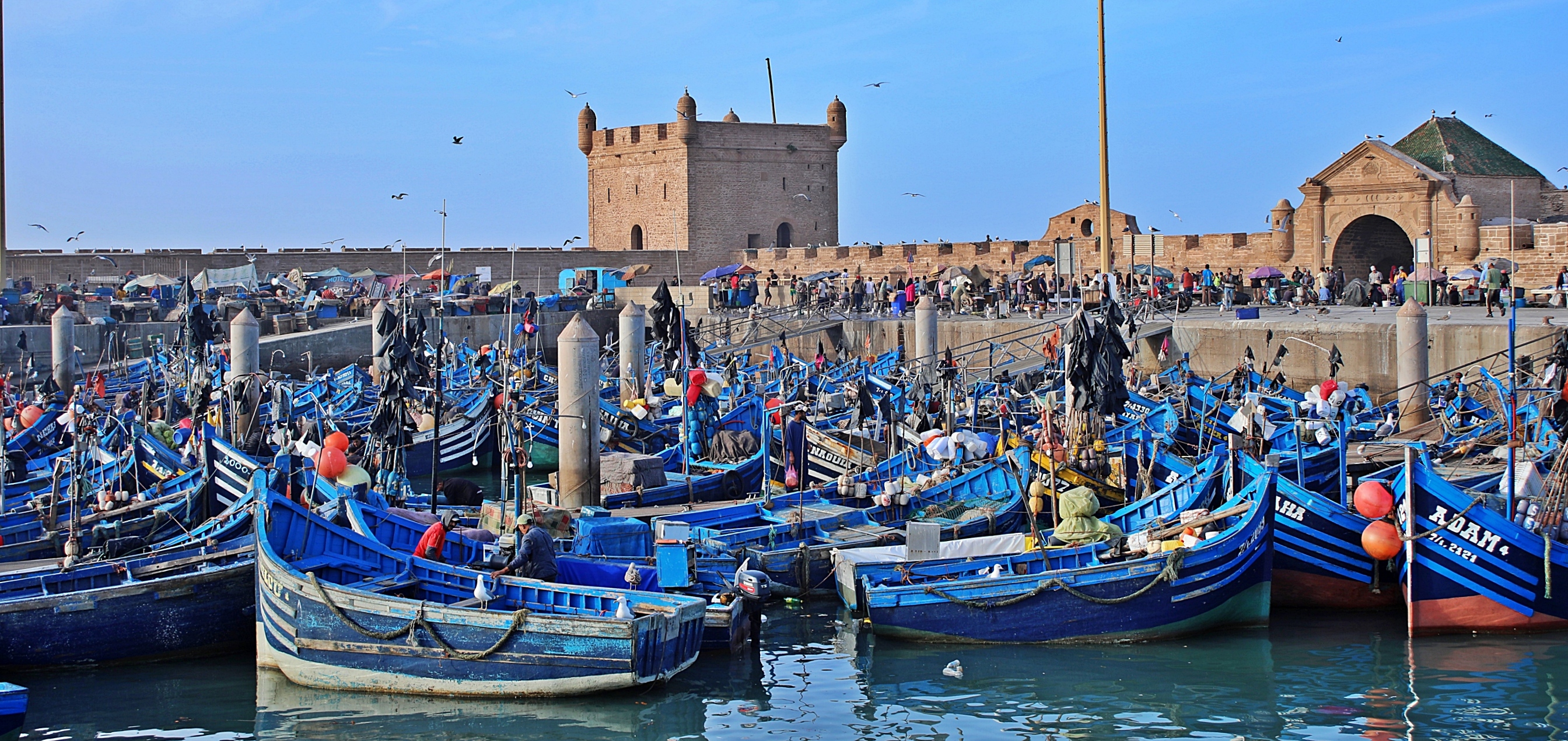
There is much to love about Essaouira. After seeing its fortress with tall ramparts on the edge of the Atlantic, colourful fishing boats in the port and vibrant streets of the medina, you will be charmed by Essaouira, Morocco.
The city’s natural port garnered attention from many civilizations over the centuries. Its location allowed goods to flow between Africa and the rest of the world. It was called Mogador, a word whose origins may be from either the ancient Amazighs or Phoenicians. Another theory is that it was named after a saint. The Portuguese built a fortress near the port in the 15th century, but they only remained in Essaouira for a few decades.
In the 1700s, Sultan Mohamed III was in charge. His vision was to have a well-planned centre of trade, protected by a fortified wall. The sultan brought in a French architect to bring his vision into reality. Under his guidance, the Portuguese fort was dismantled, and new walls were erected. The result is a striking fortification along the Atlantic Ocean with a colourful port and an organized medina. He renamed it Essaouira, from the Arabic word meaning small wall.
The old city and port have been declared a UNESCO World Heritage Site. Here are some of the things to see when you explore Essaouira.


Essaouria Medina
Walking under Sbaa Gate (Bab Sbaa) brought us to Essaouira’s magical medina. We could see its European influence immediately in the wide alleys and old warehouse-style buildings. As well, the European grid-like design of the roads leads to a more organized exploration of the medina. The further you walk through the medina, the more you’ll fall in love with Essaouira.


There are a few reminders to let you know you’re still in Morocco. It has a few tight side streets with multiple arches and braces, but even with these, it has a more European feel than most Moroccan medinas. Even though it is obviously very touristy, Essaouira has not lost its personality.


City Ramparts
One of the best things to do in Essaouira is to explore the ramparts. At low tide, you can walk on the coral under the fortress walls. We saw many locals enjoying this unique walkway when we visited. Kids were playing in the tidal pools and a few men were fishing for octopus. You can walk on the coral for the entire length of the rampart and exit on the other side of the medina. This part of the wall is called Sqala (also called Skala de la Kasbah).


Even though the tide was receding, huge waves crashed on the large rock formations offshore.


You can also explore the top of the ramparts. A favourite area is Sqala Esplanade. This long walkway goes beside crenated walls with old canons facing the sea. There’s not much to see here, but it’s very nice in the morning when the sun casts long shadows.


The medina beside Sqala Esplanade has a different feel to it with stone walls and very few people. There were actually three parts to the original town; the Medina, Kasbah and Mellah (Jewish Quarter). Today, they are intertwined making it difficult to tell which you are in at any time.


Essaouira Port
Marina Gate (Bab el Marsa) leads you to another wonderful area. Essaouira Port is a vibrant, thriving part of the city. Fishing trawlers had just returned when we visited, filled with the day’s catch. Their work was not over yet, though. We watched as nets were being repaired and boat decks were being swabbed.


Fish were being cleaned on the ramparts and sold at small vendors on the water’s edge. The sky above them was filled with seagulls, desperately waiting for leftovers. Some of these fish were being barbecued at a small pop-up cafe where you could have an early dinner.


On the other side of the harbour, photogenic blue fishing boats bob in the water after bringing home their catch of sardines.


The old fortress wall is connected to one that surrounds the port to provide even more protection from pirates and invaders. Fortress Tower (Borj El Barmil), stands tall at the edge of this wall. It is very picturesque especially when there were blue boats moored in the water below. This tower is open as a private museum.


Walk along the top of the rampart beside the tower for a view of the fishing boats as well as out to sea. From there you can see a chain of islands called Iles Purpuraires that dot the water not far from Essaouira. One of them, Mogador Island, is said to have been used by Romans to process a purple dye extracted from mollusks. Much later it was the setting for a Portuguese fort which today is in ruins.
This is also the best place to be for sunset. From there you can watch as the sun sets behind these small islands.


Essaouira Beach
On the other side of the port, the 2 km long Essaouira Beach fills in the curved bay. It has soft sand and a bit of surf. It was popular with locals who were playing beach soccer or swimming on a Sunday afternoon. Further down the beach, camels were waiting to take people for rides on the sand.


Essaouira is also known as the windy city for its constant trade winds. We weren’t there at the right time of year, but in season, it is paradise for windsurfers, kiteboarders and surfers.
Tip – Essaouira is 175 km west of Marrakesh, which means it sees lot of day-trippers. The city deserves more time than a day trip and is best explored at sunrise and sunset when the streets are quiet. We recommend staying for a couple of days.
Argan Trees and Goats
The drive between Agadir and Essaouira takes you through argan forests. In the spring, the spiky trees are covered in flowers which are a delicacy for goats. You have likely seen pictures of goats climbing trees. They do that here in the spring to eat the flowers. The goats pass the nuts which are then collected by women who press them for their oil.
Farmers took advantage of the popularity of this unusual scene, and developed a new source of income. They began forcing their goats to climb the trees, even in the summer, fall and winter, when there were no longer flowers. Tourists would pay to take picture of the spectacle. Unfortunately, the goats were not treated humanely and thankfully, the government put a stop to this behavior.
Argan oil is said to be excellent for the hair and skin and is sold throughout Morocco. If you want to buy the oil though, you are best to buy from a legitimate source such as Women’s Argan Oil Cooperative. The oil sold in many souks is often not pure argan oil and is often diluted with olive or other oils.
Where to stay in Essaouira
We always love to recommend staying in the medina and think that’s the best place in Essaouira too, but there is another option. If you would like more comfort than most riads provide, there are quite a few nice hotels along the road in front of Essaouira Beach. If you do stay in the medina, it is very small, so the location of the riad isn’t as important.
Where to eat in Essaouira
Essaouira is ready for tourists. There are many restaurants both within the medina and along the main beach. Prices are a little higher in the medina, but we had excellent meals so didn’t mind paying a little more.
How to get to Essaouira
CTM buses travel from Marrakesh (170 km), Agadir (185 km) and Casablanca (377 km) and many other cities to Essaouira. There is no train line to the city. Technically, you could visit Essaouira on a day trip from Marrakesh, but we think there’s too much to see and a day trip isn’t enough time.
You can find Essaouira on the lower coast in the map below. Click on the image to be directed to an interactive map.


Click on the link to read our Travel Tips For Morocco.
To read more of our adventures in Morocco, click here.
Coming Next – Discover The Portuguese Fortress In El Jadida
For pictures from other blogs go to Gallery at monkeystale.ca
To read about more of our adventures go to Destinations.
If you like what you read, please comment or share (with credit) using the links below.



We'd love to hear from you, please leave a comment.