
The modern city of Casablanca is not often at the top of must-see lists when people visit Morocco. Honestly, it wasn’t at the top of ours either, but we found a few interesting attractions that made it a worthwhile stop. Here’s what you can see when you visit Casablanca.
Let’s get this out of the way from the start. The movie Casablanca was not filmed in Morocco. The city doesn’t resemble the movie set in the least. It did have some involvement in WWII though, which may have led to the famous movie being set in the city. Now that expectations are set, let’s explore the sites in Casablanca.
Even though Casablanca looks new, its beginnings are as old as many in Morocco. First, an Amazigh village was situated here and they called it Anfa. In the 16th century, the Portuguese moved in, naming it Casa Branca (White House). It was changed to Casablanca when the Spanish arrived. The city was levelled in the 1755 Meknes earthquake and was abandoned by the Spanish. It was later rebuilt by Moroccan leaders, and then fell under the French Protectorate in the 20th century. As a result, most of the city’s buildings are from the 20th century, but there are a few that are worth seeing.
Hassan II Mosque
The most famous building in the city is Hassan II Mosque. With an immense marble courtyard on one side and the Atlantic Ocean on the other, the mosque certainly grabs your attention. King Hassan II had the mosque built in 1993 to honour his father, Mohamed V, second king of Morocco. It was opened on King Hassan II’s 60th birthday.
The mosque’s minaret is visible from blocks away. At 210 meters tall, it is the second tallest minaret in the world. It even has an elevator for the muezzin to use for his five daily calls to prayer.


The exterior of both the mosque and minaret have typical Moroccan details. Decorated with horseshoe arches, sculpted stucco designs, zelliges (tiles) and fountains, it is an attractive building. Its main feature though, is its sheer size. Its footprint of 172,600 m² makes it the 2nd largest mosque in Africa.


If you look carefully, you can see that 1/3 of the mosque was built over the ocean. It was constructed this way because a verse in the Quran that says the throne of God is on the water. You can appreciate this unique location when you look at the mosque from the side.

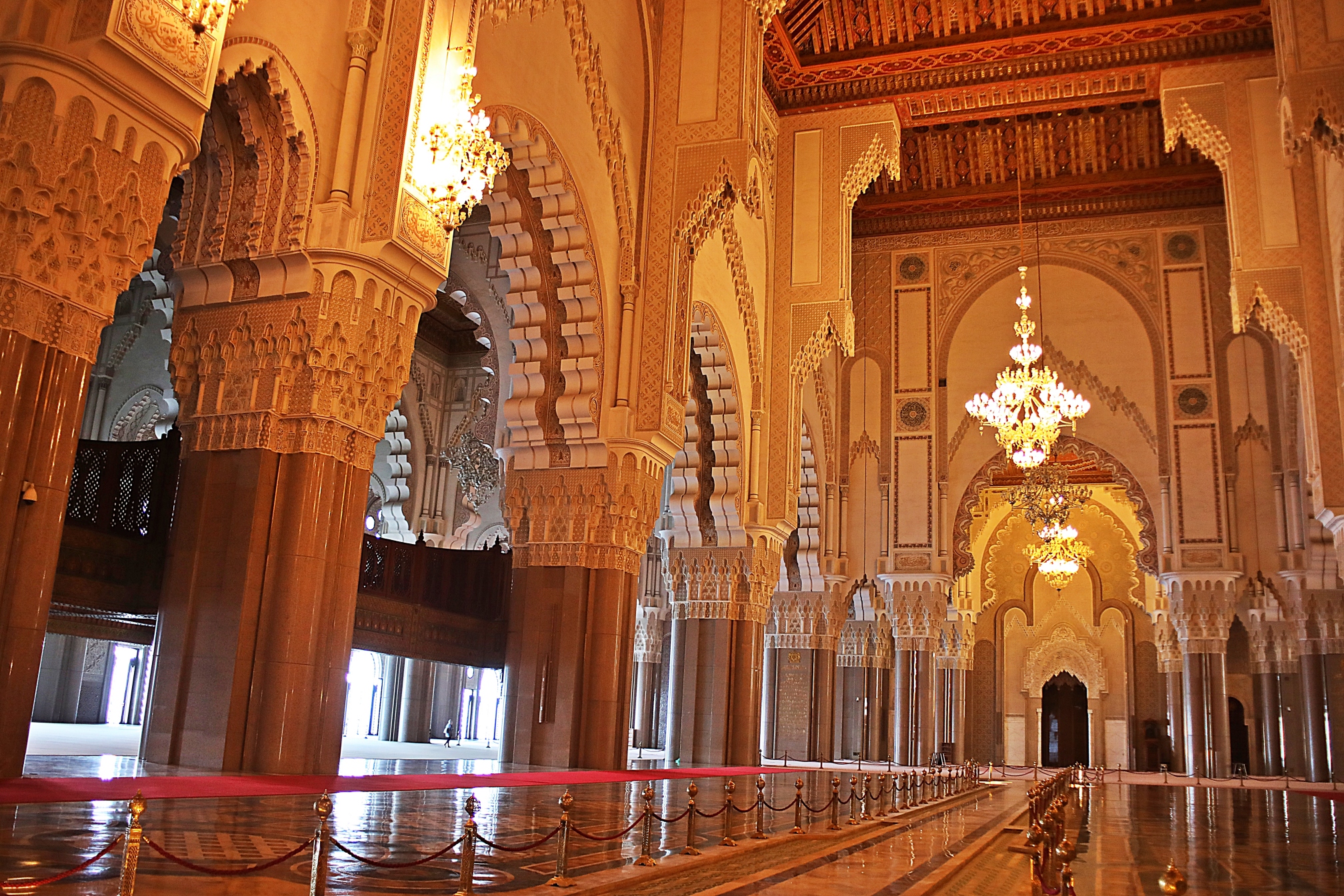
The main door leads to a large prayer room with tall marble and granite columns topped with Corinthian capitals. Between them, elaborate arches are decorated in sculpted plaster while muqarnas dangle from their peaks. Over 50 crystal chandeliers hang from the vaulted ceiling. The king attends the mosque on the 26th day of Ramadan and on the birthday of Mohammed V. The chandeliers are cleaned prior to those two visits. What a difficult task that must be.
As ornate as this room is, the three finely carved arches of the mihrab still catch your eye. This niche indicates the direction of Mecca and is on the qibla wall in all mosques.


The mosque’s prayer room holds 20,000 men, as well as 5,000 women on the mezzanine level. 80,000 can pray in the courtyard outside, making the total capacity 105,0000.
With this many people, it can get very warm in this large building. Designers came up with a unique solution to keep the room cool. The roof is retractable, similar to a sports stadium, and allows for natural cooling of the large space. It takes 3 minutes to open and, 2 to close. That’s pretty impressive for such a large ceiling.

The ablution room is in the basement. The 45 lotus-shaped fountains and 600 taps are used by worshippers to purify themselves by washing before each prayer. There is a different room for men and women.

With the number of details in this massive building, you can understand why it took 6 years to complete, with tradesmen working in shifts 24/7. Ninety-nine percent of the material was sourced from Morocco. The king paid 1/3 of the cost to build, the rest, €700,000, is said to have been donated by Moroccans.
Tips to Visit Hassan II Mosque
• The only way to visit the mosque is with a guide. In busy season you may need to book a couple of days in advance, but in November, we could buy tickets for an English tour at the door.
• It is closed to non-Muslims on Fridays.
• Head coverings are not required, but conservative dress is. Women and men must cover their shoulders and legs.
• You must remove your shoes in the prayer room so it’s recommended to wear socks. Plastic foot coverings are provided.
La Corniche
A long promenade follows the water, extending from the mosque on either side. It doesn’t have spectacular views, but it follows the shore so has a nice ocean breeze. At the far end, the pathway stops just before the busy, industrial Port of Casablanca.

Rick’s Cafe
Built in 2004, this is not the famous cafe from the movie but was built to look just like it. From the outside, we could envision scenes from the movie, as if they were shot here. We wanted to have dinner, or at least a drink at Rick’s Cafe, but the business-attire dress-code is strictly enforced, so we weren’t allowed inside.


Old Town
Casablanca doesn’t have much of a historic quarter, but the streets around Hassan II Mosque have several markets and old streets that have a medina feel to them.


Mohamed V Square
As the economic hub of Morocco, it was surprising to find a couple of relatively quiet spots. In the centre of the large city, Mohamed V Square, is a popular place for families and friends to congregate in the evenings. It’s popular with pigeons too.


Casablanca Cathedral
The stark white Casablanca Cathedral was built in the 1930s when Morocco was a French Protectorate. It was never actually a cathedral though. It’s called that because of its immense size. The official name is Old Church of the Sacred Heart. Today it is not even a church but operates as an events centre.
Between Mohamed V Square and the cathedral is the large, treed Arab League Park. It’s a nice quiet space that transports you away from the bustling city and offers the best views of the church.


Where to stay in Casablanca
In order to visit the sites in Casablanca, it would be best to stay in the city centre, between Mohamed V Square and Hussan II Mosque. Most of the sites are within this region and you can walk, or take a short cab ride to see everything.
How to get to Casablanca
The international airport receives flights from many destinations in Africa, Europe and even Montreal, Canada. The airport, though, is over 30 km away. Casa Port Train Station is located downtown and is a convenient point to reach other major centres in Morocco such as Tangier, Rabat, Marrakesh, Fez and Meknes. CTM buses connect the city to small centres and those not connected by rail, such as Essaouira and El Jadida. There is a CTM station near Casa Port Train Station.
You can find Casablanca in the middle of the coast on the map below. Click on the image to be directed to an interactive map.


This article is now featured on GPSmyCity. To download this article for offline reading or create a self-guided walking tour to visit the attractions highlighted in this article, go to Walking Tours and Articles in Casablanca.
Click on the link to read our Travel Tips For Morocco.
To read more of our adventures in Morocco, click here.
Coming Next – Exploring The Sites In Rabat – Morocco’s Capital
For pictures from other blogs go to Gallery at monkeystale.ca
To read about more of our adventures go to Destinations.
If you like what you read, please comment or share (with credit) using the links below.




We'd love to hear from you, please leave a comment.