
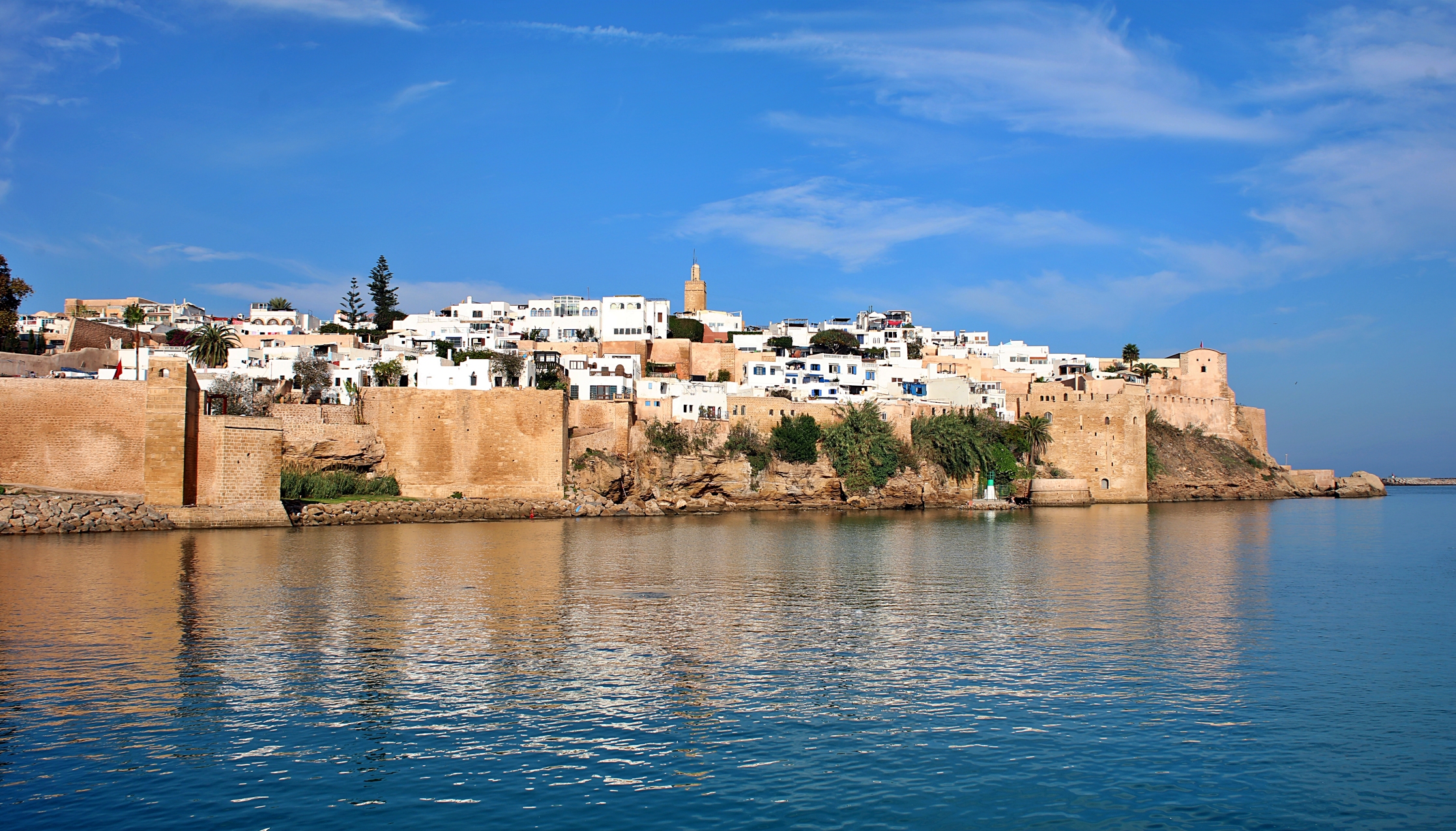
Images of the picturesque oceanfront Kasbah is what drew us to Morocco’s capital city. In addition to this lovely spot, we found Roman ruins, historic tombs and impressive monuments. It’s not as flashy as some Moroccan cities, but this capital still has a lot of sites that are worth exploring.
Rabat is one of Morocco’s four Imperial Cities along with Fez, Marrakesh and Meknes. All were capital cities at some point in Morocco’s history. When Morocco was a French Protectorate, the capital city was moved from Fez to Rabat. After achieving independence in 1956, they kept the capital in place. As a result, the city has many 20th century French buildings that have a Moroccan flare.
The capital city is more liberal than the rest of the country. That is, liberal in a Muslim country. In all the other cities, you could easily tell the foreigners from the locals. It’s not as easy in Rabat. What we noticed were quite a few Moroccan women that did not wear head coverings and most wore Western attire, like jeans. They do wear long sleeves and long pants or skirts though, so keep this in mind when you visit.

Although it is mostly a modern city, there are a few historical monuments in Rabat and we enjoyed our time exploring them. Here’s what you can see in Rabat, Morocco.
Chellah
The Phoenicians first settled on this hill above Bouregreg River in ancient times, but it was the Romans who built a large fortified town called Sala Colonia. It became a flourishing centre of trade with markets, homes, temples and public baths. Sala Colonia was then abandoned for hundreds of years until the Merinid Empire built a royal necropolis on the grounds in the 13th century. They named it Chellah. After using it for a hundred years, it was left alone again, until more tombs were added in the 19th century. The entire site was badly damaged in the 1755 Lisbon Earthquake, leaving it mostly in ruins.
Today, its fortified walls have been restored, giving you a glimpse of how this site may have once appeared.

Once inside the large space, you’ll find a mix of Roman and Merinid ruins with a few newer tombs on the edges. Between the ruins is a lovely, manicured garden with flowers, hedges and tall trees. There isn’t much left of the Roman buildings, but you can still see detailed designs on some of the Merinid’s mausoleum walls and minaret.


A colony of 70 storks lives in and near the complex. You may be able to spot their large nests on top of some buildings and in a field behind. Our favourite was the nest on top of the old minaret. They live here year round, leaving only for the month of August.


Kasbah Oudayas
Sitting where the Bouregreg River meets the Atlantic Ocean, the tall walls of the 11th century Kasbah look very regal. Fishing boats in the water in front add even more interest to the pretty scene.
Note – It is also spelled Udayas


Before entering the Kasbah, take a wander though the beautiful Andalucian garden. Palm and orange trees tower above flower beds, while peacocks walk in their shade. The garden was planted by the French on the site of the former sultan’s garden.


At the top of the hill, Oudayas Gate (Bab Oudayas) allows entry into the magical Kasbah. Once we stepped inside, we felt as if we’d left Morocco and walked into Spain. In addition to the whitewashed buildings, it is impeccably clean. Shops are organized and display local artwork, including paintings in hand-carved frames and wooden cabinets. Homes are well taken care of and many have lovely doors with potted plants in front. We heard many expats live in this community, and you can understand why.


From the edge of the kasbah, we could see both the river and the ocean. A large colourful cemetery beside, makes it a unique scene.


Just outside the kasbah, you can see more remnants of the city’s old wall.


Royal Palace of Rabat
The primary residence of the King of Morocco is not far from city centre. Visitors are allowed inside the walls to visit the palace gardens and museum. It is free, but you have to show your passport. We had forgotten to bring ours so we could only enjoy the view of the long wall from the outside.


Hassan Tower
Not far from the palace you’ll find one of the most visited spots in Rabat. Hassan Tower (Tour Hassan) is an unfinished minaret. In the 12th century, the Sultan of Mansour wanted to build a mosque with the tallest minaret in the world. Unfortunately, he died before it was completed so today, it remains as a 44 metre high tower without a typical minaret top. It’s surrounded by small pillars, remains of the unfinished mosque.


Mohammed V Mausoleum
In the same park as the minaret is a very important monument. Mohammed V was Morocco’s first king and is hailed for securing Morocco’s independence from France. He is much loved in the country and his Mausoleum is a tribute to his legacy.
The building is guarded on both sides by Mounted Royal Moroccan Guards. We hoped to see the changing of the guards but it was one of the most disappointing ceremonies we’ve ever seen. On the hour (5pm), the horses simply walked away. We waited for 5 or 10 minutes, but their replacements never arrived. In a conversation of hand gestures with a local lady, we understood that it would be a long time before the new horses would arrive and there would be no fanfare.


The mausoleum is a pretty, white building with arabesque designs on the stone walls and fountains in the yard.


Inside, the walls are covered in zeliges (tiles) and the cedar roof is beautifully carved, but it was not as spectacular as we had imagined. We thought it would be at least as elaborate as the Mausoleum of Moulay Ismail in Meknes. Maybe it was the lack of light, that took away its extravagance.
The mausoleum is also the Royal Tombs where the entire royal family will be buried. In addition to Mohammed V, there are sarcophagi for King Hassan II (King 1961-1999) and his brother Prince Abdallah. An imam prays in front of the coffins 24 hours a day.


Medina
A long wall still surrounds the city’s medina, but it is much less hectic than most Moroccan medinas we’ve visited. It is less a tourist attraction, and more local market.


How to get to Rabat
The capital city is well connected to the rest of the country as well as internationally. Within the country it is also accessible by train from Tangier, Casablanca (80 km), Marrakesh (325 km), Fez (200 km) and Meknes (145 km). You can reach Rabat from smaller Moroccan centres by CTM buses.
You can find Rabat in the middle of the coast in the map below. Click on the image to be directed to an interactive map.

Where to stay and eat in Rabat
We wish we knew how nice the Kasbah Oudayas is, or we would have stayed there. It’s a little further walk to restaurants, but it would be worth it. Otherwise, there are many places to stay in the more convenient medina as well as several international hotels nearby. There are very good restaurants along Rue Jeddah near Mohamed V Square.


This article is now featured on GPSmyCity. To download this article for offline reading or create a self-guided walking tour to visit the attractions highlighted in this article, go to Walking Tours and Articles in Rabat.
Click on the link to read our Travel Tips For Morocco.
To read more of our adventures in Morocco, click here.
Coming Next – Best Places To Visit In Morocco
For pictures from other blogs go to Gallery at monkeystale.ca
To read about more of our adventures go to Destinations.
If you like what you read, please comment or share (with credit) using the links below.



We'd love to hear from you, please leave a comment.