
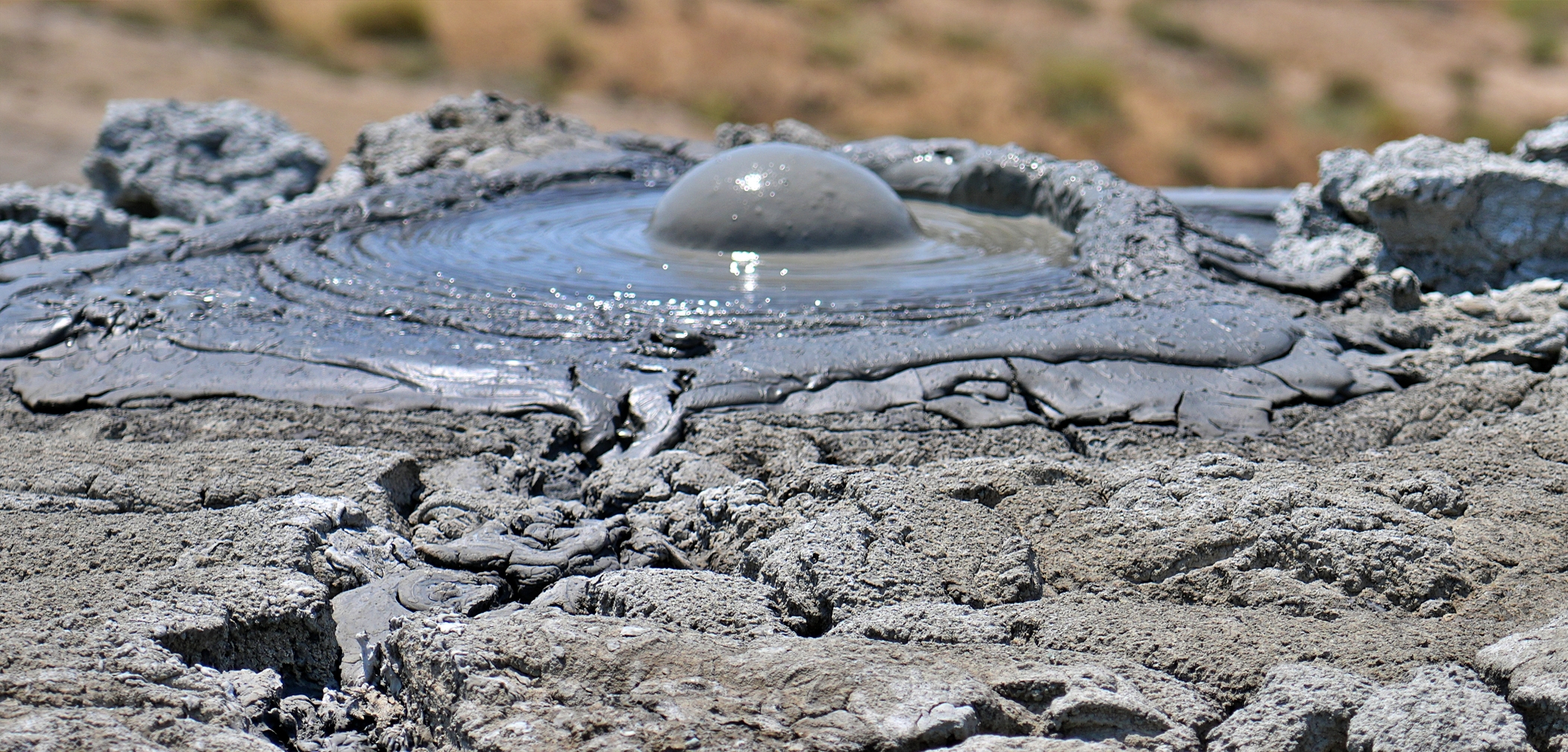
We stood on the edge of a crusty mud puddle and tapped its edge with our foot. Waves formed in the mud like a waterbed, causing a few open spots to gurgle. But this wasn’t just any mud puddle. We were actually standing on the crater of a mud volcano in Azerbaijan. One of the most unusual things to do when visiting Baku is to see Gobustan’s mud volcanoes and prehistoric petroglyphs. We’ll show you how you can see them too and what to expect.
Gobustan Mud Volcanoes
There are over 350 mud volcanoes spread across this region of Azerbaijan. These are not volcanoes in the typical sense, but are insead mud volcanoes. As gases are released in the Earth’s crust, they push up through thick layers of mud on the surface. The result is mud and sediments are forced through fissures as the gas bubbles spout out. The bubbles eventually spill over the edge and form cones or flat spheres of mud.
Mud volcanoes are usually a good indication of petroleum in the ground. As it happens, oil and natural gas are huge industries in Azerbaijan, they used to be the largest producer in the world. We saw a lot of drilling in the area as well as right in the city of Baku.
In addition to the mud volcanoes, there are said to be 140 submarine volcanoes in the Caspian Sea.

Mud Volcanoes State Nature Reserve
There are a couple of ways to see the mud volcanoes, the first is the national museum. Just south and west of Baku there are thousands of mud volcanoes. The government recently opened a complex to preserve some of these natural phenomena. Called Mud Volcanoes State Nature Reserve, there are 43 mud volcanoes in the park, but not all are accessible.
The main one to see is called the Gilinj (Sword). It is a string of 8 small to medium sized active cones up to 10-15 metres tall. In other areas they are known to be as much as 200-500 m high.


A boardwalk allows you to walk beside the cones, but you can not get very close. Even from a distance this natural wonder makes quite a spectacle. There is evidence that they have been active since the Pleistocene Era, between 770,000 and 126,000 years ago.

The mud volcanoes don’t have large eruptions, but they sputter and bubble frequently.

The surrounding landscape is very arid and looks as though it is stuck in prehistoric times. The grey mud volcanoes stand out against the ochre coloured land.


Tip – There’s a museum at the Mud Volcano Complex but it is very odd. It mostly has displays of skeletons from animals in Azerbaijan and around the world. There is no information on mud volcanoes in the museum, which is what we had expected and wanted to see.
Entrance fee – 15 AZN (€7.50); Hours – 10am-8pm
Wild Mud Volcanoes
In addition to the museum, our taxi driver took us onto private land so we could get an up-close view of a few other mud volcanoes. We approached the cones from below and could see mud slowly trickle down from the top. These mud flows slowly build up until cones are formed.
On Google maps the one was saw is called “Mud Volcan Big’. We’ve included it on our map at the bottom of the post.


We walked to the top of a small volcano to find a number of mud puddles. It was here that we experienced something new. By gently tapping a foot on the mud puddle’s crusty edge, we caused a cascade of waves. They extended from the crust to the liquid centre and reminded us of a waterbed. After a few seconds, bubbles began popping up in the mud.


We stuck our fingers in one puddle and the mud was surprisingly cold and thick. Apparently some people get right in the puddles to cover their entire bodies in mud.


Visitors usually see one or the other; the complex or random volcanoes. We saw both and are glad we did. The complex has at least a dozen volcanoes of all different sizes, but you can only view them from a boardwalk platform. The wild volcanoes are also interesting, and you can walk right up to them, stick you hand in them and maybe even take a mud bath. But, which one you go to is up to the driver and there are hundreds to choose from.
Gobustan State Historical and Cultural Reserve
Walking through a jumble of massive boulders, under overhanging cliffs and beside caves, it was easy to imagine Paleolithic humans living here. And in fact, they did. As much as 40,000 years ago humans lived among these rocks and left us their art as gifts. Not far from Baku, a series of caves and rock walls have many examples of petroglyphs left by these people thousands of years ago. Researchers believe the people were drawn to this area because it was on the main migration route travelled by prehistoric man.
Note – it is often referred to as Gobustan Prehistoric Rock Art.


We walked between the large boulders in search of the rock art. They turned out to be remarkably easy to find. The petroglyphs included depictions of aurochs (extinct bovine), horses, onangers (wild ass), deer, antelope, people and many more. There are a staggering 6,000 images on 1,000 rocks in this one complex.


We spent hours in these rocks, amazed at the sheer number of petroglyphs we saw. When looking at them, we had to remind ourselves of the crude tools tools used by these artists and storytellers.


Some walls have many petroglyphs that are carved over top of others, making it difficult to distinguish any one in particular. Archaeologists aren’t sure why this was done, but believe that each layer was carved dozens, if not hundreds, of years apart. These layers only occurred on a few walls, but in those places, there were many layers. Researchers believe this suggests something unique about the wall.

In addition to the ones we can easily see above ground, much older petroglyphs were found on cave walls below ground level. It is assumed they are much older and were covered over eons of change in the land. It’s no surprise that this site is a UNESCO World Heritage Site.
In addition to the petroglyphs, other remnants from these prehistoric people can be found below the cliffs. In one area, several holes had been sculpted into the rock. They are called Cup Marks and had different uses. Some collected rain water or stored sacrificial blood. Others were used to prepare meals.
There were even two musical instruments, called Galvadash. They were large slabs of varying thickness that produce different tones when tapped on with a stone.


The museum at the site has excellent information on Paleolithic man and of their rock art. It is worth visiting the museum before going up to the rock art location.
Entrance fee – 10 AZN (€5); Hours – 10am-5pm
Tips for visiting Gobustan Volcanoes and Petroglyphs
- If you are visiting on your own, be aware that there are two Gobustans on Google Maps. The more southern one is where you want to go. It is also spelled Qubustan. On Google Maps the Petroglyphs are listed as ‘Gobustan Rock Art Cultural Landscape’. Mud Volcanoes State Nature Reserve is labelled as ‘The Mud Volcanoes Tourism Complex’. They are both marked in the map below.
- The petroglyphs are located on a hill 1.9 km from the museum so most people hire a local taxi. If you hired a driver for the day, then it will drive you to the site. You can also walk, but it is uphill. It is silly that the museum was not built closer to the site. This set-up makes it more difficult for the independent traveller.
- There is no protection from the strength sun at any of the sites so use sunscreen, wear a hat, bring plenty of water. There is a cafeteria at both museums.
Getting to Gobustan
The easiest way to get to these sites is to take a group or private tour. There are many offered in Baku’s Old City. It is possible to go on your own, which is what we did, but it is more complicated and the taxi touts make it more exasperating. Take Bus 195 to Gobustan town centre. From there, take a taxi to both the rock art site and the mud volcanoes. Or, you can take a Yango/Bolt or taxi from Baku to Gobustan State Historical and Cultural Reserve (Rock Art). There are local 4×4 taxis on the highway in front of the museum that will take you to a private mud volcano and/or the government complex. We did not see taxis at the Mud Volcanoes State Nature Reserve so recommend going to the Rock Art site first.
If you hire a local 4×4 taxi you must be clear that you want to go to the government museum or see random mud volcanoes suggested by the taxi driver, or both. The government complex has a fee and most taxi drivers would rather take you in their beat up 4WD Lada to one of of the many mud volcanoes in the area. The exasperating part is bargaining with them.
Mud Volcano Complex, Rock Art Museum and Mud Volcano Big (that we visited) are the lowest points on the map below. Click on the image for an interactive map.

Yanar Dag
This is another unique Azerbaijani attraction. In a land where petroleum has always been close to the surface, gas used to frequently seep above ground. In these spots spontaneous flames would spark and burn for many years, some, for thousands of years. Modern oil wells have decreased these flames, but just north of the city you can see one.
Yanar Dag (Burning Mountain) is an ‘eternal’ flame on a hill above the city. Some theories say it has been burning since Zoroastrian times, thousands of years ago. Another story says the fire was started in the 1950s by a discarded cigarette and has been burning ever since. Regardless how old did is, Yanar Dag is an unusual thing to see.

Apparently there used to be many eternal flames in this region. Seeing one makes it a bit easier to understand why the Zoroastrian’s thought fire was a manifestation of their divinity. We saw other Zoroastrian sites in Wakhan, Tajikistan as well as Ateshgah Temple in Baku.
Recently a complex was built around the eternal flame and made it more gimmicky. We’re glad we saw it because it is unusual, but keep your expectations in check so you’re not disappointed.
Entrance – 9 AZN; Hours – The website states it is open from 9am until 8pm, but it closed at 7 pm when we went. Since it is an outdoor flame, it is better to see it later in the day as opposed to under a strong sun.
Getting to Yanar Dag
The site is located 20 km from Icheri Sheher and while it can be accessed by a combination of metro and bus, they are very arduous. Yango/Bolt are reasonably priced options, but it is also included on many tours. To use public transport, take either bus 217 from Koroǧlu Metro Station or bus 147 from Azadliq Prospekti Metro Station.

Click on the link to read our Travel Tips For Azerbaijan.
To read more of our adventures in Azerbaijan, click here.
Coming Next – Best Day Trips From Baku
For pictures from other blogs go to Gallery at monkeystale.ca
To read about more of our adventures go to Destinations.
If you like what you read, please comment or share (with credit) using the links below.





We’d love to hear from you, please leave a comment.