Although it is not high on most tourists’ radars, we found ourselves in Kutaisi. for a few days Our main objective was to visit Martvili Canyon and Prometheus Cave on a day trip from the city, but we were happy when we found a few interesting cultural spots right in Kutaisi.

Having been inhabited by the Colchis people as early as the 15th century BCE, Kutaisi is one of the oldest cities in the Caucasus. Over this lengthy history, it served as the capital on several occasions. The first few times were under ancient kingdoms when the region was called Colchis. Another was under King David the Builder in the 10th century. It resumed the title most recently from 2012 to 2018, before moving to Tbilisi in 2019, where it remains today. 

This extensive history can be found in a few places in the city. The weather wasn’t the best when we visited, but we were still able to explore most of the sites between rain showers. Come with us as we explore Kutaisi, beginning in its historic centre. 

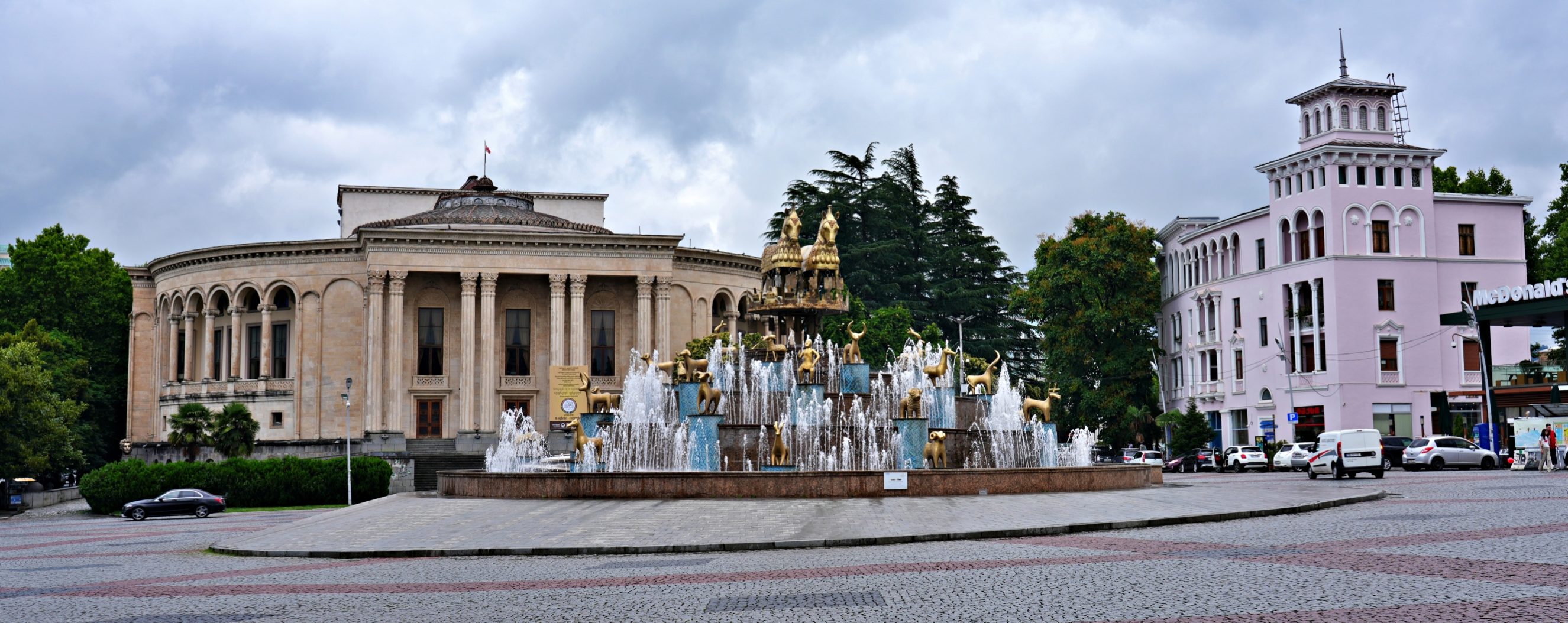
Sitting in the middle of a disorganized roundabout is the flashy fountain that is one of the most famous sites in the city. Golden statues that represent artifacts found in ancient archeological sites in the region decorate Colchis Fountain.

Adding more glamour to its surroundings are a few grand buildings on the edge of the roundabout. Traffic on the square, is not necessarily heavy, but it is very disorganized. At least seven ‘lanes’ of traffic cram into the space of three, but there are no lines so drivers go wherever there’s room. This makes it very difficult to cross on foot.

On the side of the busy roundabout is a nice park with fountains, flower beds and sculptures. Our favourite features in Kutaisi Central Park were the beautiful white barked sycamore trees. On sunny days, locals could enjoy the shade cast by these beautiful trees.

One day, as we walked around the park, we saw a man in a chokha. It is a national costume commonly worn in the Caucasus during Medieval times. Today it is worn at important ceremonies and festivals. It is a symbol of Georgian independence and pride. We’re not sure why he had it on, but we’re glad he did. Then we had another surprise. All across Georgia, we saw monks and priests dressed in cassocks. Finally, in Kutaisi, we were able to get a picture.

Kutaisi was an important city during both the Russian Empire and Soviet rule; as a result, you can find a few grand buildings from their times. Not all are at their best, but we managed to find a few. At the far end of the park is the Opera House, decorated with tall statues on the roof. The front is being renovated, but it still projects elegance. In addition to the Opera House, the neighbouring streets also have a few other lovely buildings in good condition.

Some date back to Russian times, others to the Soviet era, and a few go much further back than that. Today, much of the city is a bit of a fixer-upper. Even still, it is a pleasant city to wander its historic centre and try to find its few hidden gems.

We had read about a wonderful ceiling in the city’s main library, so we went to take a look. We searched through what we thought was every room in the old building, and only found rather run-down reading rooms and offices. Finally, we asked a librarian. She thought about it, asked someone else and then grabbed a key and took us through a labyrinth of old hallways, behind locked doors and finally into a tight room, crammed with books. She pointed to a rickety ladder. We looked up to see the small domed ceiling, hidden behind stacks of books. Years ago, the old wooden dome had been expertly carved, but unfortunately, it hadn’t been maintained. I wouldn’t call it spectacular, but it is a unique feature and we’re glad we persisted in finding it. 

On the other side of Colchis Fountain are two other heritage communities; the old French and Jewish neighbourhoods. Almost all that is left of those communities now are a church and a synagogue. Capuchin missionaries established the Holy Annunciation Church in the 17th century. The style of the building may look familiar to readers, but in Georgia, Baroque architecture is very foreign. Inside, it has been transformed into a more typical Georgian Orthodox church featuring an iconostasis at the front and the removal of pews.

Kutaisi was once home to a large Jewish Community. The 19th century synagogue is in good condition and, while the congregation is small, there is still a regular service. We had seen pictures of its pretty interior, but it was closed both times we stopped by, so we couldn’t see it for ourselves. 

The Soviets left their mark with many ugly apartment buildings, but one feature they left is quite interesting. On the side of the Green Market is a mosaic that ties in stories from the areas past, including Jason and the Argonauts, Prometheus as well as local folklore.

If you are familiar with Greek mythology, then Colchis and the Rioni River may sound familiar. Many believe Kutaisi is referred to in The Argonautica, a Greek epic poem. It tells the tale of Jason and the Argonauts, who sailed from the Black Sea up the Rioni River to a city called Aia in their search for the Golden Fleece. Since Kutaisi has ancient roots and is located on the Rioni River, many believe it to be Aia. In the poem, King Aeetes of Colchis owned the much sought after fleece. Jason needed to retrieve it so he could reclaim his land from his uncle. Before awarding Jason with the fleece, the king gave Jason three tasks to complete. The king’s daughter, Medea, fell in love with Jason and helped him successfully complete these tasks.

Not only does the location of Kutaisi on the Rioni River make it possible that it was Aia, there may have been an actual Golden Fleece. In Svaneti, in Georgia’s Caucasus Mountains, shepherds used sheep skins to collect gold dust as it floated down the river. The skins would be glittering with gold when lifted out of the water. You can read more about Svaneti in our posts. (Coming Soon)

The 3D ceramic bas relief was created by Georgian artist Bernard Nebieridze. While not usually a fan of brutalist artwork, this piece has so many interesting characters, we couldn’t help but be impressed. 

Another interesting remnant from Soviet times is Glory to Labour, found close to Kutaisi Central Park.

Kutaisi is cut in two by the Rioni River. In addition to a few modern ones, there are four old, unique bridges allowing you to cross the river. Although the bridges are no longer at their best and could use a few touch-ups, they are worth a quick stop.

White Bridge was built in 1851. Its main draw is a statue of a boy about to jump into the river. It’s a character from an old Georgian film and is called Picasso’s Boy. I wouldn’t want to jump into the river today, though. It doesn’t look very deep and there seems to be more rocks than water. Today, it is a pedestrian bridge.

Not far away is Red Bridge, which was built in France in the 1860s. Some say it was built in the same factory as the Eiffel Tower. The bridge’s actual name is Mikhail’s Bridge, for the son of Nikoloz Romanov. It received the nickname Red Bridge because it was originally painted red. Not far away is Chain Bridge. It was built on the site of a 5th century bridge. The current one has an 18th century foundation, but was rebuilt in the 1800s and then again in 1995. 

Between White and Red Bridges is a historic mansion. We first saw the Golden Marquee from White Bridge. The age of the two-story stone mansion is unknown, but it is thought to be from the 15th to 17th centuries and served as the residence for the Imeretian King. 

Beside the Golden Marquee is a 1960s cable car that can take you across the Rioni River and up to Gora Park, an amusement park on top of the hill. The base station is located in the very small Veriko Anjaparidze Square, where you can find a few moss covered nudes.

What was once a UNESCO World Heritage Site, Bagrati Cathedral’s status was revoked when restoration work didn’t meet UNESCO’s standards. You can see some of the controversial metal construction in the picture below.

It’s still a nice, old church placed high above the city on Ukimerioni Hill. A stone wall once protected the 11th century church, but the old bell tower is all that remains of that wall. Inside the church, the tall stone walls are bare and quite a few of the pillars have been replaced by metal. Because of this, we didn’t bother to take pictures of the interior.

Not far away from the cathedral is an old Armenian church. It is also a little worse for wear, but from its yard, you look down to the rooftops of the city below, including the Holy Annunciation Church.

Maybe it was the grey skies and rain, but even though there are a few nice sites in Kutaisi, the city didn’t pull at our heart strings. The main reason for visiting the city is to go to some of the sites nearby. We’ll take you to Martvelli Canyon and Prometheus Cave next. Even though Kutaisi may not have the big sites that draw tourists, we were able to fill a day.

Thanks to Leighton, from Leighton Travels for his travel suggestions in Georgia, and especially in Kutaisi.

What we did enjoy about Kutaisi was the food. We didn’t have a bad or even average meal in all of Georgia, but the food in Kutaisi was the most flavourful. Here are some of our favourite dishes:

Khinkali dumplings are one of Georgia’s best known dishes. We first had it in Kyrgyzstan, and is part of the reason Georgia moved up on our list of countries to visit. The most common ones are filled with meat or mushrooms that float in perfectly seasoned juices. We fell in love with mushroom khinkali and had it almost every day in Georgia. Khinkali can also be served fried or baked, but we preferred the original.

Another dish we enjoyed in Kyrgyzstan and had almost every day in Georiga is Lobio. This kidney bean stew has an earthy flavour thanks to pomegranate juice and crushed walnuts. Served in an earthenware pot, it is often, but not always, served with a piece of dough that has cooked to perfection while the stew is in the oven. It is also usually served with pickles, but we didn’t like Georgian pickles. We found them to be very heavy in vinegar, sometimes, a strong apple cider vinegar.

Another stew that is served similar to lobio is chanakh. It often is meat based, but we had it with mushrooms, eggplants, peppers and tomatoes a few times. Similar to lobio, it is served with a bread cover.

Khachapuri, or cheese bread, is a dish we had before coming to Georgia, and we were excited to have it in the country. Unfortunately, Georgian cheese is very salty, and we didn’t enjoy Khachapuri. Depending on the region you are in, it will come in different shapes. The best known is Adjarian, shaped like a gondola boat, with melted cheese and a barely cooked egg in the middle. Imeretian is like a thin pizza shell stuffed with melted cheese, or Gurian Khachapuri is like a cheese pie. All of these sound delicious, and they would if only the cheese weren’t so salty.

Instead of ordering a typical salad, we loved having pkhali. An assortment of salad greens are minced, mixed with crushed walnuts, garlic and herbs and served almost like a cheese ball.

For snacks, we loved lobiani, which is a round flatbread bread stuffed with kidney bean paste. An alternative is Khabizgina which is the same, except its stuffed with seasoned mashed potatoes. Puri, is a loaf of bread, most similar to a baguette, but usually with a large mid section. It has a crusty outside and spongy inside, and you will likely eat it every day since Georgians love bread.

Tip – The most difficult meal to find in Georgia is breakfast. Georgians typically have coffee and bread with jam in their homes and don’t eat out for breakfast. Finding a restaurant, or even a coffee shop, that opens before 10 or 11 am is very difficult. So we recommend booking a hotel that offers breakfast, or getting an apartment with a kitchen.

While there aren’t as many large hotels in Kutaisi, there many small, family run hotels and guesthouses. Find one that is walking distance to Kutaisi Central Park. We had the best mushroom Khinkali in all of Georgia in Gala Restaurant. You can find it on the edge of Kutaisi Central Park.

Kutaisi International Airport makes it very easy to visit the city. It receives flights from Berlin, Warsaw, Prague, Rome, Istanbul and many more. If you’re already in Georgia, Kutaisi is well connected to the other major cities and nearby towns by marshrutka. Kutaisi Central Bus Station is where all marshrutkas arrive and depart from. Another option if you’re travelling between Kutaisi and Batumi or Tbilisi, is to take the train. There are only a couple of trains a day and they are said to be very slow.

You can find Kutaisi in the middle of the map below. It is an interactive map, so you can zoom-in, or click on a marker for a link to our post from that region.

Most of the sites are within walking distance. Unlike Tbilisi, pedestrians don’t seem to have many rights, so cross streets with caution. As well, the sidewalks are often potholed and uneven. Bolt is widely available, as is the new ride-share app Maxim. There are many options for tours to the many sites outside the city. If you prefer to go alone, you can hire GoTrip or Bolt, but with GoTrip you can factor in the waiting time.  

This article is now featured on GPSmyCity. To download this article for offline reading or create a self-guided walking tour to visit the attractions highlighted in this article, go to Walking Tours and Articles in Kutaisi.

Read from another device.

Click on the link to read our Travel Tips For Georgia.

To read more of our adventures in Georgia, click here.

Fediverse reactions

78 responses to “Cultural Highlights of Kutaisi, Georgia”

  1. The Soviet era bas relief is fascinating. It looks somewhat Medieval.

    1. It does, it’s really an interesting piece. Thanks Swabby

  2. An engrossing post, Maggie. I enjoyed looking at your pictures of the Soviet bas relief. I can see why you were impressed. It seems as if the food might be quite vegetarian-based and the mushroom khinkali sound delicious. Cheers.

    1. There is a lot of meat, but there are also so many vegetarian choices. I was in heaven. Thanks Lynette

  3. You really did find some architectural gems Maggie. Not sure I would trust those old heritage building balconies or that cable car to keep me in the air. The bas-relief must have been one Soviet’s rebellion against all that era’s brutalist architecture. Thanks for taking us along. Happy Friday. Allan

    1. You’ll notice we didn’t get on that cable car 🙂 I don’t often like Soviet ‘art’, but we were quite taken by the 3D bas relief. Thanks Allan

  4. I have seen my fair share of fountains, but none of them were as striking as the Colchis Fountain. It looks like quite an impressively grand and luxurious installation, Maggie. Kutaisi looks like a lovely place worth visiting for its blend of history, culture, and nature, as it seems to offer a less commercialised and more authentic Georgian experience. Thanks for sharing, and have a good day 🙂 Aiva xx

    1. The fountain is unlike any I’ve seen. Kutaisi is fine to explore for a few days, but shouldn’t be on your top list for the country. Thanks Aiva, Maggie

  5. I like the beautiful Kolkha Fountain replete with gold statues in your feature photo. I know you mentioned the weather was not the best, but I love the sense and feel of the drama in the sky and the resultant muted light in many of the Kutaisi city photos (e.g. the Colchis Fountain and Meskhishvili Theatre photo).

    Speaking of great capture, thank you for persevering in the location with intricately carved library room celing. Even in its state, the detail and extra fine craftwork still shines. A testament to quality and intentional art at its best.

    Love the bridges, especially the Red Bridge. Fascinating to read that it is rumored to be built by the same company that built the Eiffel Tower.
    Are any of the four bridges border crossings?

    Just curious, I did not see many people in your photos. Was that for photography purposes or were there not many people around at that time of day?

    Thank you, Maggie, as always for the beautiful tour and great historical insights you share.

    1. It’s quite the fountain isn’t it? It would be nicer if it were in an actual square and not a traffic circle though.
      I’m glad we persisted with the library ceiling too. It’s quite beautiful in it’s unkempt state. The librarian was quite excited and took our picture, I’ll have to see if we’re in the library’s social media 🙂
      Kutaisi is in the middle of the country, so the bridges don’t go to a border, only to the other half of the city.
      There were barely any tourists in town, and likely because of the rain, there weren’t many people on the streets at all. Richard also patiently waits until most people have stepped out of his frame. It’s hard to complain about the rain, because we had such great weather up until this time. But it persists now for the next week…
      Thanks Suzette! Happy Thanksgiving! Maggie

      1. Happy Thanksgiving Maggie. Thanks for the additional insight and info. Safe travels always.

  6. The old heritage buildings seem to have plenty of character but that fountain is a tad over the top perhaps! I am often attracted to brutalist artwork for some bizarre reason so the Soviet bas relief would keep me occupied for some time, studying the details and taking photos. I love the sound of the food too!

  7. I would also have been intrigued to visit the library to view the ornate ceiling. Good to see even though it appears to have fallen into disrepair.

  8. Glad you persevered on finding the little bit of old ceiling in the library. Those Soviet era buildings remind me of Budapest circa 1990s.

    1. Yes, same era as Budapest. The librarian was quite excited to show us, once she remembered about the old ceiling. 🙂

      1. Very cool, Maggie. Two things stood out for me while I was in Hungary. In the late 1990s, it seemed like almost every Hungarian had a Cellphone which was not yet as prevalent in the US, but fields were still hand scythed while electricity entered the small houses in Taszar as if in the 1950s in the US. Plus each of those small houses included a vegetable garden and some type of small animals whether chickens, goats or pigs

        1. Some former Soviet block countires are still like that, sadly.

          1. Thanks for the update. Haven’t been in that part since 1997.

  9. Kutaisi does look a bit dismal, but the food appears to more than make up for it! The Soviet Bas Relief is a magnificent work of art as is the Colchis Fountain. Thank you for the tour! 🙂

    1. The food was definitely a highlight for us in Kutaisi. I’m not usually a fan if Soviet art, but I really liked that bas relief. Thanks Nancy

  10. Gosh, the carvings are amazing.

    1. It is a great piece of street art isnt it?! Thanks Paul

  11. The grey skies did nothing to temper the austere Soviet-era architecture. Love the sycamore trees and the Soviet 3D Bas Relief.

    1. I developed a new love for Sycamore trees here. 😊 Thanks Rosaliene

  12. It looks like a lovely place to visit!

    1. It was better than we expected, and the food is fabulous. Thanks Dawn

  13. Now that is a snazzy fountain! The food looks incredible, especially the Khinkali which look like thick dumplings 🙂

    1. Georgian food is amazing and the best reason to visit Kutaisi! Khinkali is a thick, delicious dumpling.

  14. Thanks for the wonderful commentary and pictures. It brought back so many good memories that I had to go back and look at Annie’s old blog posts on Kutaisi. Kudos for finding that old ceiling – we love that kind of thing.

    Stay safe,

    Steve

    1. We’re so glad we persisted in finding the ceiling. It’s not much, but we also loved finding these little gems. Thanks Steve

  15. You find yourselves is so many amazing places. Thank you for sharing with us. 😊

    1. There are so many amazing places still out there too 😊 Thanks Michele

  16. WOW Maggie, thanks so much for introducing us to the Colchis culture. Spectacular photos and the food…oh my…truly mouthwatering! 😋🥣🤗

    1. The food is even better than it looks in my pictures 😊

      1. Oh wow, I couldn’t even imagine Maggie. But what an experience my friend! 😊🥣😋🍝🌞

  17. There is a lot of interesting and varied architecture in this piece. It would be fun to just wander and take it all in.

    1. Yes, there is no big thing to see, but the streets have quite a bit of character so we enjoyed it, even in the rain.

  18. I loved this post – it certainly showed me a great deal more than I saw in Kutaisi. That golden fountain, and all the Jason and Golden Fleece references around reminded me that the Greek myth/legend did have Jason in Georgia. I was staying in a guest house up the hill, which had magnificent views. One unexpected pleasure was seeing a puppet show – a friend and I were admiring the large puppets in the window of the theatre, and we were invited in to a dress rehearsal. Not understanding the language didn’t matter – it was visually splendid, and we could work out the fairy story – a version of the Fox and the Hen. My mouth is watering at the thought of the Mushroom Kinkali.

    1. There did seem to be a lot of puppet theatres in Georgia, we didn’t go to any of them, sounds like we should have. I miss Georgian food already 😊

  19. Kutaisi sounds fascinating — a city that quietly carries so much history yet remains off most travelers’ paths. It’s amazing how places like this reveal their character even on rainy days. Martvili Canyon and Prometheus Cave are on my list too, but now I’m curious to spend more time in Kutaisi itself — it seems to have a soul beyond the usual tourist highlights.

    1. Kutaisi is a nice city, and we enjoyed a couple of days in the city, without other tourists. The food was the best part for us. Thanks for your comment, Maggie

  20. I first learned about the existence of this city from its football (soccer) club Torpedo Kutaisi back in the days when I was a big fan of the sport. The name sounded so foreign, and when I found out that it’s in Georgia, I was intrigued. From your photos, Kutaisi seems to have great potential to be a nice place to explore, if only the old buildings were better maintained. I love that you mentioned pkhali! I had really good ones at a Georgian restaurant in Siem Reap, Cambodia. I haven’t tried lobio, chanakh, lobiani, and khabizgina though. They all sound delicious and worth trying.

    1. There is a lot of potential in Kutaisi. I hope one day they restore all the wonderful old buildings.
      We didn’t have a bad meal in Georgia, all the food is delicious, but the food in Kutaisi was the best. Pkhali is yummy, but you really need to try lobio. 😊 It and khnkali were my favourites.

  21. That fountain looks crazy, Maggie, but the library is beautiful and you always find something worth stopping to look at xx

    1. The fountain is crazy, and funny that it is in the middle of a traffic circle. It’s too bad the library ceiling was in rough shape, but it must have been beautiful in its day. Thanks Jo

  22. You always find the most wonderful architecture Maggie. Coffee bread and jam for breakfast sounds perfect to me!

    1. It all does sound good for breakfast, if only you could buy it somewhere at 8am! 😊 Thanks Jim

  23. Thank you for introducing me to Kutaisi. I hope the ceiling of the library could be restored or maintained, I imagine it had been stunning. The food look delicious!

  24. It’s odd that the beautiful ceiling in the public library is locked away and pretty much forgotten about. Like you mentioned, although it’s not spectacular, it is interesting. I enjoyed seeing the traditional costumes as well. Great post!

    1. The librarian had clearly forgotten about it, but once we triggered her memory, she knew exactly where it was. It seems like much of Kutaisi doesn’t realize what they have and have let it go into disrepair. Thanks Tricia

  25. Interesting place. I enjoyed the little snippet about the connection to Greek mythology, as well as the wooden ceiling. Most of the foods sound delicious as well!

    1. The sculpture with Greek myths and local stories was a nice find, but the food was our favourite 😊 Thanks Diana

  26. Such a fascinating part of the world. Thanks for photos and descriptions.

    1. It really is, thanks Rebecca

  27. You ate and travelled very well! A fascinating city and country. Thanks for sharing your adventures. Mel

    1. We did, we loved Georgia. 😊

  28. Bummer about the weather. I couldn’t help but laugh when you mention that the Soviets left their mark with many ugly apartment buildings. The food sounds and looks delicious, especially those mushroom khinkali.

    1. Maybe I was too blunt 😊. Georgian food is so good. We ate well during our stay. Thanks Linda

  29. I can see why you love(d) Georgia. A couple of these photos particularly touched me – the man in black dress, the kid sculpture on the bridge. I would have loved those mushroom dumplings too.

  30. Some interesting architecture! All that food looks delicious. It always amazes me when coffee shops open late, maybe I’m just spoiled in NYC where you can get anything practically 24 hours a day.

  31. I can’t believe Tbilisi became the capital only a few years ago – just before the pandemic started! Wow! I love the traditional dress, the columns on the opera house, the heritage buildings, and the story about the library ceiling. I also liked the Soviet bas relief, mainly because it took up the entire side of the building. The cathedral may not have pleased the UNESCO folks, but if we’re talking about that bluish roof, I love it. Funnily enough, we just had khinkali for dinner this evening. We had made a couple of batches and froze them, and tonight we had a few!

    1. I know, I was shocked too. But it was capital before it went to Kutaisi for those few years. The Holy Anunciation Church is very pretty isnt it? I guess my invite to dinner got lost in the mail 😊


  32. Loved the fountain and the men walking around in traditional costumes. And that bas relief full of so many interesting characters and stories is amazing. The bridges are also very nice particularly the one with Picasso’s Boy – how unusual! And the food looks yummy too, especially those mushroom dumplings.

    1. The food is the best reason to visit Kutaisi, but otherwise, there are a few good things to see too. Thanks Geordie

  33. There are some beautiful buildings in Kutaisi, even those that are rundown have a charm to them. It’s cool you saw the man in the traditional chokha and that you persisted in finding the library ceiling. It must have been quite stunning in its day. The food looks and sounds amazing. Lobio and the dumplings, in particular, sound right up my street. It’s handy to know that finding breakfast on the go can be challenging.

    1. Kutaisi doesn’t have the big, flashy sites, and needs a bit of work, but it’s not a bad city. The food though, is the main draw 😊 Thanks

  34. It looks like a relatively poor area. I’m most interested in the relief. Thank you for taking so many photos, Maggie. I also enjoyed the monk with a regular jacket and gym shoes.

    1. Haha, it’s quite the outfit, isn’t it?! Georgia, in general, is still financially depressed, but has done better than many post Soviet countries. It is quite noticeable in Kutaisi, I think because they don’t get as many tourists. The relief is fantastic isnt it?! Thanks Mary

  35. This seems like a perfect hidden gem of a city. I love their collection of sculptures- like a whole new kind of artful design. And that library is so great! 🙂

    1. We were glad to find a few of these gems in Kutaisi, thanks Meg

  36. Fascinating , all of it, every nook and cranny looks so historical…. and I love hearing all the food differences , except salty cheese… when I traveled to Sweden they put salt on Licorice and the kids got every to go to the candy store and that was the favorite.. I’m sure you know that already 😂.. the food and art always speaks to me.

    1. Salt on licorice!! Yuck.

      1. That’s what I said too, 🤢

  37. You must have been happy that you had some time to enjoy the cultural highlights of Kutaisi instead of just using it as a jumping off point. Thanks for the great photos!

  38. […] Greek legend of Jason and the Golden Fleece. You can read more about the legend in our posts from Kutaisi and […]

  39. I loved seeing Kutaisi through your eyes. It brought back memories for me. Georgian cuisine is amazing, so richly flavoured and beautifully presented. Kutaisi certainly has a lot of charming historic building and monuments, that mosaic is really impressive. We often bought our fruits and vegetables in the central market. During our second spell living there the park was under renovation, so I’m glad you got to see it.

    1. Happy to take you back Leighton. We loved Georgian food everywhere, but our favourite was the restaurant we found in Kutaisi! Maggie

We'd love to hear from you, please leave a comment.

Destinations

Discover more from Monkey's Tale

Subscribe now to keep reading and get access to the full archive.

Continue reading