In the middle of the steamy Paraguayan jungle is the small city of Yaguaron, home to one of the country’s best-preserved Franciscan mission churches. These missions in Paraguay were unique because the priests allowed the local Guarani people to continue many of their ancestral practices. Therefore, in Yaguaron, you can see the presence of both Guarani and Christian traditions. Yaguaron is close enough to Asuncion to make an excellent day trip from the capital.

Not long after the Spanish arrived, Franciscan missionaries came to Paraguay to convert the Guarani population to Christianity. Although they were in Paraguay much earlier than the Jesuits, they didn’t establish as many mission villages; therefore, there were only a handful in Paraguay. San Buenaventura Church in Yaguaron is one of the only original mission churches still standing from either the Franciscan or Jesuit villages.

The indigenous Guarani people have lived on the land around Yaguaron for many generations. They were semi-nomadic, stopping to farm for a while, but frequently moved on to new locations. Both the Franciscan and Jesuit missions were called reductions because they ended the Guarani’s nomadic lifestyle, making them live in permanent settlements and thus reducing their territory. Although this was done as a form of control, in general, the Guarani people were treated more fairly than other indigenous populations. For example, they were not only community members but were also involved in their villages’ leadership, where they actively participated in decision-making. Another unique component was that they were not only allowed, but encouraged to retain many of their ancestral beliefs and customs.

In addition to preaching the Bible, the missionaries taught the indigenous people to read and write. As well, the Guarani learned skills such as woodcarving, building and cultivation. Ultimately, history states that the Guaranis befriended the Franciscans.

In the late1500s, friars Luis Bolaños and Alonso de San Buenaventura came to Yaguaron to convert the local indigenous population. By 1772, the Franciscans erected the large wooden mission church, San Buenaventura Church (Templo de San Buenaventura de Yaguarón), named for one of those first priests.

As soon as we saw the large pitched-roof building with whitewashed walls, we were reminded of the mission churches we visited in Bolivia. As well as the shape of the roof, the one on San Buenaventura Church is also overhanging and has colonnades around its base. This style was common in the jungle and was built to protect the building’s walls from the elements in this hot, humid climate.

You can see some of the Bolivian mission churches in our post Jesuit Missions of Chiquitania.

Beside it is a free-standing, wooden bell tower, but it is a mere skeleton of its former self. Its old bell hangs from a newer stand nearby. 

The simplicity of the external design tells you its size, but only the doors and windows hint at the decadent decorations you will find inside. 

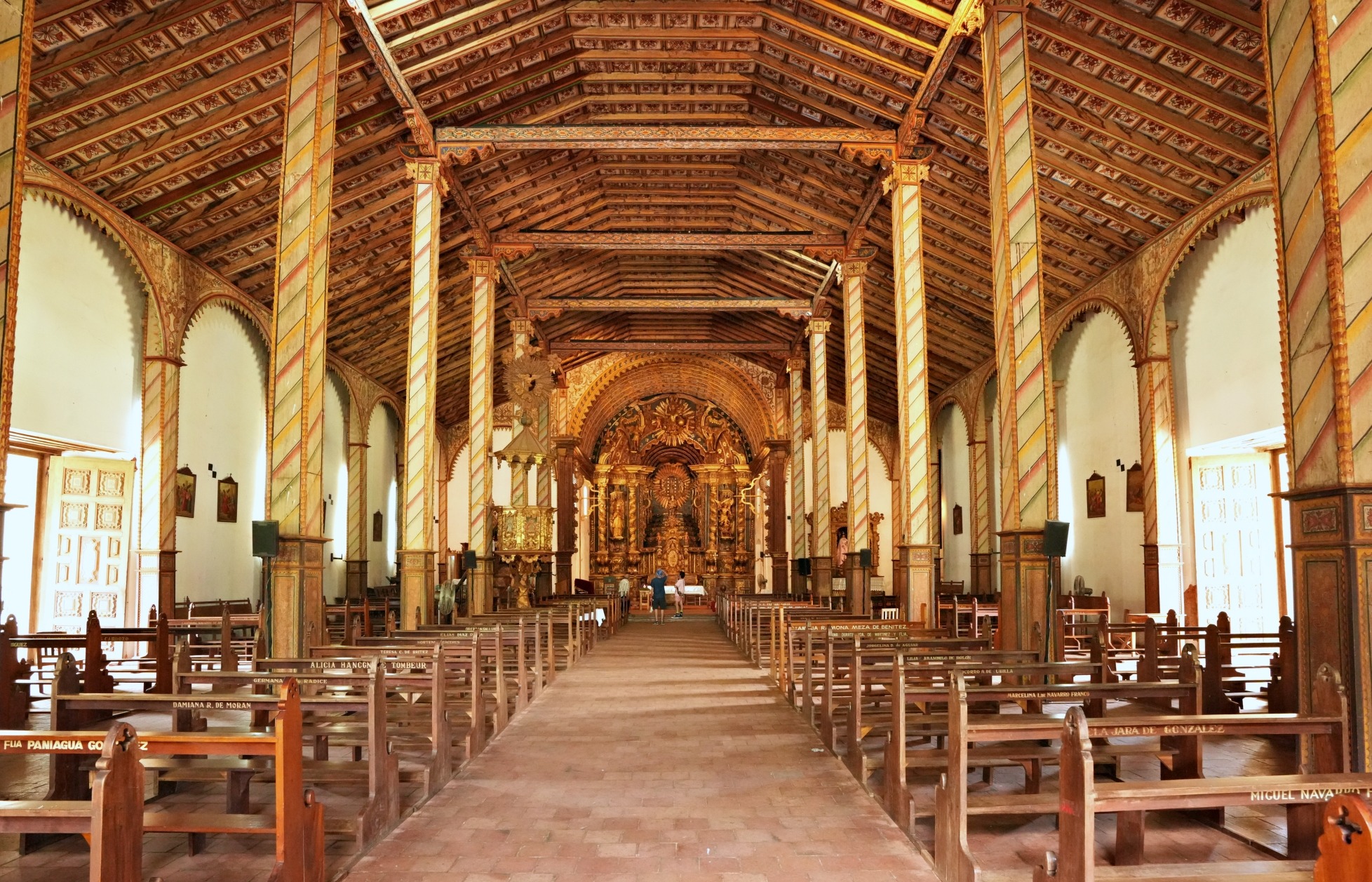
We stepped inside the Franciscan mission church and stood in awe of what we saw. The long, single room has tall wooden pillars, decorated with pastel colours. Above the pillars, the ceiling is painted with depictions of local floral details such as passion flowers, ferns and palms. Local Guarani residents added most of these decorations, and the paint colours came from local plants and minerals. 

At the front, the elaborately carved wooden altar has been painted gold. The altar is made from peteribí wood, an endemic South American semi-hardwood. It was crafted by Portuguese artist de Souza in the Portuguese Baroque style. With so many fine details, it’s easy to forget that this altar was created in a remote Paraguayan jungle rather than in an established woodworking centre.

One of its side altars was so exquisite that it was moved to the Church of the Holy Trinity in Asuncion in the 1800s. The architect designed and decorated many South American mission churches in the 18th century.

While working in Yaguaron, de Souza taught the Guaranis the crafts of sculpting and carving. They used these new skills to create the other wonderful decorations in the church.

Another beautiful piece in the church is the carved wooden pulpit. From the halo on top to the statue on the base, it is overflowing with stunning details.

When the church was handed over to the community, the locals were such strong believers in Christianity that they continued to use the church and spread Christianity among their own people.

The woodwork in San Buenaventura Church is an excellent example of the craftsmanship of the time and is one of the best-preserved Franciscan mission churches in Paraguay. For these reasons, it was awarded UNESCO World Heritage Site status.

You can also visit Jesuit Missions in southern Paraguay. For more information read out post Jesuit Missions in Paraguay.


After spending time in the mission church, there are a few more things to see in Yaguaron.

As you walk through the town centre, you’ll pass the 14 Stations of the Cross, an important part of Easter celebrations in the Catholic Church. The first station is on the church grounds, and the rest follow a route to Cerro Yaguarón. (Yaguaron Hill).  This made us think that Holy Week (Semana Santa) would be a great time to visit Yaguaron.

On one side of the church are several statues of local artists, writers, poets and musicians. These statues add a nice touch to the humble town.

We visited a few weeks before Christmas, and at one end of Paseo Cultural we found a manger scene. If you look closely, you can see chipa in the basket. It is a local bread made from manioc and is often shaped like a bagel, as we see in the nativity scene.

The name Yaguarón comes from a mythical dog in Guarani legends. It was called Jaguaru or Ñaguaru. The dog is considered to be the ancestral protector of the city. In addition to the name, there are a few reminders of their Guarani ancestry on Paseo de los Mitos (Walk of Myths). The colourful street displays wonderful street art on many of the walls and fences. The art allows you to learn a little about Guarani mythology because many include characters from indigenous legends, which led to its name. 

One of the streets that crosses it is called Paseo de Flores (Flower Walk). It is only one block long, but as its name suggests, it is bordered by beautiful flowering trees. 

The large Heroes’ Square (Plaza de los Héroes de Yaguarón) is found in the middle of town. At its centre is a monument to soldiers who lost their lives in the country’s two main wars: the War of the Triple Alliance and Guerra del Chaco, where they fought against Bolivia. 

José Gaspar Rodríguez de Francia, also known as Dr. Francia, was the first president of Paraguay. He was born in Yaguaron, and his former family home is now a sparsely decorated museum. Dr. Francia was a dictator and even with this history, he is still cherished in this town.

The streets in Yaguaron offer a glimpse of the traditional Guarani-Spanish homes. They typically include adobe whitewashed walls, gabled roofs that hang over covered porches and are held up by columns. We saw these homes throughout Paraguay.

Paseo de los Mitos leads to Yaguaron Hill (Cerro Yaguarón) on the edge of town. There is a hiking trail to reach its summit, which might be a nice walk if you visit in the autumn or winter. We found the humidity too high when we were there and were not enticed to go for a hike.


The mildest climate in Yaguaron is between May and September, making it the most comfortable time to visit. During the South American summer, between December and February, Yaguaron is very hot with extremely high humidity. In early December, temperatures were in the mid 30s°C (90s°F), but the humidity was 85-90%, making it almost unbearable. The rainiest months are November and April, but it rains every month.

Yaragon is located in the centre of the map below, not far from Asuncion. It is an interactive map so you can zoom-in, or click on a marker for a link to our post from that region.

The 55 km (34 mi) journey takes 2 hours by bus, or 1 hour by car. Buses destined for Paraguari will stop in Yaguaron and depart from Asuncion Bus Terminal (Terminal de Ómnibus de Asunción). We read that buses leave on the hour, every hour, but ours left at 10:30, so we’re not sure the exact schedule. To return to Asuncion, you can find several marked bus stops on the main road. Buses will have a sign on the front for their destination. Wave one down that says Asuncion.

These buses are not air-conditioned, and as our bus crept its way through Asuncion, we got hotter and stickier. The open windows provided a breeze, but we didn’t move quickly enough through the city traffic to allow much air in. Eventually, we made it out of the city, and with the increased speed, we welcomed the breeze.

Even in the heat, though, these buses are a way to experience typical life in Paraguay. Vendors hop on and off the moving bus, selling cold drinks, chipa (local buns) and snacks. One man was loaded with an odd assortment of things, including scissors, toothbrushes and charging cords. It is always an adventure riding these local buses.

Click on the link to go directly to our Travel Tips for Paraguay.

Read from another device.

To read more of our adventures in Paraguay, click here.

Fediverse reactions

67 responses to “Franciscan Mission Church in Yaguaron, Paraguay”

  1. Gorgeous, gorgeous! Wow Thanks Maggie. And happy new year.

    1. Thanks Selma, Happy New Year! Maggie

  2. Wow! That must have been something to see! Beautiful, and as you said, you have to remind yourself that this work was completed in a jungle, not an equipped workshop.

    1. It is staggering to see whet can be done with very few tools. Thanks Lynette

  3. The church is stunning, especially the altar, pulpit and beautiful ceilings! I also love the street art with its depictions of traditional myths.

    1. This little, unassuming town has quite a few things to see. Thanks Sarah!

  4. The church is indeed amazing; the wood carving specular. Interesting that the Franciscans treated the indigenous population with a bit more respect then in other places. (Suzanne)

    1. It was interesting to read that. It was never stated directly, but insinuated that it was because the Guarani didn’t attack them as other South American indigenous people did (rightfully so), Thanks Suzanne

  5. Wow 🤩

    1. 😊 Thanks Eliza, quite stunning isn’t it?

  6. Wow, this is such a stunning, intricately carved wooden interior that contrasts with its simple exterior. I just love all the beautiful columns, carved altars, and the details. Thanks for sharing, and have a good day 🙂 Aiva xx

    1. The church was such an unexpected treat, and the rest of the town followed suite by decorating their streets. Thanks Aiva

  7. San Buenaventura Church is absolutely amazing! It’s exterior is simple and plain but its wood sculptured interior-WOW! What’s surprising is that the extreme humidity hasn’t damage it. The street art and bench statues add to the little town’s unique charm. Thanks for the tour of Yaguaron! 🙂

    1. They have done an amazing job preserving and restoring the church in these conditions. Who would build with wood in the jungle? Thanks Nancy

  8. Very nice. Paraguay is one of the few Latin American countries I haven’t been…
    Love the statues.
    Thanks for sharing.
    Brian
    (And a happy New Year to you guys, despite all the current horrors…)

    1. It isn’t an easy country to visit, nor is it filled with sites, but we enjoyed the ones we saw and meeting the people. Thanks Brian

  9. The wood carving and the interior of that church is pretty amazing, understandable that it is a world heritage site. Encouraging to hear that it didn’t seem to be the usual story regarding the indigenous people and the Franciscans in Paraguay perhaps lived up to their calling.

    1. It probably wasn’t as pleasant as history says, but it does look like they were treated better than most. Thanks Jim

  10. OMG Maggie, Yaguaron really is home to the country’s best-preserved Franciscan mission churches. The architecture in the ceilings, altars and pulpit are simply mesmerizing! Paseo de los Mitos and Paseo de Flores are such an interesting plethora of experiences. Love it and thanks a million for sharing this great escape. 😊📸💐

    1. It really is a stunning building. Glad to take you away from the cray-cray for a few minutes. 😊

      1. Guuuurrrrllll Maggie, anything to take my attention away from cray-cray, and cray-cray magnified like a rabid bat on steroids! 😝 But this post was right on time to read and take a tour through! Love it my friend!!! 🤗💖😘

  11. I love the benches with the series of sculptures of local artists. That’s a beautiful touch.

  12. Paraguay has such a unique mix of history and soul. I was only in Ciudad del Este, and to be honest… I wish I could see more of the country. Beautiful photos too 🙂

    1. Thanks Anna, we actually didn’t even go to Ciudad del Este 😊 There are a few sites in Paraguay worth visiting, but it is more about the people and the culture, which I think is what you like to see as well. Maggie

      1. I completely agree, beautifully expressed.

  13. There should be a mistake about the son of the first dictator … it appears it is about the son of the first’s dictator successor …

    1. Oh, you’re right, I got my dictators confused 😊 I’ve corrected it now. Thanks

    2. Well, i was not intending to be right :). I just took a look for mor info about this guy since the house turned into museum made me ask myself if this is an original or just a reconstructed replica. Do you have this information? It has some curious details such as the church in the main picture has … Never saw before such a building where the masonry is just for enclosure as it seems there. Wooden pillars close but detached from the walls are looking strange and very particular.

      1. The musuem is held in his old house, which was restored, but it is original as are many of the pieces inside.
        We’ve seen these wooden columns, and overhanging rooofs in other jungle missions in South America, but for those the entire church was also wooden. From what we understand, in this one, the adobe walls provide insulation from the heat, and the wooden frame supports the roof. But obviously, we are not experts 😊

      2. Thanks! I was not thinking of adobe (being a church, i was automatically thinking of masonry as main material …) but that makes total sense now. The museum seems somehow over restored – that was the reason of my doubts.

  14. Yep, that’s what makes public transport so much fun, in all parts of tge world.

  15. Oh my, how incredible! And with no high powered, modern day tools; impressive. Love the street art too. Nice post and photos, Maggie!

    1. I know, it’s pretty amazing amazing art people can create, and in the most unlikely places. Thanks Tricia, Maggie

  16. Imagine going there as a missionary, totally unaware of how you are going to be received and not at all sure if you will even make it back alive!! Nice photo of you (I assume) sitting next to the statue 😀

    1. Yes, it is me 😊 And you’re right, it must have been pretty scary for the missionaries too, going into a wild jungle, unsure of what you’ll find. I hadn’t thought of their side of it. Thanks Paul

  17. Wow. And look where Catholicism is in that region now – it’s only a matter of time before they provide the Pope. I’ve read that the future of RC rests with South America.

    1. They are still quite devout followers in much of South Americas, so that could be true.

  18. What a place! It sounds like an incredible blend of Guarani craftsmanship and colonial history, especially with its beautifully carved wooden altar and painted interior. Looks like such a hidden gem just outside Asunción and a must-see for anyone interested in culture and history 🙂

    1. It is a hidden gem and an important part of this region’s past. Thanks so much Hannah! Maggie

  19. Beautiful carvings. How interesting to learn a little of the Guarani culture. The long low buildings seem to be typical in these towns.

    1. Yes, the low buildings with overhaning roofs are very common, we saw them throughout the country. They add a local touch to the towns. Thanks Ruth

  20. That’s a stunning church with doors and windows to match. I can see why it’s the centerpiece of this post. So here we have another country that loves its dictator (like Stalin in Georgia). Interesting. Bizarre, but interesting.

    1. I know, why do they located those who tormented them?! But, yes the church is stunning. Thanks!

  21. What a beautiful church! The ornate interior is such a contrast to the simple exterior. The intricate wood carvings and paintings are stunning and the craftsmanship exceptional.

    1. It is a stunning church, I can’t imagine how impressive it was to the locals when it was first built. I’m sure they’d never seen anything like it. Thanks! Maggie

  22. I also stopped in Yaguaron, drawn by the large church that resembles the Jesuit missions in Bolivia. A fascinating view of Yaguaron! The fusion of Franciscan architecture and Guarani art inside San Buenaventura is breathtaking: these flowered ceilings are a real treasure. It is wonderful to see how the city preserves both its mythical roots and its colonial history in such a vivid way.

    1. The carvings and paintings are gorgeous aren’t they? And the rest of the town was surprisingly cute, given the other small towns we had seen. I’m really glad we visited. Thanks

  23. Happy New Year! San Buenaventura really shows you can’t judge a book by its cover. That pulpit is really incredible!

    1. Happy New Year Lyssy! That’s very true, the interior is so elaborately decorated. I’m glad we were able to get inside.

  24. I like the look of Yaguarón. And yes, when I saw that opening shot, I was immediately reminded of your blog post on the Jesuit churches in Bolivia. San Buenaventura Church looks really beautiful, especially from the inside. I’m particularly intrigued by the painted wooden ceiling. Thanks for introducing this place to us!

    1. It is not as fancy as the ones in Bolivia, but the carvings and ceiling make this church very special. I knew you would like it. 😊

  25. The interior of the church is beautiful and so detailed. Glad it’s been preserved. It looks exceptionally clean.

    1. Me too, since it is one of the last ones standing, it is quite amazing that it is in such good condition. Thanks Linda

  26. I love that the outside has a quiet, simple beauty but then inside is really detailed and beautiful. A treasure that I’m so glad was preserved so well.

    1. I’m glad it was preserved too. It would be a shame to lose such artistry. Thanks again Meg

  27. What a fabulous post, Maggie! Great photos from Richard xx

    1. Thanks so much Jo!

  28. That church was such a surprise – fantastic ceiling and decoration. I always preferred Franciscans to Jesuits…😊 Your last post mentioned tidy Mennonite gardens – I noticed that on the border of Belize and Guatemala. My Catholic Uncle in Ireland had a great expression, “your house looks right Protestant”, meaning it was tidier and cleaner than the Catholic houses.

    1. Haha, well I don’t know if it is because they are Protestant or very disciplined, but there was an obvious difference to their farms than the Catholic Paraguayans.

      1. It is the same on the border of North and South Ireland…😊

  29. Such beauty and architecture in the middle of nowhere! And I love that the locals were allowed to continue with their traditions. An interesting spot. Ta, Mel

    1. Yes, it sounds like the Guarani people were treated much better than most. It was called an experiment, but it worked well, so I’m not sure why it wasn’t followed in more places in South America. Thanks Mel

  30. Wow, the details in those wood carvings are incredible. I can’t believe how ornate the interior of the church is!

    1. It was definitely a surprise. And imagine that they had limited tools, and had just learned how to carve! Thanks Diana

  31. Beautiful craftsmanship in the church, Maggie. An indication of reverence, faith, and dedication.

    1. It is really remarkable what they built back then isn’t it? And you’re right, you can see their devotion in their work. Thanks Mary

We'd love to hear from you, please leave a comment.

Destinations

Discover more from Monkey's Tale

Subscribe now to keep reading and get access to the full archive.

Continue reading