
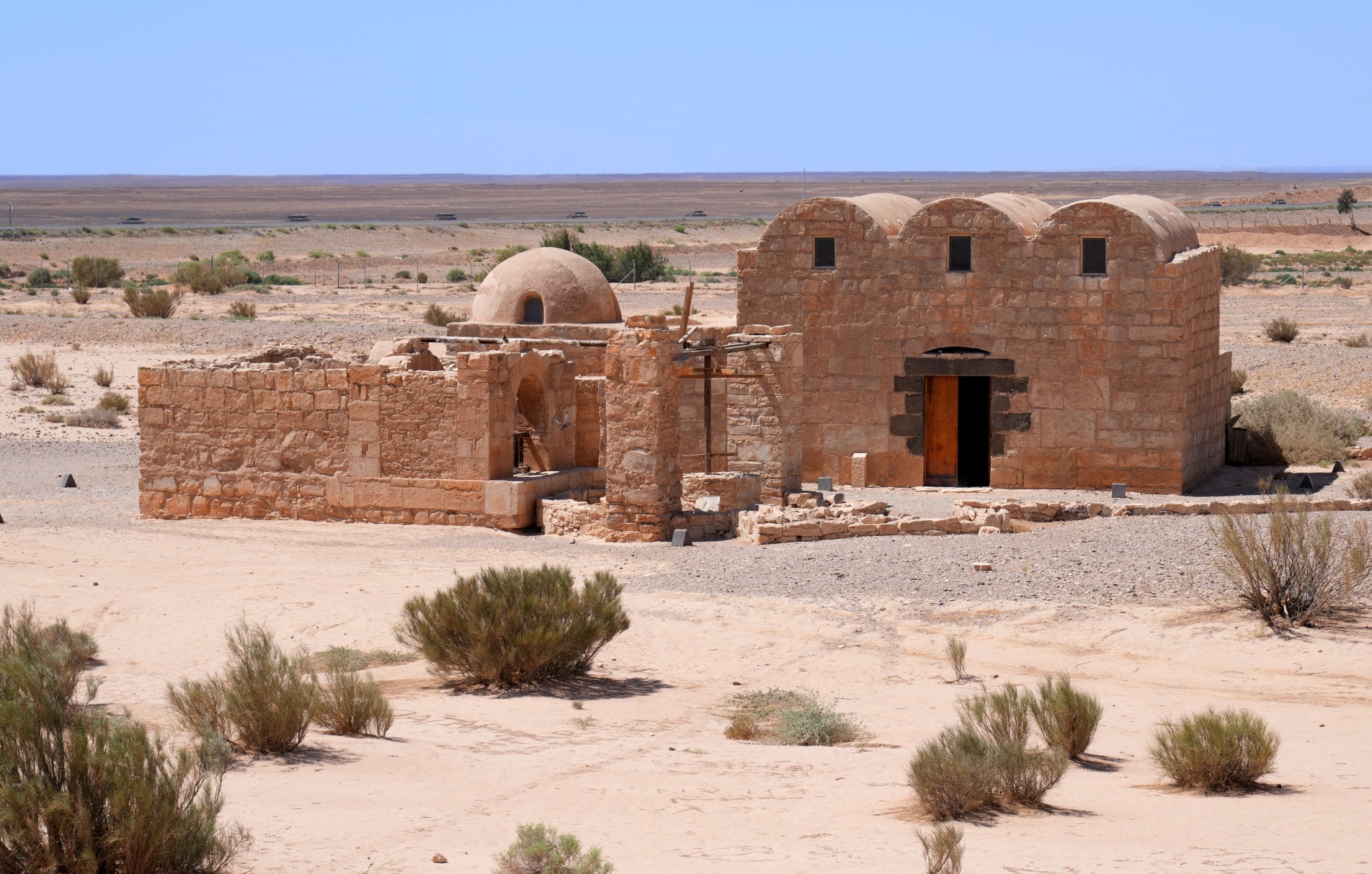
Jordan’s location means it is saturated with historical landmarks. Two places from very different eras can easily be visited on a day trip from Amman. As-Salt boasts the country’s Ottoman era, with historic homes climbing the city’s three hills. On the eastern side of Amman are a few medieval fortresses. The frescoes on Quseir Amra make it an important historical monument and a fascinating place to visit.
To see where As-Salt and Queseir Amra are located, please click on the link to view our interactive map of Jordan.
1st Day Trip to As-Salt
Less than 30 km (28 mi) from Amman Citadel, you’ll find a city with a different look and history than the capital. Since there are good sources of fresh water, people settled in the area as early as the Bronze Age. Much later, it was part of the Hellenistic, Roman and Byzantine lands. While As-Salt was conquered by the Arabs in the Middle Ages, it was the Ottoman Empire’s arrival in the 1500s that developed it into the city we see today. At that time, the Ottomans controlled most of the Levant, which included today’s Jordan, Palestine, Israel, Syria, Lebanon and Cyprus.
Things changed for the city after WWI when the Ottoman Empire was defeated, and Transjordan became an independent kingdom. Since Amman was selected as the capital, the once prosperous As-Salt lost its prominence. That event, though, allowed the city’s Ottoman buildings to remain standing rather than being torn down to make way for a new capital. As a result, they are still the defining architecture in the city’s centre today.
As-Salt is gaining popularity again with its recent UNESCO World Heritage Site designation. It is still far from the tourist trail, but it’s a popular weekend trip for Amman residents.
Old Town
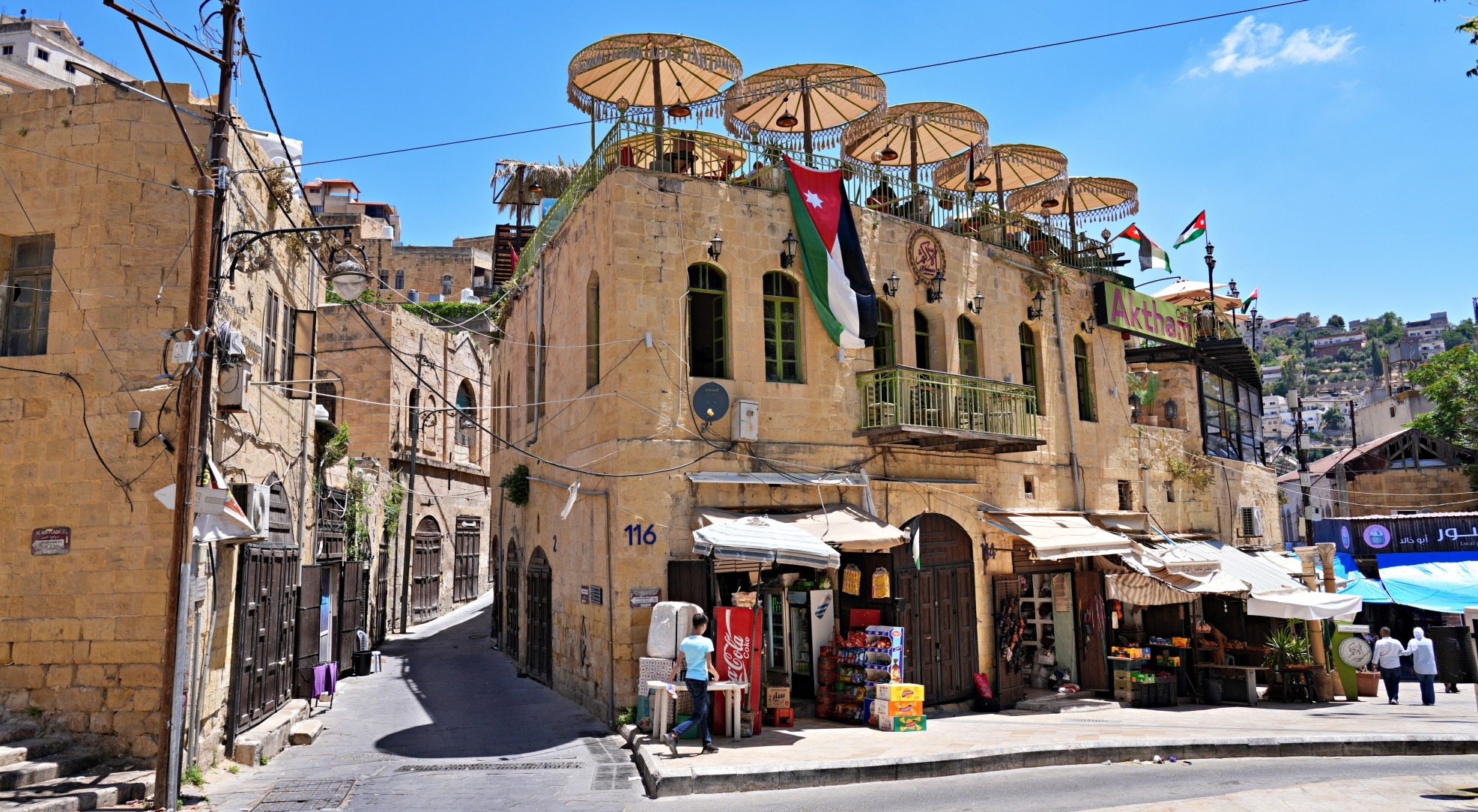
Today, the city’s Old Town is still filled with those 19th and 20th century yellow sandstone Ottoman houses, giving As-Salt a unique look. Instead of wooden walls and overhanging balconies that we’ve seen in other Ottoman communities, these limestone buildings have arched windows, metal balconies and unadorned outer walls.
To see other types of Ottoman architecture, visit our post from Cumalıkızık, Turkey.


Al Ain Plaza
As-Salt was established in a valley between three hills: Al-Qql’q (Capital), Gadaa and Salalem. Located in the narrow space between these hills, Al Ain Plaza was originally a meeting place for traders travelling through the city. Although it is only a tiny space, the plaza seems to be the hub from which the streets branch out, so it is a good place to begin your exploration. Al Ain means Spring, and it received that name because of an old mountain spring that once ran through it.
As-Salt Great Mosque
On the side of Al Ain Plaza is the yellow stone mosque and minaret. Built during the Abbasid Empire, it is the oldest mosque in the city. Unfortunately, it was closed when we visited, and we couldn’t see inside.

Al-Hammam Market
Not far away, at the base of Al-Qala’a hill, is a bustling local market. Used by locals, Al-Hammam Market sells everyday goods rather than tourist knick-knacks.
We found the people across Jordan to be very friendly and welcoming, but it increased dramatically in As-Salt. For example, in the market we tried to buy apricots, but they wouldn’t take our money. Instead, they said, ‘Welcome to Jordan’, and gave them to us for free. They were delicious apricots too.


From Al Ain Plaza, the city climbs straight up the hills. They are so steep that in many places, staircases provide shortcuts so pedestrians don’t have to follow the long, winding roads.


English Complex
From the mosque, take the Al Khader Stairs to explore the sites on Al-Qala’a hill. On the way, you’ll pass the English Complex. Unfortunately, this large facility is not open to visitors, and it is difficult to see from the street. It was a large multi-use centre in the mid 19th century, housing a hospital, Protestant church and Sunday school. Instead of getting a view of the complex, climbing the stairs to it gave us an interesting one of the Great Mosque’s roof.

Further up Al-Qala’a Hill, a lookout has even better views, allowing us to appreciate As-Salt’s hilly setting.

Churches
The Byzantines brought Christianity to the Jordan’s highlands, and many Christians still live in the city today. In the 19th century, there were as many as 80 Christian families in As-Salt, and they built a number of churches. At that time, Muslims and Christians lived together in harmony, which seems unlikely in many places today. Today, 35% of As-Salt’s population is Christian, much higher than the national average of 4%. As a result, As-Salt’s skyline includes a mix of bell towers and minarets.
St. George Church
In the 1600s, a vision of St. George appeared to a local shepherd while he was resting in a cave on Al-Qala’a hill. The saint told him that if he built a church on this spot, the villagers’ sheep would be protected from wolves. The shepherd relayed the message to the community, and in 1682, they built the Church of St. George over the cave.
This is the same martyred St. George we learned about in Coptic Cairo and the one after whom the country of Georgia is named. He was a Roman soldier who wouldn’t give up his Christian beliefs, so he was martyred.

The low Gothic-arched ceilings in the sanctuary let you know you’ve entered a sacred place. At the back of this room is the entrance to a small cave where St. George is said to have appeared. St. George is important in both Christianity and Islam, so many from both religions come to this church to pray. In Arabic, he is called Al Khader.

Dormition of Virgin Mary Orthodox Church
Beside St. George is the large white dome of the Dormition of the Virgin Mary Orthodox Church. Built in 1914, the Orthodox Church uses the term Dormition to refer to the peaceful death of Mary. It is similar to Assumption, used by the Roman Catholic church.

Our Lady of Assumption Church
Built in the late 1880s, this large Roman Catholic Church seems to be squeezed into this old neighbourhood. In fact, our best view of the church was from a rooftop patio. It was closed to visitors when we were there.

Other things to do
As-Salt Archaeological Museum – Held in an early 20th century stone house, called Touqan House, the museum has a few artifacts from the Balqa’ Region dating back to the Bronze Age. Entry is included in the Jordan Pass. Otherwise is 2JD. Opening hours – 8am- 7pm, in winter it closes at 4pm.
Abu Jaber House Museum – This small museum is located in a different Ottoman building, Abu Jaber House. It is also called As-Salt Historic Museum and features the interior an old house rather than a display of artifacts. Entry is free; Opening Hours – 8:30 am – 7 pm, in winter it closes at 4pm.
The Tourism Board has two walking routes for tourists to follow. We didn’t follow them exactly, but instead, combined their destinations into one day. You can pick up a map at their office in the Abu Jaber House or find them online.
If you have a car and more time, you may want to visit: the Shrine of Prophet Yusha (Joshua), the Tomb of Job (Khirbet/Prophet Ayyoub) and the Dolmen Burial Chambers.
Where to eat in As-Salt
There are several restaurants on Al-Hammam Street and near Al Ain Plaza. We visited Aktham’s 1881 Coffeehouse. This popular restaurant and coffee shop is located in the historic Daoud House (1881). We were more interested in seeing inside the Ottoman Building but stayed for a cup of coffee too. We recommend having tea or a cold drink, but unfortunately, we can’t recommend their coffee.

Getting to As-Salt
As-Salt is only 30 km from Amman and is easy to reach even if you don’t have a car. Take any bus or Uber to Amman’s Sweilehi Bus Station. From there, catch the SL1 minibus to the As-Salt Bus Station. Bus fees are only 0.60 JD. They leave every 10 min or so when full.
If you drive, there is a lot of street parking near the Archaeological Museum, and once you arrive you can easily walk between the sites.
2nd Day Trip to Quseir Amra
On the edge of Jordan’s border with Saudi Arabia are the remains of a 1,300 year old garrison and hunting lodge. What makes it special are the early Islamic frescoes that cover its walls.
Note – it is also spelled Qusayr ‘ Amra or Qasr Amra
The Umayyads were Islam’s second empire (caliphate). Not long after the remote complex of Quseir Amra was built, Umayyad leaders banned icons, or images of people, from all Islamic buildings. Called aniconism, it resulted in many previously painted mosques having their icons removed. Quseir Amra’s desert location, secular use and lack of importance are what likely allowed its artwork to escape destruction. Only time and more recent vandalism have caused damage to the murals.
It was once a massive complex, built in the mid 700s by Caliph Walid II, who was a prince at the time. It included a garrison, private hunting lodge and bathhouse. Since it was a two-day, 240 km camel ride from the Umayyad capital of Damascus, it was mostly used as a retreat for the prince and other Umayyad elites. This remote location was likely what allowed its frescoes to be spared.


Today, only the reception hall, bathhouse, and a 40 m (130 ft) well remain, but its walls display some of the best examples of secular Arabic artwork still in existence. What is also remarkable is that the plaster and paint have withstood the harsh desert conditions. Using natural pigments from cinnabar, lapis, ochre and copper, the images are still vibrant today. Because of this, it was awarded UNESCO World Heritage Site status.
When you see it from the outside, you may wonder why you bothered to travel this far. Step inside the small building, though, and the reason is immediately apparent. Covering the walls, ceilings and archways are wonderful, centuries-old frescoes. Some are portraits, while others depict mythical beings and legends. This building demonstrates the appreciation of art by the elites in the Umayyad Caliphate in the 8th century.


Reception Hall
The first room is the Reception Hall and has a wide variety of images. A large one depicts the prince, lounging on a couch surrounded by servants. Only one-half of the prince’s face can be seen, but once you find it, the picture makes more sense.

The wall beside it has an image of six kings from nearby lands. They are on the left side of the picture below, but the fresco is in very poor condition. Like most of the walls, this one is full of images. Beside the kings is a woman bathing, and then men wrestling. Above these is a hunting scene where wild onagers (Asiatic asses) are being chased. Another wall in this space has a boat with fishermen below a depiction of Jonas and the whale.


On the other side of the hall, 32 frames are painted on the ceiling; each depicts a different tradesman working. The end wall shows the evisceration of an animal after a hunt.


Changing Room
You’ll find quirky images framed by leaves in the Changing Room (Apoditerium). The pictures include a bear playing a lute while a monkey beside it is clapping. There are also dancing women, musicians and many animals.


Warm Room
Although the lodge looks small from the outside, it seemed as if the rooms went on and on, each leading to another surprise. Beside the Changing Room we found the Tepidarium (warm room). Its walls and ceiling are adorned with images that are uncommon in Islamic countries. Several are of naked women, and one includes a baby being bathed. Some people claim they are goddesses, but most say they depict real women.


Hot Room
The astronomical ceiling in the Hot Room (Caldarium) is one of the earliest surviving maps of the zodiac. It’s too bad that it is in such poor condition.


Because it’s so remote, we almost didn’t visit Quseir Amra, but we found ourselves with extra time, so we decided to make the trip. We’re so glad we did, because it turned out to be a real gem.
Entry fee – it is included in the Jordan Pass, otherwise, it is 3JD ($4.25 USD); Opening Hours – 8 am to 5 pm.
Getting to Quseir Amra
Located 90 km east of Amman and far from any other toursit attractions, you cannot reach Quseir Amra by public transit, but it is included on Desert Castle tours offered in Amman. Another option is to either drive yourself or take a taxi from Amman for 50 JD.
There is a US Army base in close proximity to Quseir Amra. Due to the War in Iran, please read current news to determine if it is safe to visit.
Qasr al-Kharaneh
On the way to Quseir Amra, make a quick stop at Qasr al-Kharaneh. This former Umayyad Desert Castle sits right on the edge of the highway. Researchers are unsure of its purpose. It may have been a meeting place for Bedouin tribe leaders, a caravansary, or a military outpost. But they do agree that it was built during the reign of the Umayyad Caliph Al‑Walid I, the father of the one who built Qaseir Amra.
Entry fee is included in the Jordan Pass, but there really isn’t anything more to see than its four walls.

Qasr al-Azraq
In the far northeastern edge of Jordan is Azraq Oasis. This tree-filled area in the Jordan Desert was a popular stop along trade routes throughout history, including the Nabataeans of Petra. In the middle of this oasis is an abandoned fortress, Qasr al-Azraq, built by the Ayyubids in the 13th century. It is one of Jordan’s Desert Castles and is not far from Quseir Amra.
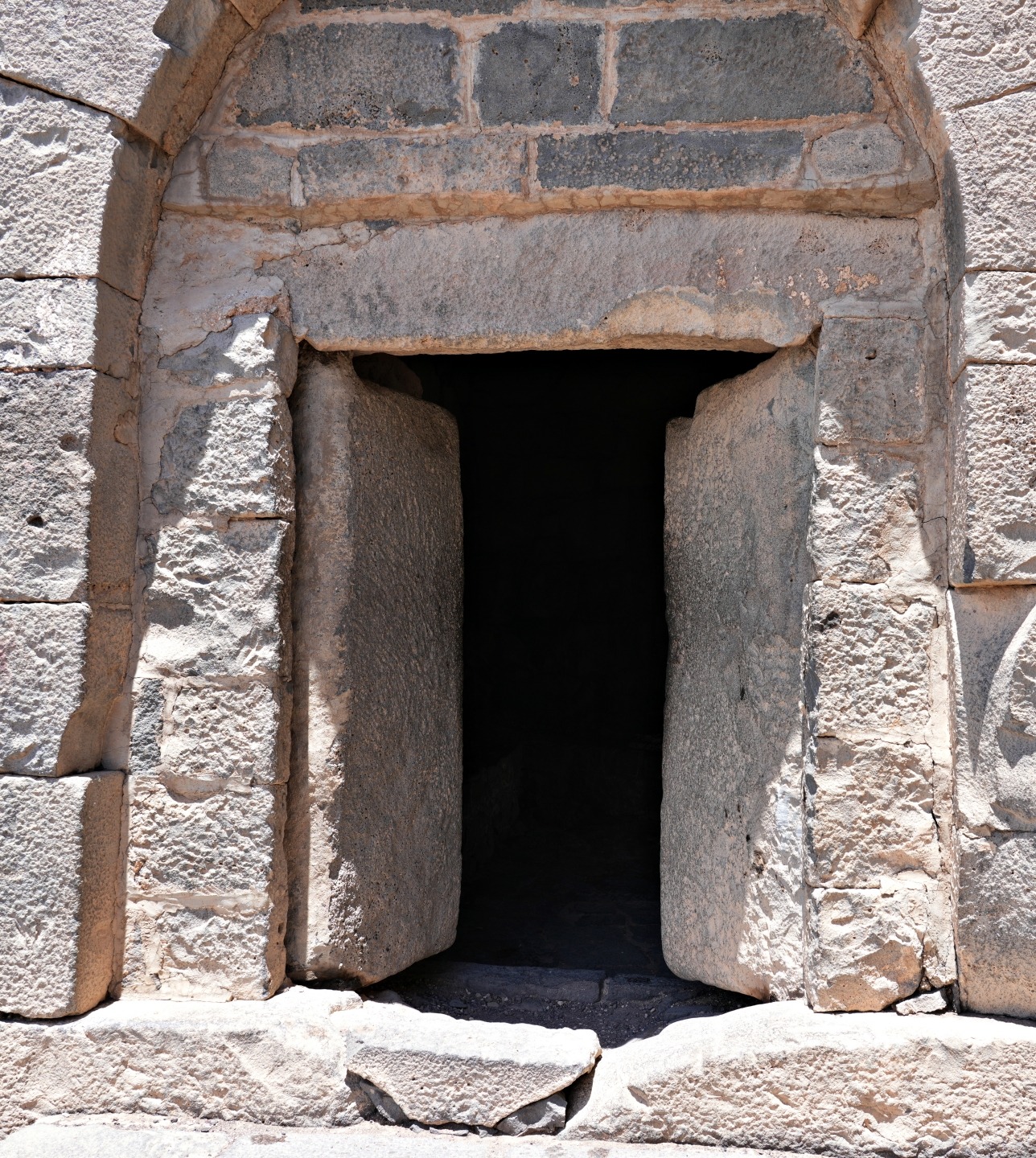
There’s not much left of Qasr al-Azraq (Blue Fortress) today. Its outer walls look like the basalt stones were piled on top of one another with no mortar, and yet they still stand. The best feature of the castle, though, is its stone door, built from two large slabs of basalt. Even the door hinge is stone.

In the middle of the complex is the old mosque. Its ceiling, made from long basalt slabs, is the most interesting part.

Even though it isn’t in good shape today, the fortress was used during the Arab Revolt in the early 1900s. It was at this time that Lawrence of Arabia is said to have stayed in the castle for a while. We’ll talk more about Lawrence of Arabia when we visit Wadi Rum.
It wouldn’t be worth the trip on its own, but if you’re coming to Quseir Amra, it is worth the extra few kilometres to reach it. Not everyone will be comfortable with its location that puts you not far from the borders with Saudi Arabia, Syria and Iraq.
Entry fee – it is included in the Jordan Pass, otherwise, it is 3JD ($4.25); Opening Hours – 8am to 5pm.
Other desert castles to see if you have time are: Qasr Al‑Mushatta and Qasr Al‑Hallabat.
If these don’t interest you, maybe a day trip to Bethany Beyond the Jordan (Baptismal site of Jesus) and Mount Nebo. You can read about those in our next post, Bethany Beyond the Jordan and Mount Nebo – Day Trips from Amman.
For information on places to visit, where to stay and eat in Amman, please visit our post Discover Amman’s Rich History.
Please note, we visited Jordan in the spring of 2026. At that time, there was a ceasefire in the Iran War due to the signing of the Memorandum of Understanding. Since conditions are changing frequently, please read current news on the area before planning your trip.

Here’s a link where you can read more of our adventures in Jordan, and a link to our interactive map of Jordan.
Coming Next – Bethany Beyond the Jordan and Mount Nebo – Day Trips From Amman
For pictures from other blogs go to Gallery at monkeystale.ca.
To read about more of our adventures go to Destinations.
If you like what you read, please comment or share (with credit) using the links below.




We’d love to hear from you, please leave a comment.