
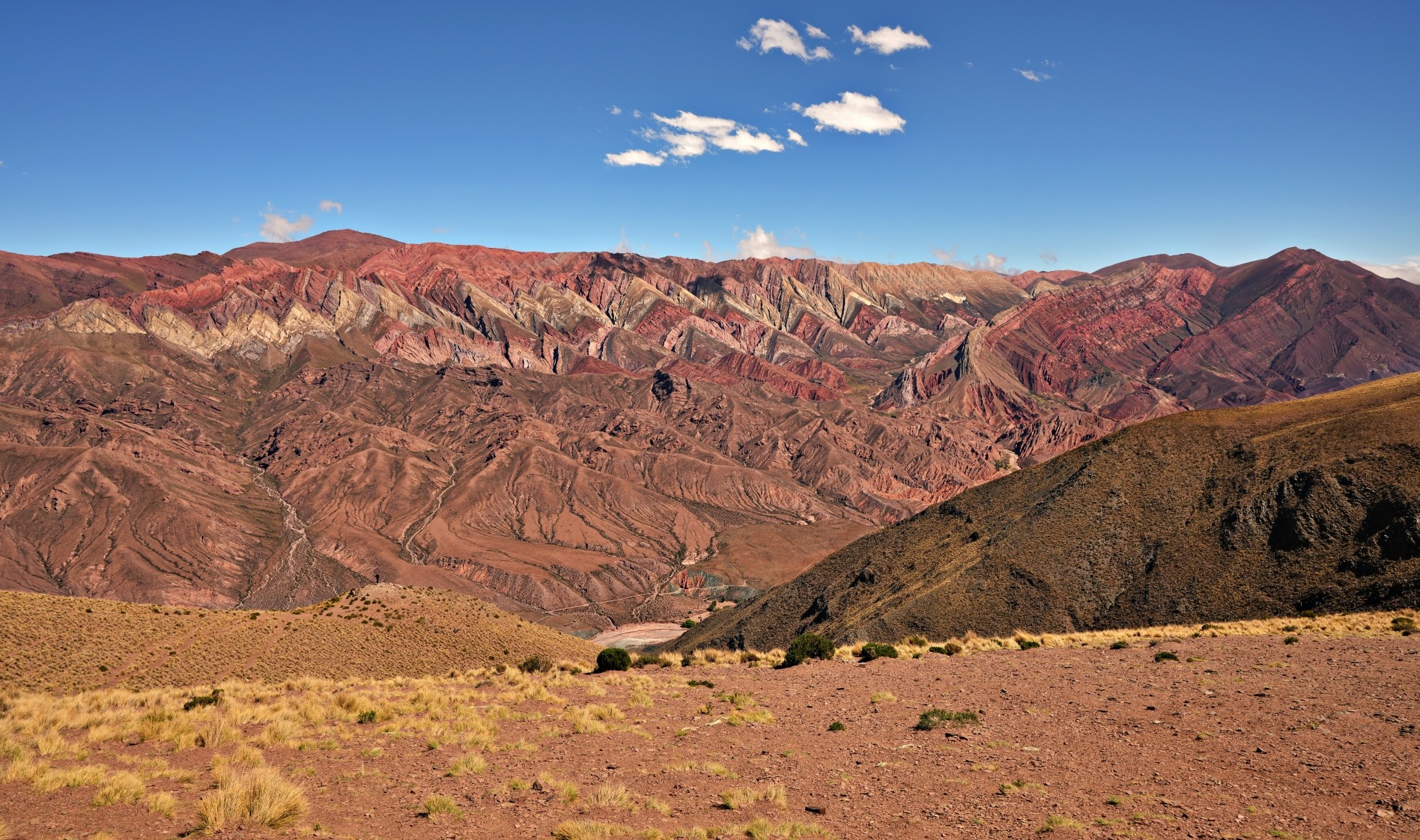
It is almost as if the mountains in Quebrada de Humahuaca are competing to see who can be the most colourful. If this is true, then the Mountain of 14 Colours wins first place. Its ridges are coated with streams of multi-coloured ribbons, leading many to call it Rainbow Mountain. Not to be outdone, below it, the quintessential pre-Hispanic town of Humahuaca has charms of its own. We can’t wait to show what makes Humahuaca and its colourful mountain so magical.
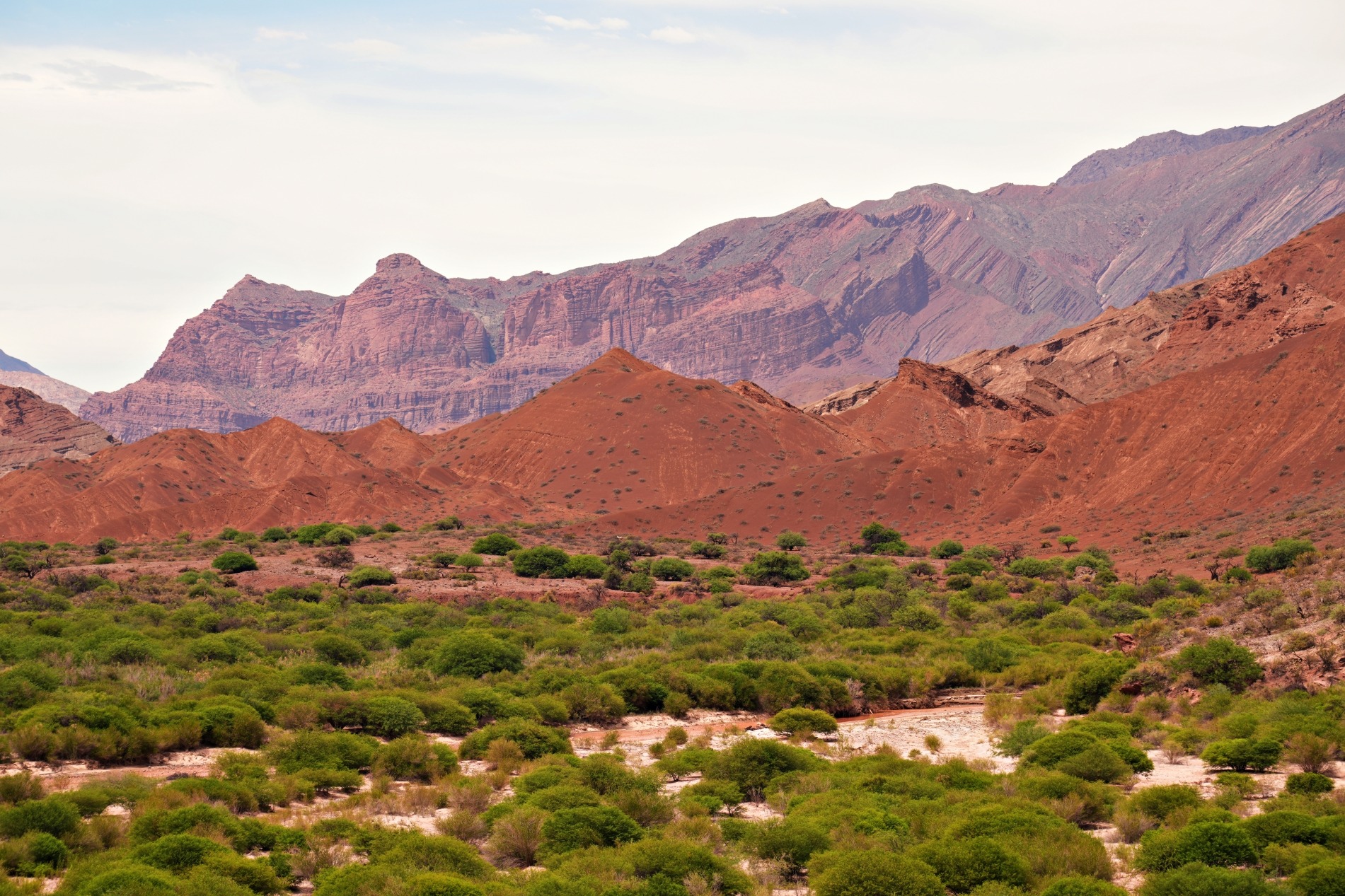
Located in northern Argentina, the province of Jujuy is a very special place. Its best feature, Quebrada de Humahuaca (Humahuaca Gorge), is home to a wealth of colourful mountains that rise high above modest mountain villages. Together they combine to form picture-postcard scenes. Not only is it picturesque, but with origins on an ancient trading route and a wealth of geological formations, the 155-kilometre-long Quebrada de Humahuaca is a UNESCO World Heritage Site.
The main towns, Humahuaca, Purmamarca and nearby Iruya in Salta, are bursting with delightful gems that made us fall in love with this region.
The Drive to The Mountain of 14 Colours
From Humahuaca, the drive slowly climbs from 3,012m (9,882ft) in town to the viewpoint at 4,350m (14,300ft). The hilly landscape is dotted with Andean grasses, a favourite of vicuñas. These are the smallest camelids in South America and only live above 4,000m (13,100ft). We were very excited to see them along the side of the road.


Mountain of 14 Colours
Clouds were spilling over the neighbouring cliffs as we approached the mountain’s viewpoint. Even though they were fascinating to watch, we were worried that they might cover the famous mountain.


Once we reached the viewpoint, though, we gasped at the amazing natural display before us. At least 14 stripes, in a myriad of colours, decorate the mountain’s ridge and made us understand why it is often called Rainbow Mountain. Several different shades of red, green, yellow, and pink combine to make a scene more beautiful than we could have designed ourselves.
The mountain has many names, but its formal name is Serranía de Hornocal.

Not only is it painted with vibrant lines of colour, but the ridge also has multiple peaks, giving it chevron patterns like a knitted sweater.

Cars can drive up to the main lookout at 4,350m (14,279ft), but the best view is from a point roughly 200m (655ft) below. From there, you are much closer to the ridge, but remember that at such high elevation, the climb back up to the car is tough.
From this lower point, we sat and stared at this astonishing feature across the valley. The colours and terrain combined to make something so beautiful, we almost could not believe our eyes.


How to see The Mountain of 14 Colours
Located 25 km (16 mi) from Humahuaca, you have a few options to reach the viewpoint. If you have a car and want to drive yourself, be aware that the winding, gravel mountain road climbs 1,338 m (4,390ft). Some hostels in Humahuaca organize trips, but there are also many independent drivers around the bus station. All seem to have the same price ($14.50 USD), departure times, and tour size. We hired a driver that we met on the street, and it was a great experience.
In addition to the tour fees, there is a $1.50 USD entry fee to the viewpoint.
Tip – The afternoon is the best time to go because the sun’s position brings out the fabulous colours.
Humahuaca Town
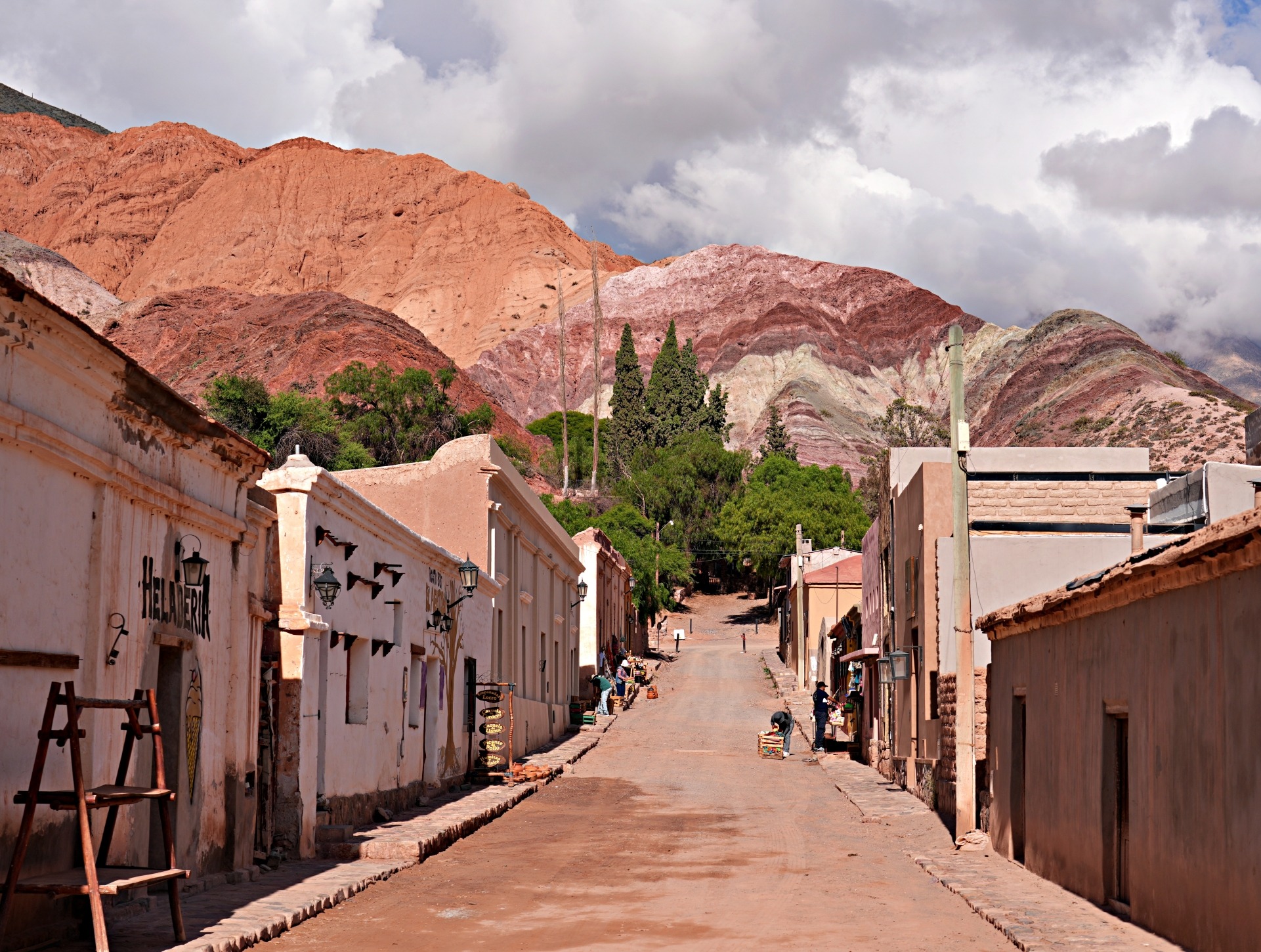
The Mountain of 14 Colours may have brought us to this area, but the quintessential mountain town of Humahuaca captured our hearts. In this small community, stone-paved streets are fringed by charming single-story adobe houses owned by the welcoming Kolla people.


These scenes are not limited to one or two blocks, either. You could spend most of the morning wandering around these streets, and when tired, enjoy a coffee at one of their small cafes.


Plaza 25 de Mayo
In addition to the street scenes in town, there are a few specific monuments to see. Many of those can be found at the pretty May 25th Square in the town centre. Its collection of uniquely designed buildings is what sets it apart from other northern Argentine towns.
Cabildo
The Cabildo, or Town Hall, stands out for its unusual design. Built in the 1940s, it has Moorish-Andalucian features, but with a few quirky touches. The most obvious of those is on its tower. Instead of a dome, it has a tiled globe whose colour matches the high-elevation blue sky.


San Francisco Solano Church
Attached to the Cabildo, San Francisco Solano Church has a similar style. It was originally built in the 17th century, but was almost completely rebuilt at the same time as the Town Hall.


Its old bell tower sounds every 15 minutes, although the German-built clock runs about 5 minutes late. The best part of visiting the church happens at noon. As the bell chimes twelve, visitors are treated to a mechanized show where San Fransico comes out to bless the crowd below. Its schedule follows the clock, so for us it was actually 12:05. The noon show is very popular with tourists, but it is not high action. The saint very slowly raises and lowers his hands in blessing. It is so slow, in fact, that we didn’t notice his arms were moving until the show was almost over.


Cathedral of Our Lady of Candelaria
The town’s cathedral (Catedral Nuestra Señora de la Candelaria) was first built in the 17th century, making it the oldest church in Humahuaca and a national historic monument. Although restored a few times, one of the towers has an original bell that dates to 1641.
It became a cathedral in the 1960s, and because of the small population, its parish covers the region all the way to the Bolivian and Chilean borders.
On the side of the church are statues of Pachamama and Incan leader Tupac Amaru, indicating that pre-Hispanic beliefs remain prevalent.


Inside, its white walls are mostly bare except for the dark paintings of the Twelve Apostles on the side walls. In front, the large golden altar dates to the 1680s.

Monument to Heros of Independence
The unmissable statue on Santa Barbara Hill above town is the Independence Monument (Monumento a Los Héroes De La Independencia), dedicated to those who fought for independence from Spain. The main feature is a 9 metre tall bronze statue of an anonymous indigenous hero. It commemorates the army of local indigenous people who fought in a total of 14 battles in Humahuaca against the Spanish. Included in those was Tupac Amaru, whose statue we saw beside the church.


St. Barbara’s Tower
Beside the monument is all that remains of a Jesuit missionary church. From the adobe-style walls of St. Barbara’s Tower (Torre Santa Barbara), you can get an idea of how the church may have once looked on top of this hill.
The church was destroyed along with much of the town in 1812. In a strategic move called scorching, Argentine Rebellion leader Belgrano ordered Jujuy residents to desert their homes and take all of their belongings so there would be nothing left for the Spanish. It is referred to as the Jujuy Exodus. In the end, his plan worked, and Belgrano is credited with helping northern Argentina gain its independence from Spain.

Peñas Blancas Hike
If you have time, we recommend this easy 4.5 km (2.8mi) return hike to a long ridge of white rock above town called Peñas Blancas. Climb up to a small chapel in the cliffs for a lovely view of Humauaca in the valley.
When there, we watched Grey-breasted Martins dart in and out of the nests they had pecked into the cliffs.


If you want to do a bit of easy scrambling, scale the rocks to the top where you can see the red cliffs behind the white ones.


Tips – The hike is called Mirador Pena Blanca on Google Maps. Go in the morning for the best light.
Peñas
Traditional Peñas are very popular in Jujuy Province. These parties are a lot of fun with live bands playing folk music to a full dance floor. The music is played on traditional instruments, including guitars, fiddles and various wooden flutes, and the lyrics describe their indigenous and gaucho heritage. We were lucky to see two in Purmamarca and one in Humahuaca. They are lively shows, and you should try to see at least one while in Jujuy. They’re easy to find in these small towns, just follow the music around 2 or 3 in the afternoon.

The only thing diminishing our love for Humahuaca is the large number of street dogs. There are so many, begging for food and howling at night. Restaurants allow them to wander inside, where we saw one steal a bone from a plate before the table was cleared. It made us avoid that restaurant the next night.
Day trips from Humahuaca
The towns in the Quebrada de Humahuaca are very close together, making it easy to visit others on a day trip. If you don’t have a car, buses travel up and down the Queberada several times a day (see below). While we do think Purmamarca is worth an overnight stay, if you don’t have time, you should at least visit it on a day trip from Humahuaca. In addition to it, there are two others to consider if you have extra time. One is the small village of Maima and its rainbow mountain. Another is the town of Tilcara and its Inca ruins. Some use Tilcara as a base to visit Cerro de 14 Colores and Iruya. Tilcara is a nice Kolla village, but we still think Humahuaca is nicer and a better option.
Getting to Humahuaca
Flights from popular cities like Buenos Aires, Mendoza, and Puerto Iguazu travel to San Salvador de Jujuy and Salta. You can catch a bus from their main bus stations destined for Humahuaca and Purmamarca. If you have a car, you could take Ruta 9 (Ruta Nacional 9) from Salta or San Salvador for an easy drive.
If you’re already in Quebrada de Humahuaca, Santa Ana buses travel several times a day between Humahuaca and the other towns in the gorge. When driving between Purmamarca and Humahuaca, you will pass through the Tropic of Capricorn, making it the third time we crossed it on this trip. One was near Concepcion, Paraguay, and the other in San Pedro de Atacama (Coming Soon). Buses also travel between Humahuaca and Iruya in Salta Province (Coming Soon).
You can leave your luggage in the Humahuaca bus station if you are just visiting for the day.
Best time of the year to visit Humahuaca
The best seasons to visit are spring (September to November) or autumn (March to May). Rainy season typically occurs between December and February, so it may be unsafe for travel on the mountain roads. We visited in early December and had one day with the threat of rain, one day of heavy rain in Salta, but most of the days the skies were clear. If you visit in late February, you’ll experience Carnival.
Where to stay and eat in Humahuaca
Even though it is now a popular tourist spot for Argentines, Humahuaca has not lost its authentic feel. This popularity means that there are many locally run hotels, hospedajes and hostels in the core. As well, you can find many restaurants on the streets around the plaza. They do take long siestas, though, so most will be closed between 2 or 3 pm and 7 or 8 pm.
We had the best empanadas in Argentina at La Felipa, located on the square. They were stuffed with quinoa and cheese, a mixture that we couldn’t find anywhere else in the country.
Humahuaca is located at the top of the map below. It is an interactive map, so you can zoom-in, or click on a marker for a link to our post from that region.
Note – Prices are listed in USD because the rate of inflation in Argentina is so high that as of 2026, any fees listed in pesos would be inaccurate within a few months. Many restaurants don’t list prices on their menus, or if they do, they have been written over many times as the value of the peso drops. Apart from hotels, most business will only accept payment in Argentine pesos.

To read more of our adventures in Argentina, click here.
Coming Next – Iruya – How To Visit The Remote Mountain Town
For pictures from other blogs go to Gallery at monkeystale.ca.
To read about more of our adventures go to Destinations.
If you like what you read, please comment or share (with credit) using the links below.






We'd love to hear from you, please leave a comment.