
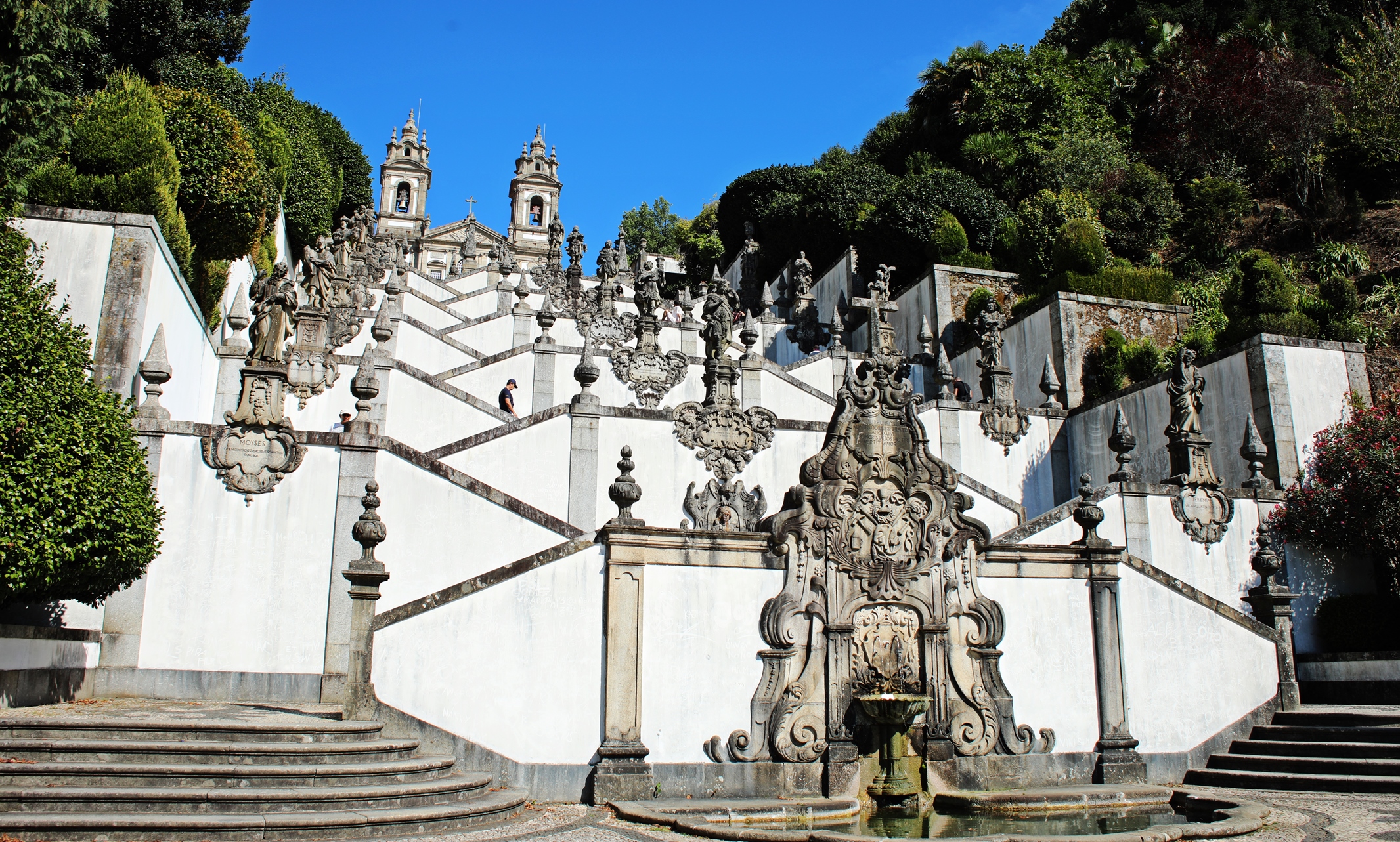
The long staircase, decorated with fountains, statues and crosses is one of the most recognizable sites in Braga, and maybe all of Portugal. Bom Jesus do Monte Sanctuary has been a draw for pilgrims and tourists for years. Finally seeing it in person, we understood its allure. In addition to Bom Jesus, there’s much more to see in this fascinating city. Come with us as we take you on a tour of Braga, Portugal.
The city of Braga was under several different rulers over the centuries. When the Romans settled in the city they called it Bracara Augusta for Julius Caesar Augustus. This led to its name Braga.
Being neither in the prosperous Douro Valley, nor on the coast to benefit from the Age of Discovery, Braga didn’t receive the wealth of other regions. Since its early days however, it has been a pilgrimage site for Christians. Its role in Christianity began in the 10th century and it went on to became one of the most important Christian centres on the Iberian Peninsula.
Bom Jesus do Monte Sanctuary
The famous staircase of Bom Jesus do Monte Sanctuary (Santuário Bom Jesus do Monte) is the main draw for visitors to Braga. Standing at the bottom of the stairs we looked up to an incredible sight. The long, 18th century Baroque staircase is spectacular. In total there are 573 steps and 17 elaborately decorated terraces. The sheer number of ornaments on the staircase is remarkable. Between the granite fountains, the many statues, and church at the top, you almost don’t know where to look.
The staircase represents the Way of The Cross and is an important pilgrimage site for Christians. We weren’t there as religious pilgrims, but we were still able to enjoy its artistry.


As we climbed the stairs, we noticed that each fountain is unique. The first five fountains represent the five senses. If you look closely at the pictures below you can see water coming out of the eyes of one fountain and the ears of the other. The top three fountains represent the virtues: faith, hope and charity.


On the terrace below the sanctuary we found a very small but pretty garden. The two chapels on either side have graphic recreations of the Stages of the Cross.


The church at the top was originally built in the 1300s, but the current building is from the 18th century. Considering some of the beautiful churches we have seen in this country, this one was a little underwhelming. A wedding was taking place when we visited so we could only peak in from the doorway.

The complex at the top is not exactly what we expected, but given the number of visitors it attracts, we shouldn’t have been surprised. On the grounds around the church is a hotel as well as many cafés and shops. It seemed a little too touristy for our liking. Because of this and the design differences in the staircases, we actually preferred Santuário de Nossa Senhora dos Remédios in Lamego. You can read about this staircase in our post A Driving Tour In Portugal’s Douro Valley.
If you don’t want to take the stairs, a funicular (tram) is also available. Built in 1882, it is the oldest funicular in the world. Going up this way though, would mean that you would miss the best part of the site, the staircase.
Getting to Bom Jesus
The site is more than 5 km from downtown Braga so driving or taking a taxi is the best option. There is a large parking lot at the funicular entrance and a much smaller lot at the base of the stairs. Even if you don’t want to take the tram, you can park at the funicular station and walk on the path up to the beginning of the staircase. It is a very busy area, but we were lucky to find a great parking spot right at the base of the stairs. It was so good, we felt like George from Seinfeld and didn’t want to move our car for a week!
Tibães Monastery
Our favourite site in Braga can be found a little outside of the city. Tibães Monastery (São Martinho de Tibães) dates back to 1110 AD but was remodeled many times between then and the end of the 18th century. Today, it shows a mix of architectural styles and ages with a blend of Mannerist, Baroque and Rococo styles. The monastery suffered from neglect for a while, but in the 1980s the Portuguese government began restoring it so today we can enjoy this magnificent complex.
The first section of the monastery that you see when you visit is one of the cloisters. Often these areas are quite bare, but not this one. Its outer walls are dressed in panels of centuries-old azulejos, painted with religious scenes. Above the walls is a wonderful, three-dimensional wooden ceiling. These cloisters gave us a hint to the magnificent designs inside.


The monastery’s church is from the 1600s and was built in the Mannerist style. Grass growing out of its domes show that the recent restoration wasn’t extensive, but this unkempt look does add to the appeal of the old building.


Inside the church, exquisite gilded decorations make this church stand out. It is recognized as one of the best collections of gilded woodcarvings in Europe.

The Upper Choir on the second floor was our favourite room in the monastery and made us like this building so much. Its walls are covered in detailed images, carved into the wood paneling. The best parts of the choir though, are the seats. Fanciful masks decorate their undersides so the seats look best when flipped up. We spotted a devil, witch, boar, sheep and many more that we couldn’t distinguish.
At the front of the choir is a large statue of crucified Christ from the 1750s.


After seeing so many people at Bom Jesus, we were surprised that there were no other tourists at this monastery. The choir room alone is worth a visit.
Behind the monastery is a large garden with grape vines, corn, hydrangeas and roses. At the back of the garden, a long forgotten staircase with fountains leads to the 16th century Capelinha de São Bento.


Tip – The monastery and its grounds are massive so plan to spend a couple of hours at the site.
Raio Palace
In the heart of Braga’s historic centre, is one of the prettiest buildings in the city. We could see the Raio Palace (Palácio do Raio) from down the street and couldn’t believe our eyes. The outer walls are adorned with lovely blue azulejos (tiles). Adding even more opulence, exquisite stonework surrounds the windows and doors. The palace is considered one of the most impressive examples of Baroque architecture in all of Portugal.

The palace was owned at one time by a rubber baron who made his wealth in Belém do Pará, Brazil. We had heard of wealthy barons like this when were visited Belém so it was nice to link the two ends of the story.
Once you step inside the decorated blue doors you are welcomed by an elegant staircase lined with azulejos. The ones on the lower level are painted with scenes of deer, ostrich and boar hunting. Further up the stairs, they depict local dances and picnics. Above the stairs don’t forget to admire the stained glass windows and the fantastic statue holding a light fixture. Some call the statue a Turk, other label it a Mexican. Which ever he is, it is fantastic.


The wonderful tiling continues in some of the upper rooms. More colour comes from the beautiful frescoes that decorate the ceilings. As we walked through the mansion we tried to imagine living in such an elaborate place.
The mansion is actually a museum of religious artefacts, but we were more interested in the building.


Old Town Braga
After seeing these three main sites, we still had the rest of the city’s historical centre to explore. The Old Town of Braga is compact which adds a bit to its charm. It is home to numerous buildings from its early years, but there are also many modern ones scattered in between.


Braga Cathedral (Sé de Braga) is the oldest cathedral in Portugal (1070). It has been altered many times since it was built so that today the building is a mix of many different architectural styles. This is particularly obvious when you look at its unusual roofline from the side.


There’s not much left of the old Braga Castle or the city wall, but you can still see a couple of remnants. The Keep is the only structure left from the castle. The tall tower seems almost hidden, tucked away in a small square. A little further away you can find Arco da Porta Nova (Arch of the New Gate). It is the only section of the wall that is still in good condition. This pretty gate was once an entrance to the medieval walled city. Today it protects the pedestrian-only area from the busy streets.


There are a few nice parks in or near the historic centre. Even in autumn we enjoyed the lovely Santa Barbara Gardens. The colourful flowers in front of the Gothic Archbishop’s Palace, makes the park even more picturesque. Our favourite view of the city though, was from Jardim de Avenida Central. From there we could see the peaks of many of these historical buildings, concentrated in one frame.


How to get to Braga
The city is not too far from Porto and technically could be visited on a day trip from the city. We think there’s far too much to see and a day trip isn’t enough time. Braga can be reached from Porto by train or if you have a car, there is a good highway that connects the two. You can also easily reach Braga from Douro Valley by car or by train.
While in Braga, you can take a day trip to visit Portugal’s first capital city, Guimarães. You can learn more about this city and others in the region in our post Explore Portugal’s First Capital – Guimarães.

Where to stay in Braga
There are many places to stay in the city centre that are walking distance to the old city. As we found though, parking is at a premium so if you drive, make sure your accommodation has parking. If you stay within walking distance of Jardim de Santa Barbara, you will be able to reach all of the sites on foot. You will have to drive or take a taxi to Bom Jesus and Tibães Monastery.
Where to eat in Braga
Every square in the historic centre as well as many of the streets, host dozens of restaurants and cafés with outdoor patios. Finding a place to eat will not be a problem in Old Town.


This article is now featured on GPSmyCity. To download this article for offline reading or create a self-guided walking tour to visit the attractions highlighted in this article, go to Walking Tours and Articles in Braga.
To read more of our adventures in Portugal, click here.
Coming Next – Hiking in Penedes-Gerês National Park
For pictures from other blogs go to Gallery at monkeystale.ca
To read about more of our adventures go to Destinations.
If you like what you read, please comment or share (with credit) using the links below.





We'd love to hear from you, please leave a comment.