
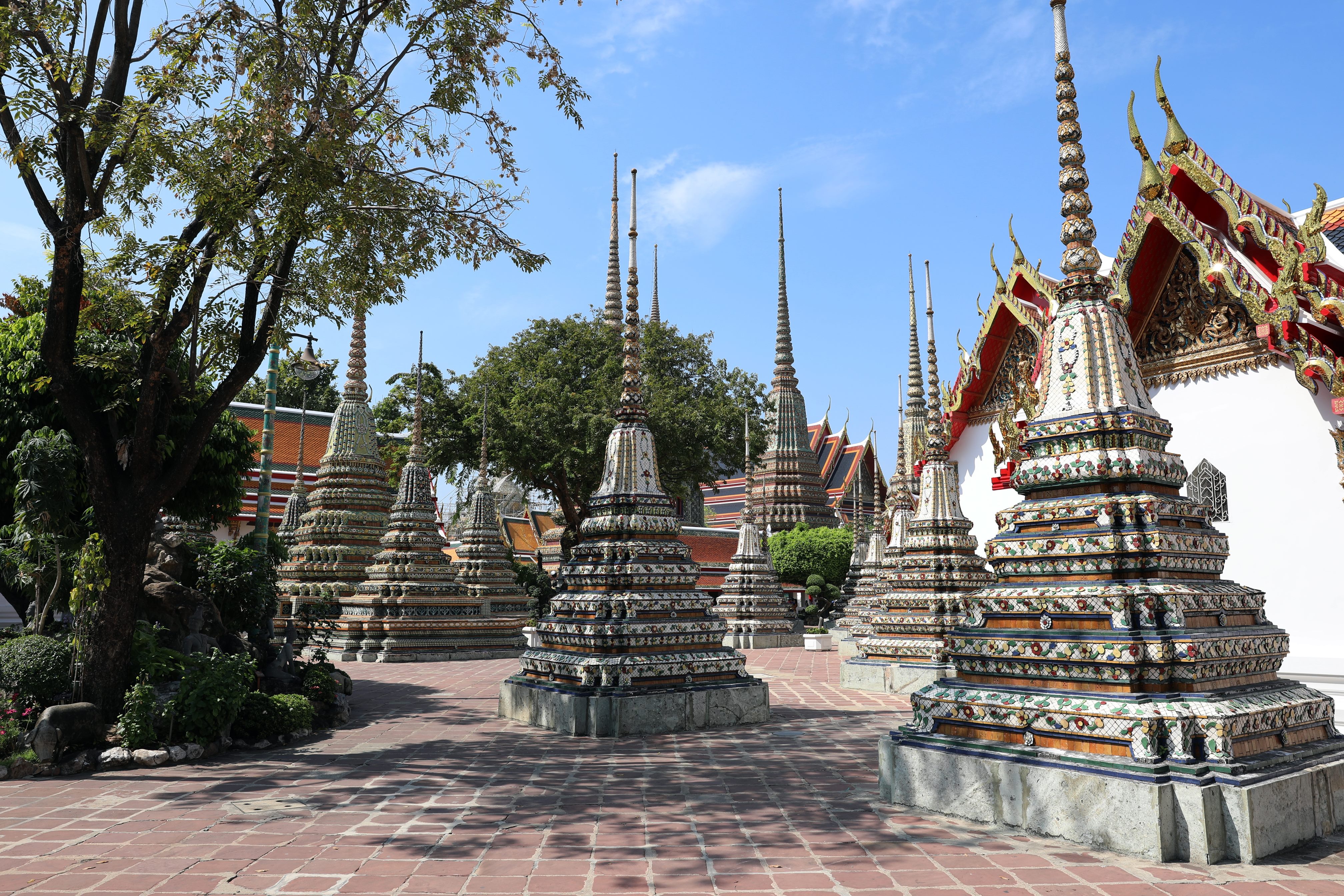
As the capital of Thailand, Bangkok is a city of contrasts. From ultra-conservative wats to raunchy sex shows; from opulent palaces to dilapidated homes, Bangkok has these extremes and everything in between.
Flowing through the heart of Bangkok, the Chao Phraya River passes many of the city’s historical sites. We used a ‘hop-on, hop-off’ public ferry which was a convenient and inexpensive way to get to most of them. It’s not always the fastest though. The ferries are large, sometimes carrying over 200 passengers and some of the skippers are very young and inexperienced. The skipper for our first trip of the day was an awful driver. He sped to each pier and then forced the motor into reverse to try to stop. Instead of stopping though, the ferry usually floated past the pier. He then tried to steer in reverse but was never able to get to the pier. Twice he had to circle around and try again. When he finally reached each pier, the ferry slammed into the pier so hard we were rocked in our seats. Eventually we made it to our stop, the fourth pier, but it took twice the time as scheduled. We did wonder if we should have used one of the more expensive tour boats. In the end we were glad to never see this captain again.

Wat Phra Kaew & The Grand Palace
The main attraction in Bangkok for both Thai and international tourists, is Wat Phra Kaew and The Grand Palace. When you first enter the temple grounds you will be overwhelmed by its opulence. Within a few steps you are surrounded by hundreds of stupas, towers and chapels. Each one is entirely covered in glittery gold, emeralds, diamonds and other precious jewels. There are so many glistening structures in a small area that you don’t know where to look.


Wat Phra Kaew is very important to Buddhists because it houses the Emerald Buddha. The wat is a gorgeous, glittery building, covered in delicate decorations made from gold, coloured glass and precious jewels. Elaborate yakshaws guard the entrance while golden garudas surround the base. Its outer design lets you know something special is inside. Many legends surround the Emerald Buddha which is not actually emerald, but instead a semi-precious stone. The legends follow its trail as it travelled throughout much of South Asia before settling in Bangkok. Wat Phra Kaew was built especially for the Emerald Buddha in the 1700s. Photography is not allowed inside, so you’ll have to visit it yourself to see the emerald statue.


Next to the wat is the Grand Palace. Not nearly as ornate, but still an impressive display of wealth and power with a golden roof and perfectly manicured gardens. It was once the residence of Thailand’s king, but today is used for official ceremonies.


After seeing all of that opulance, we passed a number of homes that were no more than dilapidated sheds. Their location, just in front of the Palace grounds, made the contrast even more startling.


Wat Pho
Another important temple, near the palace is Wat Pho. Instead of being adorned with jewels, the stupas and towers are covered in delicate porcelain flowers. For us it is a much prettier temple without the glitter of Wat Phra Kaew. The main draw for this complex is a massive reclining Buddha. At 46 m long and covered in gold leaves, the golden statue is impressive. Again, we weren’t allowed to take pictures inside.


The wat is an active temple. When we visited, a puja was taking place in one of the chapels. Worshippers sat on the floor while monks chanted mantras. This was a special moment for us to be experience.
The complex is also the site of Thailand’s first university with records from the 1700 that indicate the teaching of medicine and massage.


Wat Arun
A third important temple complex is across the river from The Grand Palace. Wat Arun is a much simpler temple and its main feature is an 82m high prang (tower). The tower is also decorated in porcelain but instead of flowers it has small Buddha statues and geometric designs. Its location on the river gives it a beautiful setting.


National Museum of Royal Barges
Further up the river is the National Museum of Royal Barges. The museum displays eight boats that are as ornate as Bangkok’s temples. They are elaborately decorated with designs made from gold and jewels. Some of the barges date back to the 1500s, before Bangkok was the capital. It must have been quite the site to see the king floating down the river one of these golden barges.


Wat Traimit
A few kilometers away from The Grand Palace is a temple that houses the world’s largest solid gold Buddha. The building is not as lavish as the other three temples, but what’s inside is quite special. A Buddha statue weighs 5.5 tons and is from the 13th century. It was moved to Bangkok from its original site in the former capital of Sukhothai.

Pat Pong Street
In complete contrast to the conservative dress code of the day, at night we experinced Bangkok’s nightlife. During the Vietnam War, Pat Pong Street was a place for US GIs to spend their time when on leave in Bangkok. Today this ‘street’ has grown to 3 streets and is famous for its strip clubs and drag shows. The bars have interesting names such as Fetish Bar-Bar, Strip A Go-Go, and Screwboys… Scantily clad ladies hang out at the doors, enticing you in. Sleazy men on the street try to get you to go to their bar’s ‘ping pong’ show. Pat Pong had a fun atmosphere which was quite different from the depressing atmosheres in cities like Udon Thani. There seemed to be a lot more curious tourists than patrons. It was definitely an interesting contrast to our morning and a great place to observe the other side of Bangkok.


Tips for visiting Bangkok
Dress code
The three main sites (Wats Phra Kaew, Pho and Arun) have a strict dress code. Women are required to wear long skirts. Men must wear pants and neither are allowed to expose their shoulders or wear tight or revealing clothing. Barefeet are not allowed so if you wear sandals you must also bring socks. These dress codes are more strictly adhered to at these three sites than at other temples.
Getting around Bangkok
There are many different tour boats and public ferries that go up and down the Chao Praya River several times a day. Most stop at several of the 9 major piers. Check at the piers to compare the schedules and fees for boats.
Bangkok’s Skytrain and MRT combine to provide a quick and inexpensive way to get around the city. The two transit systems are not run by the same company. This means that platforms are not always linked and you need to buy separate tickets for both, but it’s often faster and cheaper than using a taxi. When these won’t work there are many metered taxis in most parts of town. An alternative is to download the Grab app. We found Grab to be a cost-effective well-run taxi alternative in Bangkok.

This article is now featured on GPSmyCity. To download this article for offline reading or create a self-guided walking tour to visit the attractions highlighted in this article, go to Walking Tours and Articles in Bangkok.
For more information on travelling in Thailand visit our Travel Guide For Thailand.
Coming Next – Chiang Mai
For more pictures from our travels go to Gallery.
To read more of our stories from around the world go to Destinations.
If you like what you read please comment or share, with credit, using the links below.





We'd love to hear from you, please leave a comment.