
Situated on the edge of Tian Shan mountains, the city of Karakol is perfectly placed to explore Kyrgyzstan’s beautiful countryside. With access to tall mountains, red canyons, a mountain lake and a few waterfalls there are enough things to do around Karakol to keep you busy for a few days. Here is what we found to be for the best day trips from Karakol, Kyrgyzstan.
Issyk Kul
The drive from Bishkek to Karakol travels beside the northern shore of Issyk Kul. From the bus we had amazing views of snow-capped peaks on the far side of the large lake. Issyk Kul is the second-largest saline lake in the world after the Caspian Sea.
The name Issyk Kul translates in English to Warm Lake. At 1,607 metres (5,272 ft) elevation it was quite unexpected to have a warm body of water. The name is deceiving, however. It is related to the fact that because of its salinity the lake rarely freezes, even in the winter, giving it the illusion of being warm. We weren’t able to take pictures from the north shore as we drove by, but the views from the south were almost the same. From both sides of the lake, you can see across it to snow capped peaks giving it a unique and gorgeous backdrop.
Note: Kul is the word for lake in many of the Central Asian languages so you will hear this word a few times in upcoming posts.

On the north side of the lake, the landscape is surprisingly lush with cherry and apple orchards, vegetable gardens, verdant pastures, and dense forests. There is a former Soviet beach resort in Cholpon-Ata that has apparently regained popularity lately. It would only be of interest though if you’re looking for a party vacation.
The south side of the lake is much more arid and relaxed. There are a couple of pebble beaches near the villages of Barksoon and Tong. Which ever side you chose, don’t expect a tropical beach vacation though. It is a high elevation mountain lake.

Getting to Issyk Kul – The lake is only 17 km from Karakol and can be reached by a short drive going either north or south from the city. If you don’t have a car you can take one of the many marshrutkas going to one of the lakeside villages.
Skazka Canyon
Situated 100 km west of Karakol, just above the southern shores of Issyk Kul, is a very mysterious place. The Russian word Skazka translates in English to Fairytale and it is very appropriate for the canyon. Skazka is like a make-believe land where dozens of rocky outcrops in all sorts of weather-worn shapes and sizes dot the landscape.


There is a great legend that goes with both Skazka Canyon and Issyk Kul. Eons ago, this area was a desert and there were many villages on the land that is now Issyk Kul. The legend says that a dragon fell in love with a beautiful girl who lived in one of the villages. She refused his offer to marry, so he threatened to drown her village. He said he’d flood the land during every full moon until she said yes. The villagers also heard his threats and carefully covered the wells each full moon to keep their villages safe. When it was the girl’s turn to cover the well, she apparently forgot. The result was that not only was their village flooded, but every village in the land was flooded. There was so much water that it formed Issyk Kul. The dragon woke the next morning to see what he had done. He was so distraught at his destruction that he went to the nearby hills and turned into a rock.
Maybe there is truth to the legend. A few of the cliffs have what appears to be a dragon’s back with a rocky spine leading to its top.


Others rock formations have fascinating shapes. Some are bright red, others coloured in pastel stripes. Let’s see if you can guess the name of one that looks like an uninterested part of the male anatomy.


When we read about the canyon we had expected one or two rocky cliffs, but as we walked to the top of each outcrop, we saw another fascinating eroded cliff to explore. You need to add this canyon to your must-see list if you’re travelling to Kyrgyzstan.

Entry Fee – It is very inexpensive at only 50 KGS (57 cents USD).
How to get to Skazka Canyon – Located 100 km from Karakol, it is easy to reach if you have your own car. Otherwise, marshrutkas leave from the Southern Bus station every hour beginning at 7:50 am. Tell the driver you’re going to Skazka Canyon and they will drop you off at the entrance. From there it is a 2.2 km walk on a dirt road to the site. As we were waking to the canyon we came upon a herd of goats munching on the leaves.

Barskoon Valley
Between Skazka Canyon and Karakol is a long valley bordered by tall, rocky mountains. After visiting Skazka we were standing on the side of the highway trying to catch a lift when a couple we briefly met in the canyon stopped and said they could give us a ride. They were not going to Karakol but they would drop us off at the next major town. We thought that was better than nothing, so we got in. Part way through the drive they asked if we wanted to go with them to see a waterfall. We said sure! So, instead of dropping us off, they turned up Barskoon Creek Road.


After 10 or 15 min we could see a frozen waterfall in the distance and as we got closer we saw two lower sections that were running with water. Below the waterfall is a small picnic area and a couple of yurts. From the waterfall’s base we followed a vague trail up the steep hill for about 200 m to reach a great lookout point for the waterfall (2,350m). There is a more defined trail on the other side of the creek that would be easier to reach a similar viewpoint.


A statue opposite the picnic area recognizes Soviet Cosmonaut Yuri Gagarin. In 1961 he officially became the first person in space. The Kyrgyz locals say that after his space mission Yuri recuperated in the Barskoon Valley. The statue was built to commemorated this visit.

After seeing the waterfall, our new friends said they were planning on continuing to drive up the same road to reach a high mountain pass. Since they were our only option for a ride, we joined them for this next adventure. We drove up a good mining road, slowly gaining elevation, until we reached the final climb to the pass. At the end of the valley there were a remarkable 32 switchbacks to get up to the pass. We stopped at a lookout at halfway point at 3,442 m for a nice view of the valley. The clouds were coming in and the temperature was quite chilly at that elevation.


After climbing up the rest of the switchbacks we finally reached Barskoon Pass (3,819m). At the pass we found a large plateau with a frozen lake surrounded by snowy mountains. The sun picked the right time to come out from behind the clouds and shine on the white mountain tops. It turned out to be a great, unexpected day!


Getting to Barskoon – If you have a car it would be very easy to drive to the base of the waterfall. If you don’t, you can take a Marshrutka from the Southern Bus Station in Karakol to the town of Barskoon. From Barskoon you will have to take a taxi to the waterfall. Make sure you ask the taxi to wait for you because you aren’t likely to find another one waiting around.
Jeti Oguz
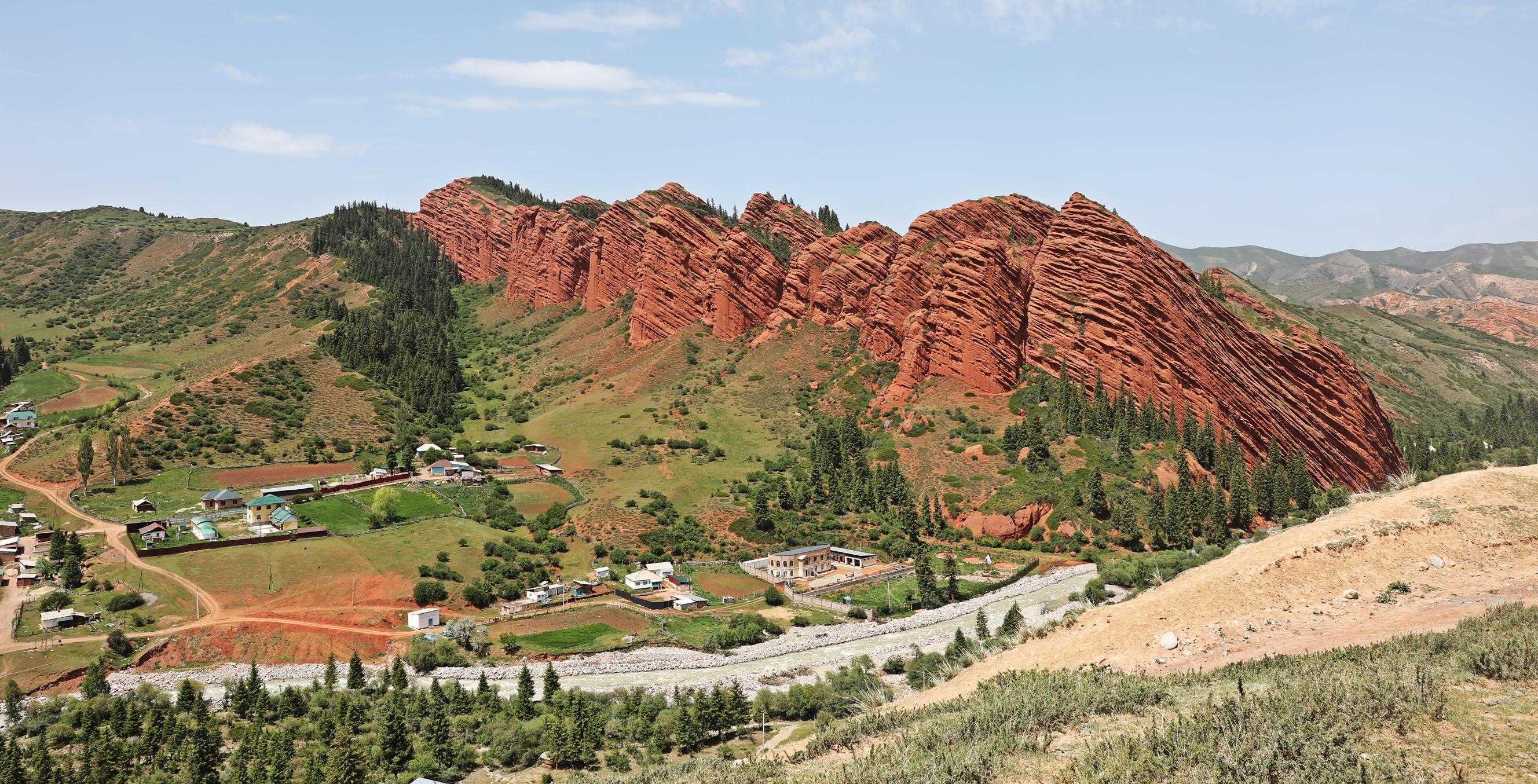
Only 45 km from Karakol is another spot with interesting red sandstone rock formations. Jeti Oguz translates in English to Seven Bulls. Standing proudly above a small resort town is a long series of red rock buttresses. Although they don’t really resemble bulls, they are a gorgeous feature.


Of course a feature like this comes with a legend. Centuries ago a local khan (king) found out that his wife had fallen in love with another man, so he decided to take revenge. A few days later there was a large feast where 7 bulls were killed. As the last bull was slaughtered, the king took a knife and used it to stab his cheating wife to death. Blood ran from her body and flushed the 7 dead bulls down the valley until they reached their final resting spot in Jeti Oguz.
In addition to the bulls there are several more red rock formations in fascinating weather-worn shapes. We climbed to the top of a small hill to find a large open plateau and more bull-like rocks.


Just before you reach Jeti Oguz you can see the formation called ‘Broken Heart’. On the backside of the bulls, the first two buttresses form the shape of a broken heart.

Water from a nearby spring is said to have healing properties. There is a health spa in the resort town that was busy with Kyrgyz people who came to heal their various medical complaints. The water apparently contains radon and hydrogen sulfide which we wouldn’t want on our skin or in our lungs so we gave the spa a pass.
Entry Fee – There is no entry fee to see the rocks of Jeti Oguz.
Karakol
After exploring the sites surrounding the city, we still had a few things to see in Karakol.
Holy Trinity Orthodox Church
The city was established during the reign of Russian Czars and there are a few remnants from that time. Built in 1895, Holy Trinity Russian Orthodox Church is a colourful church with green roofs and golden onion-style domes. Its location in front of the mountains make it even more special.


We found a few homes from that time period on the streets around the church. They are called gingerbread homes because of their colourful and detailed trim. The name made us expect something a bit cuter than they actually were. We could see enough though to imagine how pretty they must have been 100 years ago. Below are the best two we could find.


Dungan Mosque
In the 1880s Chinese Muslims from the ethnic group Dungan, fled China to avoid persecution. Many ended up in Kyrgyzstan. In the early 1900s these immigrants built Dungan Mosque. It’s very easy to recognize the Chinese influence in the architecture as it is very different from other mosques in the country.
It is still used today as a mosque by the Dungan and Karakol Muslim community. Because of this, women must cover their hair, arms and legs before entering. There are shawls available to borrow.

Parks
The small mountain town has treed-lined streets and quite a few large parks making it a lovely place to go for a walk. And as seems customary in Central Asia, there are several monuments and statues.


Getting to Karakol
Regularly scheduled marshrutkas leave from Western Bus Station in Bishkek. The cost is 500 KGS ($5.75) for the 7 hour ride. The highway take you very close to the Kazakhstan border. We could see border fences just on the other side of the highway. Outside the border gates was a long line of at least 50 semi-trailers waiting to enter Kazakhstan. We were told that some trucks have to wait days to get across the border.
Where to stay in Karakol
The town isn’t very large so what part of town you stay in doesn’t really matter, but most of the sites and buses are close to Pushkin Park.
Where to eat in Karakol
Surprisingly there are a few very good restaurants in this rugged town. Our favourite was Sierra Coffee. We later learned that it is a chain in Kyrgyzstan with several locations in Bishkek.
For Travel Tips in Kyrgyzstan go to our post on Fergana Valley.
To read our other stories from Kyrgyzstan click here.
Coming Next – Best Day Hikes in Jyrgalan
For pictures from other blogs go to Gallery at monkeystale.ca
To read about more of our adventures go to Destinations.
If you like what you read, please comment or share (with credit) using the links below.





We'd love to hear from you, please leave a comment.