
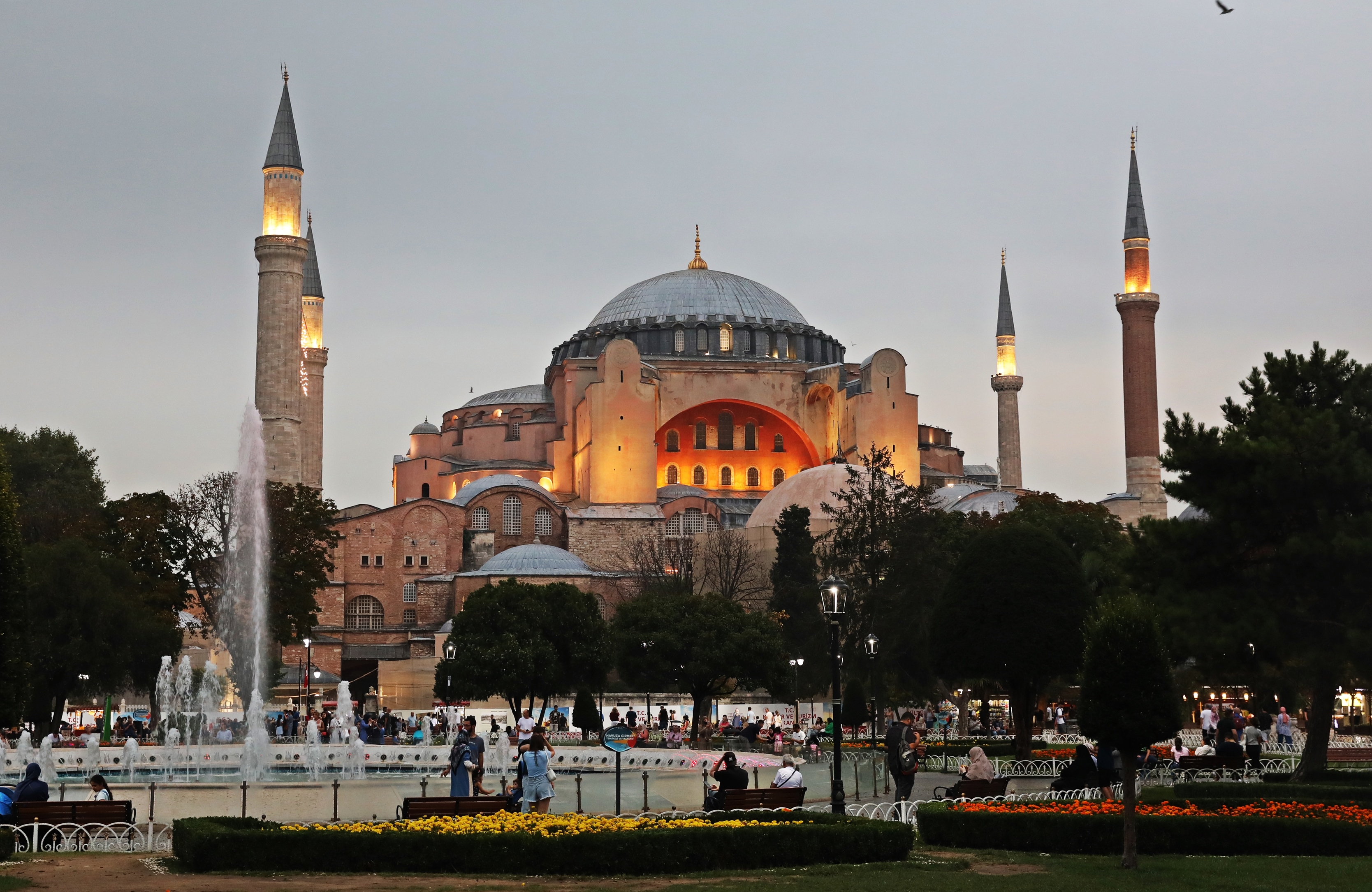
Istanbul is a city straddling the line between two worlds. One section is in Europe, the other, in Asia. Separating the land between the two continents is the Bosphorus Strait. This body of water is not that large, but it is significant as it gave Istanbul a coveted location. In addition to the geographical halves, Istanbul was dominated by two distinct Empires; Byzantine and Ottoman. Exploring the two sides to Istanbul’s past means visiting their many historical mosques and churches.
Bosphorus Strait connects the Sea of Marmara, a part of the Mediterranean, with the Black Sea. This made the strait an important shipping route for trade and meant that Istanbul was located on prime real estate. As a result, many battles took place over the centuries to win control of the city. Eventually it came under control by the Christian Byzantine Empire. Their reign lasted for over 1,100 years. At that time Istanbul was called Constantinople, after its first Byzantine ruler. This empire built a protective wall around the city and filled it with elegant churches, cisterns and watchtowers.
Eventually, they were overthrown by the Muslim Ottoman Empire and the era of Byzantine rule ended. The Ottomans converted the country to Islam and built wonderful mosques, palaces and bazaars.

The city’s historical buildings weave together these two sides of its past giving it an interesting character that sets it apart from its neighbours. It is a great city to explore, and we will begin with its many historic mosques and churches.
Hagia Sophia
The most notable mosque in the city, Hagia Sophia, definitely stands out for its grandeur. It is a massive, brick building with a broad base giving it a powerful presence. Its low angled dome roof and simple four minarets balance out its size. This grand building was originally built as a church in 537 AD by Byzantine Emperor Justinian. Hagia Sophia was converted into a mosque in 1453 by Ottoman Sultan Mehmet II when he won control of the land.
Much later in the 1930s, it was decommissioned as a mosque and was declared a museum. In 2020 it was converted back to a mosque, but remains open as a museum.


Since it was originally built, the building went through several renovations and additions. Minarets were added at different times in history explaining why they’re not perfect mirror images of each other.

With a name meaning ‘Divine or Holy Wisdom’, it has an interior that lives up to those words. The narthex (entryway) is a grand room with vaulted ceilings covered in mosaics.

Walking into the mosque’s prayer room is a little overwhelming. The large, open room has a grand, medieval feel with darker colours and adornments. Tall dark marble columns have delicately sculpted cornices and capitals. They reach up to the domed, goldenrod-coloured ceiling that is darkened by its pewter coloured details. Dark marble slabs decorate the middle of the high walls and medieval style chandeliers hang low in the centre.


The arches over the windows and domed ceilings are weathered but match the character of this historic building.

Mosaics depicting flowers and geometric shapes cover parts of the ceiling. The most interesting designs though, are the seraphims. These angelic beings hint to the building’s Christian origin. In the centre of the dome, above the seraphims, is a disk with Ottoman calligraphy, common in many of their mosques. The spot used to have a portrait of Jesus but it was covered up when the building was converted to a mosque.

The building was modified and restored many times over the centuries. As a result, the mosaics and frescoes decorating it have changed. In the 1300s, the Ottomans covered the Christian murals with plaster in order to put their own designs. These old pictures were only exposed when the building was decommissioned as a mosque in the 1930s. In 2020, the Christian mosaics suffered more controversy when Hagia Sophia was to be used as a mosque again. This time curtains were hung over the Christian images of Jesus and the Virgin and Child on the main dome. You can see the curtains in the image below.

Entrance was free in 2023, but an entrance fee was added in 2024.; Opening hours are 9:00 – 18:00. Expect long line ups.
Note – Women must cover their hair, shoulders and legs. Shoes are left at the door.
Blue Mosque
Across from Hagia Sophia is another famous mosque Sultanahmet Camii. It is more commonly called Blue Mosque and its location high on Sarayburnu Hill means that it can be seen from many parts of Istanbul.
The mosque was built by Sultan Ahmet I in the 1600s. The legend says that he wanted to have a mosque that would surpass Hagia Sophia both in beauty and in grandeur.

It was very controversial when it was under construction because of the high costs involved. In addition, it was built next to the city’s Hippodrome and many palaces and other buildings had to be torn down to make way for the mosque. In the end, Ahmet I died even before construction was complete.
The mosque also came under considerable controversy for its design which included six minarets. At the time, only the Grand Mosque in Mecca was supposed to have six minarets. Two or four are common in other important mosques. The sultan claimed that it was a misunderstanding between him and his architect and not, as some intimated, that he thinks of his building as an equivalent to the one in Mecca.

Its grey domed roof and minarets made us wonder why Sultanahmet Camii received the nickname Blue Mosque. The grey continues in the courtyard with multiple grey domes, marble pillars and archways shaping the portico around the edge of the yard.


The interior is a large, open room with a divider between the tourist viewing area and prayer room. The vaulted ceiling has a large central dome supported by tall, grey marble pillars that support its weight. Four smaller domes fill in the remainder of the ceiling and give the room a feeling of having separate spaces.
The walls are covered in blue, turquoise and grey tiles in tulip pattern. The designs are nice, but not as elaborate as others we have seen. Apparently it is these tiles that gave it the nickname, but they looked more grey than blue.

Colour comes from the stained glass windows that decorate each of the ceiling’s domes.
Even though it may not look it from the pictures below, we were quite underwhelmed by this large, gray space.


Entrance is free, but capacity is limited so if you go during high season you should expect very long line ups.; Open hours 9:00 – 18:00.
Note – Women must cover their hair, shoulders and legs. Shoes are left at the door.
Sultanahmet Square
Between Hagia Sophia and Blue Mosque is a large square that used to house the Hippodrome. From the 4th-10th centuries this enormous oval shaped stadium was used for chariot races. The Obelisk, Walled and Serpent Columns are all that’s left to mark its existence.
Today, the land has been turned into a park with pedestrian walkways, flower beds and fountains.


Not far away is Column of Constantine. It was the base for a large statue of Constantine and is the oldest remaining structure from the ruler’s time.

Also along the side of the Hippodrome is Hagia Irene. It is the oldest Byzantine church in Istanbul and was never converted into a mosque. After the Ottoman moved in, they had many other uses for the building such as a storage space for armaments and a military museum. Today it is a concert venue.


Süleymaniye Mosque
Another important group of holy buildings in Istanbul is Süleymaniye Complex. (also spelled Suleyman and Suleiman). It was named after Süleyman the Magnificent, who is said to be the greatest ruler of the Ottoman Empire.
The complex includes a mosque, two mausoleums and a graveyard. Suleymaniye Mosque is a large imposing building. From the outside it looks very similar to Blue Mosque. Inside the prayer room, however, is where the similarities end. Although much smaller, it is more colourful than Blue Mosque, with red and yellow designs decorating the white walls and domes. The mosque was damaged by fire in the 1600s. It was repaired in a different architectural style so what we see today is different from the original design, but it is still a magnificent building.


Beside the mosque are two mausoleums. One is the Tomb of Süleyman the Magnificent. It includes his tomb as well as two other Sultans, family members and important Ottoman leaders. The second is the tomb for Hurrem Sultan, wife of Sultan Süleyman and other sultan wives. The blue tiled walls made us think of the tiled mausoleums and madrasas in Uzbekistan.


From the courtyard, we had one of the best views of the city of Istanbul, Bosphorus and Golden Horn.

Entry is free; Opening hours 8:30-16:45.
Note – women must cover their hair, shoulder and legs.
In addition to these famous mosques, there are over 3,000 other mosques in Istanbul. At almost any point you can see 4 or 5 mosques at a time. Along the shore of Golden Horn is Yeni Camii. Its name translates in English to New Mosque even though it was built in 1663. It was most beautiful when it was lit at night. Across from it is the 16th century, Rüstem Paşa Mosque.


Beyond these, we saw mosques in all directions when we travelled throughout the city, whether on foot, car or boat. In many points in the city’s skyline you could see the tall minarets piercing the sky that indicate a mosque.


Istanbul’s long history didn’t only result in mosques. Ottoman Sultan’s are equally famous for their glamourous palaces. You can read about those next.


This article is now featured on GPSmyCity. To download this article for offline reading or create a self-guided walking tour to visit the attractions highlighted in this article, go to Walking Tours and Articles in Istanbul.
Click on the link to read our Travel Tips For Turkey.
You can find more of our stories from Turkey here.
Coming Next – Istanbul’s Glamourous Palaces
For pictures from other blogs go to Gallery at monkeystale.ca
To read about more of our adventures go to Destinations.
If you like what you read, please comment or share (with credit) using the links below.






We'd love to hear from you, please leave a comment.