Its prime location on the Balkan Peninsula between Europe and Asia, resulted in Bulgaria having a storied history and many different ruling empires. The land that is now called Bulgaria has been inhabited since at least 6000 BCE. Only a few leftovers from these early civilizations have survived, but seeing the ruins of Bulgaria’s first empires helped us to better understand the long history of this country.

The first ones to put their mark on this land were the Thracians in the Bronze Age. They were known to be skilled warriors and horsemen. Although they were mostly tribal, the separate tribes joined forces to fight against common enemies. They even became allies with Troy and fought in the Trojan War. It is said that the Greeks used the word Thracian to connote wild, barbarians.

At the opposite end of the spectrum from barbarian, the Thracians were also skilled at wine making. Thracians even worshipped Zagreus, the god of wine, and used wine in many of their rituals. In fact, they passed on their wine making knowledge through the ages to the current generation so that Bulgaria has excellent wines to this date. Before making this statement we had to be sure so we sampled several wines during our stay.

These barbarians also have a few illustrious citizens such as poet and musician Orpheus, Gladiator Spartacus, even Byzantine Emperor Justinian. Eventually the Thracians were absorbed by the Byzantines.

There aren’t many Thracian sites left in Bulgaria but we did find a few of their tombs. Driving though the countryside near Kazanlak we saw dozens of Thracian tumuli (burial mounds) across the land. This royal necropolis is dated from the end of 4th century BCE. Its estimated that there are over 60,000 Thracian tombs across Bulgaria.

The tomb of Sleuthes III is one of the largest tombs and today it is open as a museum. Its name is Golyama Kosmatka, which is the name of the temple that was originally on this site in the 5th century BCE. Inside the tomb, a long stone hallway leads to a round, monolithic chamber. Today its empty, but gold jewelry, a crown, bronze vessels, golden wine goblets and armour were found in the tomb. A few replica items were on display. When it was discovered researchers said there were no human remains in the tomb other than a few teeth from a child.

Large stone doors remain open today, but after the funeral they would have been closed and the hallway filled with stones and dirt.

Researchers found a bronze bust of Sleuthes III buried in the ground outside the entrance of the tumuli. Today a replica stands in front of the tomb and the original is in a museum in Sofia. Although this is a replica, it is so detailed that it is difficult to believe that the sculpture found was created in the Bronze Age.

The original 3rs century BCE Kazanlak Tomb in the city of Kazanlak is closed to visitors, but a replica was built beside it. Once inside the replica tomb you walk down a similar hallway to the one we saw in Sleuthes III’s tomb. In this museum though, the walls of the hall are painted in bright colours. At the end of the hallway the small, round tomb is also decorated. Its dome ceiling is covered in murals of horses, chariots and musicians. Seeing how these tombs may have originally looked was fascinating. The original Kazanlak Tumulus was found by accident in 1944 by soldiers looking for air raid protection.

Kazanlak is a large producer of rose oil and throughout the city are wonderful rose gardens. Our arrival in the autum meant that there were very few roses left, but we managed to find a few.

On the outskirts of Kazanlak is a much different site. The 19th century Shipka Monastery looks like a gingerbread house. Its outer walls are painted in colourful peach below a green and white checkered steeple. At the top of the steeple and golden domes are double-barred orthodox crosses.

Inside, the pillars are embellished with colourful frescos that reach up to the domed ceiling. A priest was chanting in low tones giving the sanctuary a very haunting atmosphere.

The church is dedicated to Russian and Bulgarian soldiers who died in the Battle of Shipka Pass during the Russo-Turkish. There is a crypt in the church’s basement with graves of some of these soldiers.

Driving though Bulgaria we were able to see a large variety of natural landscapes. Our route took us from the flat prairies to rolling hills and eventually through the rugged mountains. On the way to Pliska we went by hillsides covered in wonderful rocky pinnacles.

From the 5th to 7th centuries, tribes of Slavs and Bulgars settled in Bulgaria. The Bulgars were originally nomadic and they were known as skilled horsemen and fierce warriors. The nomadic Bulgars eventually united with the more organized Slavs. Together, under Bulgar leader Asparukh they overcame the ruling Byzantine Empire. They established the first court in Pliska and The First Bulgarian Empire was born.  

Pliska was a fortified citadel for nearly 200 years. Today however, the former capital is mostly in ruin. There are only a few sections of the original limestone wall. From what is left though, you see the large cut stones that were used to make remarkably strong walls.

Inside the walls are the foundations of a large city including a palace, churches, temples and an archbishop residence. On top of these foundations, the buildings would have been made of wood and were burned down during an attack by the Byzantines in the 800s.

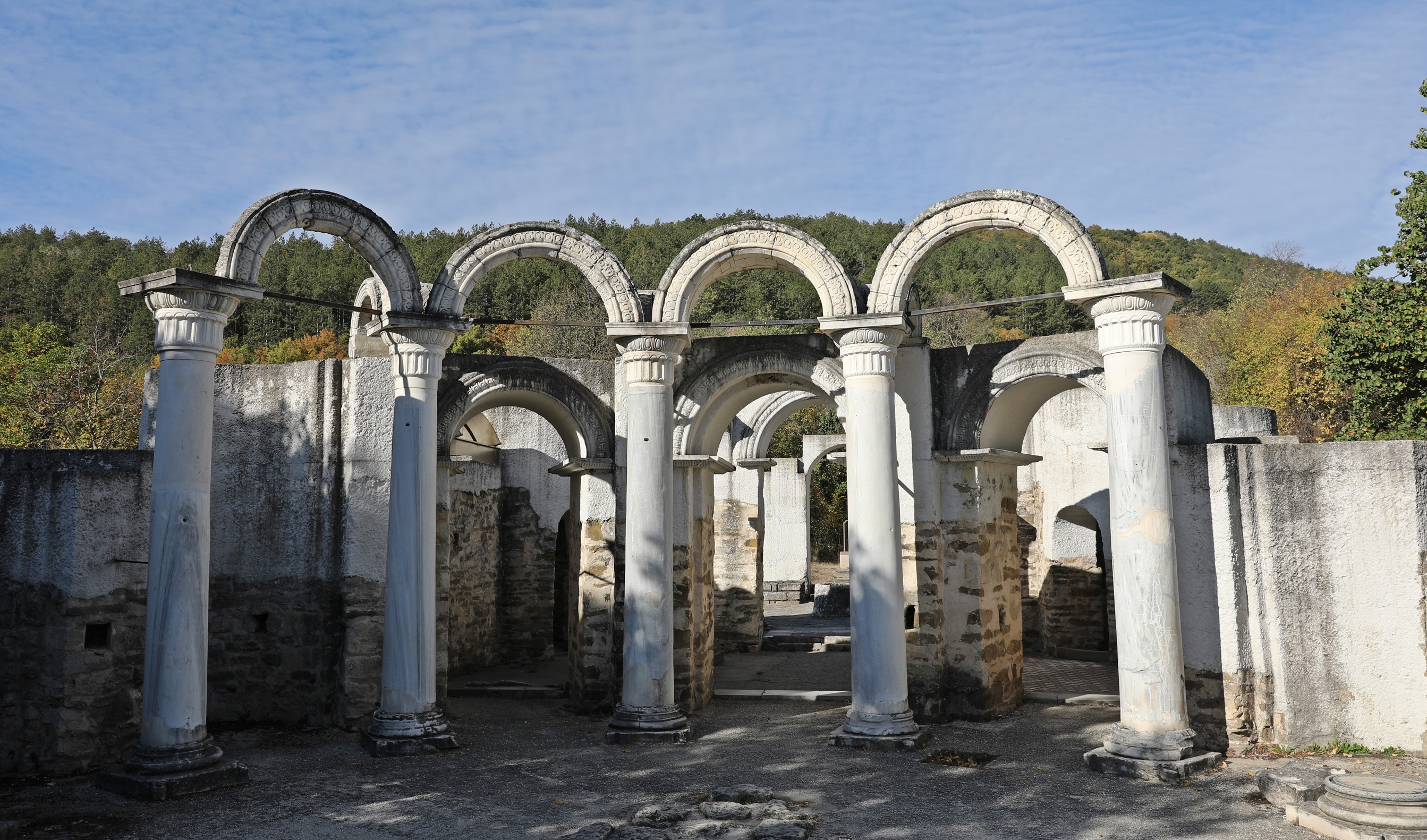
A kilometer away from the citadel are the ruins of the 9-11th centuries Great Basilica of Pliska. Some of the original walls are still standing and others have been rebuilt to give a better idea of how grand this church must have been. It was built on top of the remains of a pagan temple and turned into a church, monastery and Archbishop residence. 

Driving through the Bulgarian farming communities we saw quite a few horse and buggies travelling down the highways. We drove past the two men pictured below outside of Veliki Preslav. They were waving to us as we drove by so we felt obligated to take their picture.

In the 9th century, Bulgarian leader Boris I moved the capital from Pliska to Veliki Preslav but it was under Simeon I (9th-10th centuries) that the town morphed into a beautiful city. Simeon I was educated in Istanbul where he developed a love of arts and architecture. It was this experience that influenced the buildings in Veliki Preslav.

Simeon The Great, as he was also called, significantly expanded the Bulgarian territory. Tsar Simeon built an Empire that ran from the Black, across to the Adriatic and down to the Agean Seas. As with all empires this one crumbled in the early 1000s AD. Today, this once wealthy capital can only show us its partial walls and columns that once shaped its palaces and cathedrals.

Perhaps the best example is the Round Church that is found just outside of the city walls. Built in 907 AD, the church was richly decorated with carved marble and ceramics. It was apparently unlike any other church of its day.

Another impressive feature of this city are the thick walls that once surrounded the citadel. We stood atop one section of it to truly appreciate its size. In places the stone walls were over 3 meters thick. It was difficult to imagine how these massive stones were brought down from the mountains, several kilometres away.

In the 9th century, missionary brothers Cyrius and Methodius arrived in Bulgaria and are credited with developing the first Bulgarian alphabet called Glagolitic Alphabet. They developed this alphabet so that it would be easier to spread Christianity. The alphabet allowed priests and nobles to read the Bible in their own language. This was a large factor in the spread of Christianity throughout the land. During the reign of Bulgarian Emperor Simeon I, the Bulgarian Orthodox Church was created.

The Glagolitic Alphabet eventually was dropped for the easier to read Cyrillic, which is still used in Bulgaria today. Not far from Veliki Preslav is Cyrius and Methodius Church, built almost 1,000 years after these Greek brothers were in Bulgaria.

Getting to many of the small, mountain communities in Bulgaria is not as easy by public transportation so renting a car is often a better option. We didn’t see any tour groups in this part of Bulgaria. Visitors from almost any country outside of the EU need to show a physical copy of their international driver’s permit. A digital copy is not enough. Car rental agencies are very strict with this rule.

There are a few hotels and guesthouses in the small cities in this area. It would also be possible to visit them all on day trips from Veliko Tarnovo. We found a nice guesthouse and good dinner in Veliki Preslav.

Tip – There is not a lot of English spoken in Bulgaria and they use the Cyrillic Alphabet. It would be wise to have your destinations written in Cyrillic before leaving your hotel. Google Lens is very helpful to translate written material such as menus.

Read from another device.
Click on the link for Travel Tips For Bulgaria.

To read more of our adventures in Bulgaria, click here.

Fediverse reactions

77 responses to “Bulgaria’s First Empires”

  1. The Sleuthus bust conveys the feeling that I was once familiar with such a person (although I never actually have). The Shipka Monastery has a compelling style that I like.

    1. It’s an excellent bust isn’t it, especially considering the age. Shipka is very pretty, just like a children’s play house or gingerbread house. Quite different from the plain ruins all around.

  2. Fascinating tour of Bulgaria’s history! Thank you for taking me to a country I knew very little about.

    1. Thanks for coming along! Bulgaria was much more interesting than we had imagined. It was a great trip. Maggie

  3. An incredibly long and storied history for sure. As to the wine, I had heard they made great wine and in this part of the world, why not. Thanks for sharing Maggie. Allan

    1. Yes, we tasted several varieties, just to be sure 🙂 It’s also very cheap. Maggie

  4. Fabulous post, as usual, Maggie! Enjoyed reading it!

    1. Thanks so much Indira! Maggie

  5. gorgeous Maggie! These painted ceilings and artifacts get me everytime❣️

    1. Thanks Cindy, there’s so much history to explore in Bulgaria. I love a painted ceiling too, I want to redecorate at home 🙂 Maggie

  6. Wonderful post. That is quite the monastery. I always imagine them as plain humble places. Cheers to Zagreus. The god of wine. Although I always imagined such a god as a goddess. Then again I am partial because, these days, more women seem to prefer wine than men.

    1. You’re right, it should have been the goddess of wine. I’m just glad they figured out how to make such great wines and passed the knowledge on to today. We did our fair share of testing them out to be sure they were good 🙂 Maggie

  7. […] Coming Next – Bulgaria’s First Empires  […]

  8. I visited the tomb of Sleuthes III and the Shipka church (there was a baptism taking place there, with a friendly family who happily let me take photos!) but we didn’t get any further east, so I especially enjoyed seeing Veliki Preslav through your eyes 🙂

    1. The tombs were quite fascinating weren’t they? It was nice to inside a replica. So lucky to be there during a baptism. It’s an incredible building. Maggie

      1. Yes, I meant to say, we didn’t visit the replica so seeing that was another thing I especially enjoyed in this post 🙂

  9. Fantastic post, Maggie. I believe Bulgaria is one of the most underrated countries in Europe. Most tourists who choose Bulgaria as a holiday destination focus only on the Black Sea coast, not knowing how beautiful Bulgaria actually is. Yet the country offers so many diverse attractions and the list of best places to visit in Bulgaria is really long. Thanks for sharing, and have a good day. Aiva xx

    1. Thanks Aiva, Bulgaria is not very high on the tourist radar but we really enjoyed it. They are still rebuilding, but there are so many fascinating places to see. We did visit the Black Sea too, but in the off season, so it wasn’t busy at all.

  10. I had no idea there was so much to see in Bulgaria. Thank you for sharing your travels with us, Maggie. You offer a good taste of what it looks like and the meaning behind the buildings.

  11. The Shipka monastery looks fabulous, Maggie. Easy to forget that Bulgarian history goes back so far and is tied up with Greece and Turkey, but when you look at the map…

    1. It was coveted land back in those days. Makes for an interesting history and the buildings to go with it. Shipka monastery is very cute and literally in the middle of nowhere. Thanks Jo!! Maggie

  12. Great post as always Maggie! The Shipka Monastery looks wonderful!

    1. Thanks so much Jyothi!!

  13. Fabulous – we visited Sleuthes’ tomb, which was amazing, and are still using the beautiful rose soap we bought in Veliko Tarnovo.

    We didn’t visit the other sites you mention, but they look amazing too.

    Thank you for sharing!

    1. Ots a fascinating country isn’t it?! 😊

  14. Yes, sampling the wine to ensure its quality is a must! I do the same. 😊 I’m always amazed at the artistic abilities evident from centuries past as well as the architecture and building capabilities and on such massive scales. And then some other outfit would likely come along and destroy it. The old story of humanity, I guess.

    1. I’m always amazed at the skill of the ancient civilizations as well. And you’re right, the next one just builds over top. Thanks Lynette, Maggie

  15. I never read anything about Bulgaria so I really enjoy this! There’s so much history and beautiful sights to see.

    1. Thanks Lyssy, we didn’t really know much about it before planning our trip either. There’s a lot more to see than we thought. Maggie

  16. So amazing the bronze bust of Sleuthes III looks so advanced in skill. Great photo! You captured every detail of the replica.
    i loved the roses in Kanak. The sunshine captures in the photos looked that was a lovely day!!
    It was great to see that the great efforts made to restores portions of the wall of Great Basilica of Pliska. It must have been a grand place.
    The photo of the Cyrius and Methodius Church picturing the dome and the trees is beautiful.
    Thanks for a wonderul adventure in this area.
    P.S. Other than the mounds and the view in the back of the round church the terrain does not appear hilly for hiking etc.

    1. This was mostly in the prairie, but the north and south of the country is quite hilly. No hiking here, no, but so much history. I would have loved to see the Pliska Basillica, there’s just enough left for you to imagine how it looked. And the bust is remarkable. I can’t believe how skilled they were so long ago. It’s mind boggling. Thanks for sharing our excitement for Bugaria! Maggie

      1. Excitement is the right word, Maggie! Thank you for the great travel vlogaventure!

  17. There is a SS. Cyril and Methodius Catholic Church in the city where I live. It’s known as a Slovak church and they sell homemade pierogies for fund raisers! I enjoyed learning more about these two saints in your blog along with a wonderful Bulgarian history lesson! 🙂

    1. Those two monks got around Europe
      I guess. I bet the pierogies are delicious 😊

  18. I knew nothing about Bulgarian history until reading your post and enjoying your photos. Its rich history makes it seem quite inviting. Thanks Maggie, for sharing!

    1. We really didn’t know much either, but thoroughly enjoyed learning about it and seeing the sites when we were there. Thanks! Maggie

  19. A fabulous post Maggis and the Shipka monastery looks amazing. European history is incredibly fascinating and the buildings are just stunning!

    1. Thanks Nilla, The monastery is very pretty and the history in this area is so complex and has resulted in so many different sites to see. Maggie

      1. That’s always the way when visiting a destination. Wander around enough and you realise, you’ve only scratched its sights, cheers, Nilla

  20. This is all so absorbing and interesting, one of the more mysterious and unknown European countries – although I did know (and have enjoyed) Bulgarian wine. You know, in the 25 countries I’ve driven in, I have never once been asked to produce the international permit, but we always carry them with us, just in case. But as yet they’ve always stayed firmly tucked in the document wallet.

    1. We were pretty surprised that we had to show it, both in Bulgaria and Romania. Richard was wishing he brought his Polish passport. It would have been easier. We really enjoyed Bulgarian wine though!! Maggie

    2. Oops, I meant Polish Driver’s License, he just corrected me 🙂

  21. The rose gardens are beautiful as are the painted ceilings. Hopefully I’ll visit Bulgaria sometime too.

    1. We really enjoyed Bulgaria. The churches are beautiful and the history runs quite deep. Thanks for your comment. Maggie

  22. The thick walls of the citadel make you think about how many battles they have seen. I didn’t know they have Thracian tombs, we shall visit Bulgaria some day.

    1. You’re right, and they were Warriors so likely here were a lot of battles. We really enjoyed Bulgaria, hope you get there one day.

  23. Bulgaria isnt so well known as a tourist destination but it should be, its so fascinating!

    1. We were really surprised at how much there was to see and do!

  24. Soooo interesting. Thanks, Maggie.

    1. Thank you! Bulgaria has a long, fascinating history that was fun to learn about and see bits and pieces. Maggie

  25. Again, I really appreciate both of you venturing deep into a country’s interior to explore its many interesting corners that are often overlooked by most tourists. I don’t think I’ve ever come across any other blog post about the places you include here. I like that you summarized Bulgaria’s long history into pieces of information that are easier to digest.

    1. Thanks, I found the history easier for me to present in smaller chunks too. It’s long history is actually spread across the next couple of posts too.

  26. As usual, such impressive structure!

    1. Thanks Janice !

  27. Impressive post and destination, Maggie. Shipka monastery is beautiful as is the rose garden. The Thracian tomb is just incredible!

    1. Thanks Leighton, the tracking tombs were fascinating, especially when we could see inside a replica. And I’m not sure there’s a cuter church than Shipka 😊

  28. In the picture labeled “Bulgarians” there are in fact bulgarian gipsies …Like in Romania, there are plenty of them in Bulgaria too. So, maybe it should read “bulgarian citizens” to be politically correct 🙂 The Shipka church is such an imperial russian church in appearance.

    1. Okay thanks, I didn’t think of that 😊

  29. There’s so much history here. The Shipka Monastery looks gorgeous. Love the ruins of Viliki Preslav. Makes you wonder what it would have looked like back in the day. It’s amazing that you’ve been able to visit so many places off the beaten path. Sounds like a great way to avoid the tour groups.

    1. There really weren’t many toruists in Bulgaria at all, but definitely not at these out of the way places. Shipka is the cutest church in the country. Thanks Linda! Maggie

  30. I can’t say I knew much, if anything, about Bulgaria’s history, so I really enjoyed learning about its early history from your post. Viliki Preslav looks a fun place to explore, while the Shipka Monastery is delightful.

    1. We didn’t know much about it either before our trip. We really enjoyed exploring Bulgaria!

  31. Fascinating. The monasteries are truly stunning, these buildings are so magical today so I can only imagine how important they were back in their hey-day. What a special area to learn more about.

    1. It would be nice to travel back to see some of these places in their prime wouldn’t it. As it is we can only imagine. 🙂 Maggie

  32. Wow, the monastery is beautiful! And what a wide variety of ruins and other ancient structures.

    1. It’s too bad that they are all just ruins now, they must have been quite something in their day. This monastery looked like a doll house or gingerbread house – quite adorable. 🙂

  33. Very fascinating read on these ancient empires and great pictures of the remains of those empires scattered throughout the area.

  34. Another notable monastery with well preserved artwork (although understood that there are many replicas) and the gleaming golden domes. I wonder where those domes originated, since they are thought of now as Russian. Nice to see a glimpse of locals and how they travel on the rural roads.

    1. I think the origin is orthodox Byzantine, but they’ve modified them so they are now identified as Russian.

  35. Was going to live there before Turkiye! Are you there now?!

    1. No we were there in the fall after our Turkey trip. It’s a great city.

  36. […] You can read more about the towns of Kazanlak, Pliska and Veliki Preslav in our post Bulgaria’s First Empires. […]

  37. Gee you have some very beautiful photos on there and great architecture it makes you wonder how they built buildings like that many years ago without any cranes or the kinds of tools around today. Thanks for sharing, Would love you to check out my web page if you would like to. cheers Eileen

    1. Thanks, I think these ancient civilizations were much more clever than we ever give them credit for. I’ll look at your blog. Maggie

  38. Awesome post, jam packed with very useful information. Thanks again for this post.

    1. You’re welcome!

We'd love to hear from you, please leave a comment.

Destinations

Discover more from Monkey's Tale

Subscribe now to keep reading and get access to the full archive.

Continue reading