
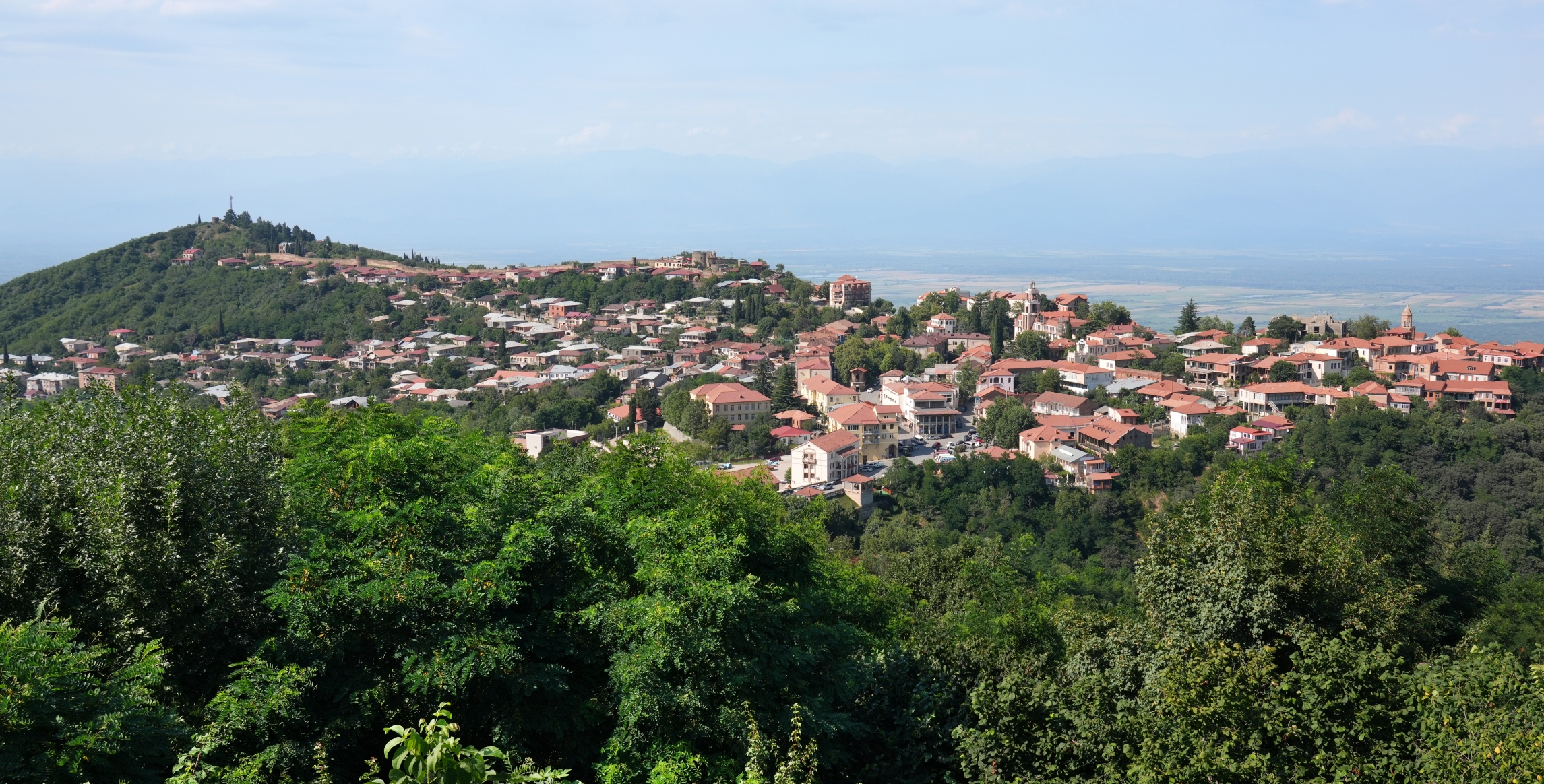
Perched on a long ridge above the fertile plains, Sighnaghi just may be the prettiest town in Georgia. Enclosed within centuries-old fortress walls is a charming scene. Colourful wooden balconies cling to old stone homes, while cobblestone streets follow the whims of the uneven ridge. On the plains below is a vast sea of vineyards that have belonged to the families here for generations. All these aspects make us believe you will also fall in love with Sighnaghi, just as we did.
The town of Sighnaghi was a highlight of our trip to Kakheti, Georgia’s wine region. Most visit on a day trip from Tbilisi, but we think Sighnaghi, as well as the nearby capital city of Telavi, warrant a longer stay. (It is also spelled Signagi).
In the 18th century, King Erekle II of Kartli-Kakheti built a five kilometre stone wall around the oddly shaped ridgetop. By enclosing the town, Sighnaghi was kept safe when under constant attack. Its location on trade routes made it a target, especially by tribes from nearby Dagestan, now a part of the Russian Federation. Today, some of that wall is still standing including a few of its original towers and gates.

Begin your exploration of the old, fortified town at its Main Gate. This entryway is a good introduction to what you’ll see in Sighnaghi. It’s cute, it’s authentic, and it’s a bit dishevelled. Some of the walls are crumbling, but this adds character rather than taking away from its charm.


After passing through the gate, wander down the cobbled streets, while admiring the old stone homes. Most are used by tourist shops today, but it is still a nice street. Halfway down, you will come to the 17th century St. George Church. It is apparently open on Sundays, but otherwise, you can only see inside when the little old lady with the key feels like opening the doors. We didn’t get so lucky.
The interesting thing about this church is its tower. Even though the church predates the city wall, its bell tower must not. It looks like it was built on top of one of the fortress towers.


Continue walking and you’ll reach a large section of the rampart. Here, a few of the towers have been restored and you can climb to their tops. From there, you’ll have a nice view of the Alazani Valley below as well as the rooftops of old town.


Between the restored towers, a section of the wall has also been repaired, and you can walk along its top. In the distance, you can see more of the old rampart as it follows the ridge line. Other villages have built up in the valley below, but Sighnaghi hasn’t filled in the fortress grounds, even yet.


The ridge above this arm of the fortress also gives you a great vantage point of the castle walls. At the top of this hill is the 18th century St. Stephen’s Church. Mostly in ruin today, its tower, called King’s Bulwark, was once a part of the city wall.


After exploring this end of town, there’s still more to see. You’ll love strolling through the compact downtown area. Here, you’ll find a charming Town Hall with a prominent clock tower, several parks, a war memorial and heritage buildings that serve as hotels and local shops.


Sighnaghi is sometimes referred to as the Town of Love because it is a popular location for weddings. There’s even a wedding venue in its centre with a statue of the flower girl in front. There are a few more of these metalic statues in town. Our favourite is Doctor on a Donkey, commonly mistaken for Don Quixote.


The undulations in the ridge create many interesting viewpoints. In addition to the ones we showed you near the fortress walls, we enjoyed a great view of the town centre from our guesthouse balcony. Our favourite, though, was from a hill above town, where you could see all of Sighnaghi spread across the irregularly shaped ridge.


On the other side of downtown, you’ll find cute, two-story homes with colourful balconies. Others are single-story rowhouses with terra cotta roofs. The hilly streets make the area even more endearing.


Almost every home in Sighnaghi has a lovely garden. Many had grape vines as we expected, but they also had beautiful flower or vegetable gardens and even fig trees.


The people in this small town are very friendly. As we were exploring the streets, we passed by a home and heard someone calling ‘Hello, hello’ The lady had just returned from the mountains and had a large container of sour cherries she had just picked. We bought a large bag of them from her. They were delicious.
Wine tasting
Located in Georgia’s largest wine region, we knew we wanted to go for wine tasting in Sighnaghi. Kakheti has the perfect climate for growing grapes. There are more than 500 varieties of grapes in the country. At roughly 400 m elevation, the fertile valleys in Kakheti account for 70% of the grapes in the entire country.
Georgians have a long history of making wine. According to evidence discovered by archeologists, they have been making wine since at least the 6th millennia BCE. Because of this, the country often claims to be the ‘birthplace of wine’. They are in a friendly competition with Armenia, though. A winery was recently uncovered in Armenia that dates back to 4,000 BCE. So, Georgia can still hold on to its claim as the birthplace of wine, and Armenia can maintain that they have the oldest winery. We’ll take you to that site in Areni, Armenia soon.
The methods used today don’t vary much from those original techniques. Wine is fermented in large underground clay vessels, called qvevri (kvevri). After the fermentation process is complete, the qvevris are sealed with beeswax, and the holes are covered in sand. We saw a few qvevris decorating the parks around town.


With 8,000 years of wine making knowledge, we were excited to sample Georgian wines. There are many maranos (wine cellars) in town to choose from. We selected a family run winery and tasted five of their wines.
Georgian wine is not typically characterized according to the grape. Instead, they are classified as a range from sweet to dry. Red is usually our preferred, but we found the red wine in Georgia to be very sweet, even the dry reds were sweet. Some even seemed to have a spritzer quality to them. In addition to the taste, they serve their reds cold, which seemed strange to us. Their white wine is more similar to a Riesling, but not as pleasant as other whites we’ve had either.

We did try other wines throughout the country and our feelings about them didn’t change. The best wine we had in the whole country was made by our guesthouse owner in Sighnaghi.
Instead of wine, we did find a couple of nice brandies and even enjoyed a few shots of chacha. This is made by distilling the contents at the bottom of the qvevri, meaning the skins and seeds of the grapes. It’s strong, but not bad in small quantities.

The other thing about Georgian wine is that, compared to other goods in Georgia, it is fairly expensive. Grocery store shelves are filled with Georgian wine, but the prices are similar to imported wine we would buy at home. So, between the sweetness and the high prices, this is one part of the Georgian custom that we didn’t take part in unfortunately. Knowing its long history, we expected the wine to be similar to Bulgarian, but we enjoyed the Bulgarian wines much more.
If you enjoyed this, you may be interested in our wine tasting posts from Mendoza and Salta in Argentina, Colchagua and Elqui Valleys in Chile, Armenia, Bolivia, Uruguay, Portugal, Bulgaria, and India.
Bodbe Monastery
Built on the burial site of St. Nino, Bodbe Monastery is a revered place for Georgians. The monastery is located on a hillside approximately 3 km from Sighnaghi. It has a peaceful location in a manicured garden with bushes, blooming flowers and Cyprus trees.

The monastery includes four churches, a bell tower and holy springs. The oldest church, St. George, was originally built in the 4th century by King Miriani III. He’s the king from Mtskheta, who declared that the country would be a Christian state. You can read about Mtskheta here.
The church was renovated and restored many times, but still has that old feel to it. Inside the stone walls still display centuries-old frescoes.


The main building is the large St. Nino’s church. Its construction only began in 2010 and it is still not complete. Inside its walls are completely white, only a golden Iconostasis is at the front.

Below the monastery is a holy spring. St. Nino is said to have healed the ill with its water. A small stone building surrounds the spring today and a fountain is outside where you can collect drinking water.
Many come to the spring to bathe in the holy water. Only one person is allowed in the spring at once. In addition, you must disrobe and wear a white robe that is rented for 10GEL (3EUR). There was a line-up of pilgrims waiting when we were there.

The walk to the holy spring from St. Nino Church is quite steep. It is 1 km long with a 125m elevation loss.
Entrance to the monastery is free; Opening hours -10 am to 6:30pm daily.
Getting to Bodbe Monastery
We enjoyed the 3 km walk to the monastery from town, but there are also many taxis in Sighnaghi’s downtown that will drive and wait for you. Another option is to visit on a tour from Tbilisi.
Getting to Sighnaghi
From Tbilisi, marshrutkas leave from the Samgori Station every 2 hours beginning at 9 am, the last bus leaves at 5pm. It is the same schedule to return to Tbilisi. Between Sighnaghi and Telavi, marshrutkas leave once a day, at 9:30 am, everyday except Sunday.
You can find Sighnaghi in the lower right section of the map below. It is an interactive map, so you can zoom-in or click on a marker to find a link to our post from that region.
Where to eat in Sighnaghi
There are many great restaurants with amazing views in Sighnaghi. We enjoyed all of our meals, but the views from Panorama Terrace made it a favourite. You can also get amazing views from the restaurants near the old wall. Another option are the many maranos (wine cellars) in town. Most serve meals as well as offering wine tasting. If you have a chance to have a homecooked meal at your guesthouse, we recommend that.
We noticed a unique shape to the bread we were served in Sighnaghi and finally saw a bakery with an unusually shaped oven. The canoe shaped bread bakes on a curved tray and explains how the bread gets its shape.


Where to stay in Sighnaghi
The town is quite small so which area you stay in is not much of a concern. There are a couple of high-end hotels in the town’s centre, but there are also many small guesthouses that we think will make your stay more enjoyable. Most guesthouses provide breakfast and you can have them prepare a dinner of local dishes, usually accompanied with homemade wines.

This article is now featured on GPSmyCity. To download this article for offline reading or create a self-guided walking tour to visit the attractions highlighted in this article, go to Walking Tours and Articles in Sighnaghi.

Click on the link to read our Travel Tips For Georgia.
To read more of our adventures in Georgia, click here.
Coming Next – What To See In Telavi, Georgia
For pictures from other blogs go to Gallery at monkeystale.ca.
To read about more of our adventures go to Destinations.
If you like what you read, please comment or share (with credit) using the links below.




We’d love to hear from you, please leave a comment.