
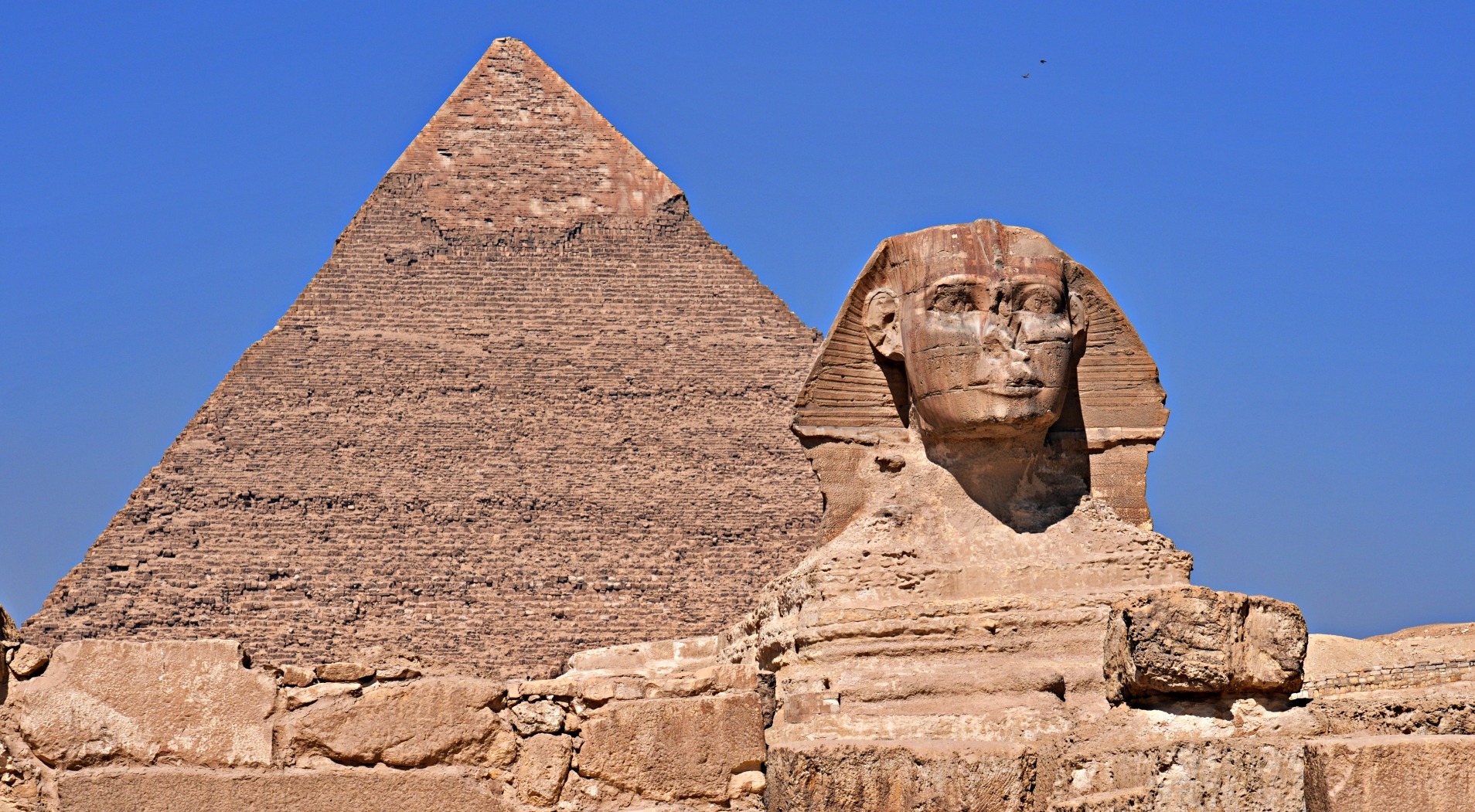
Undeniably, the most famous attractions in Egypt are the Pyramids of Giza. Sometimes such highly anticipated attractions are disappointing, but we’re happy to report that the pyramids not only lived up to expectations, but they exceeded them. Their perfect symmetry, immense scale, and close placement to one another and to the Great Sphinx combine to make it one of the most unforgettable destinations in Egypt.
A little history
To better understand these ancient monuments, it helps to learn a little about Egypt’s ancient history. Around 3100 BCE, the previously separate territories of Upper and Lower Egypt united, marking the beginning of the Dynasty of Pharaohs. The first capital of this united Egypt was in Memphis, not far from Giza and present-day Cairo.
In total, there were 30 Pharaoh Dynasties between 3100 BCE and the 300s BCE. At many times in history, the Egyptian pharaohs’ rule was disrupted by foreign rulers. With these interruptions, as well as changes in family dynasties, the history is further divided into Early Dynastic, Old Kingdom, Middle Kingdom and New Kingdom. The pharaohs buried in Giza were members of the Old Kingdom’s 4th Dynasty, roughly during the 2500s BCE.
Ancient Egyptians believed in the afterlife. They noticed that the sun sets each night and rises again the next day. Because of this, their main deity was the Sun God, whom they called Ra. This god was reborn in the east every morning. Like many emperors, Pharaohs maintained control of the population by claiming to have divine ancestry and that they are the gods’ representative on earth. In the 4th Dynasty, they went one step further, by saying that they were the son of Ra. Therefore, after death, Pharaoh Khufu would become Khufu-Ra for example.
Note – Even though these monuments have been studied for decades, their exact dates are estimates. As well, historians don’t always agree on relationships or positions of non-pharaohs. We are including the most common dates and theories, which are usually those presented by the museums.
It is sometimes difficult to put these dates into perspective. We thought this poster from Abu Simbel, would help to understand it better

Pyramids of Giza
Today, the city of Giza is within the metropolitan area of Cairo, but when these giants were built, the land was a vast desert. Standing high above this desert floor, the Pyramids of Giza command your attention. As we stared up at these architectural marvels in wonder, it was difficult to believe that they were over 4,500 years old. In fact, these pyramids were already close to 2,500 years old during Cleopatra’s time. Many suggest that she, as well as the Roman Emperors after her, were also in awe of them. It’s funny to imagine Cleopatra as a tourist, just like us.
Once you see them, there will be no doubt as to why it is a UNESCO World Heritage Site.

The Great Pyramid
The largest of the three is the Great Pyramid, which was built for Pharaoh Khufu. Improving on the architecture from the Step, Bent and Red Pyramids, Pharaoh Khufu went on to create the largest structure on earth. At 146.6 m (481 ft) high, it is the equivalent of a 35-45 story building. In fact, the Great Pyramid was the tallest man-made structure in the world for over 3,700 years. The 14th century tower at Lincoln Cathedral in England was the first to finally stand taller than the pyramid. But unlike the pyramid, it toppled during a storm after only 200 years.
You can read about the Step, Bent and Red Pyramids in our post from Saqqara.

Ancient architects used surprisingly advanced trigonometry and algebra to design this magnificent structure with precision. It was no easy task to ensure that each of the 2.3 million limestone blocks was perfectly positioned, and that interior rooms and hallways wouldn’t collapse under their weight. Its construction involved thousands of workers toiling for 20-27 years. Many suggest that there were both full-time workers and part-time ones such as farmers in the off-season. Another possibility is that they were slaves, but this is not as widely believed.
One of the biggest questions is: how did they get the massive limestone blocks to the top of such tall structures? Researchers believe that ramps, greased with wet sand, allowed the stones to be pushed and pulled into place as the pyramid grew from the ground up. Every step of its construction, from design to the finished product, makes you realize how advanced they were in ancient Egypt.


Inside the Great Pyramid, a series of above-ground, narrow passageways leads to the pharaoh’s burial chamber in the middle of the pyramid. While the main structure was built with locally sourced limestone, the walls of this burial chamber and sarcophagus were made of red granite brought from Aswan, 800 km (500 mi) up the Nile in Upper Egypt.
While we can go inside today, after the pharaoh was entombed, the burial chambers were sealed to prevent grave robbers. They didn’t work very well, though, because most of the tombs in Egypt were robbed during ancient times, likely within 400 years of them being erected.
You need an extra ticket to enter the Great Pyramid. Tickets are purchased at the main ticket office or online.
Pyramid of Khafre
At 136.4 m (448 ft) high, the second tallest pyramid in Giza was the tomb for Khufu’s son, Khafre. The bare limestone blocks we see today on all three of these pyramids were originally cased in polished white Tura limestone. The effect would have made the pyramids glow in the strong sun and add to their overall imposing stature. There is still some remaining on the top of Khafre’s Pyramid, allowing us to get an idea of how they may have once looked.
This white limestone came from Tura, 17 km (10mi) away.


Wondering what happened to the Tura limestone? In the 1300s, a large earthquake splintered the casing, and most of it peeled off the pyramids. It was used later in that century to build the Sultan Hasan Mosque-Mausoleum in Cairo, and then again in the 1800s during the construction of the Mohammed Ali Mosque in the Saladin Citadel. You can read about both those mosques in our post, Saladin Citadel and Medieval Mosques in Cairo.
Inside this pyramid, there is a single burial chamber with granite walls, an alabaster floor, and a black granite sarcophagus. There is also a separate, smaller room for funerary instruments. To date, two narrow hallways lead to the burial chamber, but researchers believe more halls and rooms were blocked off and have not yet been found.
You can visit the burial chamber inside Khafre’s or Menkaure’s pyramids on alternate days.

Pyramid of Menkaure
The third pyramid in the complex was built for Khufu’s grandson, Pharaoh Menkaure, who died before it was completed. It is much smaller than the other two, at only 62 m (197 ft) high, but it was much more refined. For example, the bottom portion of this pyramid was cased in polished granite, brought all the way from Aswan. The rest of the pyramid still shows the more typical limestone blocks, but it would have had Tura limestone casing, similar to the other two.

This pyramid and Khafre’s are open to visitors on alternate days, and it was open on the day we visited. After entering the small door, we squeezed through a long, narrow ramp, hunched over so far that we were almost bent in two. At the bottom of the ramp, we stopped to stretch in a small antechamber with a few carvings on the walls.
When archeologists first entered in the 1830s, they found a sarcophagus and a damaged mummy in this room. Interestingly, the mummy was not Menkaure; this one was 2,000 years younger. Not much is known about how it came to be in the pyramid, but reusing tombs was not an uncommon occurrence in ancient Egypt.


From there, another ramp took us deeper until we reached the lowest room, the Burial Chamber. It was cut into the bedrock, and the walls were overlain in Aswan granite. The room contained Pharaoh Menkaure’s mummy along with his valuable gems, pottery, and gold, but it wasn’t completed before he died and is therefore mostly undecorated. Apparently, it was meant to have carvings on the walls, similar to those in the antechamber. These decorations would have made it much different from previous generations whose burial chambers were plain.
When British researchers first entered in the 1830s, his basalt sarcophagus was still there, but the mummy and valuables were gone. Still, it must have been very exciting for them. Instead of leaving it in place, they hauled out the large sarcophagus, intending to display it at their museum. Tragically, in 1837, when the sarcophagus was being transported to England, the ship sank. As far as anyone knows, the sarcophagus still sits at the bottom of the Mediterranean.
While there wasn’t much to see, it was still amazing to be able to enter an ancient pyramid.


You may have noticed a scar on the outside of Menkaure’s Pyramid. In the 12th century, the Sultan of Egypt sent a crew to dismantle the pyramids. Some reports say he intended to demolish them; others say he was after the treasures inside. They began with Menkaure’s, but after 8 months and significant effort, they were only able to remove a few stones.

Behind it are three satellite pyramids for the pharaoh’s queens and a valley temple. They are all in ruins, but five versions of the Menkaure Triad were discovered amongst the rubble. They are statues of Pharaoh Menkaure, wearing the Crown of Upper Egypt with the deity Hathor and a local goddess. The one pictured below is at the Egyptian Museum in Cairo and is much more sophisticated than we expected considering its age.

The Great Sphinx of Giza
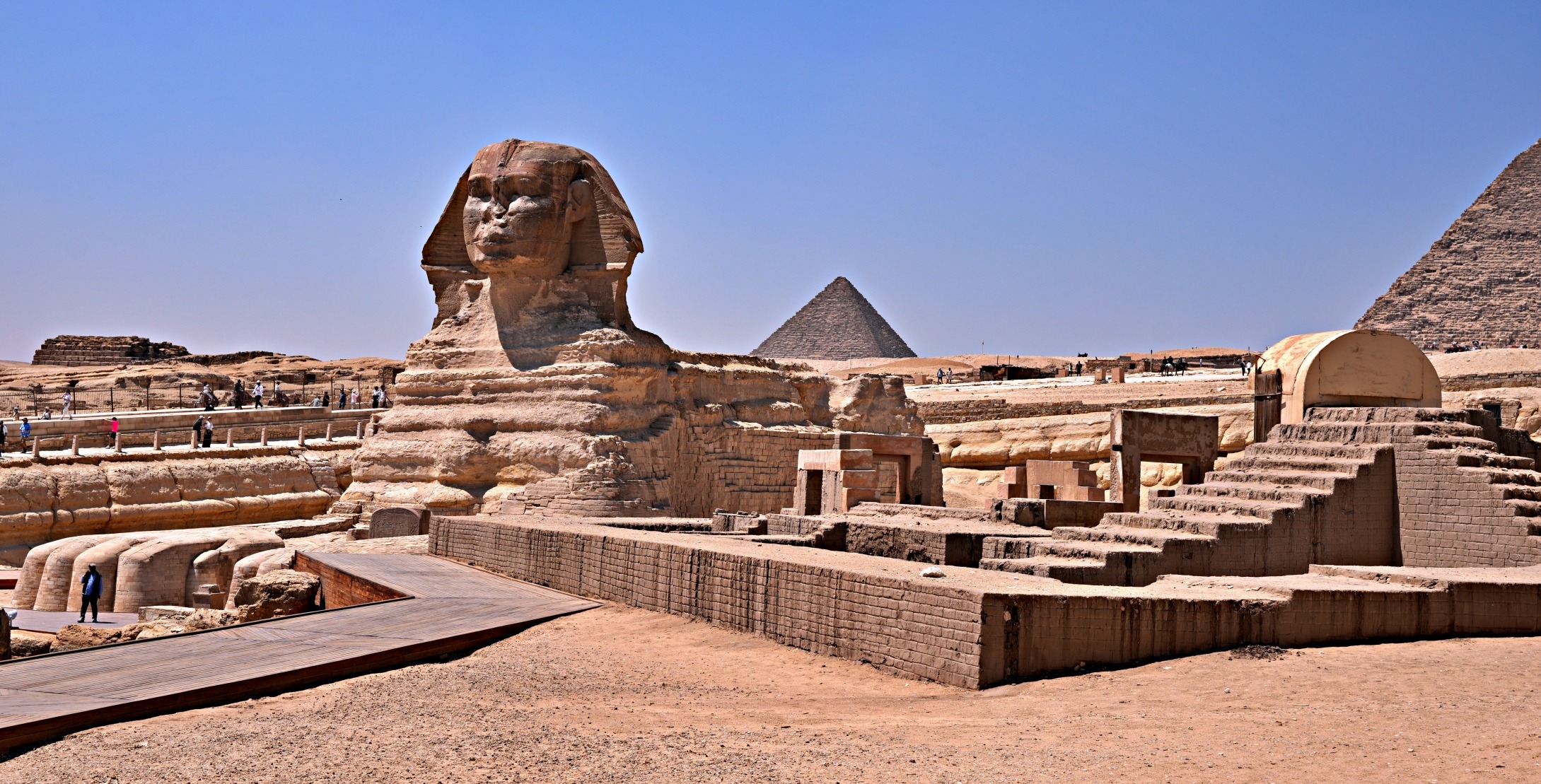
While the pyramids are impressive in their size, the Sphinx actually stole the show for us. Thought to have been carved by order of Pharaoh Khafre or his brother, the large statue has a lion’s body and a pharaoh’s face adorned with a royal headdress. Unlike the pyramids, the Sphinx was carved from the bedrock.
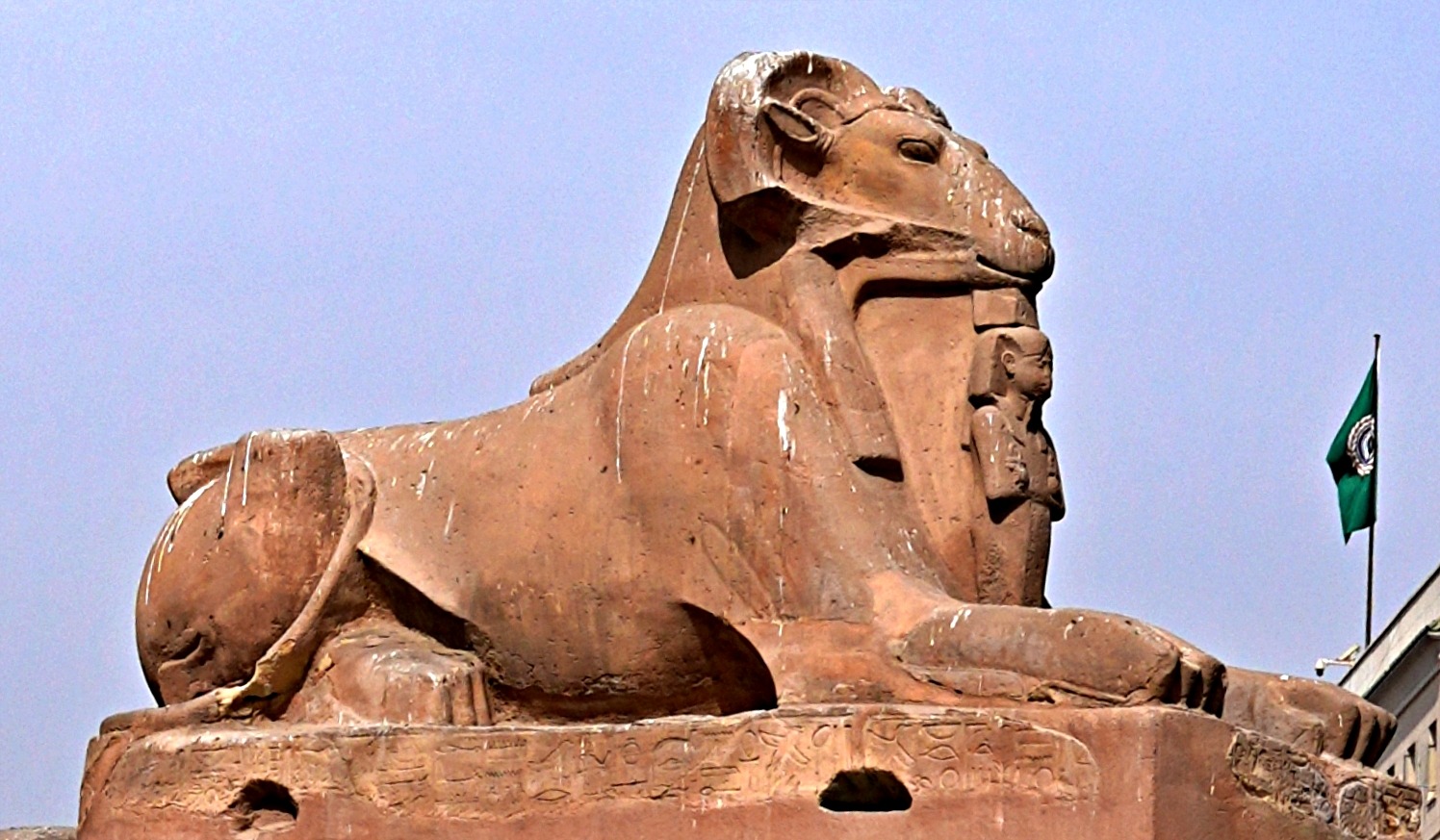
This was the first Sphinx ever built, but it wasn’t the last. This symbol of power was used repeatedly throughout ancient Egypt, and we’ll show you several in coming posts.


The Great Sphinx of Giza was buried by desert sand for thousands of years and suffered a lot of damage. All of the original brightly coloured paint is gone, and you may notice it is lacking a nose. Many theories exist as to who damaged the nose. Some say it was a medieval Sufi priest; others say it was Napoleon’s army. The truth will likely never be known. Its beard is also absent, but interestingly, this was a late addition. The beard was added more than1000 years later by Pharaoh Thutmose IV, who also installed a stele at the lion’s paws.
It’s difficult to appreciate how large the sphinx is, but this picture, with a security guard at its base, gives you perspective.


Eastern Cemetery
These large pyramids were not built in the more popular Saqqara Necropolis because there wasn’t enough flat space to accommodate them. Giza already had a small cemetery, but more importantly, it had a large open plateau. This cemetery was not used as often as Saqqara, but it continued to see burials for queens, nobles and royal families for the next 2,000 years. As a result, it has several small subsidiary pyramids and mastabas scattered in the complex; the largest collection of these is found in the Eastern Cemetery.
Most are closed, but you can enter the Tomb of Queen Meresankh III, wife of Khafre. Tickets must be purchased at the entrance or online. If you are planning to visit Saqqara, we don’t think you need to visit it, since the others have more extensive tomb art.


Valley Temples
You will also see many temples in the ancient necropolises throughout Egypt. Valley Temples are where priests performed mummy purification rituals and funerary rites. One of the best examples is the Valley Temple of Khafre. Today, most of what is left are granite columns atop alabaster floors, but originally there were 23 statues of Khafre in front of those columns. Only one was found and is now on display at the Grand Egyptian Museum (GEM).
A seated Khafre statue was found in a pit beneath the temple. You can see it in the Egyptian Museum in Cairo.


The best part of visiting this temple is that once you exit, you will be looking directly at the Sphinx. We suggest entering the complex through this temple for the best wow factor.

Mortuary Temples
There were also several Mortuary Temples in the complex. Some of them appear as small, rough pyramids beside the large pyramids. They were places to commemorate the king. Priests remained in these temples to worship and give gifts to the pharaoh for use in his afterlife. This practice often continued for hundreds of years after their death.
Mastaba of Seschemnefer IV
In front of the Great Pyramid is the restored stone Mastaba of Seschemnefer IV. Two seated statues of Seschemnefer IV are outside the entrance. He was not a pharaoh but rather an elite official to the royal family.
The mastaba was built over top of the burial shaft, which was carved into the bedrock. Some of the walls have tomb art, and if you haven’t visited Saqqara yet, this will likely be the first that you’ll see. The carvings include scenes of daily life, rituals and offerings, as well as hieroglyphic text. It was built during the 6th Dynasty, so it is a couple of hundred years younger than the pyramids.
Entrance is included in the main ticket.


Since the pyramids are so large and were known to contain valuable items, it’s not surprising that within a very short time, the pyramids were broken into by grave robbers. Because of this, the Age of Pyramids didn’t last very long. By the end of the 6th Dynasty, pharaohs’ burials were more secretive, hidden in rock-cut tombs. We’ll take you inside wonderfully decorated tombs in Luxor’s Valley of the Kings soon.
Entry Fee for Pyramids of Giza and the Great Sphinx – 700 EGP ($13.30 USD). You can buy tickets online or at the ticket office; they only accept credit cards; Opening Hours – April to Sept: 7 am to 7 pm; October to March: 8 am to 5 pm. Time Needed – Expect to spend 2-3 hours at the site. During high season, there may be long line-ups to get inside the pyramids. For us, in April, there was no line and only 20 or so people inside the pyramid.
Extra fees to enter: the Great Pyramid – 1,000EGP ($20USD); Khafre/ Menkaure – 250EGP ($5USD). For the Tomb of Queen Meresankh III the fee is 200 EGP ($4USD). These must be purchased at the main ticket office or online.
Grand Egyptian Museum
Touted as one of the best museums in the world, the Grand Egyptian Museum (GEM) has a vast collection of artifacts from Egypt on display. In the spring/summer of 2026, the only way to buy tickets is online, but unfortunately for us, their brand new, state-of-the-art website did not allow us to purchase tickets. We met several others in the same predicament. It seems that, for the short term at least, in order to visit the museum, you need to join a tour. We tried to purchase tickets onsite, but that was also not possible.
Entry to GEM – 1590EGP ($30 USD); Opening Hours – 9 am – 6 – pm daily.
Tips for visiting Giza
Getting to Giza Pyramids
Located 18km from downtown Cairo, the easiest way to reach the site is by taxi/Uber/Careem. There are plenty of taxis waiting at the entrance so you can easily find one to return to Cairo. We visited Giza and Saqqara on the same day, so we hired a taxi driver we met in Cairo the day before to take us to both. This took most of the day, and he only charged us 1,500 EGP ($28 USD), but we ended up paying him 1,800EGP to include parking costs and extras. If you find a taxi driver you like, this is a great option, and it worked well for us. Otherwise, you can hire a driver from your hotel but expect to pay more.
There are two entrances: the older Sphinx Gate and the new Visitor Centre. The Sphinx Gate is only for those who purchased a ticket online. The main entrance at the Visitor Centre is a very small, unofficial-looking building, but it is very hectic with dozens of touts waiting to pounce. To avoid as many as possible, have your driver drop you off in front of the ticket office doors.
Do I need a guide?
You don’t really need a guide since there is a lot of information online and posted at the site. It is quite easy to figure out where and what the monuments are, and a guide is not necessary.
Tip – In addition to the touts at the entrance, the badgering continues inside the complex. Camel herders and kalash drivers (horse buggies) are everywhere and will hound you to hire them. Just say ‘La Shukran’ and keep walking. Or, if you are interested, be prepared to barter. It wasn’t just the touts and camel herders either. We were very surprised when one of the security guards demanded a bribe to allow us to bring two camera lenses into the complex.


What to wear
The site is very rugged, so good footwear is needed. As well, other than the time you are inside the tombs, there is no protection from the sun, so a hat and sunscreen are recommended. Since you are in a Muslim country, women should dress very conservatively by covering their legs and shoulders.
For information on where to stay and what to see in Cairo, please visit our post Cairo’s Top Historic Landmarks.

Click on the link to read our Travel Tips For Egypt.
To read more of our adventures in Egypt, click here.
Coming Next – Ancient Wonders – Karnak Temple and Mummy Museum
For pictures from other blogs go to Gallery at monkeystale.ca.
To read about more of our adventures go to Destinations.
If you like what you read, please comment or share (with credit) using the links below.



We'd love to hear from you, please leave a comment.