
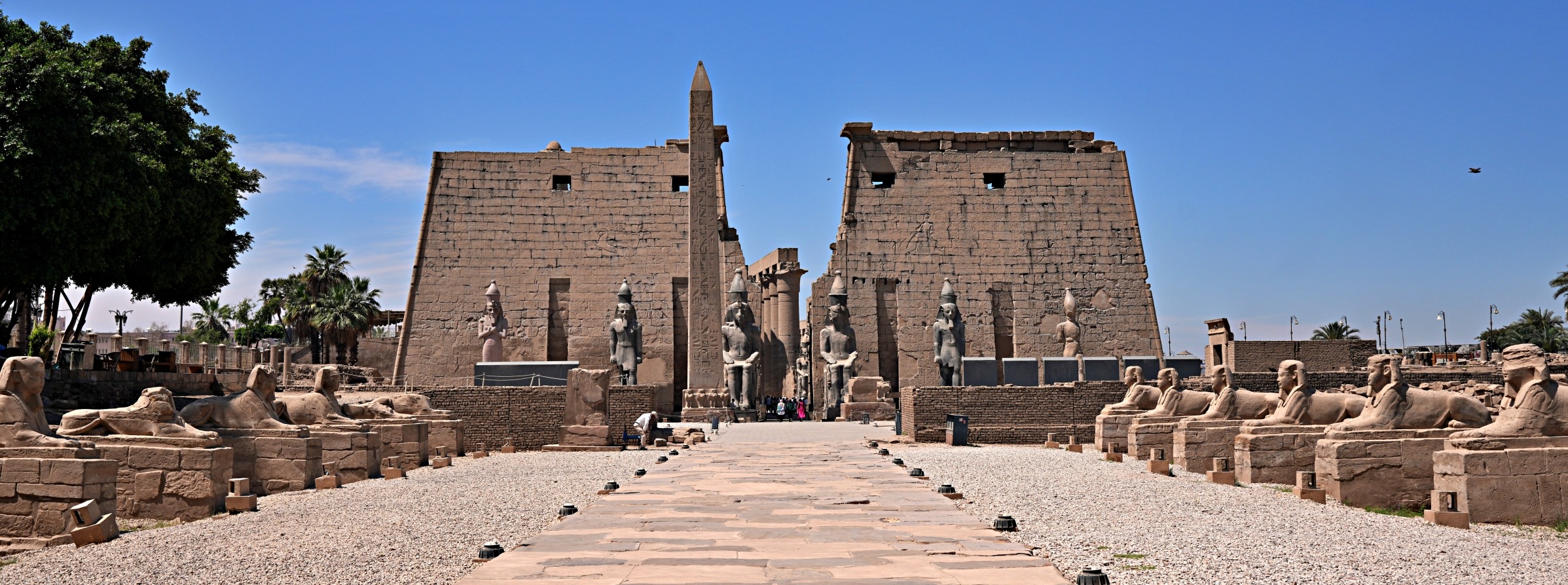
If the main entrance to Luxor Temple doesn’t impress you, we’re not sure what will. Guarded by six colossal statues of Ramses II and an obelisk, the main gate to Luxor Temple was built to make an imposing first impression. Even 3,000 years later, it will leave you awe-struck. The wow factor doesn’t end with the main entrance either. Come with us to Luxor Temple as we journey through ancient Egypt.
Avenue of Sphinxes
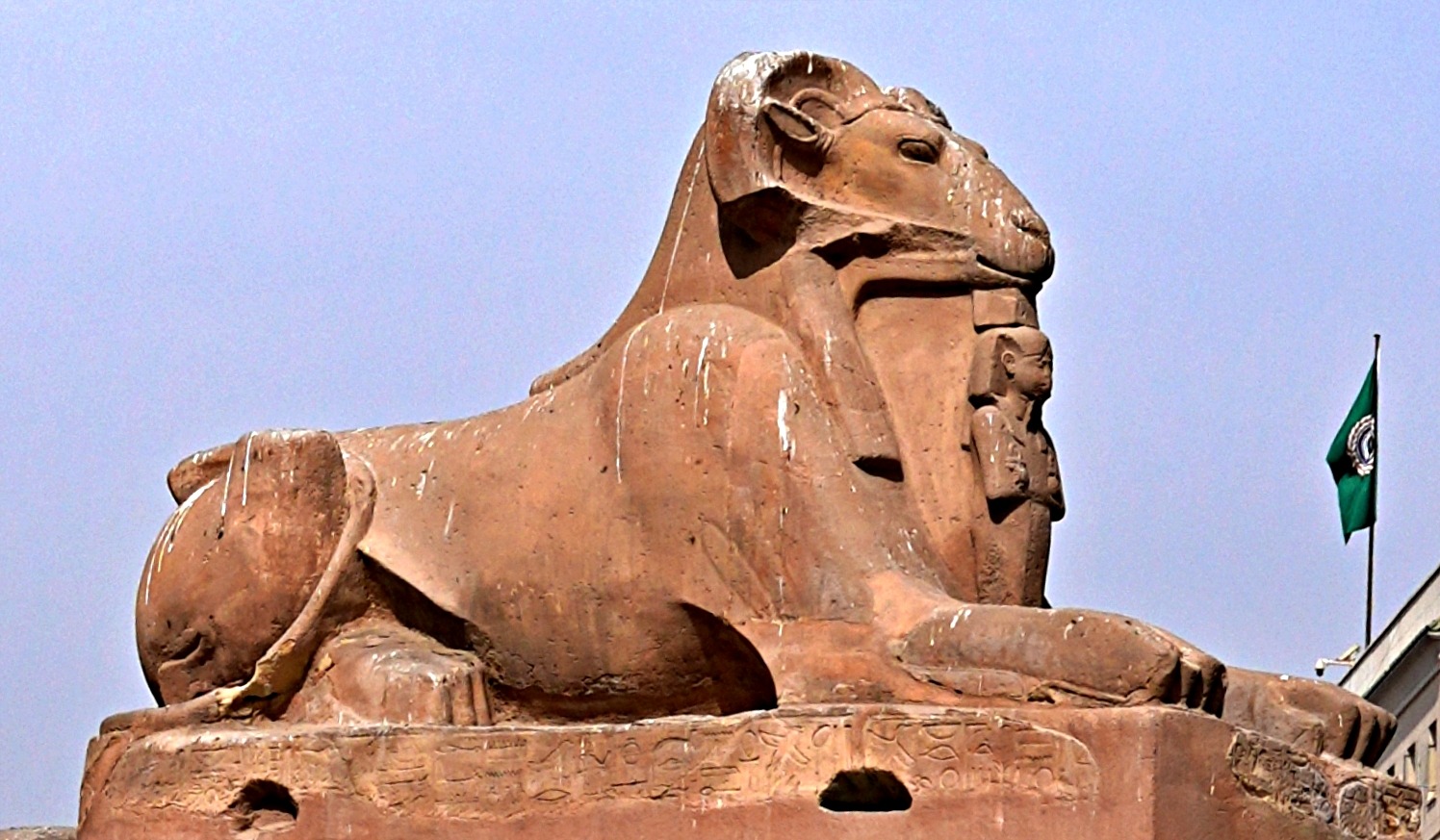
Before entering the temple, stop to visit the Avenue of Sphinxes. We saw other sections outside Karnak Temple, but we think the most impressive part of this avenue is in front of Luxor Temple. The 3 km (1 ½ mi) long avenue extended from Karnak to Luxor and was lined with as many as 1,350 sphinxes, with both the traditional pharaoh heads and ram heads on a lion’s body.
Queen Hatshepsut was first to build a processional road here, but very little of it remains. Roughly a hundred years later, Pharaoh Amenhotep III began construction of the Avenue of Sphinxes. It wasn’t completed for a staggering 1,000 years as successive pharaohs, including King Tut and Ramses II, added their own sphinxes.


Although found in another city from an earlier era, this Sphinx of Amenemhat III would have been similar to some of the first sphinxes placed on this road. You can find this one at the Egyptian Museum in Cairo.

Both the original road and the Avenue of Sphinxes were built for processions during the 27 day Opet Festival. As part of the celebration, pharaohs and priests travelled from Karnak to Luxor on golden barques (boats) carrying icons of the triad Amun-Ra, Mut and Khonsu. At the end of the festival, the icons were returned to Karnak to symbolize a rejuvenation of the triad.

Remarkably, this avenue wasn’t discovered until 1949 and was only fully uncovered in 2021. To date, only 650 of the 1350 sphinxes have been found. Many are on display outside Luxor and Karnak Temples, while others are still being restored.
Luxor Temple
Even though we call it a temple, it was actually a celebration complex for pharaohs and elites during the annual Opet Festival, rather than a religious centre. Construction began on Luxor Temple in the 1300s BCE by Amenhotep III and was redesigned and redecorated over hundreds of years by subsequent pharaohs. Most of the expansion, though, occurred under Ramses II.
Positioned before the first pylon to the Luxor Temple are six large statues of Ramses II. Since commoners weren’t allowed inside the temple, these statues outside the main gate would reinforce in them the superiority and godliness of Ramses II. While they are impressive from a distance, make sure to stop for a close-up look at the details. Not only are the carvings on the thrones wonderful, but in the picture below, you can also see a small statue of his wife Nefertari. Also, take a look at the faded reliefs depicting Ramses II’s successful battles on the wall behind them. To understand its scale, you can see a person walking toward it in the first picture below.
Pylons are large, monumental gates, usually with colossal statues in front. They are located at the main entrance to a temple and also to separate other major rooms. Two obelisks originally accompanied the statues, but unfortunately, one was moved to Paris.


Ramses Court
Once you step through the first pylon, you’ll enter Ramses Court. This large, open space is another wonderful area with engraved papyrus bud columns around the outer edge. Between the columns are striding statues of Ramses II and Amenhotep III. The statues of the two pharaohs together show them as equals, but eventually, Ramses deemed himself superior. He erased Amenhotep’s name from most of the cartouches in the temple, including ones on these statues and replaced them with his own name. This was actually quite common in ancient Egypt.

Although very weathered, the columns are decorated with reliefs of gods and pharaohs. Hieroglyphics and depictions can be seen literally on every surface. Some are raised reliefs, some are engraved, and a few even still have original paint on them.

At the end of the courtyard are two seated statues of Ramses II. One is in excellent condition, and as with the ones at the entrance, you can see artwork on the throne.

There aren’t many remains from King Tut’s short reign, but we found a statue of Pharaoh Tutankhamun seated next to his wife, Queen Ankhesenamun, at the end of Ramses Court.

Luxor Temple continued to be used long after the Dynasty of Pharaohs ended. On the side of Ramses Court, a 4th century Coptic Church was built, which in the 7th century AD was converted into a mosque.
Amenhotep III Colonnade Hall and Courtyard
Further inside is one of the first structures built in Luxor Temple. Amenhotep III Colonnade is a long hallway of open-flower papyrus columns that takes you to the Amenhotep III Courtyard. What makes this space special is that the columns have repeated patterns down the length of the hall. Since the columns were built of sandstone, though, the carvings are quite faded, so it is difficult to see in a picture.

At the end of the colonnade, you’ll find the large Amenhotep III Courtyard. The open space in the middle was for Opet Festival celebrations. Sitting in the shade on the edge of the courtyard, we tried to imagine the festivities. The main event was the arrival of the icons of Amun, Mut, and Khonsu, who would be brought amid much fanfare, including musicians, dancers, and parades.

It was while sitting here that we had another realization. Before visiting Luxor, we thought the Greeks invented columns. What we learned, however, is that the Greeks were inspired by what they saw in Egypt. In fact, many architectural details we think of as being Greek or Roman were actually originally Egyptian. In addition to columns, other architectural designs such as the cavetto (concave moulding), architrave and monumental entrances were first used in ancient Egypt. Even the general layout of temples came from the Egyptians. The impressive entry gates that draw you inside to find awe-inspiring sanctuaries and grand halls are based on the Egyptian model.
Amenhotep III Courtyard is fringed by a double row of ribbed columns. This interesting shape is meant to represent clusters of papyrus with unopened flower buds. In fact, most of the columns in Luxor and Karnak Temples are papyrus stalks, topped with either open flowers or closed buds. The colonnaded hallway pictured above has open-flower ones.


The surrounding walls also have many reliefs, including this picture of an elaborate crown.

Roman Courtyard
When the Romans ruled Egypt in the 3rd century AD, they altered Luxor Temple. In some places, they dismantled rooms and built their own sanctuaries. In others, they covered the Egyptian art with plaster and painted frescoes on top. You can see some of the Roman artwork and Corinthian columns between the courtyard and the sanctuary.
Usually, we would be excited to see original Roman frescoes, but here, where it has covered Egyptian art, it seemed more like graffiti and out of place than impressive.


Inner Santuary
Beyond the Roman Courtyard is the Inner Sanctuary. It includes a series of interconnected rooms, where one leads into the next. Most have not been restored, but there are a few to look out for.
Amenhotep III’s Coronation Room
One of the most fascinating rooms in the Inner Sanctuary is Amenhotep III’s Coronation Room, also called the Birth Room. Since Amenhotep III didn’t have royal lineage, it was important to prove he deserved to be pharaoh. Therefore, the walls in this room are adorned with Divine Birth Scenes that present him as a child of the sun god Amun-Ra. Most are damaged, but still display their original colours.


Sanctuary of Alexander the Great
In another room, Greek ruler Alexander the Great did something similar. After liberating Egypt from Persian control, he soon became a beloved leader of Egypt. Unlike most foreign conquerors, he was keen to be accepted by the people in his newly conquered nation. One way he did this was by building sanctuaries and covering the walls in images of him receiving blessings from Egyptian gods.
This one in Luxor Temple was built right in the middle of a larger hall built by Amenhotep III. Four columns were toppled to make room for the new sanctuary, but thankfully, the outer walls of the older room were left standing. That means that you can walk around the perimeter of Alexander’s room and have his 4th century BCE walls on one side and Amenhotep III’s 14th century BCE walls on the other. That combination makes this space even more special.
To find out more about Alexander’s inclusion in Egyptian mythology visit our post from the Temple of the Oracle in Siwa.


Even though much of the temple lay in pieces and was covered in sand for centuries, restoration work involved cleaning and repairing the damage, but they did not repaint the art. That makes this temple even more remarkable.
As you walk through the temple, it’s difficult to understand its size. Seeing it from either the street or the river helps you get a better understanding of how large it is. We recommend going in the evening when the lighting makes it look mysterious. The lights are turned off around 8 pm, so don’t go too late.


Entry Fee – 500 EGP ($10 USD), payment only with credit or debit cards; Opening Hours – 6 am – 8 pm daily; Time Needed – Plan to spend at least 2 hours in Luxor Temple.
Most of the ancient sites in Luxor have received UNESCO World Heritage Site status, including Karnak and Luxor Temples; the necropolises of the Valley of the Kings, Valley of the Queens, Tombs of the Nobles, Deir el-Medina; and the mortuary temples of Hatshepset, Ramesseum, and Medinet Habu.
For information on where to stay and eat in Luxor, including Travel Tips, visit our post Ancient Wonders – Karnak Temple and Mummy Museum.

Click on the link to read our Travel Tips For Egypt.
To read more of our adventures in Egypt, click here.
Coming Next – A Guide to the Magnificent Tombs in the Valley of the Kings
For pictures from other blogs go to Gallery at monkeystale.ca.
To read about more of our adventures go to Destinations.
If you like what you read, please comment or share (with credit) using the links below.



We'd love to hear from you, please leave a comment.