
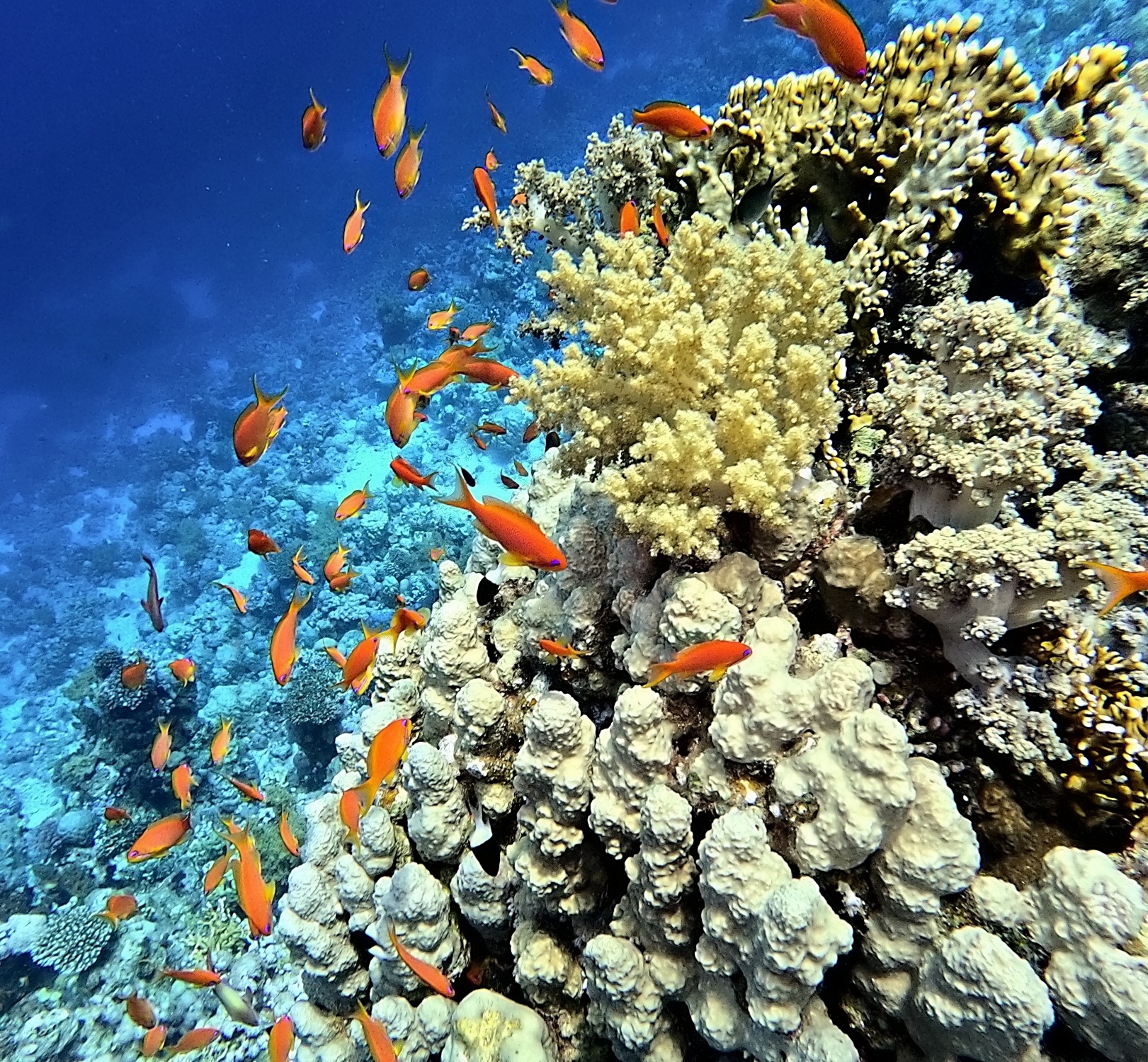
You may not think so by looking at its surface, but beneath the Red Sea’s deep blue waters, you’ll find some of the world’s best diving. Famous for its exceptional visibility, expansive reef system, and rich marine life, diving off the shores of Egypt’s Sharm el-Sheikh is an unforgettable experience.

Red Sea
Bordered by Egypt, Jordan, Saudi Arabia, Eritrea and Yemen, the Red Sea has been featured in countless historical events and legends. The Greeks named it Erythra Thelasaa, which translates into English as the Red Sea. Theories differ on why this deep-blue coloured sea was named Red. Some believe it comes from the reddish-brown algae that blooms in the winter. Another theory says it is from the red mountains that surround the Red Sea. A third claims the name was a directional reference where Red indicates south, and Black, as in Black Sea, refers to the north. Whatever the reason, it was not red at all in the spring when we visited.

Scuba Diving
Diving in the Red Sea is quite different from other seas and oceans because of its high salinity. With water that is 4.1% saline, versus the ocean at 3.5%, we noticed a large difference in our buoyancy. As a result, we had to wear more weight compared to diving in the ocean. The high salinity is due to several factors. One reason is its desert location, which results in high evaporation rates and a lack of permanent freshwater sources. In addition, it is quite removed from the nearest large body of water, the Indian Ocean. Only a narrow channel connects it to the Gulf of Aidan. From there, water still needs to flow through the Arabian Sea before eventually reaching the Indian Ocean.
You can choose from a few different diving areas in Egypt; we selected Sharm el-Sheikh as our base. The city is located on the Sinai Peninsula at the northern end of the sea. Situated between the Gulfs of Suez and Aqaba, it is a wonderland for diving. Currents from those waterways bring nutrients, resulting in an abundance of fish and a healthy reef system.
With over 1,200 species of fish and close to 350 types of coral, there is a large variety of things to see. What makes it even more interesting is that many are unique to the area. In fact, 13-15% of the fish, as well as 5% of the coral, are endemic to the Red Sea. Some of those unique fish we saw were the: masked pufferfish, blacktail butterflyfish, Red Sea clownfish, Klunzinger’s wrasse and the Suez fusillier.


We spent three days diving, and it was so good that we plan to return. In addition to the endemic fish above, here’s some of what we saw on our dives.
Tiran Island Dive Sites: Gordon and Thomas Reefs
Seeing the arid Tiran Island from above, you would never guess how much life exists in the surrounding water. With coral reefs in a spectacular variety of shapes and colours, you will never tire of exploring these reefs. Swimming around and between the coral are hundreds of fish. We were excited to see stingrays, parrotfish, angelfish, butterflyfish, sea goldies, a giant Napoleon wrasse and much more.


Look carefully to see if you can spot the stonefish in the picture below. It is the most venomous fish in the world. They are masters of disguise, so we won’t be surprised if you can’t find it. The purplish blob in the centre is not coral; it is a stonefish.

Even the reef has unusual characteristics. Despite the name, net fire coral is more closely related to jellyfish than to coral. You can tell the difference because of their smooth surface. Be careful not to touch it, though, because they also sting like some jellyfish. While they are not endemic to the Red Sea, they are present in large numbers in these waters.


One of the day’s highlights was when a turtle swam beside us for a while. You can see the turtle and more in the short video below.
In between dives, we had a rest and lunch on the boat and were able to enjoy the beautiful scenery around Gordon Reef. In addition to a distant navigation buoy, we saw parts of a shipwreck poking up from the reef. We were told that it has been there for a few years, since a drunk Russian tourist crashed his boat on the reef.
The shallow Gordon Reef is popular with snorkellers too. It can get quite busy, but our dive company made sure we completed our dive before the tour boats arrived. With stunning scenery both above and below the water, it is understandable why it is so popular.


Maybe you’ll be lucky to see a pod of dolphins since they frequent the area. We saw these on the boat ride between dive sites.

Ras Mohammed Dive Sites: Ras Ghozlani and Shark Observatory
At the tip of the Sinai Peninsula is Ras Mohammed (Mohammed’s Head), where nature has created a haven for fish and coral. The nutrient-rich currents meet at this point, creating the perfect setting for a healthy reef and a wealth of fish.


In addition to the cornucopia of coral and fish, diving here takes you beside 400 to 700 m (1,300 to 2,300 ft) tall walls of coral. In fact, the coral wall continued so far below us that we couldn’t see its bottom. We stayed at a depth between 15 and 20 metres (50-65 ft), where we swam through tunnels, cracks and caves in the coral walls.


The space was also enjoyed by many fish including, moray eels, leopard torpedo rays, black feather stars and tiny nudibranchs. Near the surface, we swam with moon jellyfish. Don’t worry, these ones are relatively harmless.


An interesting one we saw at Shark’s Observatory is the clearfin lionfish. While the red and common lionfish are considered invasive in many areas, the clearfin lionfish is not invasive and is an essential predator in the water.

The boat rides to and from the dive sites let us see the resort city of Sharm el-Sheikh from a different angle. From there, we could appreciate the unique setting this city enjoys between the sea and the jagged, red Sinai Mountains.


When to dive in Sharm el-Sheikh
The Red Sea is a year-round diving destination, but conditions do vary. For more comfortable water temperatures and lots of marine life, April to May or September to November are good choices. During the summer months from June to August, you’ll find the dive sites busier because the water is warmer, but the outdoor temperatures are in the 40s °C. Winter has exceptional visibility, but the water is much colder. It is also typically very windy in the winter and during the last two weeks of March. We experienced one very windy day when diving. Not only did the make it difficult to get back in the boat, but we also had a nausea-inducing ride back to the pier.
We drove with Red Sea Marine Dive Centre and were very happy with them. They are a locally owned shop and are very professional, experienced and safe. You can contact them through their website. We did not receive compensation for this mention.
Sharm el Sheikh
Sharm, as it’s typically called, is unlike anywhere else in Egypt. The first thing we noticed about this resort city was how clean it is compared to the rest of the country. The city hugs the southern shore of the Sinai Peninsula and its beaches are very popular with international tourists, espeically Russian.

Naama Bay
There are several communities in this 30 km long city, most of our time was spent in Naama Bay. It is nicely decorated with its streets and marble walkways, lined by flower beds and palm trees.

As you get closer to the water you’ll notice that luxury resorts hog the beach and there is very little public access. A few of these resorts rent sunbeds for 200 EGP per person, but most are private beaches. There is one public beach, but it is very small. As well, its hard wooden sunbeds aren’t next to the water and it only has a very small place to swim. They charge10 EGP per person.


Away from the beach, the streets are also novel. With flashing neon lights and ABBA or Tears For Fears blaring from the bars, we knew we were no longer in conservative Egypt. And with Russian printed on every sign and menu, and spoken by most visitors, we could tell where Sharm’s most frequent tourists came from.

Old Market
In the Hadaba District, you’ll find the Old Market. Touted as an authentic Egyptian bazaar, Old Market reminded us more of a tourist market in Marrakesh than in Egypt. With the perfectly piled spices and clean shops selling swimwear and plastic pyramids, it is far from authentic.


Al Sahaba Mosque
The primary building in Old Market is the attention-grabbing Al Sahaba Mosque. Built in 2017, the name translates to companions and refers to the Companions of Prophet Muhammad. The building combines influences from Ottoman, Mamluk and Fatimid styles to give it a very unique look. To begin with, the large limestone mosque has multi-layered domes covering its extensive roof that were inspired by the Mohammed Ali Mosque in Cairo. Adding to this, it also has two 76 metre tall minarets, castle-like rounded buttresses, multiple spires and small pergolas, all decorated with lace-like patterns. It is far from the typical mosque.


Tips for visiting Sharm el-Sheikh
- You can not use tap water for drinking or cooking. Not because it is high in bacteria, but because the water, while desalinated, still has a very high concentration of salts and minerals, which could upset your stomach. Some stores sell 12 litre bottles, but resorts also provide drinking water.
- Most of the resort areas only have convenience stores that sell cookies, chips and pop. They do not sell many groceries, fruit or vegetables. There is also no fruit market in Naama Bay or the Old Market.
Where to stay and eat in Sharm el-Sheikh
The sprawling resort city of Sharm is quite spread out, stretching for almost 30 km along the coast. We weren’t able to explore all of its neighbourhoods, but can describe three of the main centres.
Hadaba District – This district includes the Old Market where there are a lot of hotel and resort options close to the water. It is also near the Carrefour, if you want to stock up on groceries.
Naama Bay – This is where we stayed. It is further north and has a busy resort feel, especially near the water. We loved our apartment on a hill away from the beach, but there is no real town in Naama Bay. Instead, it consists almost solely of resorts and high-end apartments with only tourist shops and convenience stores.
Shark Bay – This smaller community is north of Naama Bay. It is much quieter than Naama, with fewer choices, but is close to the Shark Bay port for the Tiran dive sites. It is very popular with divers.
If you are diving, most dive shops will pick you up from anywhere in Sharm. But if you want to be near the docks, Gordon and Thomas Reefs use the Shark Bay Port, while Ras Mohammed boats use the Naama Bay Jetty.

Where to eat in Sham el-Sheikh
Since Sharm is very touristy, there is no shortage of restaurants, but most are tourist restaurants. We found two that offered good food at reasonable prices. In Naama Bay, we preferred Amedeo Restaurant and Cafe. In the Old Market, Sinai Star Seafood Restaurant is a good choice. We tried a couple of restaurants closer to the beaches and found them to be generally very expensive for mediocre food. Expect more international fare, with only a few offering Egyptian food.
You will not run out of places for socializing in Sharm. Most bars and nightclubs are located along the beaches in Naama Bay and Hadaba. A very popular one is Farsha Cafe.

Getting to Sharm el-Sheikh
Most will arrive by plane. Sharm el Sheikh International Airport receives flights from London, Amsterdam, Rome, Warsaw, Istanbul, Moscow and others. If you’re already in Egypt, you can fly from Cairo or Alexandria. Another option is to take a bus from Cairo (9-10 hours) or a minibus (7-9 hours). If you’re travelling between Egypt and Jordan, you could take a bus from Sharm to Nuweiba and then a ferry to Aqaba, Jordan.
Suez Canal
Separating Egypt from the Sinai Peninsula is the Suez Canal. This famous waterway allows traffic ranging from large cargo ships to sailboats to travel between the Red Sea and the Mediterranean. Pilot boats escort vessels through the 193.3 km (120.1 mi) long canal, taking 12-16 hours. They travel in convoys; therefore, multiple ships travelling in the same direction can go at once. Interestingly, there are no locks in the canal because the height difference between the Red Sea and the Mediterranean is only 30 – 40 cm (12-16 in).
We took the bus and we thought we’d be able to see the Suez Canal on the drive. We didn’t realize, however, that the highway travels through a tunnel under the canal. As well, there is a large, high-security zone around it that prevented us from seeing the Suez Canal at all. If you do travel to Sharm by road, be aware that before travelling under the canal, you must pass through security, which includes putting your luggage through an X-ray machine and showing your passports. There’s a second security station just before entering and leaving Sharm el Sheikh.
After passing under the canal, the highway follows the edge of the Sinai Peninsula with the deep blue and turquoise Gulf of Suez at its side. On the way, we saw dozens and dozens of empty resorts. Some are falling apart while others were left unfinished. We thought they were poorly planned hotels, but in fact, it is part of a financing scam. We were told that companies build the foundation for a hotel and then ask the bank for a loan. They then take the loan money and leave the site unfinished. Because it is so rampant, it seems crazy that the banks still fall for it. We continued to see these ghost resorts all along the Sinai coast.
Getting Around Sharm el Sheikh
There is a public minibus that runs between the communities in Sharm, but taxis are widely available and inexpensive. Supposedly, they have Uber, but the app didn’t work for us.

Please note, we visited the Sinai Peninsula in the spring of 2026. At that time, the war in Iran had not entered this region. These conditions may change, so please read the latest news on how the war is affecting the Red Sea, Sharm el-Sheikh and the Sinai Peninsula before planning a trip.
If you like diving, you may be interested in these posts: Scuba Diving in Cozumel, Tulum – Cenote Diving and Maya Ruins, Diving in the Maldives, Diving in the Andaman Islands, Caribbean Cayes in Belize, Borneo Scuba Diving, and Cruising the Galapagos.
Click on the link to read our Travel Tips For Egypt.
To read more of our adventures in Egypt, click here.
Coming Next – Tips For Visiting Mount Sianai and St. Catherine’s Monastery
For pictures from other blogs go to Gallery at monkeystale.ca.
To read about more of our adventures go to Destinations.
If you like what you read, please comment or share (with credit) using the links below.



We'd love to hear from you, please leave a comment.