
Not far from Meknes and Fez are three very different sites. The first is Volubilis, a site that showcases Roman mosaics from the 1st century. Not far away, the sacred town of Moulay Idriss marks the beginning of Islam in Morocco. If you feel like visiting a Moroccan alpine village, then Ifrane may interest you. Here’s a description of all three so you can decide which to visit on a day trip from Meknes or Fez.
Volubilis
When the Romans arrived on the fertile plains near Volubilis, they saw a huge potential for cultivating olives and producing olive oil. As early as 40 AD, they established a city and surrounded it with a fortified wall. Marc Antony and Cleopatra’s daughter married a Berber man who subsequently became king of this land. It is believed that under King Juba II, Volubilis became the Roman capital of Mauretania, the Latin name for ancient Maghreb. It was one of the most southwestern cities in the Roman Empire.

Even though King Juba II was Amazigh (Berber), he preferred Roman architecture, so he began building a city worthy of a Roman capital. It was during the 2nd and 3rd centuries though, that the city really flourished. Many citizens became wealthy from the lucrative olive oil industry. As a result, the city was filled with magnificent homes.
The Romans were defeated after only 300 years by Amazigh tribes and Rome was never able to regain a foothold in this region. The city was mostly abandoned and then was severely damaged in the 1755 Meknes Earthquake.

After the earthquake, marble and fine materials were taken from Volubilis to build the elaborate palaces and monuments in Meknes and Moulay Idriss Zerhoun. Thankfully, though, they didn’t take the Roman mosaic floors. The French began excavating the site in the early 1900s, but not much continued after they left. Apparently, work has recently begun to rehabilitate the site, but we didn’t see any signs of it.
Quite a few townhouses have been partially excavated to reveal their beautiful mosaic floors. They are worn from exposure to the elements and lack of care but, their beauty still comes through. As you wander between the half walls of the townhomes, you can find a few gems with images of tigers, elephants, birds and fish.


Others have depictions of gods, goddesses, acrobats and jesters. They are all are impressive works of art. The homes are typically named based on their mosaics or sculptures.


We saw one of these floors in Tangier. It was fully restored and took centre stage in one of the courtyards of Tangier’s Kasbah. You can see it in our post A Weekend In Tangier.
In addition to the homes, you can see the partially rebuilt remains of a basilica. We usually think of a basilica as a church, but in pre-Christian Roman times, they weren’t. Instead, it was used as a meeting hall. Beside it are a few columns from the Capitoline Temple that honoured the trinity of Jupiter, Juno and Minerva.


The largest feature is the Triumphal Arch of Caracalla. Built in 217 AD as a tribute to Emperor Caracalla, it used to be topped with a bronze chariot and four horses. The arch sits at one end of the main street and at the other, you’ll find the less impressive Tangier Gate.


Tip – Don’t visit too early in the morning because long shadows will partially cover the mosaics, making them difficult to photograph.
Moulay Idriss Zerhoun
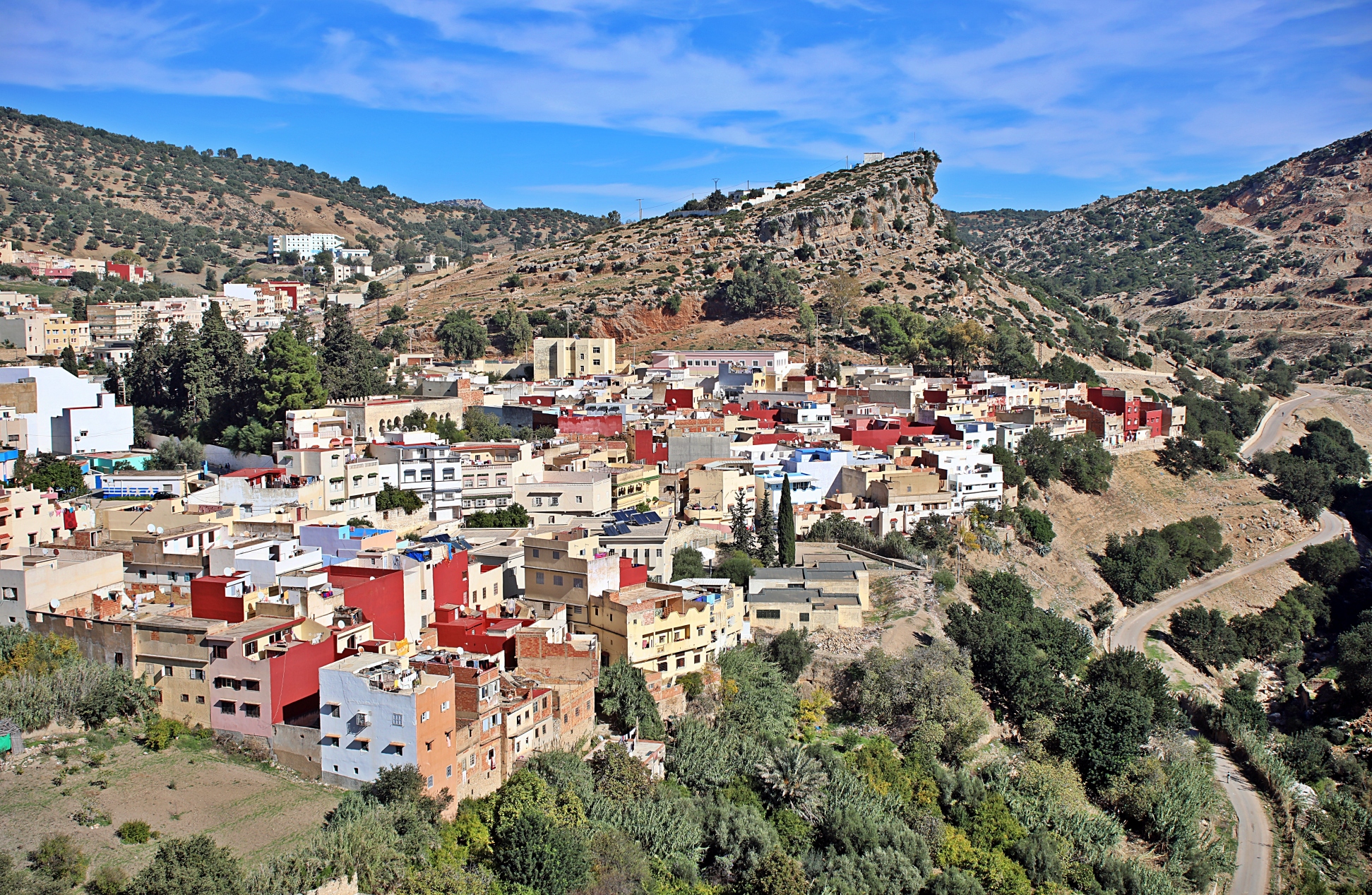
Located in the hills of the Rif Mountains you’ll find the holiest town in Morocco. In 789AD, Moulay Idriss arrived at this craggy peak and introduced Islam to the people of Morocco. He is a descendant of the Prophet Mohammed and at the time, Morocco was populated by Amazighs (Berbers) who followed various animism beliefs. Through his teachings, Idriss converted them to Islam. Today the town of Moulay Idriss Zerhoun is a pilgrimage site. It is so holy, that five pilgrimages to this town are equivalent to one haj to the holy city of Mecca. Its name is often shortened to Moulay Idriss.
We first saw the town from a distance and were excited by its setting. The homes of this holy city climb up and down two neighbouring hills to remind of of towns we saw in Spain.


The most important pilgrimage site in the city is Moulay Idriss Mausoleum. At the end of August, pilgrims arrive in the thousands to pay their respects to the holy man. Non-Muslims are not allowed inside the mausoleum. We could only peek down the narrow hallway to a gate at the end.

After seeing this little piece of the mausoleum, we wanted to see it and the city from above. On the way to the top of the hill, we walked up and down a convoluted maze of streets, typical in these old hillside towns. As we wandered, we saw a few donkeys, reminding us we were not in Spain anymore.


We went to three separate viewpoints, each offering a different perspective of this uniquely placed town. From them, we were also able to peer down, into the mausoleum and across the rooftops of town.
Two of the viewpoints are called Grande and Petite Terrasses. The third is marked as Viewpoint on Mapy.cz.


On the city’s edge is the interesting circular minaret of Sentissi Mosque made with marble from Volubilis. It is apparently the only conical minaret in Morocco.


Tip – This holy city claims to not want tourists, but has developed an entire industry of aggressive touts. They are as persistent and annoying as we had imagined they would be in Fez or Marrakesh. They ended up being the most aggressive touts we experienced in all of Morocco. So much for a holy city. They will follow you, yell at you, and beg you to let them lead you to one of these lookout sites. They won’t necessarily take you to the one you want, so just keep saying no. You can find routes to reach these lookouts on the app Mapy.cz. Google Maps has them too, but doesn’t know the route.
Getting to Volubilis and Moulay Idriss
There are a few ways to visit these two sites. They are very close together so it’s easy to see both in one day. Tours are offered in both Meknes and Fez, but it’s easy to explore on your own with a private driver. We arranged a driver through our riad in Meknes and it worked perfectly. If you prefer a cheaper option, you could travel by Grand Taxi (share-taxi) from Meknes to Moulay Idriss Zerhoun. From there, it is a 3 km walk or taxi ride to Volubilis. We found that with the low cost of a private driver, it didn’t make sense to go through the hassle of grand taxis and connecting taxis. After going to both, we think it would be somewhat difficult to do this by share-taxi and return to Meknes at a reasonable time.
You can find Volubilis in the upper half of the map below. Moulay Idriss is only 4 km away. Ifrane is south of Meknes and Fez. Click on the image to be directed to an interactive map.

Ifrane
Not only did the French establish a hill station with European alpine architecture in Ifrane, but they also planted European trees. The few blocks in town with A-frame homes and condos would suit a mountain village in Europe so it is sometimes called the Switzerland of Morocco. While they are very different from the typical architecture in Morocco, that comparison is far too generous.
Ifrane is the opposite direction from Meknes as Volubilis, so this would be a separate day trip.


The most notable feature in town is a large, stone lion statue. It was sculpted during WWII by a German soldier who was in the POW camps in Ifrane. Barbary (Atlas) Lions were once very common in Morocco’s Atas Mountains. The Romans are known to have captured these lions for gladiator fights and their numbers slowly dwindled. In 1920, the last surviving lion was killed. The sculpture is in memory of this last Barbary Lion.


We visited Ifrane in autumn when the leaves were changing colour. There are several treed parks in the city centre and their red and gold leaves were on full display. The colours made the parks very pretty and much different from other scenes in Morocco. There were even mushrooms and mistletoe, which seemed very foreign in Morocco.
There are a few cafes around the Jardin de Lion where you can sit and enjoy the cool air with a view of the trees.


From the top of a hill in Place de la Couronne, you can look down upon the A-Frame rooftops. From there you can even see the Royal Palace in the distance. It’s said to be the king’s favourite vacation destination.


Located on a high plateau at 1,700 meters (5,500 feet), Ifrane provides a respite from the typical Moroccan heat. Its local golf courses and small ski resort, make the resort town a popular getaway for Moroccans throughout the year. There are a few walks in Ifrane National Park, but they’re mostly flat and through the woods so they don’t offer many views. There are apparently Barbary Macaques in the surrounding forests, but we didn’t see any.
If you are in Fez or Meknes and you have extra time, it is interesting to see this unique side of Morocco, but don’t plan to spend a lot of time in Ifrane because there isn’t a lot to see or do.
Getting to Ifrane
CTM buses leave from the bus stations in Fez and Meknes. There are also share-taxis (Grand taxi) at both stations, but during the off-season you may have to wait longer for them to fill up. It will take approximately an hour from either city.

Click on the link to read our Travel Tips For Morocco.
To read more of our adventures in Morocco, click here.
Coming Next – Explore The Dunes of Erg Chebbi
For pictures from other blogs go to Gallery at monkeystale.ca
To read about more of our adventures go to Destinations.
If you like what you read, please comment or share (with credit) using the links below.




We'd love to hear from you, please leave a comment.