
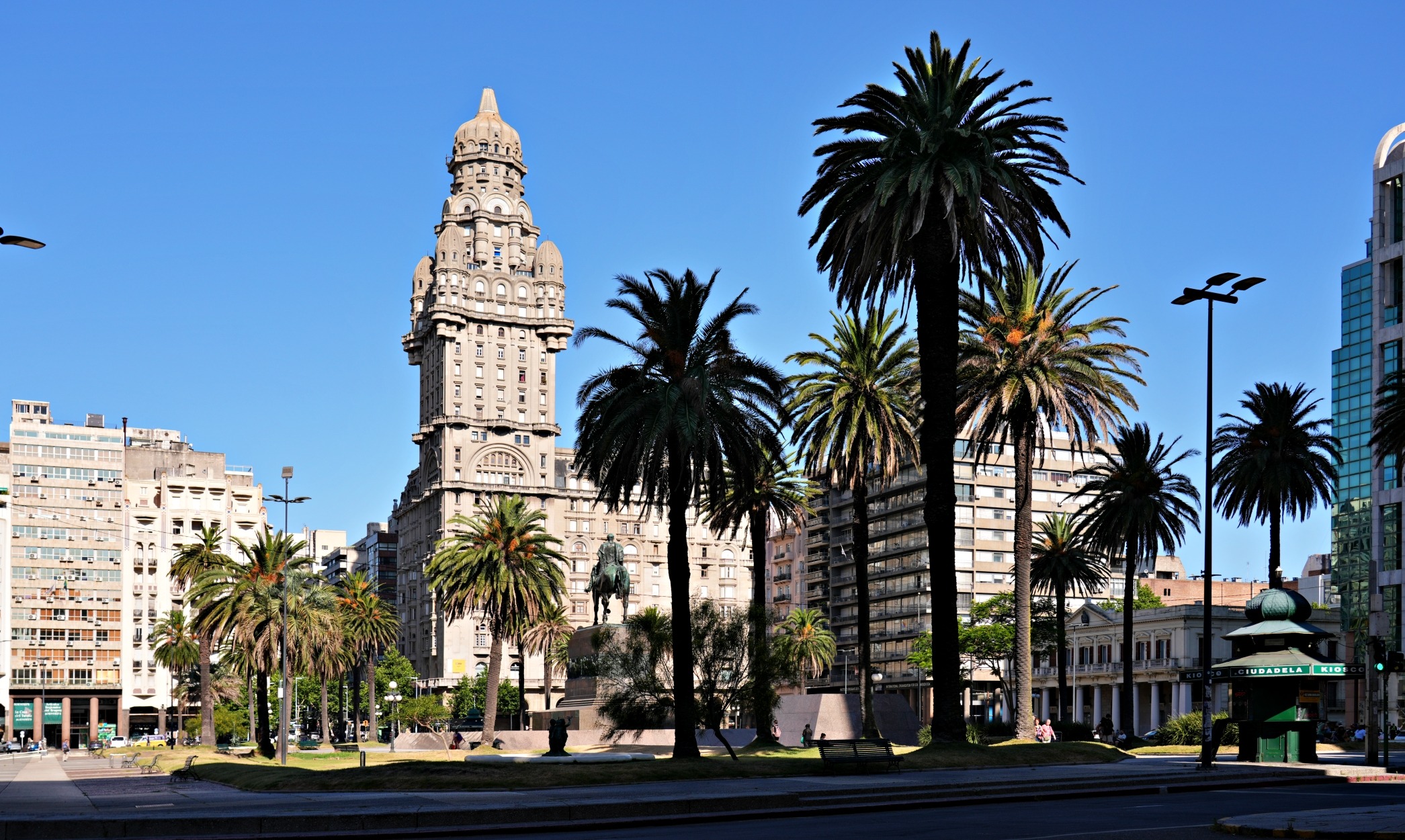
Walking along the streets of Old Montevideo feels like stepping into the early 1900s when fortunes were made hand over fist and then spent freely on indulgences. Today, the elegant, and sometimes quirky, heritage buildings in Old Montevideo provide an insight into that extravagant era, making it a rewarding part of the city to explore.
A little on the history of Montevideo
In the 1700s, the Spanish felt they needed to defend their valuable Buenos Aires. It is located on the Rio de la Plata (River of Silver) and the Portuguese had established a base across the river in Colonia del Sacramento. The Spanish solution was to build a Garrison at present day Montevideo.
Click on the links to read our posts from Colonia del Sacramento and Buenos Aires.
Rio de la Plata is the wide estuary where the Uruguay and Parana Rivers confluence and empty into the Atlantic Ocean. It is a remarkable 220 km (136 mi) across at its widest point. The two rivers shape part of the border between Argentina and Uruguay. It received its name because early Spanish and Portuguese explorers thought there were hills of silver just beyond the rivers.
You can find Montevideo in the middle of the waterfront in the map below. It is an interactive map, so you can zoom-in or click on a marker to find a link to our post from that destination..
The Spanish populated their new walled city with families from Buenos Aires and the Canary Islands. Its deep port became an important centre for trade, so it caught the attention of others, including Portugal, France and England. Many battles were fought, and ownership of Montevideo changed hands a few times.
After achieving independence from Spain in 1811, Uruguay’s history is a little different from that of its neighbours. Not long after the Spanish left, the Portuguese moved in, meaning Uruguay, including Montevideo, was still not independent. It took until 1828 to achieve sovereignty. Fortunately for Montevideo, though, these unsettled times were followed by years of prosperity due to its trading port. The main economic drivers were beef, leather and sheep exports. At this time, many Europeans migrated to Uruguay to take advantage of these riches, bringing with them their styles and preferences.
In the 1960s, exports to Europe crashed, and so did Uruguay’s economy. It seems to be doing much better today, though, as it is one of the wealthiest countries in South America.
Old City
Once you step onto the clean streets in Montevideo’s Old City (Ciudad Viejo), you will see where a lot of that wealth went. Elegant homes, townhouses, theatres and offices were built that reflect the European styles of the time, including Art Deco, Neoclassic and Art Nouveau. As we discovered, many pushed the limits of those styles. What that means for visitors today is that the historic centre is a treasure trove of architectural delights.
Independence Square
Begin your exploration of the historic centre in its main public space. The large Independence Square (Plaza Independencia) is where you will find quite a few important landmarks.
Palacio Salvo
Taking most of your attention in the square is the eclectic Palacio Salvo. What makes the iconic building really stand out is its awkward-looking, top-heavy tower. It was originally built as a hotel, and today it houses apartments and offices.
Palacio Salvo was designed by Italian architect Mario Palanti, the same architect who designed Palacio Borolo in Buenos Aires. We’ll show you the Buenos Aires building soon.

Citadel Gate
Sitting on the edge of Plaza Independencia is the Citadel Gate (Puerta de la Ciudadela). It was once part of the 18th century Spanish wall that surrounded Old Montevideo. Once Uruguay achieved independence, the wall was torn down, and the gate is all that remains.

Artigas Statue
In the centre of the square is a statue of José Artigas on horseback. He grew up as a gaucho in Uruguay and led armies of gauchos in many battles against Spain. For this, he is considered the father of Uruguay’s independence. Since Uruguay came under Portugal for a while, its true independence didn’t arrive for a few more years.
Underneath the statue is Artigas’ Mausoleum. It is typically open to visitors, but was closed over the Christmas and New Year’s holidays when we were there.
In addition to these main landmarks, there are a few other nice buildings around the plaza including Government House.


Solís Theatre
One block away from the main plaza is the Solis Theatre (Teatro Solis). First built in 1856, the building was reconstructed in 2004. The one we see today is similar to the old building’s style, but the shape of the building and its roof line were significantly altered.

Pedestrian Streets
There are a few pedestrian streets in the centre of the old city, all of which are lined by lovely heritage buildings. The main one is Sarandi Peatonal, and you will find yourself walking on this street often because it travels the length of the historic centre, beginning at Independence Square and ending at the waterfront.
In many areas, these pedestrian streets are filled with patios that become more popular as the day turns to evening and the temperatures cool down. Even if you don’t want to eat or drink, this is a great place to admire Montevideo’s old architecture.


For us, it was the elegant balconies that really made these buildings stand out. Our favourite activity in Montevideo was seeking out their wonderful details. It seemed as if there was a competition for who could create the most beautiful balconies. Today, some have added their own touches, such as those found on Loco Amor Hotel (Crazy Love Hotel).


Constitution Square
Sarandi Pedestrian Street takes you beside Constitution Square (Plaza Constitución). One thing we noticed in Montevideo was the lack of trees in the Old City, but finally, in this square, we found a few. In addition to the trees, it is much smaller than Independence Square and is therefore feels little less formal.

Montevideo Cabildo
At one end of the square is the Cabildo (City Hall). Built in the early 19th century, means it looks much more traditional than the European styles we saw on the pedestrian street. It is no longer City Hall, but instead has been transformed into a museum.

Metropolitan Cathedral
On the other side of the square is the Metropolitan Cathedral, built around the same time as the Cabildo. In opposition to the extravagant buildings in the city centre, the cathedral is rather plain-looking both from the outside and inside.
The main embellishments are the tombs of prominent government and church officials from the city’s history.


Plaza Zabala
A little further on, Plaza Zabala has a much quieter atmosphere with several trees providing shade to the park benches. In its middle is a big statue dedicated to Uruguay’s gaucho culture (Monumento del Gaucho).
Around the edge of the square, you’ll find a few lovely mansions, including Palacio Taranco. Built in 1908 as a family’s mansion, it now houses the Museum of Decorative Arts.


Port Market
The old Mercado del Puerto (Port Market) has been transformed into a hub for parrillas (steakhouses). The interesting steel building’s many restaurants display their meats, piled high on their grills.


Away from the pedestrian streets, there are still many more wonderful and unique buildings to see.


Legislative Palace
Outside the old walled city is the majestic Legislative Palace (Palacio Legislativo). It is not very decorated, but it does command your attention. Built in 1925, it is the seat of Uruguay’s Federal Government. The flower beds in front were filled with blooming African Lilies, a flower we saw a lot of in the Rio de la Plata region.

Down the street, you can visit the Basilica of Our Lady of Carmen and the old General Artigas Central Train Station (Estación Central General Artigas). A block or two the other way, you’ll find street art decorating the outside of Espacio de Arte Contemporaneo.


Rambla de Montevideo
This 24 km long pathway follows Montevideo’s waterfront from Old City all the way to the beaches on the other side of the city. You can see in the pictures below that a nice time to visit the Rambla is late in the afternoon when the city is awash in a warm glow.
A dedicated bike lane on the Rambla makes biking a great option, especially since it is such a long promenade.


Ramirez Beach
There are 10 city beaches on the edge of the Rambla. Playa Ramirez (Ramirez Beach) is the closest one to the Old City. We enjoyed watching the interesting waves from the beach. They seemed very haphazard and not in sync, as you see in the ocean. It was a reminder that we were still on the edge of the Rio de la Plata.


Punta Carretas Lighthouse
At the most southerly point in the city, and on the edge of the Rambla, is Punta Carretas with a lighthouse. We could see it from a distance and thought it would be a nice spot to visit, but as we neared, we realized that it was quite a barren spot.

Rodó Park
There are a few parks named Rodó in Uruguay, and they all seem to be places for families to gather with playgrounds, ponds, and food trucks. The one in Montevideo is located on the side of the Rambla and it even has an amusement park. They are named after the Uruguayan writer José Enrique Rodó. In the centre of this park is a monument dedicated to him.
When we visited on the afternoon of New Year’s Eve, it was quiet, but vendors were setting up in preparation for the evening’s festivities.


July 19 Avenue
One of the main streets connecting the old and new parts of the city is July 19th Avenue (Avenida 19 Julio). We walked it on January 1st, so most of the shops and museums were closed, but we were able to see a few wonderful buildings from the outside.


Considering all of the elaborate buildings in theMontevideo, City Hall (Palacio Municipal), on July 19th Avenue, is surprisingly plain.

As you explore the city, you will likely see a lot of homeless people. They didn’t seem to be a safety concern, and none bothered us, but it was still unsettling to see.

Getting to Montevideo
The most common way to reach the city is to take a ferry from Buenos Aires. Buquebus has direct ferries between Buenos Aires and Montevideo. Colonia Express Ferries travel between Buenos Aires and Colonia with a bus to Montevideo.
If you prefer to fly, most flights arrive in Montevideo’s Carrasco Airport from other South American cities, but there are a few flights from Spain and Miami. Carrasco Airport is 22 km from the Old City.
Buses also travel between Montevideo and Buenos Aires but take 8 hours
If you are coming from Brazil, most flights will come from Sao Paulo, but there are also buses from Puerto Alegre (12hours).
Getting around Montevideo
The Old City is confined to a small peninsula and is therefore easy to explore on foot. Getting to the new parts of the city and the beaches, though, would make a long walk. The city is very bicycle-friendly with bike lanes on July 19th Avenue and the Rambla, and there are a few bike rental shops in the Old City. The city buses are also very efficient and inexpensive. You can pay with a credit card or the loadable STM cards. Uber is also available.
Where to stay in Montevideo
Where you stay will depend on what you want to see and do. To explore the historic centre, it is best to stay in the Old Town. If you want to lie on the beach, then staying in the newer city is easier. There are many short-term apartment rentals and hotels in both the old and new parts of the city.
Where to eat in Montevideo
It is very easy to find a place to eat in Old Montevideo. Most of the pedestrian streets have restaurant patios; Calle Perez Castellano has the largest selection. If you want meat, head to Mercado del Puerto (Old Port Market). Be aware that restaurants usually close during siestas (1 or 2pm until 8pm).

Travel Tips For Uruguay
Uruguay has several characteristics that set it apart from its neighbouring South American countries. For starters, it is a progressive society that very early on implemented free public education, health care, unemployment insurance and gave women the right to vote. Also, making it much different from Paraguay and Argentina, Uruguay’s streets are very clean. We rarely saw litter on the streets or sidewalks.
- Expenses – Compared to its neighbours, Uruguay is quite expensive. Prices for dinner, groceries and hotels are similar to those in North America. One thing they have done to increase tourism, though, is to encourage the use of credit cards. At many hotels and stores, if you pay with a credit card, they often provide a 10 to 15% discount. In fact, it is usually cheaper to pay with a credit card than to take cash from an ATM or Western Union.
- Transportation – Travelling between cities in Uruguay is quite easy. The highways and roads are excellent, buses are on time and in good condition. For most bus schedules, go to urubus.com.uy. The larger centres have Uber, but some of the smaller towns, such as Trinity and Carmelo, have few if any taxis.
- If you drive in Montevideo make sure you have parking at your hotel. As well, there are speed and red light cameras throughout the city. Something we haven’t seen in South America before.
- Language – Uruguay is a Spanish speaking country. There is a little English spoken in Montevideo and the beach resorts, but not outside those centres. If you do speak Spanish, you will notice that their Spanish is similar to that of Buenos Aires. The main differences are that ll and y are pronounced sh. For example, pollo (chicken) is pronounced posho and playa (beach) is plasha. It was very difficult for us to get used to.
- Safety – Uruguay is one of the safest countries in South America. The city of Montevideo has a lot of homeless, but none bothered us or begged. We didn’t feel threatened at all, but it is unnerving.
- Restaurant food is generally bland. There is a government initiative to decrease high blood pressure, so salt is not usually provided on tables, and it seems that most chefs don’t use salt or seasonings much either.
- Border Crossing – The most common border crossing is between Uruguay and Argentina, using the ferry from Buenos Aires to Colonia del Sacramento. This is one of the easiest border crossings we have experienced in South America. Citizens from a few countries require a visa in advance for entry, but most only require a valid passport to receive a 90-day entry on arrival.
- Marijuana – As you walk through the cities and towns, you may notice a certain odour permeating through the air. Not only is marijuana legal, but it is also a government-run industry. The federal government controls everything from the crops to the vendors. By doing so, they ensure a safe product which they believe keeps illicit drugs off the streets.
- When to visit– Summer (December to February) is usually the best times to visit for the best weather. While it can be hot (mid to high 30°sC) in Montevideo and Colonia del Sacramento, the beaches are cooled by the prevailing Atlantic Winds. Rain can happen any month, and each area has a different rainy season, so research the climate for where you want to visit.

To read more of our adventures in Uruguay, click here.
Coming Next – Piriapolis and Punta del Este: Uruguay’s Beaches
For pictures from other blogs go to Gallery at monkeystale.ca.
To read about more of our adventures go to Destinations.
If you like what you read, please comment or share (with credit) using the links below.






We'd love to hear from you, please leave a comment.