
What began as a smuggler’s paradise, Tigre Delta is now a popular weekend retreat. Its extensive labyrinth of tree-lined canals, combined with the quiet streets in the city of El Tigre, has captured the hearts of tourists and Buenos Aires residents alike. Whether you want to take a boat trip on the delta or enjoy walking beside the canals, Tigre Delta makes a perfect day trip from Buenos Aires. Once you’ve visited Tigre, the Uruguayan city of Colonia del Sacramento is a wonderful option for a day-trip, or longer.
The natural delta is formed where the confluence of five rivers, including the Parana River, dump into the Rio de la Plata. These rivers carry sediment from the Pampas and jungles, resulting in water the colour of your morning latte. With over five thousand waterways running between hundreds of islands, the Tigre Delta is one of the largest deltas in the world. It is unique in that it flows into a river, the Rio de la Plata, rather than directly into the ocean.
Note – It is formally called Paraná Delta, but most refer to it as Tigre Delta.

Boat Cruise on Tigre Delta
The most common activity in the delta is to take a cruise that travels through the labyrinth of canals. In the 19th century, Buenos Aires aristocrats favoured the area for their weekend retreats. They built mansions on the islands in a variety of styles, including English Tudor, influenced by British immigrants. Year-round residents live in more modest homes, and many are stilt houses because of frequent flooding.
From a lancha (riverboat), you can spot mansions and wooden shacks sitting side by side on the waterfront. Some of the early mansions sat vacant for decades and today they are in a rather dilapated state. Maybe one of the fixer-uppers for sale will interest you.


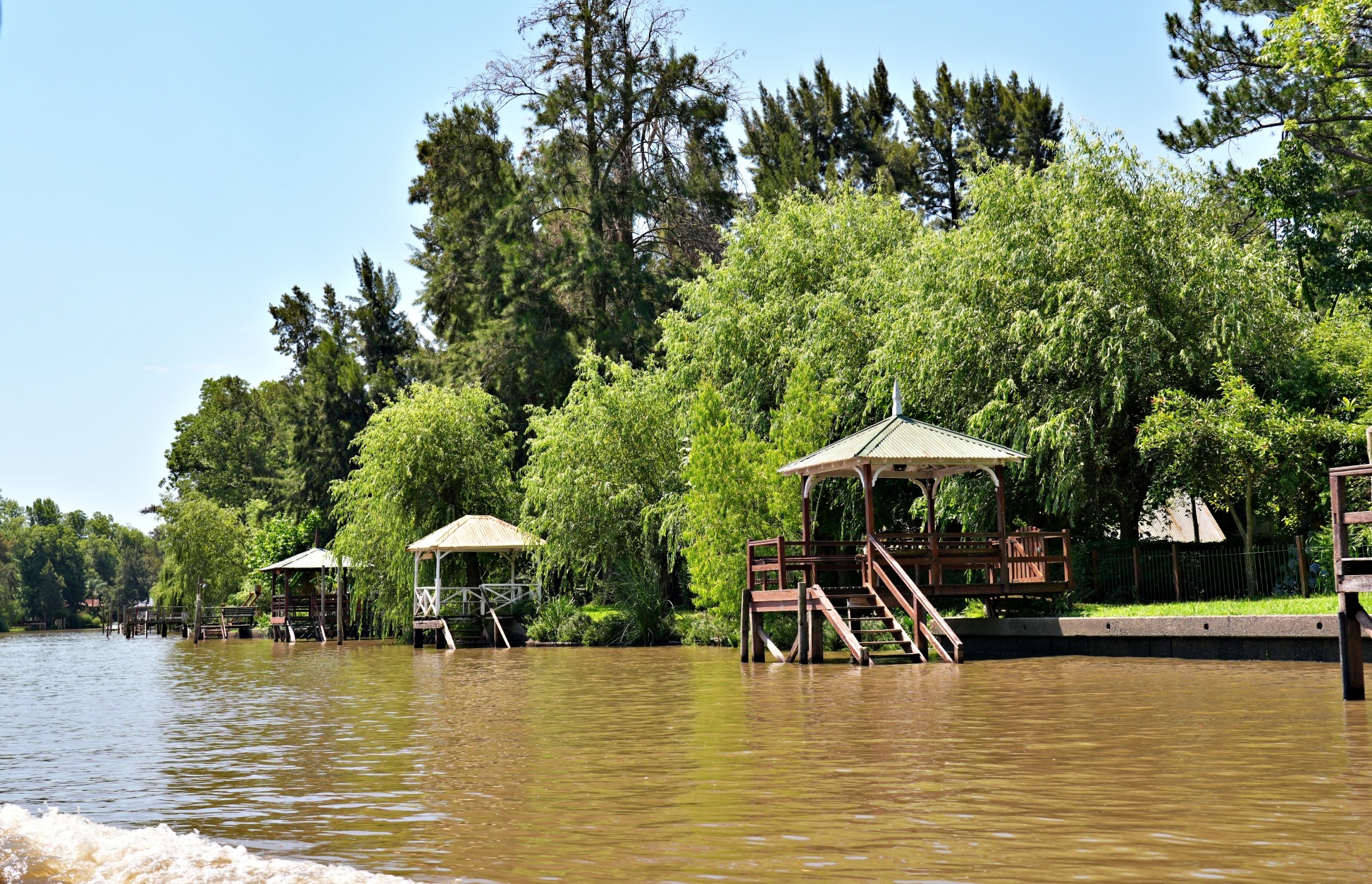
Our lancha travelled from the large main river to take us through the maze of small canals bordered by tall willows, ceibo, palm trees and reeds. The large yards boast lush gardens with hydrangeas, African lilies, and flowering bushes.
Since most of the homes are boat-access only, you’ll pass by many wooden jetties, extending far out into the water. As with the homes, some look elegant with masterfully crafted wooden pergolas, while others are more humble.


Today, many of both the mansions and small homes operate as boutique hotels, guesthouses, short-term rentals and campgrounds. It seemed like a great alternative to a cabin on a lake, as is common back home in Canada.
As we passed by, vacationers were enjoying the docks, having picnics in the shade and jumping or fishing off their ends. The brown water didn’t seem appealing to us, though, nor did the slight sewage smell we experienced in some areas.
You can find many of these accommodations online.

One of the most elaborate buildings is the Museo de Arte de Tigre (Tigre Art Museum). We saw it from the water, but if you don’t take a boat ride, you can walk on Paseo Victorica to reach the museum from town.
At the opposite end of the spectrum, we passed many boat wrecks, slowly rotting and rusting in the water.


How to take a boat tour on the Tigre Delta
There are many different options for boat cruises on the delta. They range from private tours on a small riverboat, or large, air-conditioned boat tours for $45USD, to tours on a low-roofed lancha for $9USD. Most tours are 1 or 1 ½ hours, and we felt that was long enough because the scenery doesn’t dramatically change. Lancha tours leave from the docks just past the McDonald’s.
El Tigre City
You might wonder why a South American city is named El Tigre, The Tiger. We sure did. Tigers have never lived on the delta, but Jaguars were found in large numbers when Europeans took over the land. Tigre was a colloquial term for the wild cat, so the name caught on. Unfortunately, it soon became sport to hunt the beautiful cats so that today they no longer roam in the delta.
After exploring the expansive watershed, save time before heading back to Buenos Aires to go for a walk through the community.

Rowing Clubs
Not only did British immigrants influence the architecture in the area, but they also brought the sport of rowing to the delta, a tradition that continues today. We saw many rowing clubs, both in town and on the islands. All were housed in some of the most stunning buildings, many of which were built in old English styles.
If you don’t row, kayaking is also very popular on the delta.


Puerto de Frutos
At the end of town, the historic port for fruit, vegetable and agricultural exports has now been converted to a tourist market. On a Monday afternoon, most shops were closed, but they are likely very busy on the weekend.
While the main docks are used by tour boats, the piers around the market are used by fishing boats and barges, still a main method for transporting goods along the delta.


Parque de la Costa – For different types of entertainment, you may prefer spending your day at the Amusement Park and Casino located Near Tren Costa Station.
Tigre Delta and the city’s historic centre are on the UNESCO Tentative List.
Getting to Tigre
Mitre Train – Located 28km from Buenos Aires, the most economical way to get to El Tigre is by train. The Tigre line leaves from Retiro Mitre Station, with three stops in the city (Nuñez, Belgrano and Rivadavia stations). El Tigre is the last stop on the route and takes roughly one hour. Fares are less than $1USD. You can pay with your SUBE card, or for a few cents more, you can use most international credit cards.
Tren Costa – Another option is the touristy Tren Costa, but it takes longer and is more expensive than the Mitre Train. In Buenos Aires, it uses the Mapiu Station, and in El Tigre, the station is near the amusement park and port market.
Buses – Public buses depart from the Constitución neighbourhood and take at least an hour and a half.
Car – If you have a car, the easiest access is by taking the Panamericana Highway to San Isidro. From there, follow the routes to El Tigre.
Boat – The final option is to take a boat from Puerto Madero’s North Dock.
El Tigre is located near Buenos Aires, in the centre right of the map. It is an interactive map, so you can zoom-in and click on a marker for a link to our post from that region.
Note – Prices are listed in USD because the rate of inflation in Argentina is so high that as of 2026, any fees listed in pesos would be inaccurate within a few months. Many restaurants don’t list prices on their menus, or if they do, they have been written over many times as the value of the peso drops. Apart from hotels, most business will only accept payment in Argentine pesos.
Colonia del Sacramento
A very popular day trip from Buenos Aires is to the historic town of Colonia del Sacramento in Uruguay. Taking just over an hour, the ferry ride makes it easy to spend most of the day in the pretty town. We liked Colonia so much that we devoted an entire post to it. Here’s the link to our post, Colonia del Sacramento: Uruguay’s Prettiest Town.


Click on the link to read our Travel Tips For Argentina.
To read more of our adventures in Argentina, click here.
Coming Next – Iguazu Falls: Argentina’s Natural Wonder
For pictures from other blogs go to Gallery at monkeystale.ca.
To read about more of our adventures go to Destinations.
If you like what you read, please comment or share (with credit) using the links below.





We’d love to hear from you, please leave a comment.