
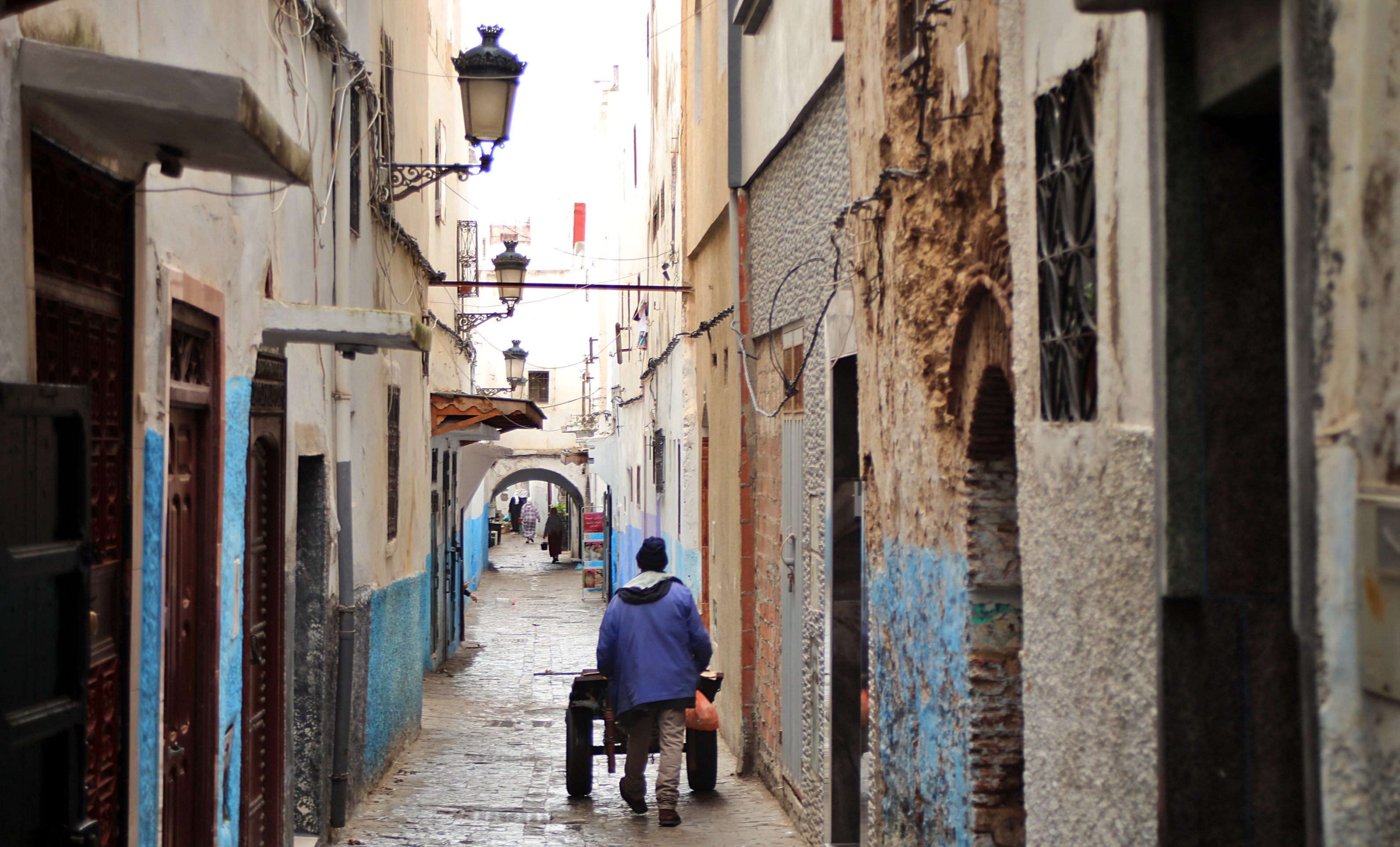
Tetouan is not on Morocco’s typical tourist trail, and that is exactly why we liked it. The narrow, covered passageways that travel through the medina were unlike anything we had seen before. They revealed a life that is very foreign to us and utterly fascinating to witness. Come with us for an authentic Moroccan experience as we show you the intriguing medina of Tetouan
When the old town was rebuilt in the 15th century, people had already been living in Tetouan for hundreds of years. Sidi Ahmed al-Mansur and thousands of other Muslims, as well as Jews and Moriscos, fled to Tetouan when they were exiled from Granada in 1492. They found a safe refuge in this land, set between the Mediterranean and the Rif Mountains. You can read our post from Granada here.
The result today is a city with a mix of Arabic and Andalucian architecture. In addition to the buildings, their Granada roots can also be heard. Spanish is much more prevalent than French in Tetouan.

Medina
Tetouan’s medina has a soul. It feels like real Morocco, not a gentrified heritage centre for tourists. Describing it as a maze of narrow streets is an understatement. Buildings don’t stick to normal rules. Alleys tunnel under them. Or maybe, the homes were built over top, leaving only a low tunnel to provide passage between streets.


Here, in the heart of the city, is where life happens. Friends meet over a cup of mint tea. Others walk through it between work and home. Kids horse around, as they should.


Shopkeepers can be found along the sides of many lanes and sell anything you may ever need: a deck of cards, a used baby carrier, half-worn pencils, pre-worn shoes and used clothing. You can even find live chickens and budgies. Some only sell a few random items, making us wonder how they make a living. In between the used clothing and fried electrical wires, you’ll find dozens of sweets shops that almost always had line-ups.
Sunday is a busy day day. It’s market day when even more vendors have their wares spread out in front of them on a table or a tarp on the ground.


And then there are the cats. Muslim profit Mohammed loved cats so therefore, most Muslims do as well. Most of the cats you’ll see are not pets. They are street cats, belonging to no one and everyone, and are well taken care of. Cardboard boxes are left in every corner and doorway giving the cats a place to sleep. Piles of cat food are scattered in various spots along the lanes.


A medina is usually the oldest part of the city and is often within a protective wall. It’s difficult to see much of Tangier’s old wall, but you can still find a few of its old gates and towers.


Tannery
Like many cities in Morocco, Tetouan has a tannery. It was quiet when we stopped by, and most of the vats were empty but a local boy showed us around and explained the process. Their techniques have been passed down for generations and haven’t advanced much in the modern age. The first stage in tanning is to soak goat, sheep, cow or camel hides in stone pots containing water, limestone, cow urine and pigeon droppings. This solution strips the hair from the hides.

After a few days soaking in those tubs, the hairs have been stripped and the hides are placed in vats filled with dyes. Colours come from natural sources such as indigo, saffron and henna.
The tannery is a messy place. We couldn’t imagine working in these conditions. When we visited the tanneries in Fes and Marrakesh a few weeks later, we saw even more atrocious working conditions.


Tetouan’s tannery isn’t large and only operates at certain times of the year. Because it wasn’t being used on the days we visited, thankfully, it lacked the noxious smell that usually accompanies these visits. Don’t worry though, we experienced those wretched odours in other cities.
From a walkway above the tannery, we saw a large hillside cemetery outside the medina. Most of it is for Muslims, but there is a small Jewish section. Seeing it from a distance, we could appreciate how large an area it covers.

Kasbahs
Tetouan has two kasbahs (fortresses). The oldest is located in the middle of the medina. It was built in the 13th century and partially rebuilt in the 15th. Today it is called Kasbah de Tetouan. The building is in rough shape though, and the medina has built around it. We walked past it a few times before even noticing its unique tower.


The newer kasbah is in slightly better condition. Built in the late 15th century, we first saw it from Feddan Park below and thought it looked quite impressive. We walked up to it for a closer look and realized that not much was left of Kasbah de Al-Mandri.
From the kasbah though, we were finally able to see the Rif Mountains that surround the city. They had been shrouded in clouds for days, but today they welcomed us.


Even though the homes are a little newer, the streets leading up to the Kasbah de Al-Mandri still have the feel of an old medina. Walking up to it through these neighbourhoods was the best part of the trip to the kasbah.


Feddan Park
From Feddan Park, we could see Kasbah de Al-Mandri and the white houses that climb the hilly streets. During our time in Tetouan, we had both rainy and sunny days. The different skies gave us pictures with very contrasting looks. During the first few days, the white buildings seemed to blend into the thick clouds. When the clouds departed, Kasbah de Al-Mandri was more easy to notice on the hill above.


Outside the medina is the newer part of the historic centre. Here, European-style buildings line the long pedestrian streets. Their wrought-iron balconies are very typical in Spain. This is no surprise since Tetouan was the capital of the Spanish protectorate in Morocco for a while.
One thing we couldn’t help but notice was the contrast between the streets outside of the medina to those inside. It really felt like two different cities.


Royal Palace
Down the street from these charming buildings is Michouar’s Square, home to the Royal Palace. Although King Mohammed VI doesn’t live in Tetouan, he has a well guarded palace in the centre of the city. He apparently does visit the city in the summer months.
At first, we thought the four tall towers in front of the palace were minarets, but they are actually lights. The building was originally built for the High Commissioner when Tetouan was the capital of the Spanish protectorate. It was designed by Enrique Nieto who was a student of Spanish architect Antoni Gaudi. It became the Royal Palace when Morocco received independence in the 1950s. There are several royal palaces throughout the country, we’ll show you more as we travel throughout Morocco.

Another indication of its time as a Spanish city is found a little further away. On one side of Place Mulay El Mehdi is Our Lady of Victoria Church (Iglesia Nossa Senora Victoria/Notre Dame de la Victoire). It has a prominent spot on this small square.

Khalifa Palace
If you have time, you could visit Khalifa Palace. Built in the Hispanic-Moorish style, it was the sultan’s residence when Tetouan was under the Spanish Protectorate. Today it is in ruins, but it is still an interesting looking building.


How to get to Tetouan
Tetouan is not located on the usual tourist route but is surprisingly easy to reach. CTM buses travel between Tetouan and Tangier (60 km), Fes (255 km), Chefchaouen (65 km) and Rabat (273 km). These buses are usually in good condition and are a comfortable way to travel. If you’re travelling from Marrakesh, you will have to transfer in Tangier.
You can find Tetouan near the top of the map below. Click on the image to be directed to an interactive map.

Getting around in Tetouan
You can not drive in the medina, and other sites are within walking distance, so walking is the best way to get around. Most online mapping apps do not know the many lanes and alleys inside the medinas. A trick we found was to use Google Maps’ satellite view. That allows you to see the actual streets, lanes and dead-ends. The GPS signal may not be accurate because of the tall walls, so you should plan your route ahead of time and keep an eye on your progress in the map.
Where to stay in Tetouan
There are quite a few riads in the medina. Traditional riads are old homes with a central, open courtyard that extends the entire height of the two or three story buildings. Guest rooms typically open up to the courtyard. Because of this open design they tend to be noisy. If you prefer to stay outside of the medina in a hotel, there are a few near Michouar’s Square and along Mohammed V Avenue.
Where to eat in Tetouan
You can find many restaurants along Mohammed V Avenue and the neighbouring streets. They are locally run establishments with great food and good prices.
We first noticed a funny custom in Tetouan that we continued to see throughout Morocco. Male customers always sit side by side, not across from one another in cafes. Even if there were two or three rows of tables, they would sit side by side, along every row. If there was no room and they were forced to sit across from one another, one of them would angle their chair, so they didn’t face their friends. It is a really strange sight to us.
We were told that it is customary for men to go to a cafe alone or with a friend. They spend their time sitting and watching people walk by while having a coffee or mint tea. They do this every day, some for many hours. Women were never a part of this tradition. It is apparently even believed that women who go to cafes are improper, possibly promiscuous. We didn’t learn this until after Richard and I sat at a few cafes, so we wonder if the rumour mills are going wild in Tetouan since our visit.


Click on the link to read our Travel Tips For Morocco.
To read more of our adventures in Morocco, click here.
Coming Next – Morocco’s Blue City Of Chefchaouen
For pictures from other blogs go to Gallery at monkeystale.ca.
To read about more of our adventures go to Destinations.
If you like what you read, please comment or share (with credit) using the links below.




We’d love to hear from you, please leave a comment.